Blog dedicated primarily to randomly selected news items; comments reflecting personal perceptions
Thursday, April 28, 2022
Reptile Species' Endangerment of Extinction
"Reptiles represent an important and diverse branch of the tree of life and play integral roles in the eco-system where they occur."
"This global assessment is a key beginning to understanding reptile conservation needs. Now we know where the priorities are and what the threats are that we need to ameliorate."
Bruce Young, chief zoologist, senior conservation scientist, NatureServe, biodiversity science organization, Arlington, Virginia
"Global collaboration and commitment are a must if we are to prevent an extinction catastrophe."
Neil Cox, manager, Biodiversity Assessment Unit, International Union for Conservation of Nature
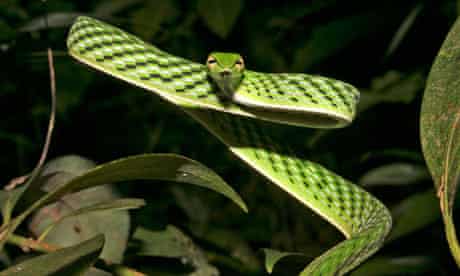
The green vine snake (Ahaetulla nasuta ) is among the world's reptiles that face extinction. Photograph: Ruchira Somaweera/IUCN/ZSL
A new study on biodiversity threats focusing on the world's reptile species, published in the journal Nature, indicates that roughly one fifth of reptile species from the Galapagos tortoise to the Komodo dragon of Indonesian islands face the threat of extinction. A conclusion based on the first comprehensive global assessment of the status of reptile conservation and possible extinction.
Other species at risk studied by researchers included West Africa's rhinoceros viper and India's gharial. A total of 10,196 reptile species was included in the study from turtles, crocodilians, lizards and snakes, to the tuatara, the sole member of a lineage dating back over 200 million years still to survive. The study found that 21 percent of species classified as reptiles are in the critically endangered category; endangered or vulnerable to extinction.
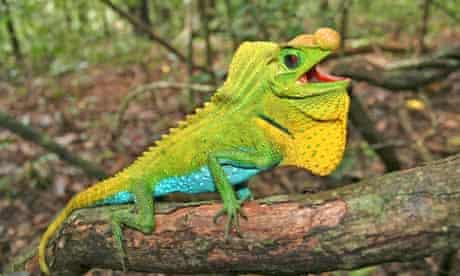
Lyriocephalus scutatus, another lizard species on threatened list. Photograph: Ruchira Somaweera/IUCN/ZSL
Another 31 species were identified that had already been declared extinct. The research reported that many reptiles are threatened to the brink of extinction through factors that imperil Earth's other land vertebrates, amphibians, birds and mammals. Deforestation to prepare arable lands devoted to agriculture; logging and development; urban encroachment; and hunting. Throw in climate change and invasive species competing with species indigenous to certain geographies and the threats multiply.
Status reports that preceded this one found that some 41 percent of amphibian species, 25 percent of mammal species, and 14 percent of bird species were placed on the threatened-with-extinction list.The status of species are assessed on circumstances associated with distribution, abundance, threats and population trends.
The world's longest venomous snake, the king cobra is vulnerable to extinction, as is the leatherback, the larges sea turtle. Vulnerable to extinction is the Galapagos marine iguana, and various tortoise species on Galapagos, ranging from vulnerable to extinct.
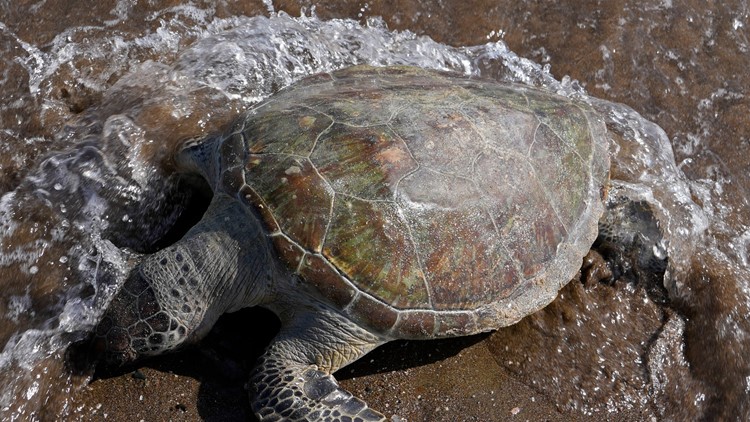
A dead green sea turtle washes up on the beach in the Khor Kalba
Conservation Reserve on the east coast of the United Arab Emirates. AP
Photo/Kamran Jebreili,
Lobster traps, like these seen in Cape Breton, are one of the most
common forms of ghost gear in Atlantic Canada. JESSICA SMITH • CAPE
BRETON POST
"When it starts impacting the bottom line of one of the most important industries in Nova Scotia ... it becomes apparent that we need to do something about it."
"We can actually make more money if we clean up our act."
"There's probably way more gear out there than this study suggests. Those economic losses are only going to increase."
"You get fish and crab in the lobster pots all the time. If the [trapped creatures] die in place, then they themselves become fresh bait for other creatures to enter the trap. As long as the trap stays intact, that [cycle] can keep on going. Those [traps] older than four years old and still intact continue to catch bycatch."
"Our estimate of the diversity of species and the total number trapped is a massive underestimate. It's important that policy changes should be made."
Tony Walker, associate professor, School for Resource and Environment Studies, Dalhousie University
Over seven tons of abandoned lobster traps and other fishing gear were
found over1,523 square kilometers in South West Nova Scotia. (Cape Breton Environmental Association)
Canada's federal Ghost Gear Fund succeeded in removing 225 tonnes of old gear from Canadian and international waters in the past two years; 159 tonnes of gear from the Atlantic, and 65 tonnes from the Pacific Coast. The issue of lost and discarded fishing gear dumped off the southwest coast of Nova Scotia, the site of the country's most lucrative lobster fishery, has been trapping species at risk and harming the lobster industry. Traps are supposed to be checked to allow for the release of bycatch every 24 hours. Bycatch referring to any species other than market-size lobster/
A new study out of Dalhousie University in Halifax saw researchers determining that abandoned traps, ropes, hooks and other fishing equipment cost the industry close to $200,000 in lost catches on an annual basis. The landed value of Nova Scotia lobsters in 2019 was estimated at $880 million. Ghost gear and all the problems associated with the issue is a problem that exists on a global scale. This is the first study designed to provide a preliminary assessment of the environmental and economic impacts of the problem.
The conclusions reached are based on findings researchers came up with last summer and fall when five fishing boats were put to use in hauling in over seven tonnes of lost, discarded and abandoned gear -- with the vessels having conducted 60 trips over 1,500 square kilometres. About 66 percent of the gear pulled to the surface represented lobster traps, while additional gear included cables, ropes, marker buoys and other debris of a marine nature.
Fishing gear collected in 2020 from the Atlantic Ocean is shown in a
handout photo from the Department of Fisheries and Oceans. THE CANADIAN
PRESS/HO-DFO
The traps referred to frequently as lobster pots could be linked to $176,000 in annual commercial losses since many continue to catch bottom-feeders once they've been left behind. Untended traps continue to indiscriminately capture creatures such as groundfish, considered species at risk. Once the traps are abandoned, a cycle is initiated, with sea creatures continuing to be trapped. Yet precisely determining numbers captured by derelict traps can be problematical.
When researchers managed to free some trapped creatures they found 15 different live species -- five representing species-at-risk; a wolffish, a cod, a cusk and two sculpins. "It adds weight to the negative environmental impact. These are federally protected species, and they're dying unnecessarily." According to Dr.Walker, fishers are loathe to bring in any traps they come across to shore that aren't their own for fear of facing allegations of poaching other people's traps.
An emaciated Atlantic wolffish, shown in this handout image provided by
Coastal Action via Dalhousie University, with chaffing injury was
released from a retrieved lobster trap near Shelburne, Nova Scotia.
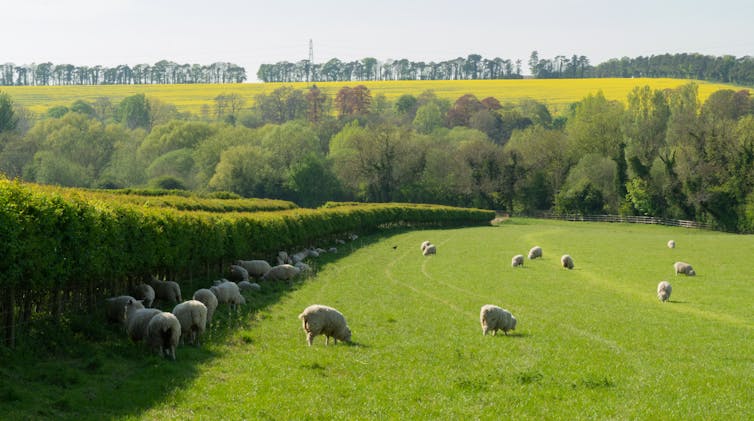
"I tell my students, it's like all the Saturdays for the rest of your life are gone. From my perspective, it's just a crime that we are destroying the biodiversity on the planet." "Of course, people need to eat and we have to have agriculture, but we were wondering if there was a way to arrange crop fields in a way that would reduce the impact on biodiversity." "Even when you have these very narrow bits between crops, that still represents a refuge. So that a species that's in a crop field when something's going on -- plowing, for example -- that's a place they can go to sit out the storm, so to speak, without having to go great distances, which many of them can't do." "People are worried right now about the crisis in the numbers of pollinators. The numbers of birds, frog and insects are all declining, and all of these actually do things for us without us being aware of it (eating pests in the fields, pollinating crops; roots reduce soil erosion]. Most of the things we do rely on natural species." "Many farmers really do love nature, so if they could be convinced that they could make their fields smaller, have this large benefit to nature and not reduce their profit, they would probably be pretty amenable to it." "From my perspective, it's just a crime that we are destroying the biodiversity on the planet." Lenore Fahrig, biology professor, Carleton University
Small strips of natural and
semi-natural habitat, like this hedgerow, can provide wildlife with an
area for food, breeding or an escape from farming operations.(Shutterstock)
It has been estimated by experts in the field of biology and biodiversity that human activity has been the cause of an estimated 15 percent reduction in species; one in seven becoming extinct in the last century and a half. Studies have concluded that the bird population has been reduced by close to 30 percent in the past fifty years; amphibians are disappearing at close to four percent yearly, and insect decline stands at roughly nine percent every decade.
Professor Fahrig has been leading research in Eastern Ontario and across Europe for the past decade, identifying strategies possible to help in halting the purge of species. She identified important factors in an article published in the journal The Conversation; the sizes of agricultural fields, and crop variety, all contributing to biodiversity decline. Suggesting alternatives that could see farmers making changes to help emeliorate the identified biodiversity losses.
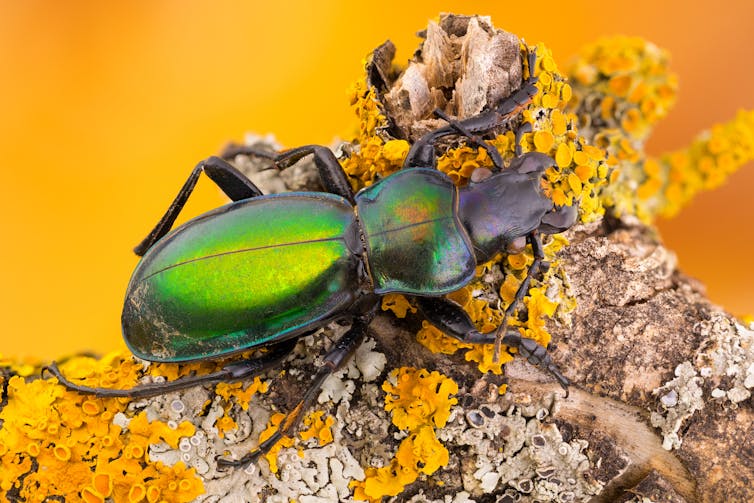
Pest-eating carabid beetle, can benefit crops.(Shutterstock)
As a landscape ecologist, Professor Fahrig zeroes in on factors like deforestation, urban buildup and roads affectng biodiversity. While all these issues play a negative role in diminished biodiversity there is no other issue that matches the effects of agriculture on species reduction worldwide as agriculture. With her colleagues, she examined 93 Eastern Ontario landscapes, each one square kilometre in measure, chosen as representing field size varieties and crop diversity.
Sampling bird numbers, along with bees, plants, spiders, carabid beetles, frogs, syrphid flies, bats and butterflies in each of the fields and at their edges, they found that the loss of many of the species important for pollination and pest control would result in serious consequences should they be eliminated from the species pool thanks to the influence of agriculture on their habitat.
In their research, they found that where smaller fields were used, much greater biodiversity resulted, reasoning that some of the increased numbers would be attributable to fence lines, ditches and hedgerows that separate fields. Professor Fahrig, however, argues that on the evidence greater biodiversity resulted by 50 percent, where average field sizes were diminished from eight to two hectares.
Similar fieldwork took place, led by Professor Fahrig in over 300 landscapes located in seven different regions and climates in Europe; England, France, Germany and Spain. Where findings were seen to be consistent with data resulting from the Ontario studies. This, at the very time when economy of scale and operational efficiency in larger fields on larger farms are currently the preferred norm.
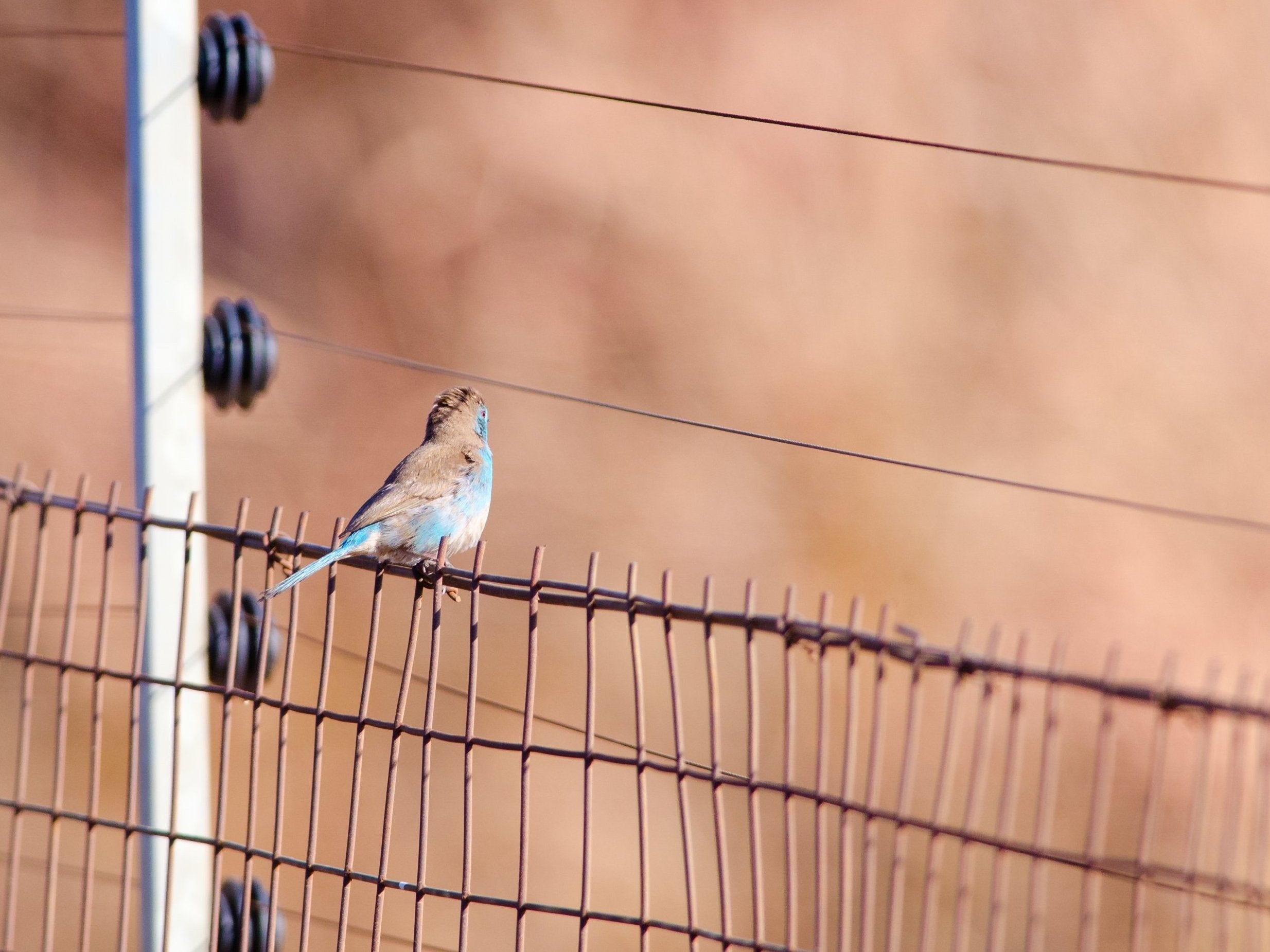
"Farmers will walk along fences and find six to eight dead tortoises in the space of one hundred meters." "These [electrical] fences have got the capacity to decimate whole [animal species] populations, and they're doing that." Luke Arnot, veterinary surgeon, South Africa
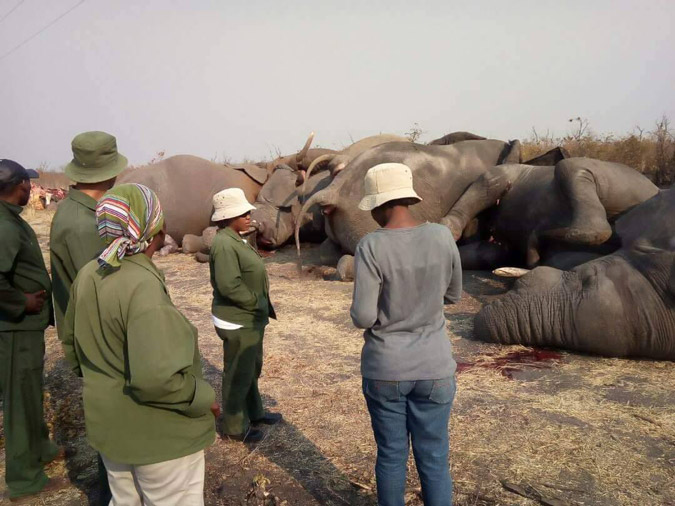
Elephants killed after being electrocuted when they pushed power lines
into a pool of water they were drinking from. The blood is from burst
blood vessels, a common symptom of electrocution. Africa Geographic, 2017
"The terrible thing about power lines is that every single one will kill. But people here say they don't care because we need to develop our country." "In wildlife areas in Kenya, hyenas and other animals make paths to power lines to get at dead birds." "This makes it impossible to go underneath power lines to enumerate the
number of deaths. But I think this is a growing threat
and that it’s enormously underestimated by most wildlife
conservationists, wardens and conservancy managers." Simon Thomsett, ornithologist, trustee, Kenya Bird of Prey Trust
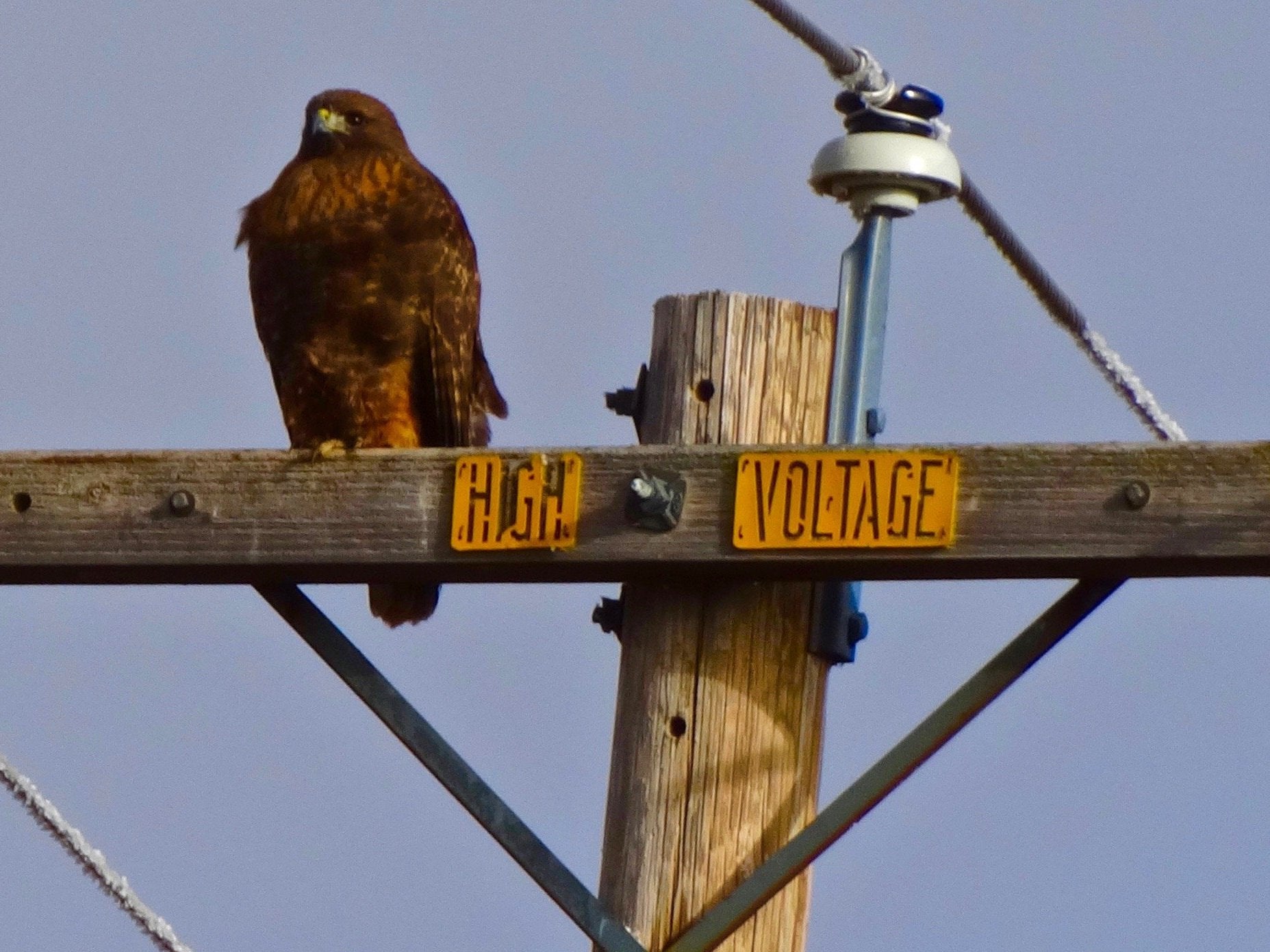
Electrocution is becoming so common that it jeopardises the survival of some species
Getty/iStock
"Animals have caused outages, disruptions and damage to infrastructure
amounting to billions of dollars." "We estimate that
60 per cent of line faults and interruptions in South Africa are
wildlife-related. It’s really important to engineer this problem out." Constant Hoogstad, senior
manager, industry partnerships, Endangered Wildlife Trust, South Africa
Africa is in its development stages, South Africa a country where ranches, farms and national parks are partitioned off, and surrounded by kilometers of electrical fencing to ensure that unwanted animals are kept out, along with human intruders' that livestock is adequately protected from predators, and so it is with wildlife in national parks as well. The fencing that has such a defined purpose also represents a solution to one problem of unwanted intrusion while at the same time becomes a deadly hazard to any animals which come afoul of its protective presence.
Interventions to reduce collisions with power lines have so far met with little success
Getty/iStock
To these unwary animals these fences have an incontestable deadly impact. Smaller animals such as birds and reptiles which are meant to be environmentally protected become casualties in huge numbers. Trip wires positioned some 15 centimeters off the ground meant to zap a deterrence to hunting carnivores like lions and bush pigs accustomed to raiding crops are to a large measure to blame for the carnage. The presumption of a deterrent effect does not always result; some creatures after being stunned simply remain where they are.
Tortoises hitting a tripwire withdraw into their shells, failing to leave and taking haven in their instinctive withdrawal where it feels itself immune to danger while pangolins tend to curl over the wire into a defensive posture, and when both of these animals react as they would under any threatening circumstances, they remain shocked and finally their hearts cease beating. A 2008 study undertaken in South Africa revealed 21,000 reptiles are killed annually on contact with electrical fences.
Dr. Arnot, alarmed by these statistics, has attempted to alert authorities as well as farmers who install those fences. Publishing articles in farming and ranching journals detailing commonsense and modest changes that will bypass some of the dangers inherent in the electric fences to devise wildlife-friendly guidelines in installing electrical fences. Principally, to lift the trip wires to a greater height from the ground as well as operating the current at night exclusively since this is when predators tend to stalk their prey. Simple. Effective. Ignored.
Alongside the threats to wildlife of electric fences are power lines strung without a thought to outcome in countries in a hurry to advance their infrastructure and which end up electrocuting animals where collisions with power lines are so fatal for the avian population. Along with the deadly costs in conservation, a notable economic toll is guaranteed. As an example, a vervet monkey caused a nationwide blackout after tripping a transformer in Kenya in 2016. Power was cut to 4.7 million homes and businesses.
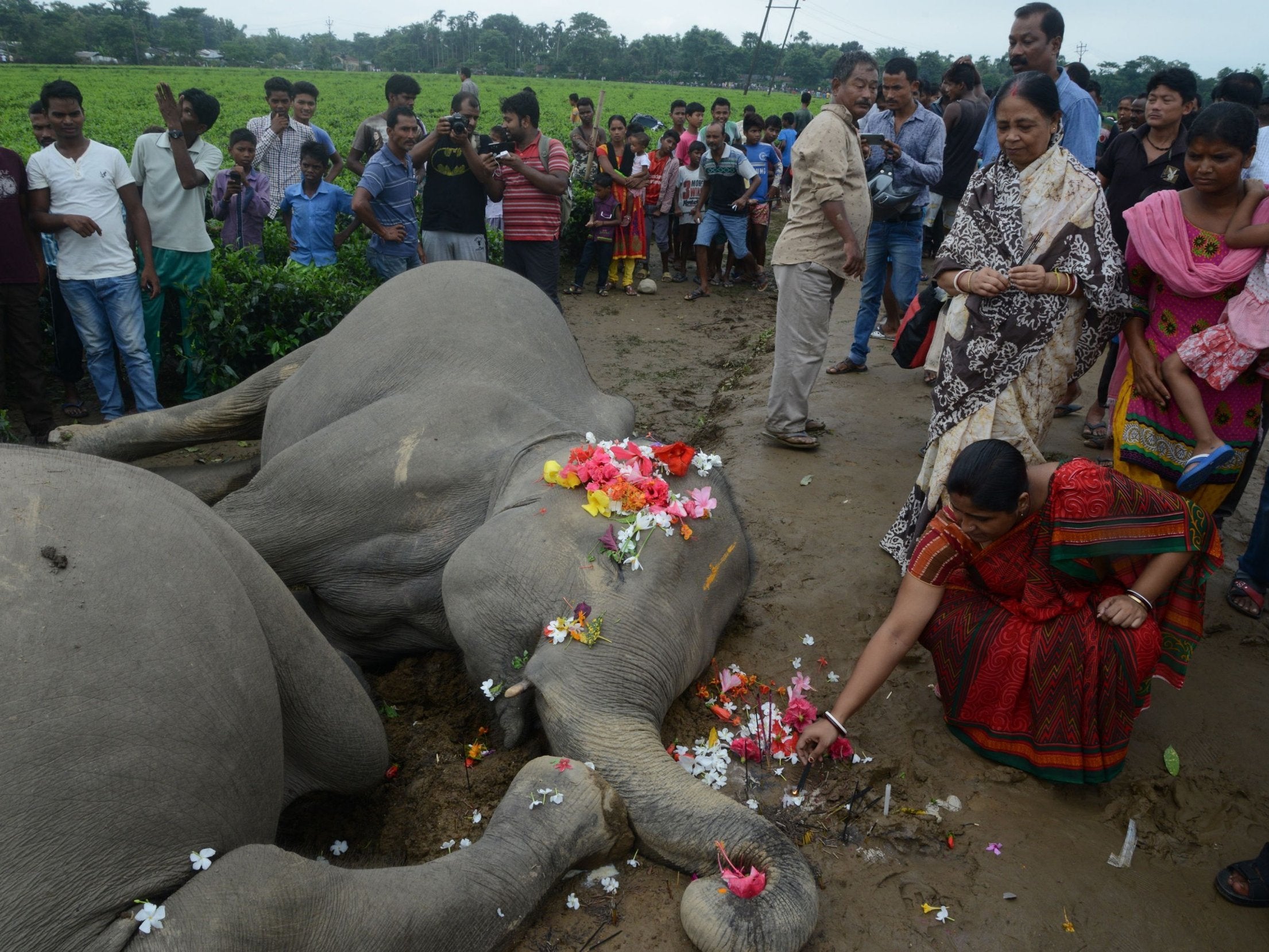
Surivival of some species is jeopardized through electrocution and considered a leading threat to Cape vultures in southern Africa, already endangered, along with critically endangered white-backed vultures. An estimated four thousand endangered Saker falcons are electrocuted in Central Asia each year. Over one hundred endangered Asian elephants were killed by electrocution in the state of Odisha, India over a dozen years through contact with power lines.
Even large animals such as elephants are at risk of electrocution (in India)
AFP/Getty
In various countries leopards, Cape buffalo, white rhinos, Giraffes and African elephants have been electrocuted in numbers. Thirty species and subspecies of primates are affected in Asia, Africa and Latin America by electrocution. According to Lydia
Katsis, a recent graduate of Bristol Veterinary School in Britain, "This is a widespread problem, but it’s also under-reported and
under-studied, so there could be more species affected."