Ruminations

Blog dedicated primarily to randomly selected news items; comments reflecting personal perceptions

Wednesday, May 20, 2026

The Swedish Humanitarian Experience

"Sweden will now have the Nordic region's toughest framework for criminal deportations."
"Those who come to Sweden and commit crimes have forfeited Swedish hospitality and should be deported."
Swedish Migration Minister Johan Forssell
 
"My Europe does not build walls." Sept.2015
"It pains me that Sweden is no longer capable of receiving asylum seekers at the high level we do today."
"We simply cannot do anymore.  Nov. 2015
Former Prime Minister Stefan Lofven, Social Democratic Party
 
"There was a time when Sweden was looked upon by American liberals as an inspirational example of the Scandinavian welfare state. Although Europeans were less impressed, even the country’s immediate neighbors tended to, grudgingly, accept Sweden as a senior brother."
"After staying out of World War II, Sweden had evolved into a high-performing export-oriented economy, based on a stable parliamentary democracy and social consensus. The country had top-notch health care and education. It enjoyed social and gender equality, had low crime rates and little ethnic conflict. While grounds remain for optimism about some of these indicators, especially in the industrial sector, most have been transformed beyond recognition."
"Present-day Sweden carries the dubious distinction of having the highest rate of gangland killings in Europe. It boasts the lowest average age of serious offenders, with children in their low teens being arrested for murder. Increasing segments of suburbs are officially classified as “especially vulnerable areas,” where it is “hard, bordering on impossible” for the police to operate. In layman’s terms, these are no-go zones, where local clans rule and where first responders will not enter without flak jackets and police escort."
Stepan Hedlund, GIS Reports online 
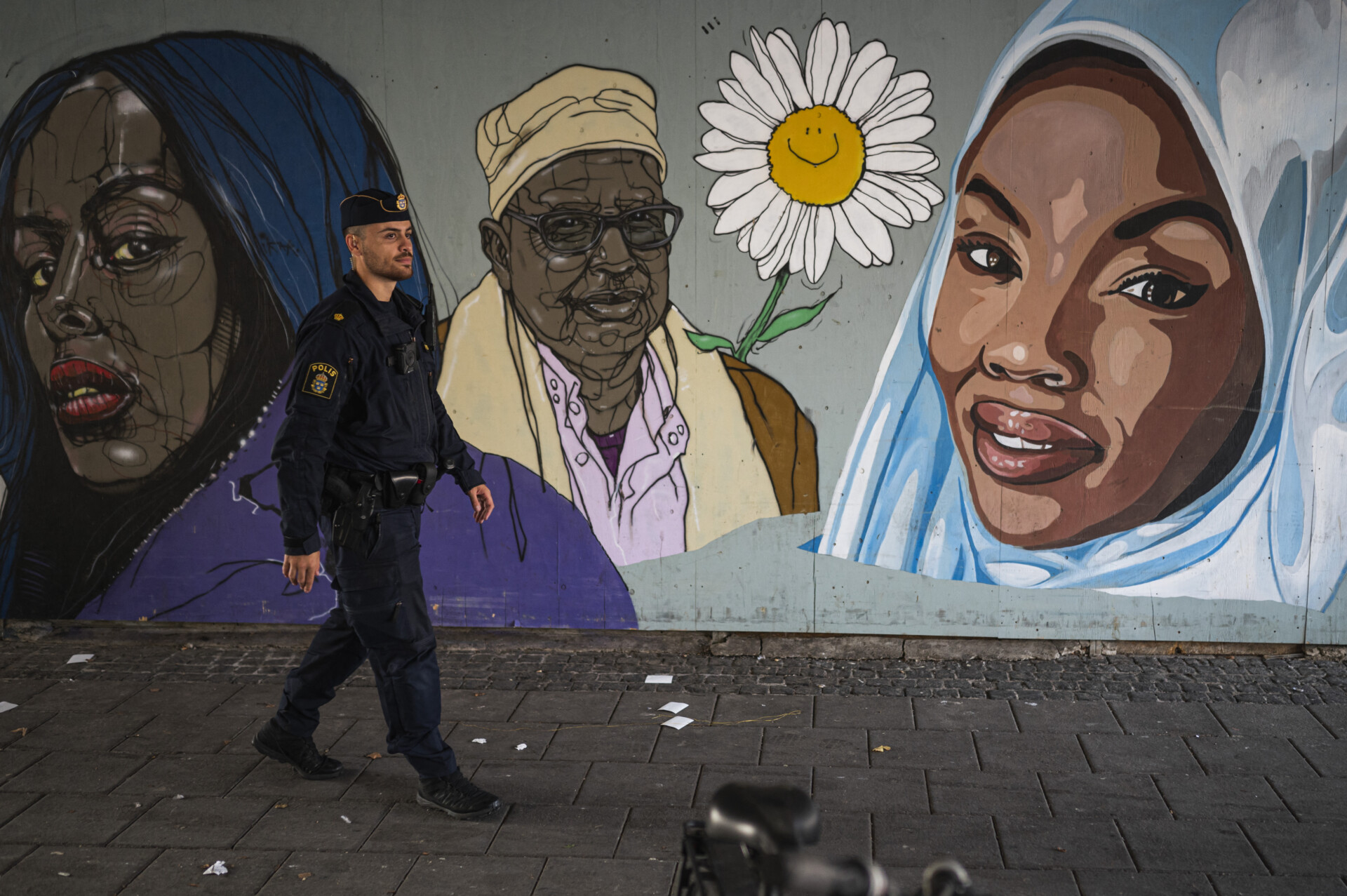
https://newlinesmag.com/wp-content/uploads/GettyImages-1242974775.jpg
A police officer patrols the immigrant borough of Rinkeby, in Stockholm, on Aug. 31, 2022. (Jonathan Nackstrand/AFP via Getty Images)
 
 Once one of the most tolerant, welcoming of European nations toward refugees and migrants, Sweden's experience with that open-handed friendliness has resulted in the country now taking to offering foreign national adults $51,000 should they decide to voluntarily leave Sweden. For a family, that voluntary repatriation rises to $88,000 happily handed out to "lawful residents", should they decide to return to their country of origin -- actually in fact, to leave Sweden for any other country at all. As in !!please leave!!, we'll pay you handsomely to abandon us for anywhere else on Earth!
 
Come September, any foreign national who having committed a crime and having been sentenced to any punishment greater than a mere fine, will be liable to deportation. "Prosecutors will be required to request deportation where the offence constitutes grounds for removal", explains the Swedish Migration Agency. And under these new rules, the expectation is that deportations will rise from the current figure of 500 yearly, to 3,000 government-assisted (booted-out) departures annually. 

 
https://newlinesmag.com/wp-content/uploads/GettyImages-1242605375.jpg
Police secure the scene of an Aug. 19, 2022 shooting at Emporia Shopping Center in Malmo, Sweden. (Johan Nilsson/TT News Agency/AFP via Getty Images)
 
 Residency permits are to be revoked for criminality or misconduct; in failing to comply with laws, posing a security threat, or having unpaid debts. This government initiative to come into effect by July 2026, under the rubric of "good conduct assessment". Tougher requirements will be imposed for those planning to become Swedish citizens from June forward. Applicants will thence forward have to demonstrate "good conduct", and prove they are able to adequately support themselves financially. Prospective citizens moreover, must have been resident in the country for eight years and demonstrate through tests their knowledge of the Swedish language and societal culture.
 
No more open border policies, as when, in 2015, Sweden accepted 163,000 migrants applying for protection at the peak of the European migrant crisis when refugees from Syria, Afghanistan and Iraq, fleeing their nations' wars pushed Europe to the brink of being totally overwhelmed. Sweden, as did Germany at the time, generously rose to the occasion, flinging wide their borders. 
 
Sweden had already previously opened its doors to foreign nations. There were 665,600 foreign-born nationals in Sweden in 1985, representing 7.8 percent of the population. That number was 2.2 million last year, representing 20.2 percent of Sweden's population. It took awhile, but gradually over the past decade immigration and refugee rules became more stringent, bringing the situation to the present tense with the country's more intensely severe crackdown.
 
Swedish Prime Minister Ulf Kristersson last month stated his aim was to form a majority government with the Sweden Democrats following September elections; the Sweden Democrats Party is far-right, and anti-immigration. This party last year apologized for its neo-Nazi, antisemitic, racist past. Political debates have tackled endlessly the degree to which immigration is linked to the incomprehensible levels of criminality taking place in Sweden. 
 
A Sweden whose gun crime death rate tops the European Union. The Swedish National Council for Crime Prevention's statistics reveal that four deaths per million inhabitants took place in 2025, in comparison with Europe's average of 1.6. Caught in the crosshairs of gangland shootings, the past three years has seen 23 innocent bystanders killed. There were 317 explosions -- linked to gang-related protection rackets -- in 2024 -- leading Sweden's prime minister to admit: "It is clear that we do not have control over this wave of violence".
 
Local gangs are depicted as represented from first- or second-generation migrant backgrounds; typically high school dropouts, and from marginalized areas marked by poverty and unemployment, according to the Global Organized Crime Index. Sadly, the Swedish experiment in humanitarian openness is not in and of its generous impulse, enough to make good citizens of those whose heritage, culture and prior experiences make them unsuitable to meld into civilized democracies as 'good citizen' fodder.    

 
https://ichef.bbci.co.uk/news/1024/cpsprodpb/2A52/production/_131643801_127a5d010b059fbc83710a8932cf19e0a5a012070_0_8394_47241000x563.jpg.webp
Police patrol the streets after a man was shot dead in September in a suburb south of Stockholm  Nils Petter Nilsson/EPA-EFE/REX/Shutterstock 
 

Labels: , , , , ,

Sunday, August 25, 2024

"Safe" Injection Sites?

"Here are the so-called experts in the [federal] government telling us the best thing for us to do is to hand out high-powered pharmaceutical opioids to the drug addicts, that are two to five times more powerful than the drugs they get on the street."
"Make it pure pharmaceutical grade and somehow this is better?"
"There's nothing compassionate about leaving somebody intermittently homeless in minus -40 weather, speedballing methamphetamine with fentanyl, and saying that we're just going to let that person sort this out because it's about free choice."
"You can't build a system out of thin air. It is a huge culture shift. Even the creation of Recovery Alberta -- it's in the name, 'recovery' -- we're changing the way we're thinking about mental health and addiction from its fundamental assumptions for the past 25 years."
Alberta Mental Health and Addiction Minister, Dan Williams
 
"Our first priority must always be protecting our communities, especially when it comes to the most innocent and vulnerable."
"People are not going to die. They are going to get access to services. I do not call watching people inject an illicit drug, health care in the province of Ontario."
"We need to do better and we can do better."
Ontario Health Minister Sylvia Jones 
https://i.cbc.ca/1.7132648.1709646003!/fileImage/httpImage/image.jpg_gen/derivatives/16x9_780/somerset-west-community-health-centre-march-2024.jpg
The supervised drug consumption site run by Somerset West Community Health Centre in Ottawa will be forced to shut down in March. It may apply to become one of the province's new 'HART hubs,' part of the Ontario government's shift away from harm reduction. (Sam Konnert/CBC)
 
Ontario is now moving toward 'doing better' by heeding the cries of residents who decry the operation of 'safe injection sites' in neighbourhoods that have been affected by rising crime reflecting these operations and in particular the placement of many of these sites in close proximity to schools. There is also the considerable dysfunction of their presence attracting illicit drug dealers to the area of the sites to conduct business. And then, the undeniable reality of site 'clients' trading their 'free drugs' on the street for more potent drugs to give them a desired high, thus increasing the availability of drugs on the street.

Supervised consumption sites situated within 200 metres of schools and childcare centres are now being closed down by the Ontario government. This shift in policy will see ten of 17 supervised consumption sites cross-province being shut down. The health minister explained that parents concerned for the safety of their children around these consumption sites has motivated the government to finally act. Citing the increase by 146 percent of violent crime near one particular site.

Not unexpectedtly this announcement took consumption and treatment services personnel by outraged surprise. It took them little time to respond with the warning that the move would inevitably lead to greater numbers of deaths by overdose. Alongside the closure of these sites the government announced prohibition of any new supervised consumption sites from opening, let alone further participation in federal funding for safer supply initiatives. 

A twin announcement of a $378-million investment in 19 new homelessness and addiction recovery treatment hubs to provide primary care; mental health services; addiction care support; social services and employment support; shelter and transition beds; supportive housing; and other supplies and services, including naloxone, failed to impress critics of the wholesale government 'safe supply' restructuring initiative.
"We are gravely concerned that the decision to defund and close consumption and treatment services will have devastating consequences for our community."
"Our services save lives by providing a safe space. That is what consumption and treatment services were designed to do, to reverse overdoses and prevent deaths and connect people to the services they need. Consumption and treatment services are a cornerstone of harm reduction."
Suzanne Obiorah, executive director, Somerset West Community Health Centre, Ottawa

"The announced steps mean unsafe communities, more deaths, overwhelmed emergency services and spiking health-care costs, and leave nurses wondering who the government is trying to serve."
Doris Grinspun, head, Registered Nurses Association of Ontario
The answer to that is quite simply; the government serves all. The placement of the 'harm reduction sites' that are scheduled to close, has been harmful to the communities they are contained in. Violent crime has risen exponentially, so has property damage and theft, drug paraphernalia litters the streets, and fears for the welfare of area children abound. Proximity to schools sees drug users verbally abusing schoolchildren. Inveterate drug users also threaten nearby residents with physical harm. These people too are deserving of the government's concerns.

The Province of Alberta is addressing very similar issues and has dedicated its health system to addressing the issue of mental health, homelessness and drug addiction in a more thoughtful manner. Their Canadian Centre of Recovery Excellence will research best practices, analyze data and ensure that evidence-based recommendations for "recovery-oriented systems of care" are undertaken. Their online portal tracks EMS responses, emergency room visits, overdose reversals and deaths.

And nor is this new direction confined to these two provinces alone; the Quebec government has decided to meet demands of the residents of Montreal where a housing project catering to unhoused people with addiction or mental health issues located across from an elementary school, including a supervised drug-use site has locals and parents fed up with its presence. Open drug use and aggressive behaviour are but two of the issues involved at Maison Benoit Labre.

https://i.cbc.ca/1.6956383.1693830488!/fileImage/httpImage/image.png_gen/derivatives/original_1180/supervised-inhalation-site-monreal.png
Maison Benoît Labre provides services for people experiencing homelessness in the Saint-Henri neighbourhood. (Christinne Muschi/The Canadian Press)

Labels: , , , , , , ,

 
()() Follow @rheytah Tweet