Ruminations

Blog dedicated primarily to randomly selected news items; comments reflecting personal perceptions

Friday, May 06, 2022

"Based on a comparison of coronavirus deaths in 210 countries relative to their population, Peru had the most losses to COVID-19 up until April 26, 2022. As of the same date, the virus had infected over 510.2 million people worldwide, and the number of deaths had totaled more than 6.2 million."
"Note, however, that COVID-19 test rates can vary per country. Additionally, big differences show up between countries when combining the number of deaths against confirmed COVID-19 cases."
"The source seemingly does not differentiate between "the Wuhan strain" (2019-nCOV) of COVID-19, 'the Kent mutation' (B.1.1.7) that appeared in the UK in late 2020, the 2021 Delta variant (B.1.617.2) from India or the Omicron variant (B.1.1.529) from South Africa." 
Statista

Performing last rites before the cremation of a family member who died of COVID-19 in India. Anupam Nath/AP

 According to new research out of the World Health Organization, a newly-issued report concludes that official data accounting for the number of people who have died resulting from COVID infections are a third of the actual numbers. The WHO presents this latest report as representing the most comprehensive study at the actual toll globally of the pandemic to date. Their study team expressed confidence in the accuracy of a total listing 14.9 million excess deaths to the end of 2021.
 
In that period, from January 2020 to the end of December 2021, the official count directly attributable to COVID reporting to the WHO numbered just over 5.4 million. In the WHO's accounting, excess mortality figures include those who died of COVID-19 along with those who died indirectly resulting from the outbreak. Encompassing people unable to access health care to treat other conditions when hospitals were overwhelmed during the waves of pathogenic infection. 

Included were those deaths that would normally have occurred during the pandemic but did not; ie., owing to lower risk of traffic accidents taking place during lockdowns. Deaths missed in countries lacking adequate reporting account for lower official numbers being reported, according to the WHO. They pointed out that under-reporting did not arrive exclusively with COVID, but represented a situation where an estimated six in ten deaths globally failed to be registered officially, overall.

Close to half of the globally numbered deaths, it is now suggested, occurred in India with the report suggesting that 4.7 million people died there as a result of the pandemic, mostly in the May and June 2921 surge. The Indian government's official figure is put at 480,000 in the period January 2020 to December 2021, finding fault with the calculation methodology utilized by the WHO study.

It must also be borne in mind that India has an immense population of 1.3 billion, right behind China's 1.4 billion. Beijing's figures for COVID-related deaths would be hard to come by. Even given its comfortable relations with the WHO, China prefers to keep such data from prying international eyes. It is also notable that the United States, with an official death rate of 991,000 and 81-million infections, has a population about one quarter the size of India's; their numbers fairly well match.

Relatives carry a body for cremation past corpses partially exposed in shallow sand graves. In May, rains washed away the top layer of sand at a cremation ground on the banks of the Ganges River in Shringverpur, India. Ritesh Shukla/Getty Images

Comprised of international experts working for months amassing data, the WHO panel made use of a combination of national and local information, along with statistical models to estimate totals when dealing with incomplete data. Independent assessments also place the Indian death toll higher than the official government tally. A report published in Science suggested three million people could have died of COVID in India. While other models reached similar conclusions regarding the global death toll, higher by far than the recorded statistics.
 
A large study in the United States found the Omicron variant of the SARS-CoV2 virus to be intrinsically as severe as previous variants, whereas the assumption has been that Omicron, reflecting previous studies, was more transmissible, yet less severe. "We found that the risks of hospitalization and mortality were nearly identical between periods", was the consensus of the four scientists who conducted the study.
 
Previous studies assuming Omicron to be less threatening in severity took place in a number of areas including South Africa, England and Canada. The current study undergoing peer review at Nature Portfolio, posted on May 2 on Research Square, was adjusted for confounders (demographics, vaccination status and the Carlson comorbidity index) predicting risk of death within a year of hospitalization for those with specific comorbid conditions.


Labels: , , , , ,

Tuesday, April 17, 2018

"Subjective Expectations of Survival" Survey

  • Survival pessimism may mean that individuals save less during working life, and spend more in the earlier years of retirement, than they would, given their actual survival chances.
  • The risk of this faster-than-optimal spending down of wealth, combined with optimism about survival at the very oldest ages, means that if individuals survive through their 80s and into their 90s, they may not only have relatively low levels of wealth, but may then be reluctant to spend this, with negative consequences for their living standards.
Cormac O'Dea and David Sturrock, Institute for Fiscal Studies, ELSA Survey

This recent survey and its conclusions from Britain's Institute for Fiscal Studies, which focuses on economics, set out to study how the elderly prepare for their retirement years, setting aside finances and depending on state-provided subsidies for the elderly retired, by seeking to judge how it is that individuals as they age contemplate how long they may live, and with that figure in their heads, then calculate what they will need in financial support to enable them to live with a semblance of comfort and grace until they reach their expiration date.

What the study authors -- Cormac O'Dea and David Sturrock -- used for the data they acquired was an unimpeachable source; the statistics gathered by the U.K.'s Office for National Statistics, picking through its long-term surveys to assess "subjective expectations of survival" linked to economic plans for a feasible lifestyle in old age. Since people do realistically have to plan to ensure whatever funding they do have will take them through to that time when they no longer need it, the topic is fairly universal.

Individuals from age fifty upward in the English Longitudinal Study of Aging (ELSA), with its base of some 16,000 respondents were queried and asked to respond by estimating what they felt to be their personal chances of surviving to set ages. An age marker held to be between 11 and 15 years ahead of their current age saw younger respondents doubtful about chances of living to age 85. Following on the initial questionnaire repeats were taken biennially.

Information relating to personal medical and family history, along with socioeconomic background all constituted part of the survey questions. To which people surveyed appeared to respond with individual biases, so that for example people whose parents failed to live to a ripe old age were less optimistic that they themselves could aspire to do so. Those who smoked gave themselves between six to eight years of diminished longevity. With repeated surveys the opportunity arose for 'corrections'; should a diagnosis of adverse health have intervened, life expectancy figures went downward.

Very realistic self-diagnoses, in other words. On the other hand this study verified what others before it discovered; that a general pattern exists in people's estimates of their own mortality. So that when in their 50s and 60s when the initial intimations of gradually failing sight, hearing, physical endurance and strength begin to emerge, doubts creep in, along with a tendency to underestimate chances of acquiring the benefits of advanced age.

As example, for 65-year-old men born in the 1940s, the collective belief becomes that a mere two-thirds will reach age 75, whereas national life tables give the real figure for that generation as 83 percent -- and women tend to render a similar collective response, even though women live longer with the real-world survival rate for that generation being 89 percent.

This is termed "survival pessimism", common to people under age 70. Then again, as people grow into their 80s the opposite occurs with a significant overestimation as to how long they will then expect to live. The key to the group's interest in the study results resided in the economic element; just how well financial planning decisions are being made, to match longevity expectations.


  • Relative to life tables, individuals from a range of ages and birth cohorts underestimate their chances of survival to ages 75, 80 and 85, on average. Those in their 50s and 60s underestimate their chances of survival to age 75 by around 20 percentage points and to 85 by around 5 to 10 percentage For example, men born in the 1940s who were interviewed at age 65 reported a 65% chance of making it to age 75, whereas the official estimate was 83%. For women, the equivalent figures were 65% and 89%.
  • Individuals in their late 70s and 80s are, on average, optimistic about surviving to ages 90, 95 and above. This optimism becomes larger at older ages (10–15 percentage points when looking at age 95) and is larger for men than for women, amongst those born in the 1920s and 1930 For example, men born in the 1930s who were interviewed at age 80 reported a 32% chance of making it to age 95, whereas the official estimate was 17%. For women, the equivalent figures were 37% and 24%.
Cormac O'Dea and David Sturrock, Institute for Fiscal Studies

Labels: , , , ,

Friday, December 08, 2017

Bicycle Commuting in Europe

"I didn't intentionally set out to visit the world's No. 1 and 2 best bike cities, although cycling was certainly on the agenda when I booked my tickets. And I had no way of anticipating what it would look like when an entire city is designed to prioritize two-wheeled transportation. I had thought that I'd lived in bike cities before. I spent a year in D.C., where I zipped past cars and around traffic circles to arrive at work each morning. Or rather, as I now realize, where I squeezed myself past and around bumper-to-bumper traffic and narrowly avoided death on a daily basis, helmet tightly fastened, entire body on alert to oncoming hazards, trips torturously [sic] rerouted to include, for as much of them as possible, the semblance of a bike lane. Back in New York, I gave up the commute, clinging instead to the strip of paths that will get me around Central Park or up and down the waterfront on the Brooklyn and Manhattan sides of the East River, but rarely to practical destinations like a supermarket, or my midtown office."
"'The Dutch all bike in the rain,' an Amsterdam local assured me as we dined side by side at a neighborhood Moroccan restaurant. 'They bike in snowstorms. It's just our culture: it's easy, it's affordable, it's healthy'. I didn't quite believe that last part, given the tendency I'd observed for the Dutch to steer their bikes with one hand while holding lit cigarettes in the other. But some quick Googling confirmed that the Dutch and the Danish aren't intimidated by the elements. And my new friend's explanation for why this was so left me at once envious, and dismayed. Because if what it takes to get people out on bikes is some deep, engrained attitude that it's just what you do, then I couldn't imagine bicycling ever truly taking off the U.S. the way it has there."                                                     Lindsay Abrams, Salon magazine
Bike traffic at Copenhagen road shows European bike-transit integration
Fifty percent of people in Copenhagen bike to work or school: Bike traffic at Copenhagen road shows European bike-transit integration; Copenhagen cyclists on a dedicated bicycle path. Reliance Foundry
Mayors of European cities are increasingly vying with one another in the creation of cycling cities through a view of the future they call "cycling visions". And possibly the most famous bicycling city in the world, Copenhagen, is seen as a blueprint for all other cities anxious to compete for the approving environmentalist title of 'cycling city' extraordinaire. Both Paris and London are hoping to compete in this cycling revolution to be acknowledged "the cycling capital of the world".

Now that the recognition of the benefits of cycling to cities hoping to diminish vehicle traffic and convince residents of the safety, efficiency and health effects of cycling has been well established, new European Union statistics may place those ambitions in question, because according to statistics, across the EU cycling deaths have latterly seen a steady rise, accounting for eight percent of all traffic fatalities, an increase of a third in the last decade. In urban areas, cyclists account for a surprising 2 percent of all road fatalities.

Cyclists are seen to be responsible for 30 percent of fatalities in the Netherlands, recognized as a top cycling nation, held as a model to be emulated everywhere. Unbelievably, bicycle fatalities now are five to ten times that of automobiles per kilometre travelled, a complete reversal of a decade earlier when motor vehicle deaths were falling dramatically, along with bicycle deaths in the European Union. Progress in diminishing vehicle deaths has come to a standstill.

And some regard the initiative to make cycling safer, allowing the bicycle a larger share of the road has managed to backfire on all kinds of vehicles. Of all those seriously injured in road accidents in the Netherlands, 63 percent are represented by cyclists, increased from 51 percent ten years ago. Soberingly, in 80 percent of these injuries there were no motor vehicles involved. What is now acknowledged is that that cycling accidents are mostly caused either by poor road conditions or cyclist negligence.

The addiction to checking smart phones, cycling while intoxicated, racing, using handlebars to carry baggage or having poor brakes or tires are all being identified as contributing factors to cycling accidents. And when collisions occur, it is more frequently with another bicycle than with a car, and even when a motor vehicle is involved, the fault can often be attributed to the cyclist having run a red light, swerved into the motorist's path, or being in a state of intoxication; alcohol or recreational drugs.

In two Dutch city centres, surveys of evening bicycle excursions discovered that 42 percent of cyclists registered blood alcohol levels exceeding the legal limit, and that number of impaired rose to 68 percent by the time one a.m. rolled around. In North America, cycling is represented by road deaths at a two percent rate, with U.S. Department of Transportation reporting cycling accidents have gone up six percent over the last decade; intoxication a frequent factor. Some 19 percent of cyclists who died had blood alcohol concentrations consistent with the phenomenon of binge drinking.
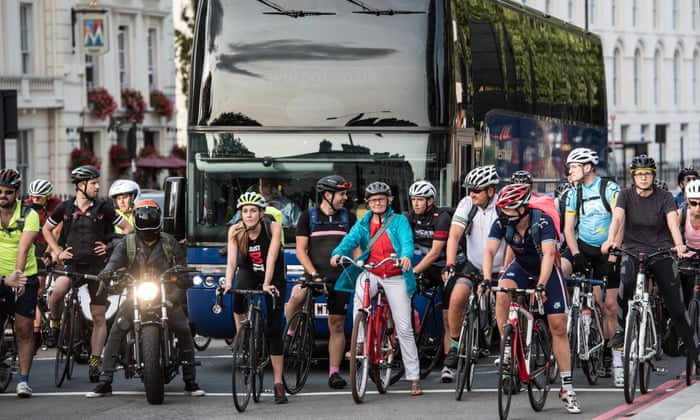
Cyclists wait at traffic lights in London.  Photograph: Carl Court/Getty

As in Europe, in the United States 29 percent of bicycle fatalities were linked to collisions with motor vehicles. In the remaining 71 percent of such cases falls, collisions with other bicycles or with stationary objects, the appearance of potholes and distracted riding were all cited as causatives. Authorities in cities in Europe are contemplating banning mopeds from bicycle lanes, persuading cyclists that quieter residential roads should be used, and thinking of measures such as redesigning buses so cyclists cannot slide beneath them.

Seniors, to date the cause of the highest rate of cycling accidents, might be encouraged to make use of tricycles, while planners think of re-designing bike paths in hopes of reducing intersection accident rates where half of cycling accidents take place, in high-cycling cities. The overwhelming majority of cycling accidents might be reduced by additional measures  such as apprehending negligent cyclists, by fixing potholes and by recognizing that cycling infrastructure has an opposite effect to what is intended; increasing accidents particularly at intersections.

So, it would then appear that the belief that cars result in city streets being dangerous to cyclists which has led cities to investing in expanding bike lanes and allied bicycle programs, might be wrongheaded. Where cycling deaths had previously been diminishing in incidents, they have, in concert with greater expenditures on municipal cycling infrastructure, been rising. No word whether the proliferation of cycling lanes and infrastructure has influenced greater numbers of people to venture out on bicycles for commuting and recreation, possibly accounting for the rise in accidents and fatalities.

Man and woman on bicycles reveals Amsterdam’s bike culture in historical center
Cycling is the cultural norm in many European cities.  Reliance Foundry


Labels: , ,

 
()() Follow @rheytah Tweet