Ruminations

Blog dedicated primarily to randomly selected news items; comments reflecting personal perceptions

Thursday, April 20, 2023

Plant Communication

"An idyllic field of flowers can be a noisy place. It's just that we can't hear the sounds."
"Our findings suggest the world around us is full of plant sounds, and that these sounds contain information -- for example, about water scarcity or injury."
"We assume that in nature the sounds emitted by plants are detected by creatures nearby, such as bats, rodents, various insects, and possibly also other plants -- that can hear the high frequencies and derive relevant information." 
Lilach Hadany, School of Plant Sciences and Food Security, Wise Faculty of Life Sciences, Tel Aviv University
Drew Beaudoin sits on a chair surrounded by dozens of plants.
House plant enthusiast Drew Beaudoin is surprised to learn plants emit sounds. (Katerina Georgieva/CBC)

Scientists in Israel discovered that plants voice their discomfort and distress due to drought, neglect or disease. The human ear cannot detect these sounds that are high-pitched emergency signals of distress. But they recorded the sounds of tomato, tobacco, wheat, corn and cactus making occasional ultrasonic popping noises which the researchers likened to bubble wrap. Plants ramp these sounds up when they're suffering stress. The findings were published in the journal Cell.
 
Famously, other, previous studies showed that plants respond positively and tend to thrive when exposed to music and to being gently spoken to. Now, science brings us the news that plants also communicate in their very particular biological way that nature has endowed them with; plant speech. Water scarcity or injury provoke plants to distress they aurally broadcast.

The research team placed plants in an acoustic box that was placed in an isolated basement with no background sound. Microphones capable of recording sounds at frequencies of 20 to 250 kilohertz were placed four inches from each plant.The plants were then subjected to different treatments; some left unwatered for five days; others had their stems cut, and a control group was left intact. 

Subsequent recordings showed sounds were emitted by the plants at frequencies of 40-80 kilohertz. Unstressed plants produced barely one click every hour on average; the stressed plants emitted dozens of sounds every hour. The maximum frequency detected by a human adult is roughly15 kilohertz.

Noises were emitted by water-sressed plants before they were visibly dehydrated. The researchers found it was possible to identify the distressed plant along with the type of stress being experienced. A dehydrated tomato plant made a different pattern of clicks as compared to a dehydrated cactus. Happy plants on the other hand, had a tendency to be quiet.

The potential for monitoring plants to determine whether they are struggling, based on their noises is a potential for a new type of agricultural program the research team envisions emerging from this research. Sound recordings could conceivably be used in irrigation monitoring crop hydration to help distribute water more efficiently.

Two professors stand in front of plants.
Tel Aviv University professor Lilach Hadany, right, led the study, working with Prof. Yossi Yovel, left. (Tel Aviv University)

Labels: , , , , ,

Sunday, September 12, 2021

Hope for Alzheimer's Treatment

"We have discovered that hyperbaric oxygen therapy induces degradation and clearance of pre-existing amyloid plaques and the appearance of newly-formed plaques."
"Elderly patients suffering from significant memory loss at baseline revealed an increase in brain blood flow and improvement in cognitive performances, demonstrating hyperbaric oxygen therapy potency to reverse core elements responsible for the development of Alzheimer's."
"We had a control group of similar mice that did not receive the oxygen therapy, and they grew many more amyloid plaques. Among those who received the therapy, only a third of the number of new plaques appeared, and existing large plaques reduced their size, on average, to a half of what they were."
"More research is needed, but there could be tremendous benefits if this can help people who lose cognitive abilities, either before or during the onset of Alzheimer’s."
Uri Ashery, professor of neurobiology, director Sagol School of Neuroscience, Tel Aviv University
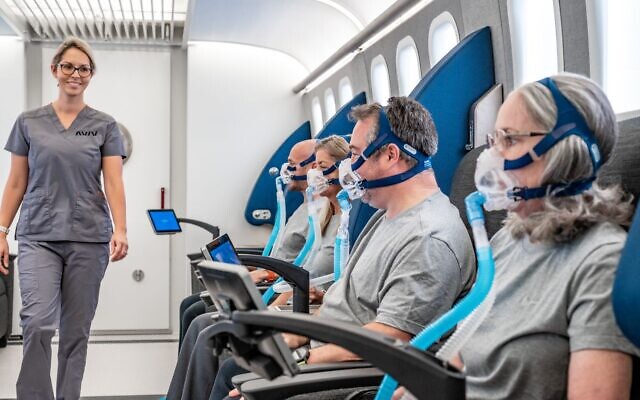
A man receiving hyperbaric oxygen therapy while nurse is checking his mask. (Drazen Zigic via iStock by Getty Images)
  
Scientists have long been baffled by neurological disorders like dementia seen in diseases like Alzheimer's, their search for pharmaceutical solutions to the degeneration of brain function and eventually that of all bodily organs leading to early death, having come to nothing. Now, however another type of treatment in animal an experimental stage may begin to serve as a solution opening new avenues of preventive treatment to stop the degenerative process.

Scientists at Israel's Tel Aviv University have realized success from a hitherto-unthought-of source, but one that has traditionally been used for somewhat similar purposes; supplying extra oxygen to the brain through the use of hyperbaric chambers. Used to ensure that deep-sea divers don't sustain brain injuries from their time deep under sea. A study conducted at the university demonstrated that patients with Mild Cognitive Impairment benefit by increased blood flow in the brain when placed in a hyperbaric chamber.

That protocol was seen to flood the brain with auxiliary oxygen improving memory, attention and processing speed. Diagnosed with Mild Cognitive Impairment (MCI), many people tend to develop Alzheimer's in time. Use of a hyperbaric chamber to boost blood flow to the brain may prove to be the first treatment capable of preventing an irreversible decline in brain functionality.

The therapy operates through a mask where oxygen passes into brain vessels while patients are seated within a pressurized chamber. The very same type of high pressure environment traditionally in use to aid divers recover from the bends. More oxygen flows resulting from pressure change, dissolving into tissues, similar to a state of "hypoxia" (oxygen shortage common in high elevations where oxygen tends to be thinner, starving the brain of oxygen) known by science for its regenerating effects.

The onset of dementia is marked by reduced blood flow to the brain resulting from a decrease in oxygen; flow level correlating with the degree of cognitive impairment in Alzheimer's. Improving blood flow is behind the theory that the condition may be improved. For the study, six elderly patients were given oxygen five days a week for 90 minutes each exposure, within a chamber. Blood flow was seen to increase by 15 to 23 percent.

Treatment improves levels of oxygen to the brain and actually changes blood vessel structure, increasing width and reducing wall thickness, the researchers concluded. Suggesting that the beneficial effects last for some time following treatment. Not yet tested on patients with Alzheimer's, when the treatment was tried on mice with Alzheimer's the number of amyloid plaques were reduced by up to 30 percent. Remaining plaques shrank by 18 percent, preventing re-emergence of new ones.

It is the sticky plaques believed to prevent brain cells communicating and as such are one of the major targets in producing drugs for Alzheimer's treatment. Following their treatment, the experimental mice began building improved nests, and navigating mazes more proficiently. The same team of researchers in 2020 showed that hyperbaric therapy is capable of reversing the aging process, lengthening telomeres; the protective caps at the end of chromosomes, by 20 percent.

Senescent (dormant) cells were also cut by up to 37 percent, providing an avenue for new healthy cells to replace them. Reports of improved physical abilities resulting in greater energy, stamina and even sexual performance in men have been recorded by patients. On the downside, few hospitals are equipped to offer hyperbaric treatment, the therapy itself has a gruelling timetable of sessions. "The treatment would have to be continued indefinitely, so patients would have to be motivated and have good transport links to the treatment facility", commented Tom Dening, professor at University of Nottingham.
 
A hyperbaric chamber using Shai Efrati’s anti-aging protocol. (Courtesy: Sagol Center for Hyperbaric Medicine)


Labels: , , , , ,

 
()() Follow @rheytah Tweet