Ruminations

Blog dedicated primarily to randomly selected news items; comments reflecting personal perceptions

Friday, July 19, 2019

Avoiding Lyme-Bacteria-Carrying Deer Ticks

"That's a threshold. Once you know that more than twenty percent of the ticks in your area carry Lyme disease bacteria then we don't need to check in on that [by testing ticks to ascertain whether they're carrying the Lyme bacteria]."
"That is what we now call an 'at-risk area'."
"It's a good-news story, actually, that there is antibiotics that work to treat Lyme disease."
Dr. Vera Etches, Medical Officer of Health, Ottawa Public Health
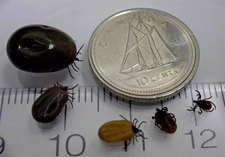
5 ticks on a ruler and surrounding a dime. They range in size from about 3 millimeters long to about half the size of the dime.
Adult female blacklegged tick at various stages of feeding. Photo: Government of Canada

"So it's really important to take precautions when you're out walking on recreational trails, in wooded areas, particularly those areas with deciduous forests or where you might encounter some deer."
"By understanding some of the driving forces and factors, whether they be environmental or sociological, we can really get a better grasp on how to prevent and control disease."
Manisha Kulkarni, assistant professor, School of Epidemiology and Public Health, University of Ottawa, faculty of medicine
Researchers from the University of Ottawa hunt for ticks at the Mer Bleue conservation area as they collect data for a three-year tick population study. (Robyn Miller)

Lyme-carrying ticks are expanding the territory they move into and colonize at the rate of about 46 km annually, according to a 2014 study carried out by the National Collaborating Centre for Infectious Diseases, University of Manitoba. In 2017, over 1,400 cases of Lyme disease were confirmed across Canada with more than two-thirds of those cases in Ontario, assumed to have been locally contracted.

Prior to the last decade, most diagnosed cases in Canada happened in people who were bitten by ticks while travelling in the United States. The ticks' incursions into Canada has been facilitated by changing climate conditions leading to a warming atmosphere. The deer ticks which carry Lyme disease are less likely now to be destroyed by cold winters; they are surviving the moderated cold and more of them are found to be carrying the Lyme bacteria.

Many public health units in Canada make the assumption currently, that if someone is bitten by a tick, they should be treated for Lyme disease, bypassing the past protocol which called for testing ticks in specific areas to determine whether the bacteria causing Lyme disease is present. Public health units have now set aside the testing protocol in the assurance that the bacteria is present on area ticks acting as vectors spreading the disease.

According to Dr. Vera Etches, over a fifth of black-legged (or deer) ticks that were tested registered positive for Lyme. Once an individual finds a tick attached to themselves and has the impression it has been there for over 24 hours, a prescription for antibiotics should be sought to prevent being infected by Lyme -- no testing required. Bacteria in the tick's gut move to its salivary glands and become transferred to a person after a period of 24 hours.

Preventive treatment is ineffective after a lapse of three days. Patients are advised to wait for the appearance of symptoms or to allow sufficient time to elapse for antibodies to evolve that can be detected in a test. Symptoms can take over a month to appear and when they do they can be mistaken for the effects of influenza onset; fever and aches and sometimes a telltale rash. It takes as long for the immune system's antibodies to appear on a lab test.

Untreated, Lyme disease has the potential to cause serious illness such as meningitis. On the good news side, because the condition is bacterial-caused, it is treatable with drugs. Lyme is caused by bacteria traded among black-legged ticks and migratory birds and small mammals such as mice and chipmunks. When birds and small mammals that are infected with the bacteria are bitten by ticks, the ticks become infected and transmit that infection when they in turn bite humans or their pets.
In Ottawa, where more than two-thirds of the ticks tested in some neighbourhoods carry the bacteria that causes Lyme disease, the public-health unit no longer bothers to test ticks at all.

There are many health benefits from being active and enjoying the outdoors; however, if you are in outdoor areas suitable for ticks, for example, wooded areas or areas with tall grasses, you need to be aware of the risk of Lyme disease. To help prevent Lyme disease, Ottawa Public Health monitors ticks and human illness trends and increases awareness of Ottawa residents of the risks posed by ticks and educates on how to prevent Lyme disease. Preventing tick bites is key to the prevention of Lyme disease, you can do this by:
  • Applying an approved insect repellent containing DEET or icaridin
  • Doing a tick check on yourself, your children, and pets
  • Checking your pet daily for ticks, especially if it spends time in wooded or overgrown areas
  • Removing ticks as soon as possible. If you find a tick on your body, using fine-pointed tweezers, grasp the tick's head as close to the skin as possible and pull slowly until the tick is removed. Do not twist or rotate the tick. Do not use a match, lotion or anything else on the tick.
Ottawa Public Health

Labels: , , ,

Friday, October 19, 2018

Lyme Disease in Canada Hosted by White-Tailed Deer

"So it's a multi-pronged approach to recruit patients across Canada to increase our knowledge of the natural progression of this disease and how it's resolved, as well as improved diagnostics."
"We want to follow patients who get Lyme disease, from their initial diagnosis all the way through for the first two years after their diagnosis and treatment. We want to look for any complications or failure in the treatment."
"By doing that, we're going to be able to detect, for the first time in Canada, what are the circulating strains of Lyme disease in humans and is there a change in the severity of the strains between what's in the United States and Canada?"
"It's a benefit to the patient [who agrees to help in the research] because we'll follow them closely to make sure their symptoms are resolved and the patient will be helping the community to understand this disease."
"Are there methods that we can create in our environment that we can reduce the presence of ticks?"
Dr. Kieran Moore, professor of emergency and family medicine, regional medical officer of health, Queen's University
Blacklegged or deer ticks, which can carry Lyme disease, are increasingly surviving Canada's warming winters. (CDC/Associated Press)

A team of researchers led by Dr. Moore and including Dr. Richard Resnick, dean of health sciences at Queen's University who had previously established a multidisciplinary team to investigate the disease now so prevalent (as an adjunct fallout linked to the phenomenon of Climate Change) throughout Canada has received a $4-million grant through the Pan-Canadian Research Network on Lyme disease, funded by the Canadian Institutes of Health Research and the federal government.

Included in the network to focus on gaps in the protocol currently used in prevention, control, diagnosis and treatment of Lyme disease will be scientists, clinicians and patients. Blacklegged ticks, carried by deer, transmit the infectious disease to people when a tick in its immature nymph stage bites. Most people are left with an expanding red rash at the tick-bite site accompanied by fever, chills and symptoms similar to those of the flu.

Other people, however may experience far more serious symptoms affecting heart, joint and resulting neurological disorders. If a diagnosis is not made correctly identifying the infection and remedial action taken, lifelong effects can haunt and diminish people's health. The intention of the team is to collect data from patients where tick bites and Lyme disease are rife. Southeastern Ontario, the south shore of Nova Scotia and the St.Lawrence River close by Sherbrooke, Quebec, and Manitoba have been identified as prime Lyme disease sites.
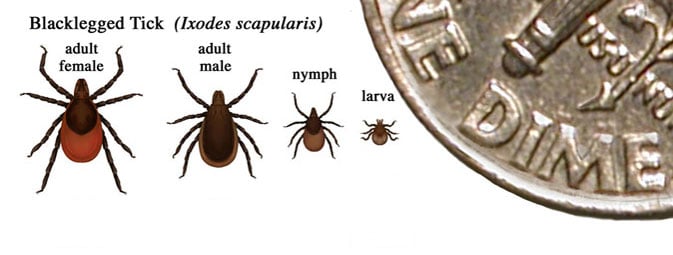
Relative sizes of several ticks at different life stages. In general, adult ticks are approximately the size of a sesame seed and nymphal ticks are approximately the size of a poppy seed.
In general, adult ticks are approximately the size of a sesame seed and nymphal ticks are approximately the size of a poppy seed. Centers for Disease Control and Prevention

Canada has seen previous efforts on an ongoing basis through surveillance, research, best-practise sharing, laboratory diagnostics and testing, along with prevention education and public awareness through education, but this latest concerted effort is meant to tie everything together with an enhanced focus on better understanding the transmission of the infection and how best to both avoid and treat the infection, alerting the general public in the process,

The first step in launching the research study is to convince patients with Lyme disease that it is in their best interests and that of the public at large to agree to allowing researchers to extract biological samples: blood, urine and skin scrapes surrounding the rash that appears after a tick bite. Dr. Moore anticipates that the tests that will ensue will turn out to be sufficiently sensitive to isolate strains of the infection seen to be particular to Canada.


He foresees the potential of between 500 to a thousand people who have been tick-bitten will agree to become involved in the research over the following four years, after its April 2019 initiation (the bites occur in spring primarily, followed closely by infection symptoms). The  ultimate goal is to succeed in improving diagnosis and treatment of Lyme disease, and at the same time increase the efficacy of public education as well as alerting health-care providers.

Reducing the risk of Lyme disease transmission by somehow altering the environment that nurtures it is yet another hoped-for result.

Ticks live in some of our favourite outdoor places; like grassy fields, the woods, gardens, beaches and nature parks. Ticks need blood to survive, so they choose to live in habitats frequented by potential mammal hosts. Areas with dense deer populations are often Lyme disease hotspots.
Lyme-carrying ticks can be found across the country, yet eastern Canada consistently reports the highest rate of infection. There are several contributing factors, but a major one is eastern Canada’s large population of White-Tailed Deer – the deer tick’s preferred host.Eastern and central Canadian provinces also share borders with Lyme “hotspots’ in the United States and are within flight distance for ticks catching rides on migratory birds.
Despite the frequency of infection, Lyme disease awareness is still relatively low in the east.
CanLyme – Canadian Lyme Disease Foundation - Lyme education & research fundraising in Canada

Labels: , , , ,

 
()() Follow @rheytah Tweet