Ruminations

Blog dedicated primarily to randomly selected news items; comments reflecting personal perceptions

Saturday, July 25, 2026

Trump's Trade/Tariff Edicts Roiling the International Community

"President Trump recognizes that decades of moral suasion have not eradicated forced labor from global supply chains."
"The United States has had a forced labor import ban for nearly a century, and rigorously enforces it; it's well past time for our trading partners to do the same."
"We're not in favour of sweatshops, and we don't want anyone else to be in favour of it [sic] either." 
U.S Trade Representative Jamieson Greer
 
"The Trump administration has shown little actual concern so far for human rights." 
"The Trump administration is using forced labour as an excuse to impose tariffs just as they declared emergencies under IEEPA to impose tariffs."
"Many Americans are wearing clothes that have forced labour in the supply chain. The irony is that many of our allies who are the targets of these new tariffs have better laws and enforcement against forced labour."
Andrew Hale, fellow, Advancing American Freedom, Washington 
https://www.reuters.com/resizer/v2/RDTNLUJ2P5LQ5HDWUH2H6QCYZ4.jpg?auth=06e0bb9c40383cb5f5e8813dd5d9989ba56c2e538543295ed8b5e987096c6333&width=640&quality=80
A cargo ship full of shipping containers is seen at the port of Oakland, California, U.S.  REUTERS/Carlos Barria/
 
Canada is preparing, along with 59 other targeted trade-tariff countries, to have additional tariffs imposed, following the US Trade Representative having invoked Section 338 of the Tariff Act of 1930 to introduce anti-discrimination tariffs on a targeted goods list comprising about five percent of Canadian imports at the astronomical rate of 50 percent. According to Jamieson Greer, a forced labour investigation backgrounded the new tariffs under Section 301 of the Trade Act of 1974.
 
Canada and Mexico were included along with China and dozens of other countries, after findings resulting from two rounds of public hearings and over 2,100 public comments, concluded that screening goods produced by child or forced labour were not sufficiently undertaken. Back in March when the investigation had been completed, including Canada "was unbelievably shocking to me", admitted Clark Packard, research fellow at Cato's Herbert A. Stiefel Center for Trade Policy. "This poisons the well in terms of any USMCA negotiations", he prophesied.   
"The administration is trying to recreate what they lost when the Supreme Court shot that abuse of power down."
"[The 301 tariffs are] another unlawful power grab [by Trump and will likely be legally challenged]."
"In the end, Customs and Border Protection will spend billions in processing refunds."
Andrew Hale
Imports from all U.S. trading partners are currently subject to a 10% universal tariff, unless they negotiated a country-specific rate with the government.
Tech, clothes, baby gear, household basics and more are about to get more expensive, even if they’re made in the U.S.A.  NBC News
 
Under Section 301 which follows a formalized consultation and hearing process, it generally takes a year to complete investigations. Trade officials in the U.S. noted their expectations that the probes would be completed by midsummer -- expedited to replace the time-limited Section 122 duties imposed following the ruling by the U.S. Supreme Court against the International Emergency Economic Powers Act tariffs. 
 
Three categories have been established for the new duties protocol: 10 percent for countries with forced-labour prohibitions including Canada and Mexico; 10 to 12.5 percent net of most-favoured-nation rates for some products from the European Union, Taiwan, Japan, South Korea and Switzerland; and 12.5 percent for the remaining countries. The Section 301 duties, unlike the 338 tariffs, include carve-outs for goods compliant with the Canada-U.S.-Mexico Agreement in accord with the Federal Register Notice.  
"Given that USTR determined that Canada fails to enforce its existing legal regime against imports made with forced labour but provides scarce evidence as to this failure and its impact in displacing US exports, it's not immediately clear what Canada could do to obtain a wholesale reduction or elimination of this tariff."
Alfredo Carrillo Obregon, trade policy analyst, Cato Institute, Washington 
 
"[Canada has] one of the world's most robust frameworks to prevent and address forced labour."
 "Canada shares the United States' objective of ensuring goods produced with forced labour do not enter our supply chains."
"We will continue engaging constructively with the United States on this matter, as well as other outstanding issues, over the coming weeks."
Canada-U.S. Trade Minister Dominic LeBlanc 
 
"[The Trump administration's justification for the new tariff regime is] too convenient to be taken seriously." 
"Forced labour is a real and pervasive problem in our supply chains and demands serious enforcement." "It should never be cheapened into a pretext for a tariff policy built on dubious legal theories and personal grievances."
Congressman Richard Neal, Democrat/Massachusetts, U.S. House Ways and Means Committee 
Source: U.S. Treasury Department
 

Labels: , , , , ,

Saturday, July 11, 2026

Canada-U.S. Trade Insecurity

"Taken together, size does not change the direction of travel, but it does influence the pace."
"Larger, more globally integrated firms are responding earlier and at greater scale, while smaller firms remain earlier in the cycle."
"This highlights both the potential scale of the shift and the likelihood that similar patterns may emerge across other sectors."
KPMG Canada 
 
"While most manufacturers are staying, many are reassessing where future investment, growth and production will occur. The decisions made today will shape Canada's manufacturing sector for years to come."
"Businesses can only operate in endurance mode for so long."
"At some point, uncertainty begins to shape long-term decisions about where investment, production and growth will occur."
"[While Canadian manufacturing still has a part to play in North America], the question is how strong that position will be." 
Anamika Gadia, KPMG Canada partner/national leader, industrial markets
https://smartcdn.gprod.postmedia.digital/nationalpost/wp-content/uploads/2026/07/0611-lf-outlook_303504552.jpg?quality=90&strip=all&w=564&h=423&type=webp&sig=XEmjLfzYrEodRJLWJtrpJw
Trade uncertainty is prompting more Canadian manufacturers to shift production to the U.S. and delay investments in Canada, a new survey finds. Photo by Peter Power
 
Ongoing and worsening trade uncertainty with Canada's largest trading partner across the long 'undefended' border with the United States is creating an atmosphere of economic destabilization in Canada the likes of which have never in anyone's living memory ever before been seen. The situation has led a growing number of Canadian manufacturers to move their enterprises or to plan to move a portion of their production to the U.S. A majority, responding to a recent survey, plan to restrain themselves in their Canadian investments.
 
This is a scenario seen before in a much more prolonged manner when China in the process of becoming the manufacturing behemoth it now is, began flooding the international market with consumer goods to be sold at prices that appealed hugely to the purchasing public throughout Europe and North America. Cheaper goods, widely available, because of cheap Chinese labour and government support (subsidies) eventually convinced manufacturers throughout the Western world that since they were unable to match the pricing and wide range of Chinese-produced goods, it was best to fold their manufacturing and submit to the inevitable.
 
Under this volatile administration with a president who believes himself an expert on deal-making, and who has been accusing all countries globally that have or were doing business with the United States of taking 'advantage' of the most powerful economic force on the planet, and he wasn't going to take it any longer, so here's tariffs for you, and you, and you, the world is reeling. Try that on for size. And as much as global manufacturing had been altered by the world's premier production manufacturing in China, the world economy was far more immediately and deeply beleaguered and beggared by the new Trump-led upending of world trade alliances.
 
According to the 2026 KPMG Canada manufacturing poll, four in ten (42 percent) of Canadian companies have latterly adjusted their horizons by shifting or planning to shift production to the United States, 29 percent of whom had already taken the plunge in banking on the move to further their bottom line. Another 13 percent plan to do likewise, while 77 percent of that group anticipate committing within two years  under the operating environment as it is at present. 
 
Mandel Ngan/AFP via Getty Images
 
"I love Canada [but I'm] not going to bend."
"The United States can't subsidize a country for $200 billion a year, We don't need their cars. We don't need their energy. We don't need their lumber. We don't need anything that they give."
"We do it because we want to be helpful. But it comes a point when you just can't do that."
"[Canada, a longtime ally, would be much better off without tariffs -- as part of the U.S.]"
"[Not to use military force against Canada, only] economic force."
"That would really be something [taking control of Canada]."
"You get rid of that artificially drawn line, and you take a look at what that looks like. And it would also be much better for national security. They’re great, but we’re spending hundreds of billions here to protect it [subsidies include substantial military support while the United States loses out through trade deficits]."
U.S. President Donald Trump  
The majority (49 percent) represent businesses with over $300 million in gross revenue, mostly having made the move in full or in part. A third (34 percent) of companies generating less than $300 million have or are planning to move, leaving a mere fifth (20 percent) which have as yet chosen to take no action. "Higher margins when producing and selling within the U.S. than when exporting from Canada", reported a third (32 percent) of respondents, attesting to "stronger margins on international sales from the U.S."
 
Lower operating costs in some states, more favourable tax environment and easier supply chains when customers are already in the U.S. are cited by some firms choosing to migrate south -- outside of the tariffs issue. When queried what circumstances could alleviate the situation to the point where owners would prefer to remain in Canada, corporate executives and decision-makers representing 275 companies polled responded that certainty around free trade, continued tariff relief, lower corporate taxes, cheaper energy, better access to skilled workers and lower housing costs for workers. 
 
 The survey revealed capital investment projects have been "paused, reduced or cancelled" by 57 percent of firms, with 42 percent operating similarly with respect to their research and development.          Roughly half of those polled stated they were focused on weathering the economic tempests driven largely by U.S. President Donald Trump and his trade policies. The poll revealed as well that 61 percent felt they would be unable to remain in business lacking access to the U.S. market. Almost all (96 percent) stated their products qualified for tariff-free treatment under the Canada-U.S.-Mexico Agreement. An Agreement that is now lacking stability given the U.S. refusal to renegotiate.
 
https://smartcdn.gprod.postmedia.digital/torontosun/wp-content/uploads/2026/07/2281265084.jpg?quality=90&strip=all&w=564&h=423&type=webp&sig=YEy0Wn5NY3mFbZ2Ta347vA
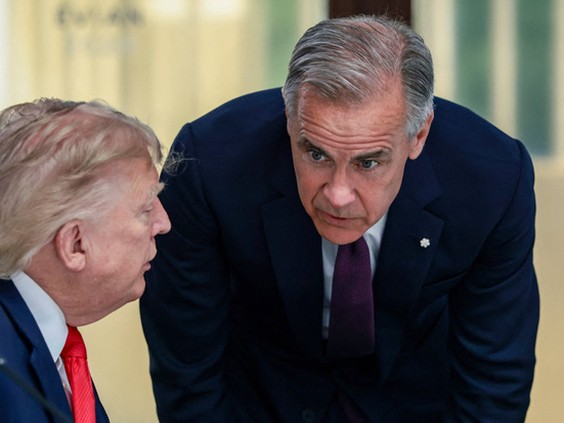
U.S. President Donald Trump (left) and Prime Minister Mark Carney (right) attend a work lunch as part of the G7 summit, in Evian, France, June 16, 2026. Photo by Evelyn Hockstein / POOL / AFP /Getty Images
 
"While tariffs are an obvious factor, Canadian manufacturers are making long-term decisions about where to locate based on a broader assessment of where they are most likely to have a competitive advantage."
"Otherwise, Canadian exporters may have to depend on U.S. customers to act as importer of record, potentially straining key commercial relationships."
Joy Nott, KPMG Canada partner, trade and customs 

Labels: , , , , ,

Thursday, May 07, 2026

U.S. First Amendment Guarantees on Free Speech

President Donald Trump listens as Homeland Security Secretary Markwayne Mullin during the swearing-in at the Oval Office of the White House, Tuesday, March 24, 2026, in Washington. (AP Photo/Alex Brandon)
President Donald Trump and Homeland Security Chief Markwayne Mullins at the White House swearing-in ceremony. Canadian Press
 
"I have long admired the United States for its commitment to free speech." 
"Never in a million years did I think that, after criticizing the U.S. government, I would be targeted with a summons seeking to find out who I am, where I live, where I go, and what I read online."  
"You don't have to be from America to know that this is un-American." 
Canadian 'John Doe'  
 
"Plaintiff John Doe uses a pseudonym online and in this lawsuit to protect his privacy and family."
"Doe regularly posts strongly-worded criticisms of President Trump and his policies on [his] social media accounts, including his account on X."
"His posts have collectively received well over 100,000 views."
"The Trump administration continues to attempt to unmask social media users who criticize the administration -- a transparent gambit to chill speech that the government dislikes." 
"Google has the capacity to collect this information and often does." 
American Civil Liberties Union 
 
"When we receive a subpoena, our review process is designed to protect user privacy while meeting our legal obligations."
"We inform users when their accounts have been subpoenaed, unless under legal order not to, or in an exceptional circumstance."
"We review every legal demand and push back against those that are overbroad or improper, including objecting to some entirely." 
Google spokesperson
https://bellmediainc-bnn-bloomberg-prod.web.arc-cdn.net/resizer/v2/https%3A%2F%2Farc-goldfish-bellmediainc-thumbnails.s3.amazonaws.com%2F05-06-2026%2Ft_9abe45a96e2e44c5b00428de848eef54_name_doj.jpg?auth=1c793f11c0f346a6f229ea7a6e8b82da57990f8148cd0ec824d71dfd67244ab5&width=960&height=540&smart=true&quality=80
An unnamed Canadian is suing the U.S. government after they requested their personal data from Google following criticism of U.S. President Donald Trump on 'X.'  CTV News
 
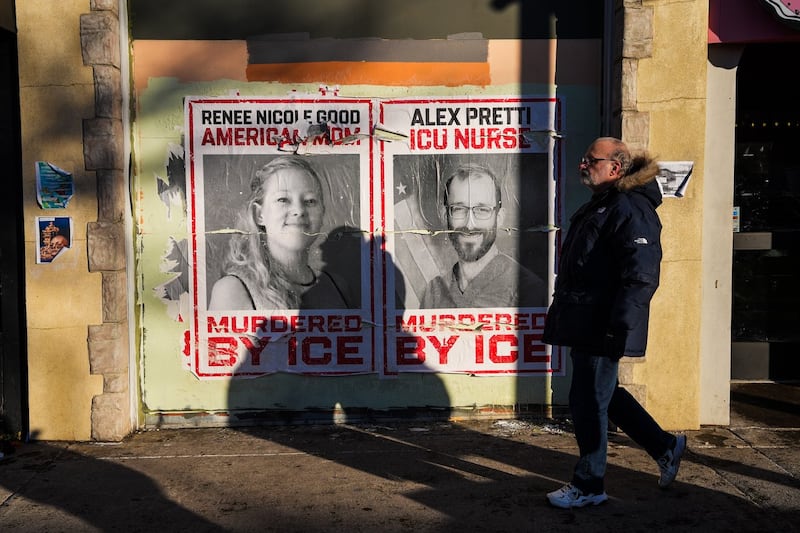
A legal complaint has been filed against the U.S. Department of Homeland Security's Secretary Markwayne Mullin, for the purpose of putting a stop to the U.S. government's move to obtain the plaintiff's information from Google. The American Civil Liberties Union, which has taken up the Canadian's suit, explained that the Department of Homeland Security had issued a summons for those records from Google. This followed an online posting criticizing the killing by federal agents of Renee Good and Alex Pretti in Minneapolis last January. 
 
The man known as Joe Doe for the purpose of the legal complaint is a Canadian citizen. He lives in Canada, has not taken a trip to the United States in the past decade and has no business or meaningful social contacts with anyone residing in the United States. Despite which, the summons to Google to reveal the man's personal information based its demand on a customs enforcement law. 
 
The Department of Homeland Security issued the Google summons in February of 2026, requesting information linked to the Gmail address of Doe's X account, covering a five-month period. The summons seeks disclosure of "vast swaths of information" inclusive of records relating to John Doe's Gmail and associated accounts; his name, where he lives, information on his physical movements, and records in detail  of websites he visits and people he communicates online with. 
 
In addition to disclosure of "any associated names, residential addresses, telephone numbers and credit card numbers or bank account numbers".
 
A man walks by posters of Renee Nicole Good and Alex Pretti, who were both fatally shot by federal agents, in Minneapolis, Saturday, Jan. 31, 2026. (AP Photo/Ryan Murphy)
 
 During the first Trump administration, points out the ACLU, it was the Inspector General of DHS itself that concluded DHS officials had improperly undertaken efforts "to unmask social media users, and Twitter filed a lawsuit challenging the practise", through the same legal basis of customs enforcement. The second time around, pointed out the ACLU, a number of social media users filed actions against administrative subpeonas meant to reveal their identities, with a view to obtaining other information relating to them.
 
The Department of Homeland Security thus challenged, sought to defuse the situation, and in response "DHS has withdrawn several subpeonas subjected to such challenges before a court could fully review them". The ACLU points out that the current lawsuit asks the court to invalidate the John Doe summons to make it "clear that the government may not use its customs enforcement authority to seek to identify and intimidate its critics".


Labels: , , , , , ,

Thursday, July 17, 2025

Population Migration Shifts

"I have been getting calls every day from people in the United States who are terrified they will be deported."
"We have spoken to people who have been hiding out in church basements for weeks in the U.S. because they're worried ICE [U.S. Immigration and Customs Enforcement agents] will come to arrest them."
"Haitians don't trust Trump. So they're still coming to Canada because that's the one place where they might feel safe." 
"Canada is actually deporting people by proxy. Carney is making the rules tougher -- he's using immigration as a bargaining tool because he knows Donald Trump is very sensitive about everything that's immigration." 
Frantz Andre, coordinator, Comite d'Action des Personnes sans Statut
https://i.cbc.ca/1.5305211.1744149805!/fileImage/httpImage/image.jpg_gen/derivatives/original_1180/frantz-andre.jpg?im=Resize%3D1180
Frantz André is a spokesperson for the Action Committee for People Without Status. (CBC)
 
Prior to his November election, for months Donald Trump had spoken of his intention to deport over 11 million undocumented migrants should he win the presidency. The message he sent to Haitian immigrants among others with his anti-migrant rhetoric was to prepare to face the fact that their days would be numbered in the United States. Then, in late June when the Trump administration moved to begin deporting over 500,000 Haitians living in the U.S. by ending their temporary legal status, their fears were realized. 
 
That has led to officials at the St-Bernard-d-Lacolle border crossing between Quebec and New York receiving over a 400 percent increase of asylum claims from the same period the year before, according to the Canadian Border Services Agency. Claims rose in number 128 percent in June and since the start of the year, an overall rise of 82 percent. Of those claimants, most were Haitians.
 
According to Frantz Andre, a coordinator with the Comite d'Action des Personnes sans Statut, who has been actively involved with assisting Haitians in their bid to settle in Canada for over a decade, the rise in the number of Haitians living in the United States turned to applying for asylum in Canada began before the election of Donald Trump to the U.S. presidency. 
 
In April 2,733 people applied for asylum in Canada at the St-Bernard-de-Lacolle crossing south of Montreal. A total of 19,730 asylum applications were processed in Canada from people arriving at all ports of entry between January and July 2025. By the same time last year, the Canada Border Services Agency had processed 39,085 asylum applications. Of that total, 2,169 were returned to the United States, judged ineligible to enter Canada, most having made their asylum claims at official ports of entry. 
 
https://i.cbc.ca/ais/0d1aef4a-df66-4a10-a3e5-a8fcfa3f0a65,1744143866078/full/max/0/default.jpg?im=Crop%2Crect%3D%280%2C0%2C1180%2C663%29%3BResize%3D620
There has been a significant change in the number of asylum claims since U.S. President Donald Trump took office. CBC
 
The nationality most represented among asylum claims at land border crossings in Canada are Haitians, hoping to settle in Montreal, a French-speaking province with an already-established large Haitian community. The second-largest proportion of those seeking asylum is Venezuelans, while Americans themselves comprise the third largest proportion of people seeking asylum at land-border crossings. Under former U.S. president Joe Biden, temporary legal status was granted to a half-million Haitians, most having lived in the U.S. since 2010, when an earthquake and tsunami devastated Haiti. 
 
That temporary legal status was extended under the previous American administration until February 2026, in recognition of the political instability, gang violence and allied factors roiling a now-dystopian Haiti. Those Haitians refused entry to Canada are customarily placed into the keeping of U.S. authorities who have the option of either detaining them, or placing them in prison pending deportation back to Haiti. Only Haitians who have close family in Canada can claim asylum here if they're arriving from the U.S.
 
Under the long-standing Safe Third Country Agreement, in requiring refugee protection in Canada or the U.S. asylum claimants must seek refugee protection in the first country they reach. Those who go on to either of the two as a second attempt will be turned back. "Many Haitians living in the United States are not aware of these regulations", explained the former head of the Maison d'Haiti organization in Montreal, that serves the Haitian community. "And they are trying to come in just as the Canadian government is making it more difficult for people to seek asylum here."
 
https://i0.wp.com/ijb.utoronto.ca/wp-content/uploads/2025/06/IJB-Web-Image_US-Canada.png?w=1080&ssl=1
A torn U.S. flag flies beyond a barbed wire fence in the United States.
 
In 2024, close to 80 percent of those seeking asylum, making their case to a Canadian immigration judge, were granted refugee status. The problem is that Canada has suffered the consequences of accepting too many immigrants, refugees and migrants over the past several years. For a country of 41-million people, bringing in a million a year in those categories has meant severe strains on the country's social support systems. 
 
Having to house and support that number of people deleteriously impacts the universal health care system, already strained beyond capacity to serve Canadians. Housing costs have soared in lock-step with a steadily rising population, leading to a crisis of insufficient housing stock and unsustainable market prices placing young Canadians out of contention for home ownership. Large numbers of foreign students studying at Canadian universities and given permission to seek  temporary employment has seen employment for young Canadians collapsing. Emergency housing meant for Canadians in duress is now crowded with refugees and migrants.
 
https://i.cbc.ca/1.7376533.1730990891!/fileImage/httpImage/image.jpg_gen/derivatives/16x9_1180/roxham-road.jpg?im=Resize%3D780
Roxham Road, a once-popular irregular border crossing between Canada and the United States, was closed last year. (Sarah Leavitt/CBC)
 

Labels: , , , ,

Sunday, June 08, 2025

The U.S. "Muslim Ban" Reactivated

"[The U.S. Departments of State and Homeland Security, and director of national intelligence given orders to compile report on] hostile attitudes [toward the United States]."
"[To] protect its citizens from aliens who intend to commit terrorist attacks, threaten our national security, espouse hateful ideology, or otherwise exploit the immigration laws for malevolent purposes." 
Trump administration
 
"[The  U.S.] is a dangerous country where human rights of immigrants are nonexistent."
"If you are thinking about travelling, cancel your plans immediately."
Venezuelan Foreign Ministry 
 
"[There is concern about] the potential negative impact [of the ban on educational exchanges, business ties and broader diplomatic relations]."
"The African Union Commission respectfully calls upon the U.S. administration to consider adopting a more consultative approach and to engage in constructive dialogue with the countries concerned."
African Union Commission
https://ichef.bbci.co.uk/news/1024/cpsprodpb/ed5f/live/a6b73e00-4202-11f0-b6e6-4ddb91039da1.png.webp 
 
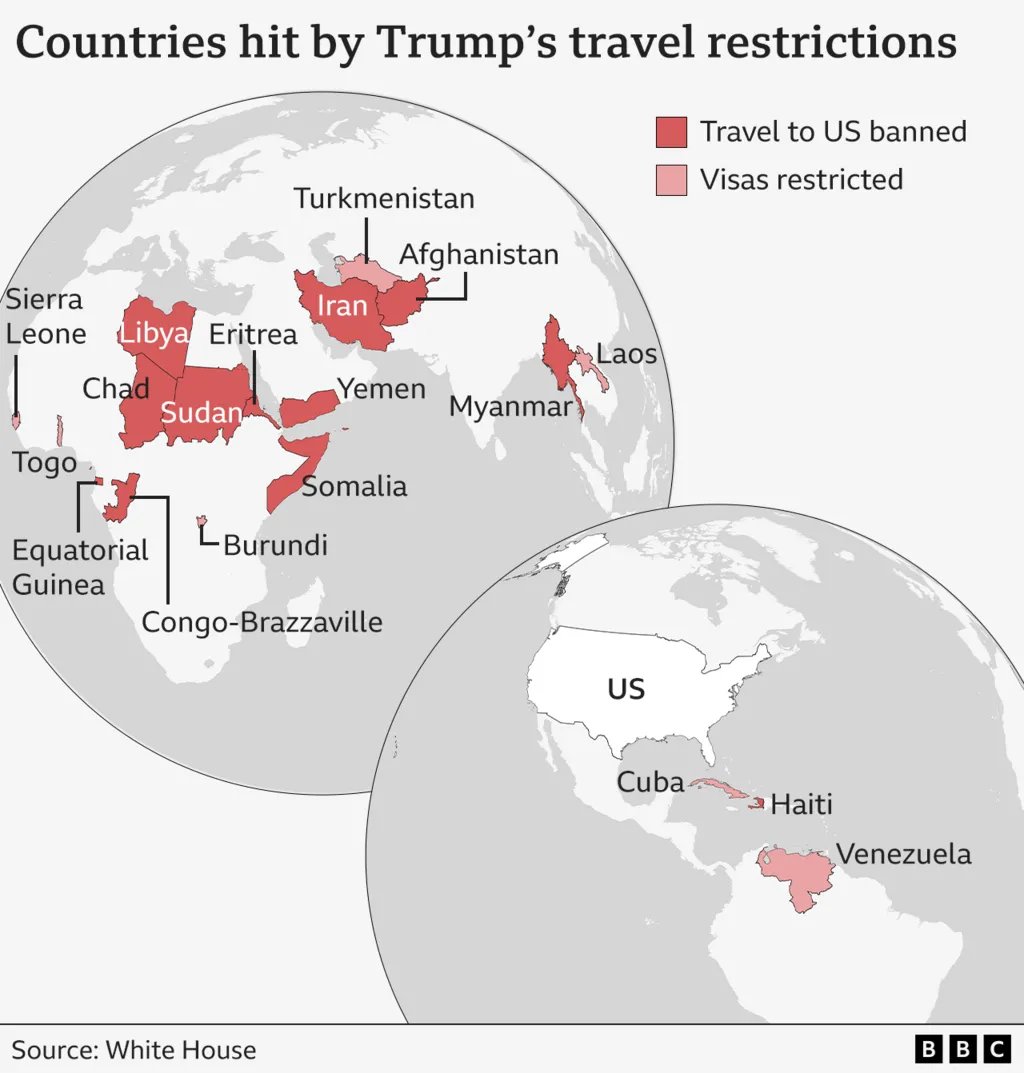
Citizens of a dozen countries -- primarily from Africa and the Middle East -- have now once again been banned from entering the United States, in a renewal of the original banning from the first Trump administration. Citizens of Afghanistan, Myanmar, Chad, the Republic of Congo, Equatorial Guinea, Eritrea, Haiti, Iran, Libya, Somalia, Sudan and Yemen have been swept into the wide-cast net that the policy of restricted entry embraces.
 
And nor may citizens of Burundi, Cuba, Laos, Sierra Leone, Togo, Turkmenistan and Venezuela, outside the United States and without valid visas, feel themselves free to enter the U.S. The Council on American-Islamic Relations, the largest Muslim civil rights and advocacy group in the U.S. spoke of the order as "unnecessary, overbroad and ideologically motivated". Whether indeed it is unnecessary, overbroad and ideologically motivated is, of course, a matter for the United States to determine and none others.
 
The newly-restrictive ban reworked for the second Trump administration linked the ban to the Boulder, Colorado terrorist attack, stating as an example it perfectly underscored dangers inherent in admitting some visitors who tend to overstay their visas. While the country that the attack suspect is from was not included on the restricted list, the intention is clear. Nationals of countries on the ban list pose "terrorism-related" and "public-safety" risks, stated President Trump.
 
Some of the listed countries had "deficient" screening and vetting or have historically refused to take back their own citizens, the president elaborated. An annual Homeland Security report of visa overstays of tourists, business visitors and students who arrive by air and sea, formed the basis for the Trump contention. Countries with high percentages of those remaining in the United States despite overstaying their visas were singled out. "We don't want them", Mr. Trump asserted baldly.
 
U.S. President Donald Trump attends a "Summer Soiree" held on the South Lawn of the White House in Washington
U.S. President Donald Trump speaks as he attends a "Summer Soiree" held on the South Lawn of the White House in Washington, D.C., U.S., June 4, 2025. REUTERS/Leah Millis
 
If authorities of designated countries are able to demonstrate commitment to "material improvements" to their own rules and procedures, the list can be altered according to the administration. Alternately, "as threats emerge around the world", countries can be added. "This policy is not about national security -- it is about sowing division and vilifying communities that are seeking safety and opportunity in the United States" responded the president of Oxfam America.
 
During President Trump's first term in office, an executive order was issued in 2017 banning travel to the U.S. by citizens of seven predominantly Muslim countries including Iraq, Syria, Iran, Sudan, Libya, Somalia and Yemen. Given the ongoing conflicts there of sectarian and tribal origins, where the unifying feature would be identified as contempt for western democracy and all of those countries' violent antipathy to a Jewish state in the Middle East which happens to be a primary ally, the ban is explicable. 
 
Once again, travellers from the banned countries will be barred from flights to the U.S., or detained at U.S. airports after landing. The impact will include students and academic faculty along with business people, tourists and those visiting friends and family domiciled in the US.  The original ban had been upheld in 2018 by the Supreme Court. At that time the ban applied to travellers and immigrants in various categories from Iran, Somalia, Yemen, Syria and Libya along with North Koreans and included some Venezuelan government officials.
 
Exempt From the Ban:

1. Green card holders
2. Dual citizens, including U.S. citizens who also have citizenship of one of the banned countries
3. Some athletes: athletes and their coaches traveling to the U.S. for the World Cup, Olympics or other major sporting event as determined by the U.S. secretary of state
4. Afghans who worked for the U.S. government or its allies in Afghanistan and are holders of Afghan special immigrant visas
5. Iranians belonging to an ethnic or religious minority who are fleeing prosecution
6. Certain foreign national employees of the U.S. government who have served abroad for at least 15 years, and their spouses and children
7. People who were granted asylum or admitted to the U.S. as refugees before the ban took effect
8. People with U.S. family members who apply for visas in connection to their spouses, children or parents
9. Diplomats and foreign government officials on official visits
10. Those traveling to U.N. headquarters in New York solely on official U.N. business
11. Representatives of international organizations and NATO on official visits in the U.S.
12. Children adopted by U.S. citizens
13. People from targeted countries who already have valid visas, although the Department of Homeland Security still has the authority to deny entry, even to those with a valid visa 

https://www.politico.com/dims4/default/3a1b8ed/2147483647/strip/true/crop/5000x3333+0+0/resize/630x420!/quality/90/?url=https%3A%2F%2Fstatic.politico.com%2Fdd%2F36%2F5a4d69bd42c9b896b52f3e3e1d5b%2Fmyanmar-eid-al-adha-82791.jpg
Muslims pray to mark celebrations of Eid al-Adha at a mosque June 7, 2025, in Yangon, Myanmar, one of the nations impacted by the travel ban. | Thein Zaw/AP
 

Labels: , , , ,

Monday, April 21, 2025

Disciplining Harvard University

"The consequences of the government's overreach will be severe and long-lasting."
"In recent weeks, the federal Government has launched a broad attack on the critical funding partnerships that make this invaluable research [studies on pediatric cancer, Alzheimer's disease and Parkinson's disease] possible."
"This case involves the Government's efforts to use the withholding of federal funding as leverage to gain control of academic decision making at Harvard."
"Today, we stand for the values that have made American higher education a beacon for the world."
"We stand for the truth that colleges and universities across the country can embrace and honour their legal obligations and best fulfill their essential role in society without improper government intrusion."
President Alan M. Garber, Harvard University 

"The gravy train of federal assistance to institutions like Harvard, which enrich their grossly overpaid bureaucrats with tax dollars from struggling American families is coming to an end."
"Taxpayer funds are a privilege, and Harvard fails to meet the basic conditions required to access that privilege."
White House spokesman Harrison Fields
https://ichef.bbci.co.uk/news/1024/cpsprodpb/bf10/live/adc02cd0-1efc-11f0-80b3-83959215671c.png.webp
Harvard University, Reuters

"[Many international students at Harvard are] scared of speaking up [because they feel merely attending the school has put a target on their back]."
"It's incredibly scary for people. All student visas right now at Harvard are at risk, and what the Trump administration is trying to do is divide us."
Leo Gerden, senior Harvard student from Sweden 

"The Government has not — and cannot — identify any rational connection between antisemitism concerns and the medical, scientific, technological, and other research it has frozen that aims to save American lives, foster American success, preserve American security, and maintain America's position as a global leader in innovation."
"Nor has the Government acknowledged the significant consequences that the indefinite freeze of billions of dollars in federal research funding will have on Harvard's research programs, the beneficiaries of that research, and the national interest in furthering American innovation and progress."
"[The freeze was also] arbitrary and capricious and in violation of the Administrative Procedure Act."
Harvard lawsuit 
https://i.cbc.ca/1.7515007.1745272079!/cpImage/httpImage/image.jpg_gen/derivatives/original_1180/education-trump-harvard.jpg?im=Resize%3D1180
Students, faculty and members of the Harvard University community rally on campus in Cambridge, Mass., on April 17. (Charles Krupa/The Associated Press)

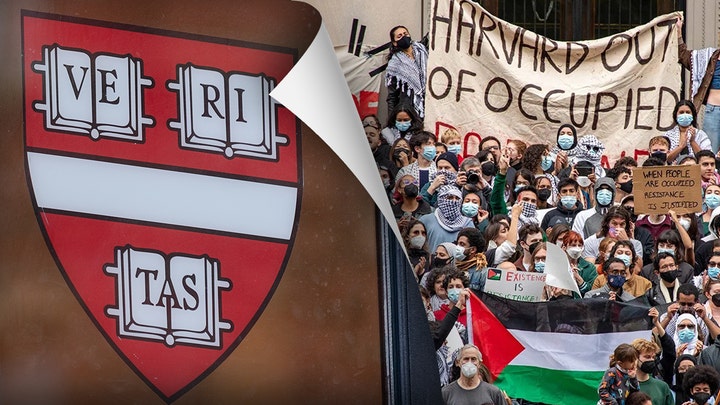
Ivy league universities across the United States have hosted scores of vehement, organized 'protests' against Israel as an 'occupying power', claiming it is committing 'genocide' against Palestinians in the months following the terrorist attacks by Palestinian groups Hamas, Palestinian Islamic Jihad and the Popular Front for the Liberation of Palestine, followed by ordinary Palestinian citizens who breached the separation wall between Gaza and Israel to flood southern Israel with thousands of operatives intent on creating a savage barbarity of mass rape, torture, and slaughter of entire families whose homes were burned around them. 
 
The protests on U.S. university campuses began almost immediately after the October 7, 2023 attack. Palestinian student groups organized, advertised and instructed their followers to get out and demand of university administrations full and complete academic and investment divestiture in anything pertaining to Israel, while shouting their slogans of Israel disappearing into the sea so Palestinians could be free. Jewish university students were hounded, threatened, their security and sense of place fully disrupted. University staff members became involved in support of the Palestinian protests.
 
https://images.jpost.com/image/upload/q_auto/c_fill,g_faces:center,h_537,w_822/656999

A graduate displays a Palestinian flag during the 373rd Commencement at Harvard University, Cambridge, Massachusetts, May 23, 2024.
(photo credit: Craig F. Walker/The Boston Globe via Getty Images)

Harvard, the premier institute of higher learning in the U.S., was among others of its kind to host these disruptive, violent campaigns in a spirit of toleration and free speech rights taking precedence over the rights of Jewish students to be able to access classes, to be free of intimidation and threats. With the  ascent of U.S. President Donald Trump to his second term in the White House, his administration, as promised during the election campaign, has sought to close down the protests, and it has resorted to the threat of withholding federal funding for the oldest and most prestigious university in the States.
 
Harvard has responded by defying the orders, insisting it has itself launched a number of investigations into the protests that had turned virulently antisemitic. Harvard's defiance against orders to defuse the situation by refusing to host any further campus activism, and crack down on antisemitism and 'diversity' programs, has signalled its defiance by launching a lawsuit against the Trump Administration. 
 
Harvard refused the demand by the Department of Homeland Security to turn over 'detailed records' of its foreign student visa holders' "illegal and violent activities" by April 30. Two grants to the school totalling US$27 million were cancelled. At Harvard, international students comprise 27 percent of the campus with the majority of its student body in graduate school, engaged most often in conducting nationally prominent research. The university's distinction as a premier study destination is linked to its ability to attract top global intellectual talent. It also distinguishes itself as attracting large tax-deductible donations from wealthy American philanthropists, most of whom were former alumni.
 
https://a57.foxnews.com/static.foxnews.com/foxnews.com/content/uploads/2024/05/720/405/GettyImages-2152222205.jpg?ve=1&tl=1
Harvard faculty and staff hold signs inside Harvard Yard during a press conference by faculty supporters of the Harvard Out of Palestine coalition.  (John Tlumacki/The Boston Globe via Getty Images)

All of which makes it that much more disturbing that riotous protests damning Israel and discomfiting Jewish students with anger directed at their presence, to the extent that many students felt compelled to miss their classes as a result of having been corralled and trapped by enraged Palestinian/Hamas-supporting groups committing criminal acts of occupation of university grounds and buildings, while demanding that faculty have no academic intercourse with their Israeli counterparts and the university commit to complete divestment.
 
Over US$2 billion in federal grants and contracts has been frozen to the Ivy League institution. Harvard is reeling from the threat to its hosting of international students even as the Trump administration has gone about deleting records to terminate the legal status of international students at schools country-wide. There is no recourse for the students on  how they may regain legal status in the United States. It seems a just enough solution to the problem of international students feeling free to abuse the hospitality of a country they find fault with, even as they advantage themselves of the superior education opportunities it offers.
 
Some 1,024 students to date attending 160 colleges, universities and university systems have seen their visas revoked or had their legal status removed since late March. An administration insider with familiarity in the contentious matter revealed that the Treasury Department had directed the IRS acting chief counsel to begin the process of revoking Harvard's tax-exempt status, while speaking on the condition of anonymity.
 
https://a57.foxnews.com/static.foxnews.com/foxnews.com/content/uploads/2025/04/720/405/harvard_antisemitism_2_.jpg?ve=1&tl=1
Anti-Israel students at Harvard's law school reportedly conspired to smear law firms that bucked campus antisemitism after Hamas' Oct. 7, 2023, attacks against Israeli civilians. (Getty Images; Fox News )

Labels: , , , , ,

Wednesday, April 09, 2025

Canada: Managing Asylum Seekers from the U.S.


"I know some people are struggling. I know it's tough, but in Quebec, our capacity to receive more and more people is overwhelmed."
"[Canada must ensure that] nobody is crossing the line between border crossings via the forest. Of course, I think it's really important to keep our humanity, to take care of people who live here, but we can't take more."
Quebec Immigration Minister Jean Francois Roberge 

"[Arrivals from Haiti are] somewhat different [because they are French-speaking]."
"That does not relieve us of the obligation to have a system that follows the rules and has the resources needed to properly manage asylum seekers."
Bloc Quebecois Leader Yves-Francois Blanchet 

"I'm in favour of legal immigration. When people arrive here in Canada, if they are asylum seekers, they have to show that they are real asylum seekers."
"If someone is a true refugee who [is] truly in danger abroad and they come in under the proper rules, then they should be allowed to stay."
Conservative Leader Pierre Poilievre
https://images.radio-canada.ca/q_auto,w_960/v1/ici-info/16x9/generique-etats-unis-canada-frontiere-douane.PNG

There has been a significant change in the number of asylum claims since U.S. President Donald Trump took office, specifically at the regular border crossing in Lacolle, Que., according to Canada Border Services Agency (CBSA) data obtained by Radio-Canada and CBC News. The data shows there had already been 557 asylum claims at Lacolle in the first six days of April — just three fewer than in all of January.  Photo: Getty Images


So many issues have erupted since the Trump administration returned to the White House, the world will have a difficult time adjusting to the impacts -- ranging from across-the-board abandonment of free trade, of trade pacts with the United States, of stiff new tariffs imposed on goods and services entering the United States, re-alignment of traditional trusted allies, uncertainty for NATO, and for Canada and likely Mexico as well, yet another influx of people claiming refugee status who have been targeted for their illegal status in the U.S. by receiving notice of deportation.
 
As a result, Canadian border authorities are seeing another rise in people seeking asylum at a Quebec border crossing near Montreal, leaving their years-long temporarily-granted status now revoked, to find potential haven in Canada. Haitians were given temporary status as a humanitarian gesture following a disastrous earthquake and in recognition of the civil war raging in Haiti and the dangers inherent in armed and dangerous gangs taking over civil society. As an option for their future they understandably don't recognize a return to Haiti as a solution to their homelessness.
 
In the first week of April alone, the Canada Border Services Agency report 557 migrants' arrival at the St-Bernard-de-Lacolle border crossing between New York and Quebec; roughly as many seen at that location for the entire month of January, approaching 40 percent of the number in March, when 1,356 claims were registered. Over 500,000 Haitians living in the United States with Temporary Protected Status will see that haven evaporate, ending in August. 
 
https://ichef.bbci.co.uk/news/1024/cpsprodpb/7155/live/2a234d50-06d6-11f0-97d3-37df2b293ed1.jpg.webp
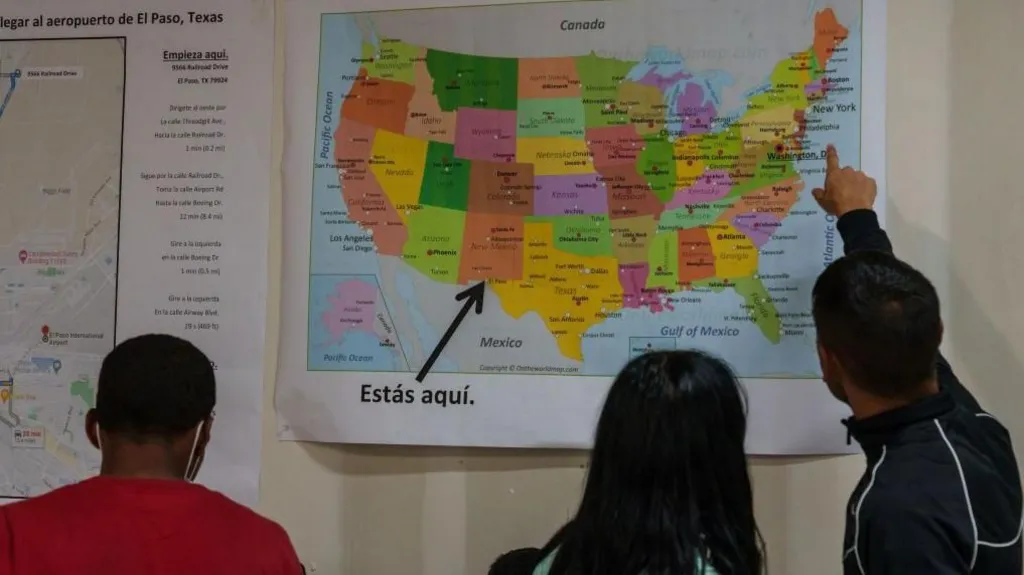
Migrants from Venezuela viewing a map of the US at a Welcome Center in El Paso, Texas in 2022  Getty Images
 
Since the catastrophic earthquake and tsunami in 2010, Haitians were permitted to live and work in the U.S. Now, that protected designation sits on the cusp of ending, and some of those involved have decided to go to Canada, much as a previous wave of Haitians chose to do, whose permits were being revoked under the first term of President Donald Trump. Under the Safe Third-Country Agreement between the U.S. and Canada, asylum seekers can be sent by Canada back to the United States in reflection of its having represented a first safe-haven prior to arriving in Canada which under the agreement is then not obligated to admit them.
 
https://media.npr.org/assets/img/2018/01/17/ap_17220759666559_wide-ebabbb90bb6b4cf5102c816f7f2381fee50dec00.jpg?s=800&c=85&f=webp

A family from Haiti approach a tent in Saint-Bernard-de-Lacolle, Quebec, stationed by Royal Canadian Mounted Police, as they haul their luggage down Roxham Road in Champlain, N.Y., last August. Charles Krupa/AP

A fresh influx of asylum seekers has no humanitarian popularity in Quebec, which has long since complained that its social services resources have been strained to the limit by years of illegal cross-border applicants for refugee status. The province, according to its immigration minister, is at full capacity for asylum seekers. His response is echoed by the leader of the Bloc Quebecois who maintains the federal government must accelerate the processing of asylum seekers so they can be distributed across the country to alleviate Quebec's burden.
 
It was announced last month by U.S. Homeland Security that it was in the process of revoking temporary status for 532,000 people from Cuba, Haiti, Nicaragua and Venezuela. They had flown to the United States at their own expense, with a financial sponsor; their temporary legal status is set to end on the 24th of April. An end to Temporary Protected Status was also announced by the Trump administration for 600,000 Venezuelans and roughly 500,000 Haitians.
 
The Canada Border Agency, in anticipation of an influx of haven seekers, began expanding the Saint-Bernard-de-Lacolle centre's intake capacity to enable expeditious processing of asylum claims "in the event of an influx". That influx has, as expected, materialized.
 
https://i.cbc.ca/ais/0d1aef4a-df66-4a10-a3e5-a8fcfa3f0a65,1744143866078/full/max/0/default.jpg?im=Crop%2Crect%3D%280%2C0%2C1180%2C663%29%3BResize%3D620
There has been a significant change in the number of asylum claims since U.S. President Donald Trump took office, specifically at the regular border crossing in Lacolle, Que., according to Canada Border Services Agency (CBSA) data obtained by Radio-Canada and CBC News. The data shows there had already been 557 asylum claims at Lacolle in the first six days of April — just three fewer than in all of January.  CBC
 
There's so many people that have been deported since Donald Trump has been in office, you know they're just scared. [People have started receiving letters from U.S. authorities saying their status has been revoked].
So, as soon as they get the letter, they're looking for ways to get out of the states.
We've seen already what's happening, I don't think they're going to wait... because currently ICE [Immigration and Customs Enforcement] is going to workplaces, to churches, going on the street. 
They intercept you and, if you are one of those, you're gone.
Frantz André, spokesman, Montreal-based group that helps undocumented migrants with asylum cases
https://smartcdn.gprod.postmedia.digital/financialpost/wp-content/uploads/2025/04/us-canada-irregular-border-crossings-were-low-in-2024-arriv.jpg?quality=90&strip=all&w=564&h=423&type=webp&sig=U5roGYGbR-heHFQIeKAEBg

Labels: , , , ,

Saturday, April 05, 2025

Canada Experiencing Reverse Brain-Drain Resources

"There is a lot of concern and incredulity that this is happening."
"The kinds of people that might be available are fairly high flyers. This is a big deal. It's not like minor frustration over prior presidents, or differences of opinion with policy. I think people would be in play if you could make jobs available."
"I think we will definitely get some people."
"There's a disturbance in the force, so to speak. Americans are considering relocation options and career moves they haven't considered before."
"For Canada to cash in on this angst, we'd have to deal with the fact that we currently don't have lots of empty jobs in academic medicine. We'd also have to come up with the startup funds newly hired faculty need to build their research labs." 
"Advertising and promoting that idea recruiting practising doctors by ensuring American physicians are considered on par with Canadian doctors] of, 'We welcome you in Canada, and we'll make sure that we expedite your licensure and help with moving  you to Canada', could free up lots of very talented physicians who are not researchers but who would help our healthcare system."
Dr. Stephen Archer, director, Translational Institute of Medicine, Queen's University, Kingston, Ontario
 
"Compared to 2018, in 2024 there is close to a 300 percent increase in the number of [certifications] awarded via this route (198 in 2018 versus 775+ in 2024)."
"The CFFC [College of Family physicians of Canada] welcomes American family doctors, as we always have."
"Every additional family physician certified by the CFPC means another doctor caring for more Canadians."
College of Family Physicians of Canada president Dr. Carrie Bernard 
https://i.cbc.ca/ais/02689b78-c109-42ec-98fe-ac0442f5f12b,1739499273167/full/max/0/default.jpg?im=Crop%2Crect%3D%280%2C91%2C2048%2C1152%29%3BResize%3D620
Robert F. Kennedy Jr, a vaccine critic who has pledged to tackle chronic disease, was named U.S. Health Secretary on Thursday after overcoming resistance from the medical establishment and members of Congress with promises to limit his role in vaccination policy.  CBC
 
There has been an unprecedented surge in interest from American doctors looking to re-locate from the United States where President Donald Trump has gone on a spree of re-ordering and cost-cutting in science and medicine affecting the quality of research and medical services in the United States. Suddenly Canada has become an attractive alternative for a growing number of family physicians and medical researchers. For Canada, that surging interest couldn't come at a better time, given the country's shortage of general practitioners and a medical system that is collapsing under the weight of demands it cannot meet.
 
The founder of CanAm Physician Recruiting Inc., a firm in business for the last 27 years, states that its current job board lists over 150 open positions across Canada. A typical listing would be: 'Family physician in Edmonton -- Guaranteed salary and No Overheads in Fantastic Location'. And others reading: Anesthesiologist in Calgary, obstetrician/gynecologist in Moncton, emergency doctors in 'multiple locations'. 
 
https://i.cbc.ca/1.6965636.1694629709!/cpImage/httpImage/image.jpg_gen/derivatives/original_1180/meningitis-outbreak-inside-the-cdc.jpg?im=Resize%3D1180
For years, the Centers for Disease Control has been at the front lines of disease outbreak response in the U.S. and abroad, including meningitis, Ebola and more. (Pouya Dianat/The Associated Press)
 
Evidently it appears that a number of American doctors and academics contemplate leaving the United States in response to what many of the country's elite scientists and medical researchers call the "wholesale assault" on science by the Trump administration. This represents a historical turn-about, where Canada typically educates doctors who then see fit to relocate to the United States. In the current situation, Canada has become one of the preferred destinations of American doctors looking elsewhere to raise their families and operate their medical practises.
 
Canada should be prepared to welcome these professional health workers with open arms given the Canadian health-care system's desperate need of more physicians. Some observers recommend the creation of a special university hiring track for 'high flyers', along with an increase in grant funding agencies through boosting research and development spending by government alongside a robust strategic recruitment campaign.
 
Hundreds of millions in university grants and contracts has been slashed or paused, since the Trump administration took office, with 20,000 positions eliminated from American health agencies, defunding of laboratories, and cuts to some areas of research related to sex, gender and reproduction, under sweeping changes that Health Secretary Robert F. Kennedy Jr. and Tesla chief executive Elon Musk have led. 
 
https://i.cbc.ca/1.7502558.1743798089!/fileImage/httpImage/image.JPG_gen/derivatives/original_1180/usa-trump-health.JPG?im=Resize%3D1180
Department of Health and Human Services employee Julie Siegel stands outside the Mary E. Switzer Memorial Building in Washington, D.C., on Tuesday, as she was denied access and her badge was taken away. (Kevin Lamarque/Reuters)
 
Canada, unfortunately, cannot hope to match the expenditure of the United States on science and health care. The budget of the Canadian Institutes of Health Research was $1.2 billion in 2020-21, a trifling amount in comparison to the expenditure of the U.S. National Institutes of Health's $45 billion during that same time frame, even taking into account that the population of the U.S. is almost ten times that of Canada's. 

It does  help the process of transitioning medical personnel from the United States to Canada when, over the past two years the College of Physicians and Surgeons of Ontario opened 'registration pathways' for doctors trained in the United States. The updates permit American board-certified physicians to practise without a need to complete additional qualifying professional 'upgrades' in training or exams. The college registered 351 American physicians following the changes in policy between 2023 and 2024.
 
The College of Family Physicians of Canada arranges automatic certification with no exams required for family doctors trained and certified in the United States. Three other approved jurisdictions', the United Kingdom, Ireland and Australia are offered the same automatic certification. Once they are certified they can obtain full licenses to practise in every Canadian province.
 
Dr. John Philpott, founder of CanAm Physician Recruiting Inc. reports having heard from American doctors working in family medicine, but also emergency medicine, general surgery, pediatrics, psychiatry, ob/gyn -- "all specialties, right across the board, from California, Arizona to Florida, New York to the Midwest". "I was talking to one of my staff, she was talking to an emerge doc yesterday. And the doctor said, 'Listen, I'm coming; I'm coming tomorrow. ASAP. Put me wherever'." 

https://i.cbc.ca/1.7502534.1743803287!/fileImage/httpImage/image.jpg_gen/derivatives/16x9_1180/2204184584.jpg?im=Resize%3D780
Thousands of people at key health agencies in the United States have lost their jobs. Canadian provinces are hoping they continue their research north of the border. (Elijah Nouvelage/Getty Images)
"The nice thing about investing in science is it improves life. The payback to government through taxes and innovation are very quick."
"The accreditation of medical schools is done by the same agency, so there's a lot of similarity."
"And Canadian physicians, although this might be controversial, are reasonably well paid, relative to American physicians."
Dr. Stephen Archer

Labels: , , , ,

Tuesday, February 04, 2025

U.S. Agency for International Development Status

The agency’s funding was corrupted, with grants going to radical causes and organizations.
Perhaps the best illustration of how USAID has misused its funding is found in the Middle East.
In 2024, as the region reeled from the aftermath of the bestial atrocities committed by Hamas in Israel the previous year, the United States significantly boosted its financial support for projects in Gaza and the West Bank, spending more than $200 million of American taxpayers’ money in territories already rife with terrorist incitement and activity.
The respected Israeli research organization NGO Monitor pointed out that as the US government “dramatically increased funding” for these various projects, it “drastically decreased transparency.”
These grants were made to what USAID called “miscellaneous foreign awardees.” You wouldn’t know from the opaque accounting process that beneficiaries included local partners who praised the October 7 onslaught.
A “flash appeal” issued by the United Nations for assistance in Gaza attracted $114 million from Washington, feathering the nests of local non-governmental organizations like Al Awda, a “health and community center” with close ties to the Marxist Popular Front for the Liberation of Palestine, designated as a terrorist organization, and the Palestinian Medical Relief Society, whose president described the massacres in Israel as “a glorious day for the Palestinian resistance and people.” 
Foundation for Defense of Democracies
 
"With regards to the USAID stuff, I went over it with [the president] in detail and he agreed that we should shut it down."
"It became apparent that it's not an apple with a worm in it."
"What we have is just a ball of worms. You've got to basically get rid of the whole thing. It's beyond repair." 
"We're shutting it down."
Elon Musk, Department of Government Efficiency
https://ichef.bbci.co.uk/news/1024/cpsprodpb/3ed3/live/177687f0-e280-11ef-bf78-8ba219386e40.jpg.webp
Demonstrators outside the US Agency for International Development (USAID) headquarters in Washington, DC on Monday   Getty Images
 
When President John F. Kennedy established the U.S. Agency for International Development in 1961 its mandate was clear; "international development assistance opportunities", then a shift in focus occurred, to "basic human needs". USAID had been dedicated to extending assistance to countries in  recovery from disasters, countries working internally to escape poverty, countries dedicated to democratic reforms.
 
President Trump, on the other  hand, saw the agency as being run by "radical lunatics" and said as much on Sunday, agreeing with tech maestro Elon Musk that it was a "criminal organization" and he said as much the following day, when he posted just that. 

On Monday, staff of USAID were instructed not to enter the Washington headquarters of USAID. Police blocked the agency's lobby after President Trump took steps to shut the agency down. This follows the laying-off of thousands of USAID employees since Donald Trump took office two weeks ago. As an example of the Department of Government Efficiency (DOGE)'s powers in influencing government administration this is compelling.
 
Latterly USAID focused on "basic human needs" in the form of food availability, population planning, health, education and human resources development, along with sustainable development abroad. Sectors such as gender equality and female empowerment, as well as water availability and sanitation, along with issues relating to economic growth and trade. Billions in funding have been dispensed on an annual basis globally.
 
It is Mr. Musk's contention in his new quasi-governmental role influencing the Trump administration that in promoting liberal causes the organization mismanaged its funds. USAID  workers wee informed by way of a memo last week that they should cooperate with the new administration in Washington in recognition of Mr. Trump's "America First" policy.
 
Once Mr. Trump issued  his executive order re-evaluating and realigning U.S. foreign aid, Marco Rubio as Secretary of State "paused all U.S. foreign assistance funding by or through the State Department and USAID for review". By Wednesday the USAID website was no longer in evidence. Over 600 staffers were reportedly locked out of the agency's computer system. Those still able to access their computers received emails to the effect that "at the direction of Agency leadership" the headquarters building "will be closed to Agency personnel on February 3."
 
Two top security chiefs at USAID were placed on leave of  absence after refusing to turn classified material in restricted areas over to Mr. Musk's inspection teams. DOGE conducted a similar operation at Treasury Department, to gain access to sensitive information, leading to a resignation by a senior Treasury official. At the present time, USAID's future remains unknown. 

USAID-funded Palestinian NGOs: Introducing Children to Convicted Terrorists
A number of USAID sub-grantees ran programs that introduced children to convicted terrorists, presented convicted terrorists as role models, and publicly demonstrated support for terrorists and terrorist organizations
NGO Monitor
Norwegian People’s Aid Funding to Terror Affiliated NGOs
According to the US Department of Justice, NPA provided “material support” to Iran, Hamas, the Popular Front for the Liberation of Palestine (PFLP), and the Democratic Front for the Liberation of Palestine (DFLP) – designated terrorist organizations under US law. As a result of these partnerships, in March 2018, NPA settled a civil-fraud suit, paying a $2 million settlement to the US.
NGO Monitor
 
On Friday, February 7, 2025, at 11:59 pm (EST) all USAID direct hire personnel will be placed on administrative leave globally, with the exception of designated personnel responsible for mission-critical functions, core leadership and specially designated programs. Essential personnel expected to continue working will be informed by Agency leadership by Thursday, February 6, at 3:00pm (EST).
For USAID personnel currently posted outside the United States, the Agency, in coordination with missions and the Department of State, is currently preparing a plan, in accordance with all applicable requirements and laws, under which the Agency would arrange and pay for return travel to the United States within 30 days and provide for the termination of PSC and ISC contracts that are not determined to be essential. The Agency will consider case-by-case exceptions and return travel extensions based on personal or family hardship, mobility or safety concerns, or other reasons. For example, the Agency will consider exceptions based on the timing of dependents’ school term, personal or familial medical needs, pregnancy, and other reasons. Further guidance on how to request an exception will be forthcoming.
Thank you for your service
 

Labels: , , , ,

 
()() Follow @rheytah Tweet