Ruminations

Blog dedicated primarily to randomly selected news items; comments reflecting personal perceptions

Wednesday, October 15, 2025

All Together Now ... In a Union of Like Minds ...

 
 https://www.amnesty.org/en/wp-content/uploads/2025/05/250103-1468x710.jpg
 
"For us, it is important that the Commission recognizes that Belgium already has a disproportionate burden."
"[The federal government has decided that it will contribute to the solidarity mechanism only with] financial means, because our reception centres are full."
"[Belgium is ready to pay] on condition that everyone else also takes responsibility."
"Solidarity and responsibility go hand in hand; every country must apply the Dublin rules."
Anneleen Van Bossuyt, Minister for Asylum and Migration of Belgium  
The 27-member European Union is staring down a Christmas deadline on agreement for the relocation of, at minimum, 30,000 asylum seekers on a 'fair' allocation system meant to be voluntary, to guarantee a level of relief for front-line countries which have received the lion's share of migrants as a result of geographic placement. Tuesday saw interior ministers gathering from the EU's member-nations in Luxembourg to begin negotiated talks on the 'solidarity mechanism' representing a key platform of migration reform that saw adoption in 2024, and meant to enter fully into force this year.
 
Frontline countries like Greece and Italy are groaning at their seams, overburdened by the humanitarian intake of asylum seekers washing up on their Mediterranean shores. The pact represented by the 'solidarity mechanism' is meant to ease the pressure on them, requiring other member states either to accept asylum seekers or to obligate themselves to the tune of 20,000 euros each person  in support of the strain that Greece and Italy's find themselves in by involuntarily accommodating so many arrivals.  

 
https://images.euronews.com/articles/stories/09/51/02/63/1366x768_cmsv2_a512f1c5-446e-5a8a-b074-a409b0b2d626-9510263.jpg
AP Photo
 
Unsurprisingly, the plan has been hobbled by  resistance from some EU nations. Prior to Tuesday's meeting, Poland let it be known that it had no intention of accepting relocated asylum seekers in any number. That unaccommodating position is one echoed by Austria, Belgium and Sweden. "This is going to be a painful discussion", one European diplomat stated, leaving no alternative but to reach a final decision by the end of the year.
 
The new solidarity mechanism, once in place, is meant to apply to at least 30,000 asylum seekers each and every year. The European Commission was on the cusp of publishing a list of countries deemed under "migratory pressure", the list  compiled and comprised based on irregular arrivals and population size criteria. With the list finding agreement among members, negotiations will go forward on how many people each member state is willing to absorb or relocate -- alternatively -- how much financial aid will be offered instead. 
 
No one expects immediate agreement, anticipating a number of rounds of talks will be held to build consensus before a final agreement is accepted. In the wake of heavy pushback from a number of heavyweight capitals including Germany, Brussels has asked for an additional "couple of days" to enable it to refine its methodology. "It's not easy because it's the first time" the system is being tested, remarked Magnus Brunner, EU commissioner: "We're discussing that throughout the day".  
 
https://www.eunews.it/wp-content/uploads/2016/07/Rimpatri-migranti.jpg
Still from video   eunews
 
 Parallel discussions saw ministers debating how to improve the return of migrants with rejected asylum claims. Only about 20 percent of those ordered to leave the EU are actually returned, currently. Measures that would allow states to open "return hubs" outside EU borders to process rejected asylum seekers, alongside tougher rules for migrants refusing to leave have been proposed, yet even so, divisions have a tendency to persist.
 
There is a growing anti-immigrant sentiment throughout Europe, making the issue politically fraught. And pressure mounts from critics insisting that a harder line must be developed that goes beyond the humanitarian impulse to offer haven to those who have undertaken long and perilous journeys in hopes of reaching Europe, given the outsized influx of migrants gaining Europe's shores in the last decade.  

 
https://img2.chinadaily.com.cn/images/202510/16/68f04585a310f735017eecea.jpeg
People wave Dutch flags as they confront riot police during a second demonstration outside the Houten town hall against the city project to welcome a center for asylum seekers in Utrecht Province, Netherlands, reported on Oct 15. [Photo/Agencies]


Labels: , , , , , ,

Wednesday, April 09, 2025

Canada: Managing Asylum Seekers from the U.S.


"I know some people are struggling. I know it's tough, but in Quebec, our capacity to receive more and more people is overwhelmed."
"[Canada must ensure that] nobody is crossing the line between border crossings via the forest. Of course, I think it's really important to keep our humanity, to take care of people who live here, but we can't take more."
Quebec Immigration Minister Jean Francois Roberge 

"[Arrivals from Haiti are] somewhat different [because they are French-speaking]."
"That does not relieve us of the obligation to have a system that follows the rules and has the resources needed to properly manage asylum seekers."
Bloc Quebecois Leader Yves-Francois Blanchet 

"I'm in favour of legal immigration. When people arrive here in Canada, if they are asylum seekers, they have to show that they are real asylum seekers."
"If someone is a true refugee who [is] truly in danger abroad and they come in under the proper rules, then they should be allowed to stay."
Conservative Leader Pierre Poilievre
https://images.radio-canada.ca/q_auto,w_960/v1/ici-info/16x9/generique-etats-unis-canada-frontiere-douane.PNG

There has been a significant change in the number of asylum claims since U.S. President Donald Trump took office, specifically at the regular border crossing in Lacolle, Que., according to Canada Border Services Agency (CBSA) data obtained by Radio-Canada and CBC News. The data shows there had already been 557 asylum claims at Lacolle in the first six days of April — just three fewer than in all of January.  Photo: Getty Images


So many issues have erupted since the Trump administration returned to the White House, the world will have a difficult time adjusting to the impacts -- ranging from across-the-board abandonment of free trade, of trade pacts with the United States, of stiff new tariffs imposed on goods and services entering the United States, re-alignment of traditional trusted allies, uncertainty for NATO, and for Canada and likely Mexico as well, yet another influx of people claiming refugee status who have been targeted for their illegal status in the U.S. by receiving notice of deportation.
 
As a result, Canadian border authorities are seeing another rise in people seeking asylum at a Quebec border crossing near Montreal, leaving their years-long temporarily-granted status now revoked, to find potential haven in Canada. Haitians were given temporary status as a humanitarian gesture following a disastrous earthquake and in recognition of the civil war raging in Haiti and the dangers inherent in armed and dangerous gangs taking over civil society. As an option for their future they understandably don't recognize a return to Haiti as a solution to their homelessness.
 
In the first week of April alone, the Canada Border Services Agency report 557 migrants' arrival at the St-Bernard-de-Lacolle border crossing between New York and Quebec; roughly as many seen at that location for the entire month of January, approaching 40 percent of the number in March, when 1,356 claims were registered. Over 500,000 Haitians living in the United States with Temporary Protected Status will see that haven evaporate, ending in August. 
 
https://ichef.bbci.co.uk/news/1024/cpsprodpb/7155/live/2a234d50-06d6-11f0-97d3-37df2b293ed1.jpg.webp
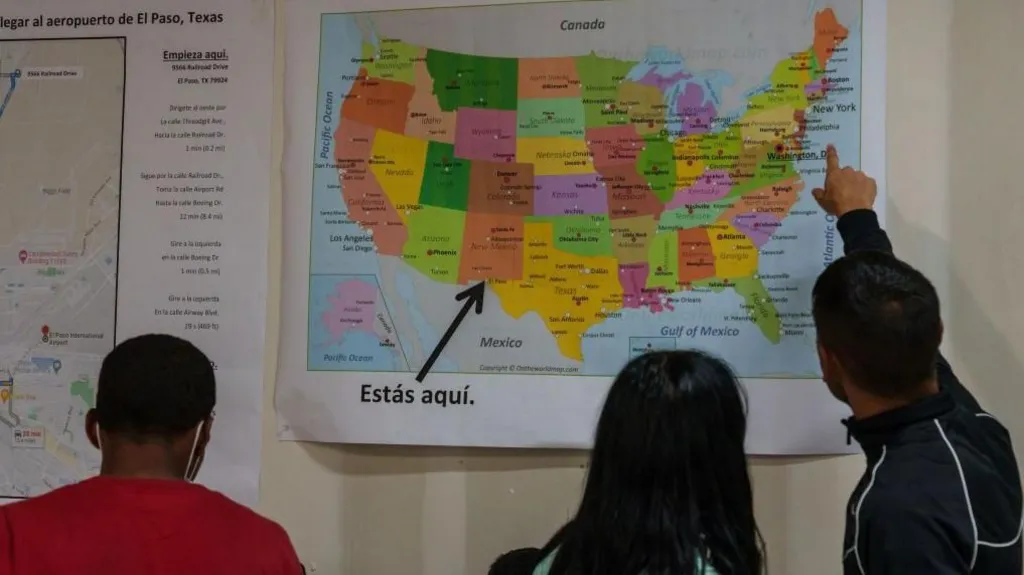
Migrants from Venezuela viewing a map of the US at a Welcome Center in El Paso, Texas in 2022  Getty Images
 
Since the catastrophic earthquake and tsunami in 2010, Haitians were permitted to live and work in the U.S. Now, that protected designation sits on the cusp of ending, and some of those involved have decided to go to Canada, much as a previous wave of Haitians chose to do, whose permits were being revoked under the first term of President Donald Trump. Under the Safe Third-Country Agreement between the U.S. and Canada, asylum seekers can be sent by Canada back to the United States in reflection of its having represented a first safe-haven prior to arriving in Canada which under the agreement is then not obligated to admit them.
 
https://media.npr.org/assets/img/2018/01/17/ap_17220759666559_wide-ebabbb90bb6b4cf5102c816f7f2381fee50dec00.jpg?s=800&c=85&f=webp

A family from Haiti approach a tent in Saint-Bernard-de-Lacolle, Quebec, stationed by Royal Canadian Mounted Police, as they haul their luggage down Roxham Road in Champlain, N.Y., last August. Charles Krupa/AP

A fresh influx of asylum seekers has no humanitarian popularity in Quebec, which has long since complained that its social services resources have been strained to the limit by years of illegal cross-border applicants for refugee status. The province, according to its immigration minister, is at full capacity for asylum seekers. His response is echoed by the leader of the Bloc Quebecois who maintains the federal government must accelerate the processing of asylum seekers so they can be distributed across the country to alleviate Quebec's burden.
 
It was announced last month by U.S. Homeland Security that it was in the process of revoking temporary status for 532,000 people from Cuba, Haiti, Nicaragua and Venezuela. They had flown to the United States at their own expense, with a financial sponsor; their temporary legal status is set to end on the 24th of April. An end to Temporary Protected Status was also announced by the Trump administration for 600,000 Venezuelans and roughly 500,000 Haitians.
 
The Canada Border Agency, in anticipation of an influx of haven seekers, began expanding the Saint-Bernard-de-Lacolle centre's intake capacity to enable expeditious processing of asylum claims "in the event of an influx". That influx has, as expected, materialized.
 
https://i.cbc.ca/ais/0d1aef4a-df66-4a10-a3e5-a8fcfa3f0a65,1744143866078/full/max/0/default.jpg?im=Crop%2Crect%3D%280%2C0%2C1180%2C663%29%3BResize%3D620
There has been a significant change in the number of asylum claims since U.S. President Donald Trump took office, specifically at the regular border crossing in Lacolle, Que., according to Canada Border Services Agency (CBSA) data obtained by Radio-Canada and CBC News. The data shows there had already been 557 asylum claims at Lacolle in the first six days of April — just three fewer than in all of January.  CBC
 
There's so many people that have been deported since Donald Trump has been in office, you know they're just scared. [People have started receiving letters from U.S. authorities saying their status has been revoked].
So, as soon as they get the letter, they're looking for ways to get out of the states.
We've seen already what's happening, I don't think they're going to wait... because currently ICE [Immigration and Customs Enforcement] is going to workplaces, to churches, going on the street. 
They intercept you and, if you are one of those, you're gone.
Frantz André, spokesman, Montreal-based group that helps undocumented migrants with asylum cases
https://smartcdn.gprod.postmedia.digital/financialpost/wp-content/uploads/2025/04/us-canada-irregular-border-crossings-were-low-in-2024-arriv.jpg?quality=90&strip=all&w=564&h=423&type=webp&sig=U5roGYGbR-heHFQIeKAEBg

Labels: , , , ,

 
()() Follow @rheytah Tweet