Ruminations

Blog dedicated primarily to randomly selected news items; comments reflecting personal perceptions

Thursday, April 16, 2026

Guard It Or Lose It -- Canadian Arctic

"These activities [Russian and Chinese] rarely trigger formal defence responses, but over time they reshape the strategic environment."
"Canada's current security architecture is not strongly equipped to counter grey-zone activity." 
"[While] Arctic ice melts at an unprecedented pace, the region is opening up. Navigation windows are getting longer, leading to increased activity by research vessels, ice-capable survey ships, cable-mapping operations, and autonomous underwater systems."
"[Russia and China] are rapidly advancing their Arctic-based drone capabilities, outpacing NATO."
Sweekriti Pathak, fellow, Macdonald-Laurier Institute think tank 
https://www.canada.ca/en/ombudsman-national-defence-forces/education-information/caf-members/career/canadian-rangers/_jcr_content/par/mwspanel/panPar/mwscolumns/colpar-1/mwsadaptiveimage/image.img.png/1734026133056.png
The Canadian government issued a February announcement of up to $40-billion investment in Arctic defence infrastructure. This is part of the Liberal government's pledge to increase defence spending to reach the level that NATO members were informed to be the latest expectation for member-states of the Western military alliance, from 2% of national GDP to a new high of 5%. Arctic defence falls into that general commitment for Canada.
 
In line with that commitment and increased military infrastructure spending to meet the target, the Canadian Armed Forces' intention is to operate in the Arctic on a more permanent basis, rather than as has been the norm to the present, only during warmer months. To that end, troops are expected to practice military operations in the frozen north during its iciest periods, and to accustom themselves to operating in sub-zero conditions on a prolonged basis.
 
https://i.cbc.ca/ais/1.7632874,1757708951000/full/max/0/default.jpg?im=Crop%2Crect%3D%280%2C0%2C4032%2C2787%29%3BResize%3D796
Canadian soldiers prepare for a surveillance mission in Pond Inlet, Nunavut, as part of the annual Operation Nanook on Sept. 6. The exercise sees the small team inserted onto a remote mountain top with no additional support, honing their survival skills for multiple days. (David Common/CBC)
 
"Canada must guard against foreign research in the Canadian Arctic and North that is dual-use -- having both research and military applications", alerted a statement by Global Affairs Canada. Canada has long neglected its Arctic geography, and but for an Indigenous battery of Northern Rangers, poorly equipped by Canada, which is dedicated to acting as security scouts guarding Canadian territory, the government has not formally made it a priority to protect its northern assets. 
 
Both Russia, which geographically has a presence in the Arctic, and China, which has not, but is preparing for shipping opportunities for the future through the fast-melting sea ice -- hitherto unused in view of winter sea ice making passage challenging -- have been aggressively pursuing their objectives in the Arctic. Russia has committed to refitting and manning elong-neglected and abandoned military bases in the Russian Arctic, stationing troops there, asserting sovereignty. 
 
https://i.abcnewsfe.com/a/89670b34-0f76-4166-9470-ca5187e311ad/arctic-gty-er-251125_1764110138930_hpMain.jpg?w=750
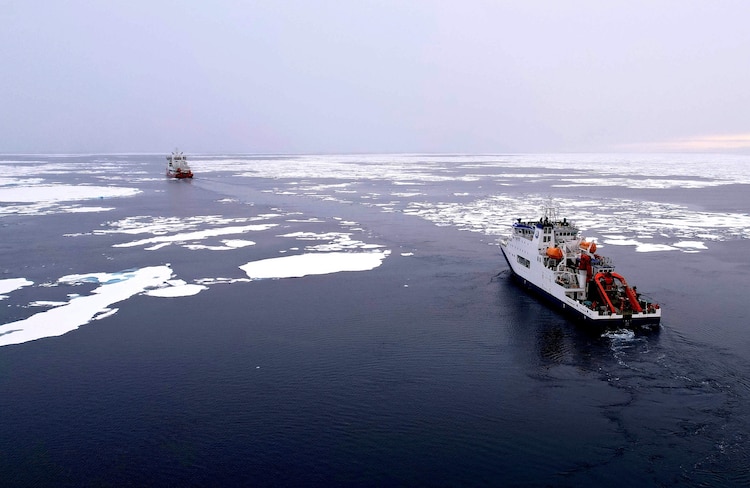
A drone photo shows China's research icebreaker Xuelong 2 breaking the ice to lead the way in the Arctic Ocean, Aug. 5, 2025.  Liu Shiping/Xinhua via Getty Images
 
Both countries have established an active and alert presence in the Arctic, on the long-held theory that absence is abandonment, and presence is a deterrent to any challengers. Their sustained presence focuses on data collection and development of infrastructure. Both Russia and China have keen interests in future exploitation possible in mining the seabed of its mineral and energy resources. Both have invested in Arctic-condition ships, capable of cutting through thick sea ice.
 
Russia has built nuclear icebreakers that go along with revitalized bases along sea lanes key to their interests, that include activities along the Northern Sea Route through Russia's Arctic coast, with a focus on extensive seabed and hydrographic surveys to identify underwater features; depth, topography and hazards in the interests of safe navigation and marine construction plans. Canada is just finally waking up to the necessity to do the same, initiated by the previous Conservative government.

https://images.jpost.com/image/upload/f_auto,fl_lossy/q_auto/c_fill,g_faces:center,h_720,w_1280/716579
The Israeli Elbit Systems Ltd. Hermes 900 unmanned aerial vehicle (UAV) flies over the airbase during a media presentation in the central Swiss town of Emmen
(photo credit: REUTERS)
 
Canada recently took possession of a sophisticated and powerful new Hermes 900 StarLiner drone, capable of multiple tasks such as monitoring the North for oil spills and surveys of ice conditions, part of the Department of National Defence plan to strengthen Canada's Arctic defences. Built by Israel's Elbit Systems, the drone is a medium-altitude, remotely piloted device with a range of over 1,400 nautical miles, equipped with radar and camera sensors. 
 
The drone is meant to fill the gaps between satellites and manned aircraft in support of maritime surveillance for oil spills, ice mapping, shipping monitoring, search and rescue, and environmental protection. Currently, the Canadian Coast Guard has in operation six icebreakers used in the Arctic from June to November to advance maritime safety and security. New icebreakers will be designed to operate during the months heretofore left untended, featuring greater icebreaking capacities. 
 
https://www.thearcticinstitute.org/wp-content/uploads/2023/03/Chinese-Coast-Guard-vessel_icy-Russian-waters-2048x908.jpg.webp
Chinese Coast Guard vessels traversing icy waters during the joint exercise with Russia in 2024. Photo: China Coast Guard
 

Labels: , , , , , ,

Sunday, May 26, 2019

The Online SuckerPunch

"We created a project just so we could capture when people are seeing these fake ads and being sucked down this rabbit hole. It's been going on for a long time."
"They've [on-line fraudsters] gotten very good at doing these things. They can make almost any email or website look authentic. You've got all these authentic-sounding terms. You've got the names and business names that are real, to trick people into believing this is good and it makes sense."
"The spoof websites are the icing on the cake."
"We conservatively estimate that we only capture five percent of reporting. Fraud is under-reported often because of stigma/shame, embarrassment, etc. and we do not have the capacity to handle all the calls or validate all the online fraud reports we receive."
"What we capture provides a snapshot of what is occurring in Canada."
Jeff Thomson, senior intelligence analyst, RCMP Canadian Anti-Fraud Centre
Image result for online fraud
ripandscam.com

"The 2018 [FBI] report shows  how prevalent these crimes are. It also shows that the financial toll is substantial and a victim can be anyone who uses a connected device."
"Awareness is one powerful tool in efforts to combat and prevent these crimes."
Donna Gregory, chief, FBI complaint centre

"In today's complex digital landscape, hackers are becoming increasingly sophisticated, which means it's becoming more difficult to tell real from fake, phishing from friendly."
Rob Fodor, chief data scientist, vice-president of fraud, Interac

"We're finding that it's increasingly difficult for criminals to steal from Canadians using old methods. They constantly evolve. They're going at it through trickery."
"[The] CRA scam [Canada Revenue Agency, case in point, where a fraudster attempts to extract money from victims, claiming to be a government tax collector]."
"Who would have thought in the past about [scam artists] using the government to try to get money from us?"
Rachel Jolicoeur, Interac
CAFC logo

The Canadian Anti-Fraud Centre is operated jointly in Canada with the RCMP and the Ontario Provincial Police and the Competition Bureau; 466 reported attempts to defraud with fake car sales ads came to their attention in 2018. Of that number, 168 people became victims of the scam, with a reported loss of close to $860,000. The schemes these fraud artists devise are so increasingly slick and believable, with the use of connections and assurances that look absolutely legitimate, there's little wonder so many people get sucked in.

And as increasingly professional as these come-ons have become, all signs point to even more robust and well-planned, completely believable schemes in the planning stages, to entice and abuse even more peoples' trust, and scam them of their money. The FBI recently released its 2018 annual Internet Crime Report with the finding that complaints at its Internet Crime Complaint Center -- designed to capture calls regarding Internet-enabled theft, fraud, and exploitation -- totalled 351,937 last year.

Those complaints led to a loss of over $2.7 billion for the people so ignominiously gulled by credulous-seeming on-line fraudsters. The FBI made good use of those statistics to re-awaken the public to the extent of the fraud, and to persuade them to increase their vigilance against being taken by a fraud artist. The agency figures that the more people are reminded of the plight being visited on the unwary with a related loss of hard-earned cash, the more dedicated people will become to protecting themselves.

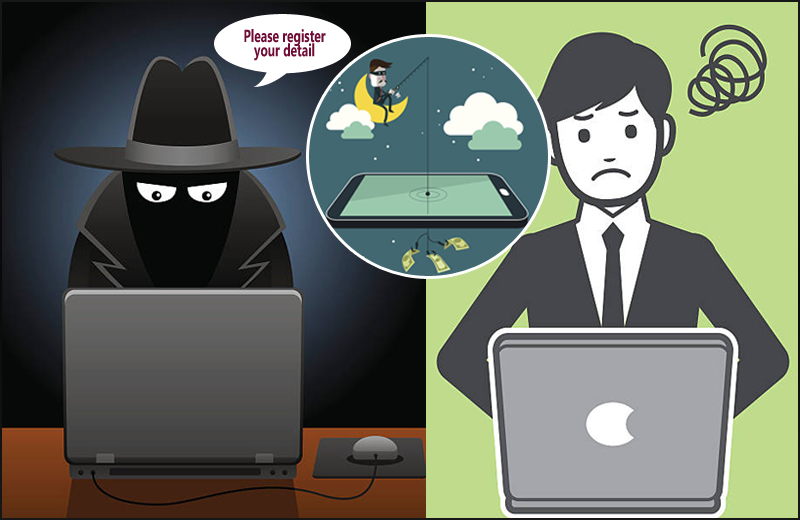
Online fraud has become so complex, according to Interac, out of 1,064 Canadians who took part in a new study, over 96 percent failed to identify online fraud on being confronted by it. Many people who took part in the study believed the most effective way to respond to fraudulent activity would be to swiftly react by shutting down their computer, or turning their Internet browser off. It does work in the immediacy of the situation when the screen is suddenly blocked and a large red notice screams that one's computer has been compromised -- call the number given, immediately.

There is so much fraud and it is on the increase simply because it is worthwhile someone's effort; the returns on the investment, so to speak, means that even if a small number of people fall prey, the amount of money they are cheated out of, makes for a rewarding enterprise from the fraud artists. A total of $97.7 million was reported stolen from Canadians linked to online fraud in 2018; an increase over the $83.3 million lost in 2017, by varying methods geared to profit the crooks.

Romance scams netted $22.5 million in 2018 from over 760 Canadians. This kind of scam with online dating, revolves around a fraud artist meeting another person online, cultivating a relationship, and eventually asking for cash. The figures don't actually reflect in total the numbers involved; in that only about five percent of all fraud is reported to police. Fraud reported to local police departments runs into a dead end.

When money is sent to someone online, ending up in another country, local police departments are stymied, so many victims fail to report the fraud, given personal issues of embarrassment or shame suffered when nothing is gained from reporting the crime, other than teaching the victim to be a little more wary next time around.

Typically, phishing messages will ask you to "update," "validate," or "confirm" your account information. They might even ask you to make a phone call. Watch out for these catch phrases: 
  • “E-mail Money Transfer Alert:  Please verify this payment information below…”
  • “It has come to our attention that your online banking profile needs to be updated as part of our continuous efforts to protect your account and reduce instances of fraud… “
  • “Dear Online Account Holder, Access To Your Account Is Currently Unavailable…”
  • “Important Service Announcement: You have 1 unread Security Message!”
  • “We regret to inform you that we had to lock your bank account access.  Call this number to restore your bank account.”
Often, the message or website includes official-looking logos and other identifying information taken directly from legitimate websites. Government, financial institutions and online payment services are common targets of brand spoofing.
http://www.rcmp-grc.gc.ca

Labels: , , ,

 
()() Follow @rheytah Tweet