Ruminations

Blog dedicated primarily to randomly selected news items; comments reflecting personal perceptions

Saturday, January 11, 2025

Nicolas Maduro: "I Come From The People"

"[Venezuela sets a] dangerous precedent [for democracies in the hemisphere]."
"[Showing that] in the 21st century, an important country in Latin America can disregard the will and sovereignty of the people and remain in a de facto government."
Carolina Jimenez Sandoval, president, Washington Office on Latin America 

"Maduro has violated the Constitution, and the sovereign will of Venezuelans expressed on July 28." "He carried out a coup d’état and crowned himself a dictator."
Venezuelan opposition leader Edmundo González, in exile in Spain

"[With his inauguration] they decided to cross the red line [and] they stomp on our constitution."
"Today, Maduro did not put the presidential band on his chest, he put it on his ankle like a shackle that would tighten more every day."
Fellow opposition leader Maria Corina Machado
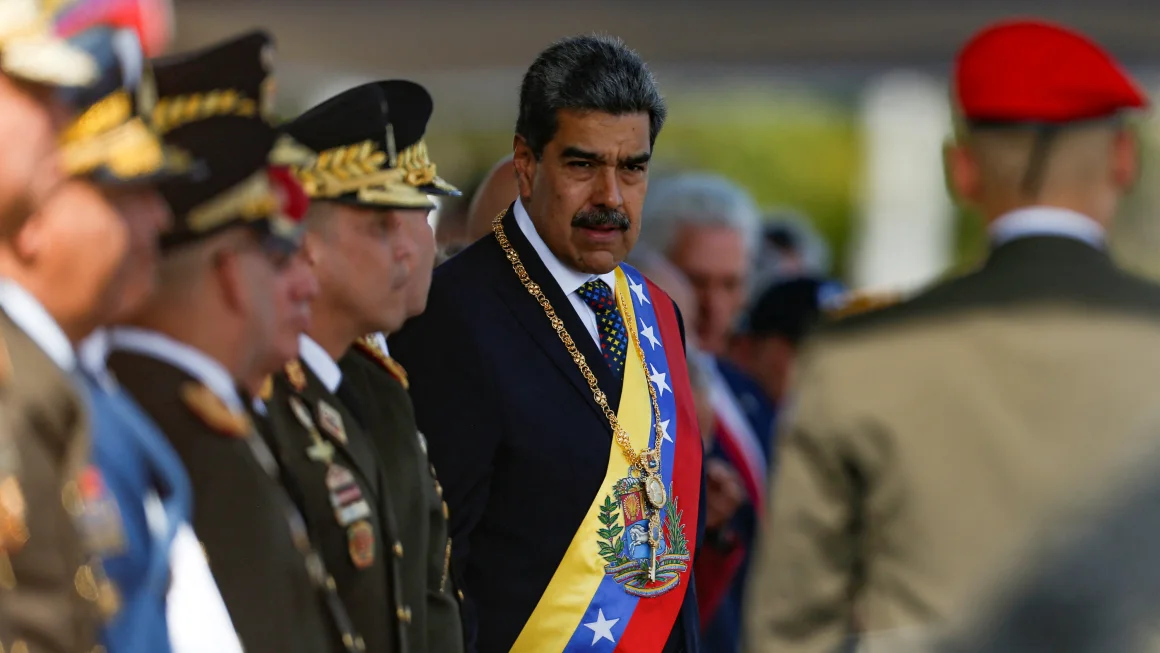
https://media.cnn.com/api/v1/images/stellar/prod/2025-01-10t185528z-862582687-rc227ca62nxw-rtrmadp-3-venezuela-politics-copy.jpg?c=16x9&q=h_653,w_1160,c_fill/f_webp

The 'man of the people' who claims he represents the will of the ordinary Venezuelan in reclaiming the presidency of the country for a third six-year term Friday, is prepared to continue the authoritarian rule that he and his predecessor, Hugo Chavez, imposed upon Venezuela, ruining its democratic nature, its economy, devastating its society, all the while claiming that their version of governance is what the people of Venezuela demanded of them, and continue to. Venezuelans who are so happy with their lot under this government that they've departed in massive numbers to find refuge elsewhere from the ruinous governance that has devastated their country.

The United States, along with a number of other countries, rejected the claim that the latest election was handily won by the sitting president, recognizing opposition candidate Edmundo Gonzalez as the true president-elect of Venezuela. Without so much as providing evidence of having won this latest sham of an election, Maduro claimed electoral victory. This election was a replay of previously fraudulent elections in the country. But for the first time the opposition was able to provide evidence of its own claim to victory.

Opposition leader Edmundo Gonzalez was forced by Maduro to go into exile. Currently, there is no indication that it would be safe for him to return to Venezuela, much less take up his duly elected position as the country's new president. Maduro's government has threatened, should he return, to detain him, having issued a $200,000 reward for his arrest. During the months leading up to the election the military aided Maduro's campaign of fear and repression. Over 1,700 political figures were arrested and remain prisoners.

Maria Corina Machado, just prior to Maduro's inauguration to a new six-year term, revealed that she had been detained briefly by "the repressive forces of the regime", upon leaving an opposition rally in Caracas. Observers spoke of the election as representing the largest electoral fraud in recent Latin American history where voting centre receipts collected by the opposition and verified by the Washington Post along with independent election observers indicate clearly that Gonzalez likely beat Maduro in a landslide.

Gonzalez vows he will return to Venezuela. The Biden administration announced it plans to continue to place pressure on the Maduro government with new sanctions and other allied measures. The bounty offered for information leading to Maduro's arrest and conviction for U.S. indictments on conspiracy and narcotics charges increased from its current $15 million to $25 million. 
 
"I come from the people. The power I represent belongs to the people and I owe it to the people", Maduro said during his third-term inauguration.

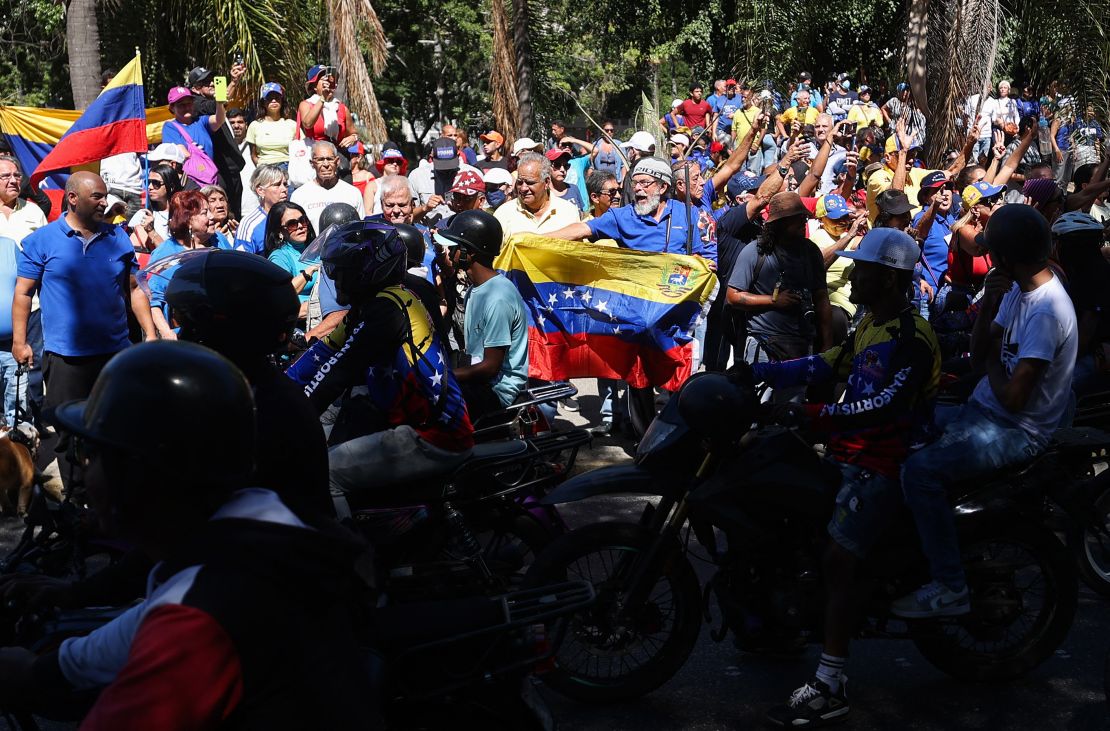
Anti-government demonstrators shout slogans as supporters of Venezuelan President Nicolas Maduro ride past on motorcycles during an opposition protest on the eve of Maduro's inauguration, in Caracas on Thursday.

Labels: , , , ,

Tuesday, February 02, 2021

COVID-19 False Certification Profiteers

"The detection of fake COVID-19 negative test certificates confirms that criminals -- be it organized crime groups or individual opportunistic scammers -- seize profitable opportunities once they arise."
"As long as travel restrictions remain in place due to the COVID-19 situation, it is highly likely that production and sales of fake test certificates will prevail."
"Given the widespread technological means available, in the form of high-quality printers and different software, fraudsters are able to produce high-quality counterfeit forged or fake documents."
Europol intelligence alert
Reuters
 
The European Union's law enforcement agency Europol recently stated that criminals are well prepared to take advantage of any opportunities presenting during this period of global pandemic destabilization to exact profit wherever they can. And one opportunity in particular has motivated people who excel in defrauding others in the complexity of their schemes to  take advantage of people's willingness to deal with them is the sale of negative test certificates.

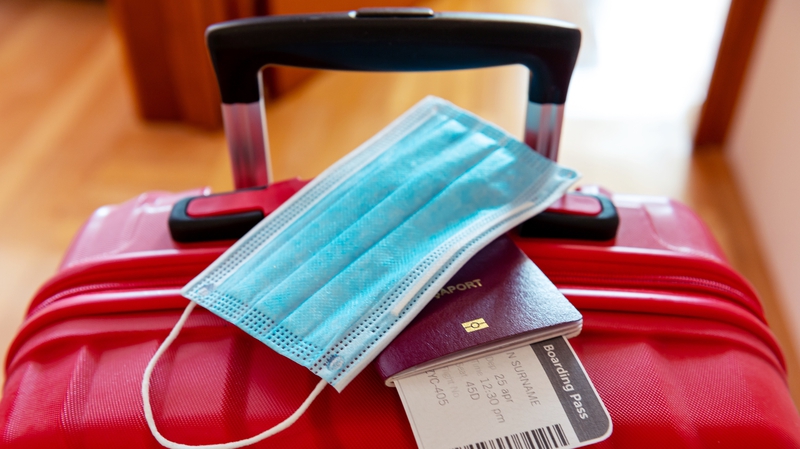
In Britain's London Luton Airport, north of London where flights take off to cities in Europe, the Middle East and North Africa, a number of those destination sites require travellers to have on hand proof of a recent negative COVID-19 test to enable entry. At the airport on January 22 a man was taken under arrest for suspected fraud by false representation. Warwickshire authorities in Britain just before Christmas announced that scammers offered fake COVID-19 tests on sale for the equivalent of $175 for a bogus certificate of negative results.
 

Europol Photograph:( Reuters )

This was a fairly sophisticated gambit, using the name of a genuine testing laboratory on the certificate. In Spain a woman was arrested when she sold false negative COVID-19 test certificates over the Internet, offered for $62. Clients, she boasted in her advertisements had successfully used her issue of certificates in their travels abroad. The name of a legitimate laboratory located in Madrid was used, leading the laboratory to complain to Policia Nacional, a federal police force in Spain. Arrested for crimes against public health, fraud and forgery and investigators began to rack down her customers.

Scammers in the Netherlands were caught selling fake test certificates priced between $75 to $100 through the social platforms WhatsApp and Snapchat, issuing fake certificates in the names of real doctors and real laboratories, with no COVID-19 tests having been carried through. Paris's Charles de Gaulle Airport, the second-busiest airport in Europe, was the site of the largest known suspected forgery ring, .           

When a passenger checked in for a flight from the Paris airport to catch a flight to Ethiopia, he was discovered using a fake certificate that declared he was clear of COVID-19. On that occasion seven people were arrested; six men, one woman, for selling certification for prices ranging from the equivalent of roughly $230 to $465. All six were charged with forgery, use of forgery and complicity in fraud.

The Europol alert was issued two days ago for the purpose of raising awareness of the schemes and to encourage member agencies to alert their counterparts to the presence of other activities related to fake COVID testing documentation.

Europol has said several cases of such fraudulent certificates being sold to travellers have already emerged

Labels: , , ,

Sunday, December 20, 2020

Russian Roulette by Any Other Means

Experts said that many of the vaccines for sale on the dark web were either fake or would never be shipped.
"There will always be a market for people who wouldn't necessarily have access to that medicine and wanted to protect themselves and their families."
"There will be, certainly globally, a lot of money that can be made by criminals."
Amy Shortman, pharmaceutical logistics expert, Overhaul, supply chain security

"We need to tell people at the vaccine centres that they carry gold."
"Criminals don't see a vaccine load, they see money."
Thorsten Neumann, head, Tapa, European arm supply chain security association

"Pharmaceutical manufacturers are already spending a lot of time to make sure their products and their supply chain is secure."
"I don't think there is any other industry on the globe that is as prepared for something like this."
Chuck Forsaith, head, Pharmaceutical Cargo Security Coalition, industry association
"We have seen very targeted (cyber) attacks related to the vaccine. The health sector is not very mature in terms of cyber-security", according to Evangelos Ouzounis, head of the secure infrastructure unit at Enisa, the EU Agency for Cyber-security. One opinion based on experience and the reality of the situation, the other quick to run to defence of the industry's capability of protecting their products from the grasp of a criminal element. So, which is it? where is the biased assurance and where the reality-based acknowledgement?
 
Report: Purported COVID-19 Vaccines Hit Dark Web
The most secure government and their agencies sites for whom a firewall of restricted entry has been relied upon for its assurances of being impervious to cyberattacks has most recently been stunned by the revelation that they have been infiltrated by ingenious, determined and malicious state actors and have been oblivious to the fact that high security data of all kinds have been siphoned away for the scrutiny of unauthorized actors putting the lie to their presumed attention to securing high-value data away from hostile eyes.
 
Yet where there is a market there will be painstaking efforts to satisfy the demands of that market, if not legally, then by illegal means in the great interests of profiteers. An expert points out the lapse in security within the health sector, yet even elite government agencies for whom secrecy is of the highest order have failed, spectacularly, to prevent infiltration through cyberleak safety. While those within society deemed at highest risk of succumbing to COV-19 are fast-tracked for vaccine relief, other sectors of society feeling equally at risk, will seek any means by which they too can be prioritized for inoculation, even if through their own resourcefulness.
 
And for many, in what they regard obviously as a life-or-death situation, compelled by a need to protect themselves and their loved ones, it is worthwhile to seek out any method even illegitimate and potentially harmful means, for the legitimate desire to arm themselves against a dread disease playing havoc in the global community of humanity. 

The dark web may seem like a sinister place to many, where traffic in the worst passions of a segment of sociopathic tendencies can be satisfied. But it is also a place of last resort for the desperate who will recklessly seek a source to supply them with forbidden elements of human gratification, from child porn to illicit recreational drugs and now to a new drug formula that will act as a vaccine against COVID-19. 
 
Sellers advertisement on DeepPaste
Seller's Advertisement on Deep Paste
 
Cybersecurity groups have tracked offers on the dark web for such vaccines in response to the anxiety of the public fearful of contracting the disease. Shipping costs and methods are suggested, with "stealth" delivery and special packaging. Vendors claiming their product is derived from known sources, safe and effective. Many of the vaccines purportedly for sale on the dark web, according to experts are fake to begin with, and the product, once paid for, may never be delivered.

The issue is also that people suffering from a high degree of anxiety over personal safety, hoping to avoid infection will go to any ends to acquire what they believe will help to save their lives. Without due consideration with respect to what exactly it is they're hoping to receive and achieve. There are no guarantees that the 'vaccine' they plan to use is either effective or safe for human use. It is also an unknown whether vendors have somehow gained access to authentic products.

What experts in the field do agree upon, however, is that these underground offers for the sale of purported COVID vaccines will proliferate the longer the world community has to wait for mass inoculation. Vaccine shortages, accidents in delivery and distribution, handling and storage will all add to the massive work involved in administering the vaccine to the general public once the initial vaccines have been utilized in inoculating the identified high-risk candidates.

In December, Interpol and Europol gave warning of a likely "onslaught" of criminal activity with links to COVID-19 vaccines, citing online fraud and cyber crime, to theft and the sale of fake or substandard doses. Illegally refilled empty vaccine vials could be offered by vendors whose object is to gain profit, not ensure that safe substances will be injected intra-muscularly in desperate people hoping to avoid COVID-19. This is a public health threat of significant proportions "ineffective at best, toxic at worst".
 
Pfizer vial
The arrival of coronavirus vaccines means people have started hawking so-called "vaccines" on the Dark Web. CHRIS JACKSON/POOL/AFP via Getty Images

Labels: , , , , , ,

Sunday, May 26, 2019

The Online SuckerPunch

"We created a project just so we could capture when people are seeing these fake ads and being sucked down this rabbit hole. It's been going on for a long time."
"They've [on-line fraudsters] gotten very good at doing these things. They can make almost any email or website look authentic. You've got all these authentic-sounding terms. You've got the names and business names that are real, to trick people into believing this is good and it makes sense."
"The spoof websites are the icing on the cake."
"We conservatively estimate that we only capture five percent of reporting. Fraud is under-reported often because of stigma/shame, embarrassment, etc. and we do not have the capacity to handle all the calls or validate all the online fraud reports we receive."
"What we capture provides a snapshot of what is occurring in Canada."
Jeff Thomson, senior intelligence analyst, RCMP Canadian Anti-Fraud Centre
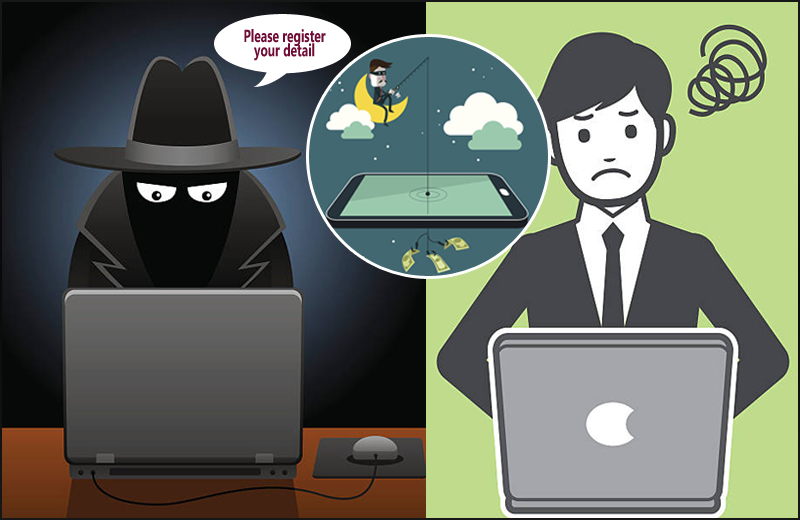
Image result for online fraud
ripandscam.com

"The 2018 [FBI] report shows  how prevalent these crimes are. It also shows that the financial toll is substantial and a victim can be anyone who uses a connected device."
"Awareness is one powerful tool in efforts to combat and prevent these crimes."
Donna Gregory, chief, FBI complaint centre

"In today's complex digital landscape, hackers are becoming increasingly sophisticated, which means it's becoming more difficult to tell real from fake, phishing from friendly."
Rob Fodor, chief data scientist, vice-president of fraud, Interac

"We're finding that it's increasingly difficult for criminals to steal from Canadians using old methods. They constantly evolve. They're going at it through trickery."
"[The] CRA scam [Canada Revenue Agency, case in point, where a fraudster attempts to extract money from victims, claiming to be a government tax collector]."
"Who would have thought in the past about [scam artists] using the government to try to get money from us?"
Rachel Jolicoeur, Interac
CAFC logo

The Canadian Anti-Fraud Centre is operated jointly in Canada with the RCMP and the Ontario Provincial Police and the Competition Bureau; 466 reported attempts to defraud with fake car sales ads came to their attention in 2018. Of that number, 168 people became victims of the scam, with a reported loss of close to $860,000. The schemes these fraud artists devise are so increasingly slick and believable, with the use of connections and assurances that look absolutely legitimate, there's little wonder so many people get sucked in.

And as increasingly professional as these come-ons have become, all signs point to even more robust and well-planned, completely believable schemes in the planning stages, to entice and abuse even more peoples' trust, and scam them of their money. The FBI recently released its 2018 annual Internet Crime Report with the finding that complaints at its Internet Crime Complaint Center -- designed to capture calls regarding Internet-enabled theft, fraud, and exploitation -- totalled 351,937 last year.

Those complaints led to a loss of over $2.7 billion for the people so ignominiously gulled by credulous-seeming on-line fraudsters. The FBI made good use of those statistics to re-awaken the public to the extent of the fraud, and to persuade them to increase their vigilance against being taken by a fraud artist. The agency figures that the more people are reminded of the plight being visited on the unwary with a related loss of hard-earned cash, the more dedicated people will become to protecting themselves.

Online fraud has become so complex, according to Interac, out of 1,064 Canadians who took part in a new study, over 96 percent failed to identify online fraud on being confronted by it. Many people who took part in the study believed the most effective way to respond to fraudulent activity would be to swiftly react by shutting down their computer, or turning their Internet browser off. It does work in the immediacy of the situation when the screen is suddenly blocked and a large red notice screams that one's computer has been compromised -- call the number given, immediately.

There is so much fraud and it is on the increase simply because it is worthwhile someone's effort; the returns on the investment, so to speak, means that even if a small number of people fall prey, the amount of money they are cheated out of, makes for a rewarding enterprise from the fraud artists. A total of $97.7 million was reported stolen from Canadians linked to online fraud in 2018; an increase over the $83.3 million lost in 2017, by varying methods geared to profit the crooks.

Romance scams netted $22.5 million in 2018 from over 760 Canadians. This kind of scam with online dating, revolves around a fraud artist meeting another person online, cultivating a relationship, and eventually asking for cash. The figures don't actually reflect in total the numbers involved; in that only about five percent of all fraud is reported to police. Fraud reported to local police departments runs into a dead end.

When money is sent to someone online, ending up in another country, local police departments are stymied, so many victims fail to report the fraud, given personal issues of embarrassment or shame suffered when nothing is gained from reporting the crime, other than teaching the victim to be a little more wary next time around.

Typically, phishing messages will ask you to "update," "validate," or "confirm" your account information. They might even ask you to make a phone call. Watch out for these catch phrases: 
  • “E-mail Money Transfer Alert:  Please verify this payment information below…”
  • “It has come to our attention that your online banking profile needs to be updated as part of our continuous efforts to protect your account and reduce instances of fraud… “
  • “Dear Online Account Holder, Access To Your Account Is Currently Unavailable…”
  • “Important Service Announcement: You have 1 unread Security Message!”
  • “We regret to inform you that we had to lock your bank account access.  Call this number to restore your bank account.”
Often, the message or website includes official-looking logos and other identifying information taken directly from legitimate websites. Government, financial institutions and online payment services are common targets of brand spoofing.
http://www.rcmp-grc.gc.ca

Labels: , , ,

Tuesday, October 16, 2018

The Penalties for Defrauding and Victimizing an Elderly Woman?

"[The lawyer's actions] were a direct infringement of Mrs. Piela's fundamental rights."
"She was deprived of her freedom, forced to leave her home and taken by force into a private seniors' residence."
Quebec Bar Association, disciplinary committee

"[The subsequent medical report found] that she was totally capable of taking care of herself, she had an excellent memory, [and] she didn't have Alzheimer's."
"The police officers came to the house, they entered by the back door, so she started to scream and so the police officers called an ambulance and covered her mouth."
Igor Dogaru,lawyer for Veronika Piela, 94
Veronika Piela, 92, in December 2016. She says people took control of her life with a forged mandate and had her placed into a residence with no access to a phone or visitors. Phil Carpenter / Montreal Gazette

Imagine you've reached beyond 90 years of life, are a capable individual with a home of your own and manage all your own affairs. Age has done nothing to impair your memory, your facility with looking after yourself. You value your independence, and treasure your lifestyle, including your enjoyment in continuing to live in your home. You have a healthy bank account and decide to advertise for someone to come in from time to time to help manage some of the aspects of living independently, so you hire a woman and trust her and then everything goes wrong.

Veronika Piela who had immigrated to Canada after the Second World War, was most comfortable speaking Polish or Ukrainian. While she was still physically active, her knees were becoming a problem getting around, and she needed some help. She knew someone from the church she attended, and it was that person's daughter, in her 50s, whom she hired for general help in 2013. She paid Anita Obodzinski to help in her apartment, a bit of cleaning, shopping for groceries, feeding the cats. With no relatives close by much less children of her own, she relied on this woman to aid in her independence.
Anita Obodzinski prepared a mandate that gave her control of Veronika Piela’s personal protection and belongings if Piela were ever to become incapacitated. She later claimed she was Piela’s niece.

One day when she discovered money was missing, Veronika confronted Anita and dismissed her, informing the younger woman her services were no longer required. Six months passed, when suddenly Anita appeared at her apartment, accompanied by her husband ArthurTrzciakowski, demanding that she sign some papers, and she refused. The two rough-handled the elderly woman, who sustained cuts to her arms, insisting she sign the documents, until she relented: "I said 'Please, take everything. Please, leave me alone. Leave me alive. I need that'."

As soon as the two left, Veronika called the only two people she knew well in Montreal; her pastor and a notary, who referred her to lawyer Igor Dogaru who responded by sending a formal notice for Obodzinski to refrain from contacting her former employer at any future time. Unknown to both was that Obodzinski had prepared a mandate to give her control of Piela's personal protection and belongings should Piela ever become incapacitated, claiming she was Piela's niece, in a later affidavit.

She then proceeded to hire a social worker, Alissa Kerner, who just happens to be lawyer Gelber's wife. and advised her to prepare a psychosocial report, to state that Piela was incapable of looking to her affairs, impaired by ill health, both physical and psychological, which would accompany a medical report by Dr. Lindsay Goldsmith stating that Piela suffered from Alzheimer's disease. Obodzinski's plan was to have Piela declared mentally unfit to result in Obodzinski being placed in charge of Piela's affairs.

The report claimed Piela not only had irreversible Alzheimer's and dementia such that she was unable to take personal care of herself, was living in squalid conditions with cats, and that alcohol abuse made it additionally risky for her to continue to live on her own. "Mrs. Piela is unable to express herself within reason as her memory, insight and judgment are all severely impaired", wrote private social worker Alissa Kerner in her psychosocial report. Gelber, holding Piela's savings in trust, transferred $100,000 from Piela's account to Obodzinski.

The disciplinary committee of the Quebec Bar Association found that lawyer Charles Gelber, in acting for Obodzinski hadn't bothered to inform Piela or her lawyer that a court judgement had declared her legally incompetent. It found as well that he had failed to advise Igor Dogaru, lawyer for Piela that a request had been made to remove Piela from her home and into a residence for seniors. As well, Gelber's action in transferring substantial sums of Piela's savings to Obodzinski was clearly a criminal act, since reimbursed.

Obodzinski and her husband Arthur Trzciakowski both pleaded guilty in their roles plotting a scheme to defraud her former employer, with Obodzinski sentenced to two years house arrest and her husband, a conditional discharge. After pleading guilty to mischief and being unlawfully in Piela's home, Gelber's wife, social worker Alissa Kerner, received a conditional discharge, but was suspended by Quebec's order of social workers.

And the lawyer who used his legal know-how to underhandedly scheme with Piela's former employee to defraud the elderly woman who only managed to get a hearing in a court of law establishing her complete mental competence and outlining the manner in which all five people schemed to criminally defraud her -- has been suspended from practice, citing his role in forcing an elderly woman from her home by having her declared mentally unfit -- will serve an 18-month suspension after pleading guilty to seven disciplinary infractions.

A virtual slap on the wrist for all who were involved in his mendacious scheme to deprive an elderly woman of all she held dear, and take possession of her life savings in the process. A slap on the wrist for terrorizing an old woman, forcing her to live in a freezing basement where she was denied access to a telephone or any way in which she might contact the outside world. In the dead of a Montreal winter, she escaped, was found by police on a street without a coat and taken into custody. She asked for someone who could speak Polish and to that police officer described all that had occurred. The wheels of justice, as bitterly inadequate in this case as they proved to be, turned into action:
"A judge had ordered the curator to take charge of her file while the suit worked its way through the court system. It had been a long two years, but the personal documents that had been taken from her — her will, marriage papers, family photos, and more — were to be returned. A physical manifestation, of sorts, that she’s fully capable of taking care of herself."
"She’s also gotten most of her money back: Nearly $300,000 that had been transferred to the public curator from the in-trust account has been returned. Cheques for another $100,000 were sent to her last week. Another roughly $46,000 is gone, spent, and Piela’s lawyer says he is still trying to get it back. Ordered by a judge to account for the money spent from the in-trust account, Gelber wrote that $20,000 went to Obodzinski for items and services for Piela. Kerner was paid about $5,000 for her social work. Gelber was paid roughly $12,000 in legal fees. The rest went to Piela’s rent and a company to clean her apartment."
Montreal Gazette
Veronika Piela feels safe in her new residence, though her trust in people is shaken and a toll has been taken on her health.

Labels: , , , ,

Friday, May 05, 2017

Food Fraud: Adulteration, Replacement, Mislabelling

"A good fraudster is someone who technically hides very well his game. We're not supposed to discover the issue, but when it turns badly and when the fraud is done by people that have no scruples in what they are doing, it can even lead to tragic consequences."
"An important measure is beefing up traceability measures. Food ingredients are sourced from all over the planet but that doesn't mean there shouldn't be the right traceability to prevent food fraud from occurring."
Samuel Godefroy, leading expert, food risk analysis, Laval University, Quebec

"I think essentially you're dealing with the future of food."
"If you don't have trust from the consumers, it becomes very difficult to add any value and grow the food business."
"Food categories that are more vulnerable to food fraud are fish, seafood, liquids, spices, fruits, vegetables and meat products. Canada has seen its share of cases in recent months, one of the most notable ones is Mucci Farms in Ontario. The company was fined $1.5 million for selling Mexican tomatoes as a product of Canada. The company denies the labelling was intentional and faults their computer system. Other cases have emerged, mostly whistleblowers trying to give food fraud more attention. Cericola Farms, one of the largest poultry processors in the country, was in court over organic mislabelling allegations, but the case has gone quiet since October. The number of cases is adding up. The Canadian Food Inspection Agency received more than 40 complaints in 2016 and many expect that number to increase in 2017."
Sylvain Charlebois, researcher of food fraud, Dalhousie University, Halifax 

"We have to remember the people conducting the fraud are interested in making money." 
"But sometimes it's in ways that we haven't anticipated, so it's important to exchange information and make sure all the players in the system have open channels of communication in order to address this critical issue."
Aline Dimitri, deputy chief food safety officer, Canadian Food Inspection Agency
In this photo, lobsters are processed at a seafood plant in Maine. Sylvain Charlebois argues that seafood is one of the products vulnerable to 'food fraud.' Robert F. Bukaty / AP

Research undertaken by Michigan State university concluded that food fraud reached $40-billion worldwide; fraud that is inclusive of mislabelling country of origin, using 'organic' labels falsely, altering expiry dates, producing counterfeit products -- as well as adulterating or substituting ingredients. The 2008 scheme to adulterate milk powder with a chemical that produces plastic in China, caused the death of four children and made 300,000 people ill.

Instances of wood pulp discovered to be used as a 'filler' in Parmesan cheese, garlic powder 'filled' with talc, misrepresented pure virgin olive oil, the widespread problem of food fraud by unscrupulous purveyors seeking to use inferior products, adulterating pure food with inedible and sometimes dangerous ingredients represents a problem that just doesn't want to go away. And it will not, as long as those seeking to gain profit from short-cuts or the production of dangerous and inferior products go undetected.

The mislabelling of seafood with inferior, more plentiful substitutes is a common problem, occurring in Canada and the United States. A CBC Marketplace study discovered that 34 of 153 fish samples taken from grocery stores had been mislabelled, when lower-priced fish was given a higher-priced fish labelling, for obvious reasons of illicit profit to the detriment of the consumer. The Canadian Food Inspection Agency randomly checks food samples and cites non-compliance with labelling laws by food suppliers.

Some 70 instances of non-compliance with labelling laws annually over the past five years have been published on the (CFIA) Food Inspection Agency's website. And no one researching the ubiquity of food fraud feels this to be an accurate number of fraudsters; merely the number that random checks have ferreted out. Food items like olive oil, honey and maple syrup all have been found adulterated by the CFIA. Mr. Godefroy, in his capacity as a food fraud expert, recommends increased resources for those random checks.

Barcoding technology can be used in the identification of food fraud through testing the precise molecular level production of a food item, determining whether it is organic and what its geographical origin is. DNA analysis technology remains costly and slow, but Mr. Charlebois of Dalhousie University, sees a future where people could access affordable hand-held DNA analysis devices to use while in the supermarket or at home to themselves detect the existence of food fraud.

The University of Guelph, in fact, is working with the CFIA on a goal to simplify DNA analysis technology, making it more cost-effective and accessible in the near future to the general public. A good proportion of Canadians are concerned that the basic foods they purchase are not really reflected on the labels identifying their ingredients. People with specific health conditions in particular are alert to the problems inherent in food fraud, according to a survey a Dalhousie research team conduced on line.

CTV Toronto: Consumers worried about food fraud

Labels: , , ,

Sunday, September 11, 2016

"High Price for a Low Fish"

"We kept thinking we'd find a success story, a place where seafood wouldn't be mislabelled."
"Every single study that we reviewed, except for one, found seafood fraud."
"It is likely that the average consumer has eaten mislabelled fish for sure. You're getting ripped off ... you're paying a high price for a low fish."
"This report [on seafood fraud] reveals that it's a global problem. And it's not going to go away on its own."
Beth Lowell, senior campaign director, Oceana


According to the ocean conservation group Oceana, one in five seafood samples undergoing tests on a global sweep turned out to be completely other than what the menu or the packaging containing the fish claimed it to be. Over 25,000 seafood products were sampled and when the group analyzed the contents, a full twenty percent were proven to be labelled incorrectly.

The group, whose lead author was their senior campaign director, analyzed over 200 previous studies from 55 countries. One of the studies examining the situation in Italy identified that 82 percent of the 200 samples of perch, grouper and swordfish had been mislabelled. In South Africa, another study pointed out, King mackerel, known to be high in mercury content, was billed as "barracuda" and "wahoo".

And in Hong Kong, one only of 29 samples of "abalone" product was correctly identified on the label. In Southern California, two sushi chefs in Santa Monica sold endangered whale meat which they had identified as "fatty" tuna, and for their troubles they were charged with fraud, as a result. An interactive map was produced by the Oceana researchers demonstrating where cases of inauthentic fish were found.

Asian catfish which, with its white flesh is readily disguised when presented as fillets and drenched in sauce, turned out to be the most common of the impostor fish, sold in lieu of 18 types of more costly fish species including perch, cod and grouper. The group's study include DNA analyses from peer-reviewed papers, newspaper investigations and Oceana's own previous studies.

Examples were found of mislabelling practices reflecting every level of the supply chain handling seafood; the wholesaler, the importer and the retailer. Roughly 80 percent of the studies took their samples at grocery stores and restaurants, reflecting the final stage of the supply chain, resulting in retailers being found to have higher levels of mislabelling. The consumer, needless to say, remains blissfully unaware.

The researchers simply presented what they discovered, making no effort to apportion blame. They were, in fact, not certain whether food stores and restaurants deliberately make an effort to deceive clients, or whether they are themselves victims of false claims when they purchase the fish they later highlight with uncertain identities.
Linda Hughes/Shutterstock
Of the mislabelled samples, 58 percent were found to have been substituted for some types of fish that potentially might surface as health risks to consumers such as pregnant women and children. One New York grocery store was given as an example of this finding: the researchers discovered blueline tile-fish -- a species on the U.S. Food and Drug Administration's "Do Not Eat" list resulting from its high mercury content, labelled "Alaskan halibut", and alternately "red snapper".

Occasionally, substituted fish turned out to be, in reality, an endangered species. Instances occurred in Brazil where "shark" was actually fish meat from the large-tooth sawfish, critically endangered, as is highlighted by the International Union for Conservation of Nature. Stricter regulation for fish tracking through the supply chain is considered to be one way that this kind of fraud can be controlled.


Labels: , , ,

Saturday, October 31, 2015

Beware and Be Cautious

"We believe that most authors are not necessarily tricked into publishing in predatory journals; they probably submit to them well aware of the circumstances and take a calculated  risk that experts who evaluate their publication lists will not bother to check the journal credentials in detail. Hence we do not uncritically see the authors as unknowing victims."
"The universities or funding agencies in a number of countries that strongly emphasize publishing in 'international' journals for evaluating researchers, but without monitoring the quality of the journals in question, are partly responsible for the rise of this type of publishing."
From  study published in journal BMC Medicine: authors Cenyu Shen and Bo-Christer Bjork, Hanken School of Economics, Finland

"Academic fraud has reached a new level of deceit as a "predatory" journal that prints low-quality research for cash has stolen the identities of a dead doctor and the head of a Canadian science funding agency."
"Sir Richard Doll was an eminent British epidemiologist who was among the first to realize that smoking causes lung cancer. He died in 2005, aged 92. Now his photo has popped up with an altered surname -- Turner -- on the list of people who supposedly edit a shady academic journal, Journal of Spectroscopy and Molecular Physics."
Tom Spears, science journalist, Ottawa Citizen
The world wide web of the Internet with its vast store of  data interconnecting people from around the world has proven an invaluable source of communication, commercialization, connection, information-sharing and remains the foremost venue for the general public to learn and to gather information. Data is accessible to everyone, from the ordinary person looking for mundane information to scientists and academics searching for research that might prove of interest to them.

For most people, Internet searches are conducted innumerable times daily; ranging from map and location searches, to on-line market sales item listings, to verifying symptoms impacting on health. Of those categories, the third may or may not render correct data, entirely dependent on the source being used and its reliability, so it becomes obvious that caution on the part of the searcher is required to ensure that information being sourced comes from a site that can be trusted.

Researchers, specialists in various fields of science require no less vigilance in scoping out data for their reliability, for much can depend on the venues from which data is extracted. Sites identified with credentials that testify to their trustworthiness are often connected with government agencies, with recognized universities, and with journals themselves which have built their reputation over time, qualifying for recognition as sites that can be trusted.

In the great wide world of the Internet and universal connectivity, predators too recognize a wide scope of opportunities that have opened to them, since most people tend to be both trusting and gullible. Stories abound about people who have been taken advantage of, cheated, done irreparable harm because they have guilelessly trusted those who claim to be what they are not.

The world of science is no stranger to deception, to the presence of scurrilous charlatans who claim to have discovered world-shattering formulae and treatments whose application is capable of curing the most dread diseases that ruin people's health and cut short their lives. These are psychopaths with no regard for the harm they do, but who focus instead on building a reputation of trust among the naive, and in the process drain them of their financial resources, and eventually their hope.

New information is always surfacing about frauds of one type of another, and the field of academic research is no different, with new journals popping up on line frequently, distinguishing themselves as predators printing worthless research in exchange for cash payment. Academics, scholars, and most people in the fields of science are anxious to have their papers proving or disproving theories published and cited to build their reputations also fall prey in the press to publish.

It might be said that a new low has been reached with a shady academic journal titled Journal of Spectroscope and Molecular Physics which has been publishing 'research', signing them off as reliable findings of highly successful and respected scientists who hope to gain influence for their futures. Even the editorial board of the journal is comprised of faux names comprised of stolen identities of people in the field of science, still living, but unaware their names (and their reputations) have been appropriated; others the names of people who have left this mortal coil long since..

Of the ersatz editorial board of the physics journal, most listed don't reflect the field of physics research; one is a professor of chemistry at Simon Fraser University, another a hematologist in Michigan; an anthropologist in Little Rock specializing in Micronesia; and a dermatologist living in Singapore. Yet another is an obesity expert at Boston University School of Medicine. All unaware their names are being used to bolster the reputation of a false journal, as Tom Spears points out in a recent revelatory article.

The journal BMC Medicine, an authentic and trustworthy journal, has published a new study disclosing that 420,000 articles were published in 2014 in such predatory journals, a huge increase from the 53,000 published five years previously. In total, the study outlines that 8,000 predatory journals  were responsible for publishing that breathtaking number of faulty, unreliable articles.

Mainstream academic journals annually publish a likewise not-inconsiderable number of research papers: between 1.4 million to two million genuine research articles. The conclusion reached by Cenyi Shen and Bo-Christer Bjork of the Hanken School of Economics in Finland was that academics throughout Asia and Africa, widely excluded from Europe and North American journal publications, choose sometimes to publish in bogus journals.

In defending itself, an anonymous person on staff at the Journal of Spectroscopy and Molecular Physics claimed it was the victim of  website hackers who sabotaged them with incorrect data about the editorial board and the journal was unable to  remove the offending posts.

Academic publishing fraud has seen explosive growth; small operations for the most part, purloining identities of real researchers to make it appear as though theirs is an established, trustworthy endeavour. Predatory journals skip the peer review process, printing anything submitted as long as the article is one which its author is prepared to pay a handsome fee to publish.


Journal of Spectroscopy and Molecular Physics promotes a better world!

About JSMP  [from journal website]

Journal of Spectroscopy and Molecular Physics (JSMP) presents experimental and theoretical articles on all subjects relevant to spectroscopy and molecular physics and its modern applications. An international medium for the publication of some of the most significant research in the field, the Journal of Spectroscopy and Molecular Physics is an invaluable resource for astrophysicists, chemists, physicists, engineers, and others involved in molecular spectroscopy research and practice.
The Journal of Spectroscopy and Molecular Physics (JSMP) is a peer reviewed journal of high quality devoted to the publication of original research papers from applied physics and their broad range of applications. JSMP is sponsored and published by the European Society for Applied Spectroscopy (E.S.A.S.).

Our Work

JSMP publishes quality original research papers, comprehensive review articles, survey articles, book reviews, dissertation abstracts in sputtering science and its applications in the broadest sense. It is intended that the journal may act as an interdisciplinary forum for Spectroscopy and Molecular Physics and their technologies. Innovative applications and material that brings together diverse areas of spectroscopy science and molecular physics are particularly welcome. Review articles in selected areas are published from time to time. It aims to disseminate knowledge; provide a learned reference in the field; and establish channels of communication between academic and research experts, policy makers and executives in industry, commerce and investment institutions.
Feature Articles
It is planned to have several peer reviewed Feature articles in the Journal of Spectroscopy and Molecular Physicseach year. These articles will overview areas of particular significance in molecular spectroscopy. They may review and consolidate an area of theoretical development or a collection of experimental data, in each case offering some new insights. The articles may also summarize the present status of a rapidly developing and/or evolving field. All the articles should serve as introductions to areas of spectroscopy other than one's specialty and should be particularly valuable to students entering the field.
Feature articles will be solicited by invitation of the Editor. However, the Editor invites suggestions, with a reasonable level of detail, about topics that could be of interest. Self suggestions by potential authors are particularly encouraged.

Labels: , , ,

 
()() Follow @rheytah Tweet