Ruminations

Blog dedicated primarily to randomly selected news items; comments reflecting personal perceptions

Saturday, February 26, 2022

Kyiv, Fighting Back

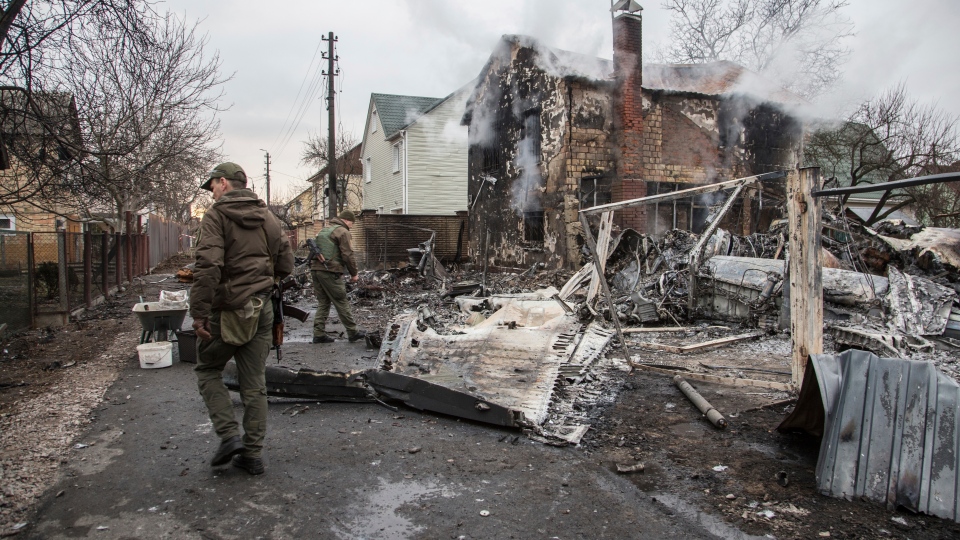
Kyiv damage
Ukrainian servicemen walk at fragments of a downed aircraft seen in in Kyiv, Ukraine, Friday, Feb. 25, 2022. It was unclear what aircraft crashed and what brought it down amid the Russian invasion in Ukraine Russia is pressing its invasion of Ukraine to the outskirts of the capital after unleashing airstrikes on cities and military bases and sending in troops and tanks from three sides. (AP Photo/Oleksandr Ratushniak)
"I couldn't imagine this would happen. We are a war with Russia for eight years already, but this? It's insane.:
"I think we will go to Poland. I already have friends there, so I will be fine. If we can make it in, that is." 
Young Ukrainian woman, name withheld, Kyiv, Ukraine

"I knew something bad was coming, ever since Putin recognized [the breakaway Donetsk and Luhansk People's Republics] on Monday."
"But to wake up to Russian missiles was something else."
"I will go and make Molotov cocktails. I want to fight them. I went to the recruitment office today, but they said they wee only taking veterans [for active duty], so I decided on this."
Anya, 25-year-old designer, Kyiv   
 
"Yesterday I woke up from the noise of explosions, I saw flash fires. It was scary."  
"I feel very, very, very angry because it's not a normal situation. It's my country, it's my land, it's my city. And now all of us, all of Ukrainians are under attack. Multiple cities are under attack."  
"All the sanctions are good, but it's not enough. This war is not about only Ukraine and our independence and safety. We are a shield for you - Europe and the world."
Ksenia, resident of Kyiv
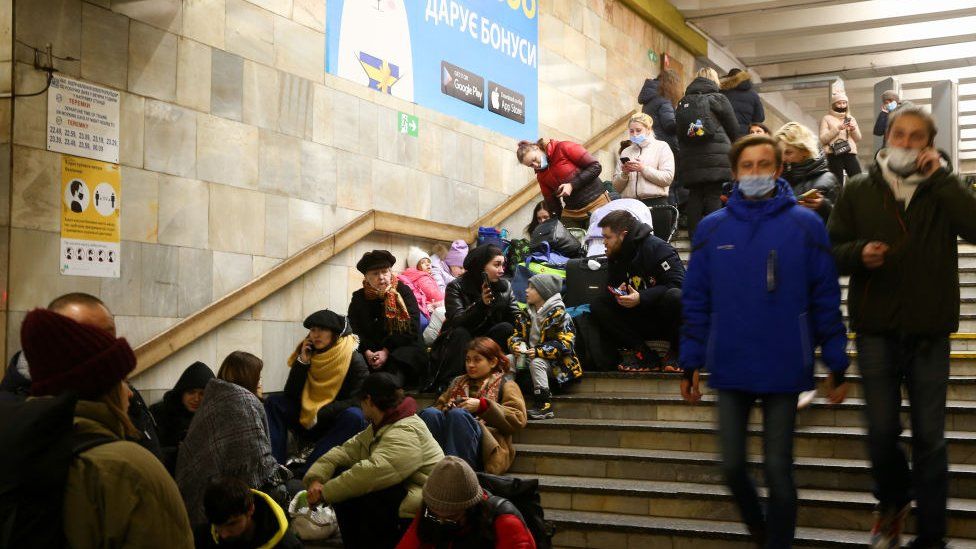
Residents seeking shelter in a metro station
Kyiv residents seek shelter in a metro station after being urged by air sirens to find safety  Anadolu Agency
 
Reports emerged on Friday, the second day of Russia's invasion of Ukraine, that Russian special forces had entered the city, some disguised in Ukrainian uniforms, engaged in a scheme directed by Vladimir Putin to put a quick end to the war by storming the government to take prisoner or kill Ukrainian President Volodymyr Zelensky and others governing the country along with him. That rumour was circulating mid-morning.

By early evening President Zelensky was on the streets of Kyiv, making himself very present, very visible, even as a disinformation rumour began spreading that he had left the country, taken up the offer proffered by the Biden Administration in the U.S., to have American military agents spirit him to safety. He made it be known that he planned to stay right there, along with Ukraine's soldiers, "fighting for our independence". 

Earlier in the day, automatic gunfire rang out in the city; bursts of small arms firing intermittently that could be heard from Ukraine's capital city centre. Air raid sirens sounded regularly throughout the day in response to the threat of Russian bombing raids, sending the city's residents to area air raid bunkers. Ironically, one of those bunkers is a metro station built during the Soviet era to withstand  nuclear attack.
 
On Friday, reports circulated that 50,000 Ukrainians had fled to Poland. Its border was jammed with refugees. Ukraine authorities had taken steps to intercept any vehicles with Ukrainian male civilians over the age of 18 and under 60, to stop them from leaving, to encourage them to enlist in service to their country, to help fight off the attackers. Authorities in Ukraine urged citizens to take up arms in defence of the capital. 

Automatic rifles would be available to anyone wanting to make use of them, and by late Friday 18,000 had been distributed. Other measures were circulating images explaining how Molotov cocktails could be produced; improvised explosives made by filling a bottle with oil and gasoline. Another touch of bitter irony, since the improvised explosive devices were a brainchild of a 1930s-era Russian general.

Older residents of the city were a trifle sanguine about the situation: "These Russians can't do anything to us. I survived the Soviet Union, I'll survive this, too", said one elderly resident. She had no plans to leave the city. "And where would I go? I'll stay right here", she laughed. "A few weeks in a shelter is easy enough."

From both the north and east, Russian armoured columns are closing in on Kyiv. To slow down their progress, Ukrainian forces have been detonating bridges. The city's thermal power station became victim to a Russian hit. As night fell on Friday, men with Kalashnikov assault rifles were on alert, guarding the metro shelters from the potential threat of Russian infiltration.

"Putin and his thugs can try to take Kyiv", said one of the guards holding a rifle. "Let them see how they will manage against three million of us." The piercing sound of intermittent air raid missiles forming the background.
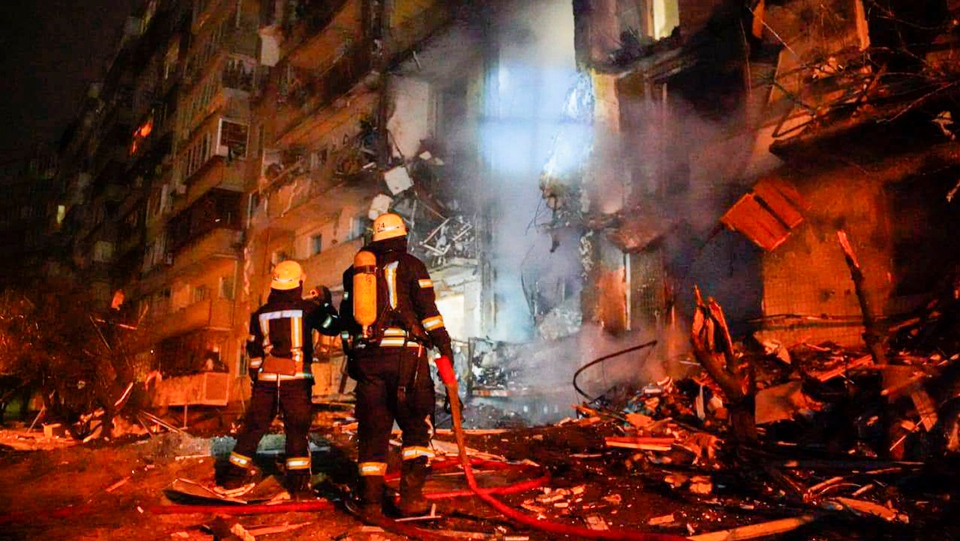
Kyiv damage
Firefighters inspect damage at a building following a rocket attack on the city of Kyiv, Ukraine, Friday, Feb. 25, 2022. (Ukrainian Police Department Press Service via AP)

Labels: , , , ,

Friday, February 25, 2022

Hint: We Have a Nuclear Arsenal

"Whoever tries to hinder us ... should know that Russia's response will be immediate. And it will lead  you to such consequences that you have never encountered in your history."
"As for military affairs, even after the dissolution of the USSR and losing a considerable part of its capabilities, today's Russia remains one of the most powerful nuclear states."
"Moreover, it has a certain advantage in several cutting-edge weapons. In this context, there should be no doubt for anyone that any potential aggressor will face defeat and ominous consequences should it directly attack our country."
Russian President Vladimir Putin
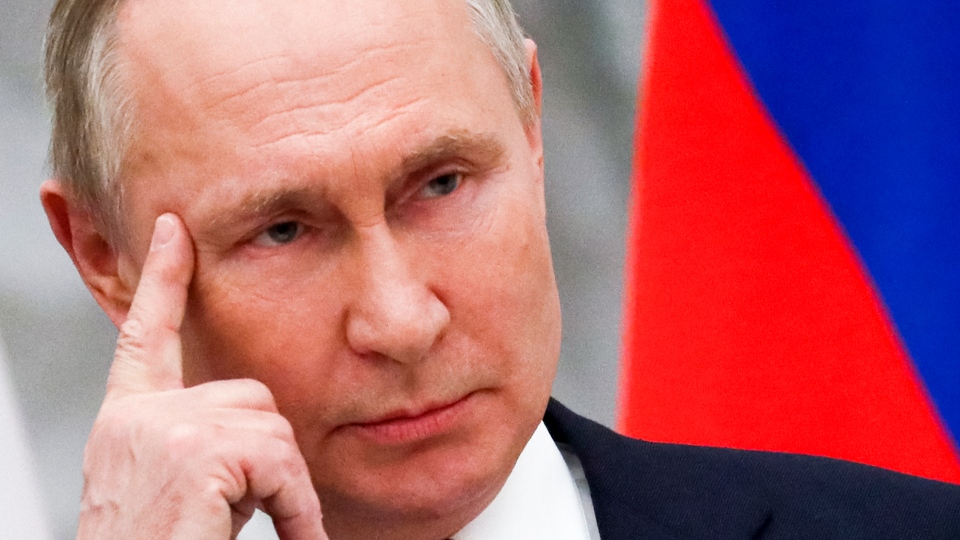
Putin
Russian President Vladimir Putin listens to a journalist's question during a joint news conference with Hungary's Prime Minister Viktor Orban following their talks in the Kremlin in Moscow, Russia, Tuesday, Feb. 1, 2022. (Yuri Kochetkov/Pool Photo via AP)
"It's a full-scale invasion of a type we haven't seen on European soil since the invasion of Poland by Nazi Germany in 1939."
It's totally unprovoked, like in 1939, with a very similar narrative: That the Poles don't deserve to have a state or to even be a nation."
"[Putin signalled his intention for days] using obscene language like the 'de-nazification' of Ukraine. What is colonialism if not the pretense that the people cannot govern themselves? That's exactly what Putin is telling us: That Ukrainians are incapable of governing themselves. It's bone-chilling to hear that."
"Short term, sanctions will not stop the war. The Russians are  hoping for a quick war, but we have plenty of examples of course, in world history of quick wars that became less quick. Then the impact of sanctions could be significant because it's very expensive to wage a full-scale war."
Dominique Arel, Associate Professor of Political Science, Chair of Ukrainian Studies, University of Ottawa
How full-scale? Russian soldiers and tanks approaching Ukraine's second city, Kharkiv mere hours after the Russian military was given the signal Thursday before the crack of dawn to advance and begin their full-out assault on Ukraine. It took only hours for the Russian defence ministry to claim that 74 military facilities, 11 airfields and 18 radar stations for anti-aircraft batteries had been destroyed by heavy and medium bombers. 

Vladimir Putin delivered an address to his nation, just before signalling the start of the invasion, speaking of the 'demilitarization' and 'de-nazification' of Ukraine. A mission statement beyond ludicrous in his bellicose slander of an eastern European nation that has steadfastly democratized and grown closer to the shared values of the West, moving steadily out of the orbit of Russia, and in the process infuriating the Russian president as it attempted time and again to gain acceptance into NATO.

Efforts expended by Ukrainian President Volodymyr Zelensky foiled by the very reality that Russia bristled with fury with each successive attempt, leading NATO to exercise its judgement to forestall those attempts. Neither NATO in general or any of its members relish the thought of diplomatically, much less militarily, tangling with Putin's Russia. Of the former eastern European countries that had been commandeered into the USSR, and are now part of NATO, none was seen as so fiercely dominated by Russia as Ukraine.

Ground troops crossed into Ukraine in a three-pronged attack, from the north; from the east through Donetsk, Luhansk, Kharkiv and Sumy; and from Crimea in the south. Tanks were deployed, helicopters and jets flooded across the border into Ukraine, in a carefully planned invasion which saw missiles raining down on cities as the killing machine initiated and fierce fighting began, Ukraine defiant and determined to defend itself and its citizens.
 
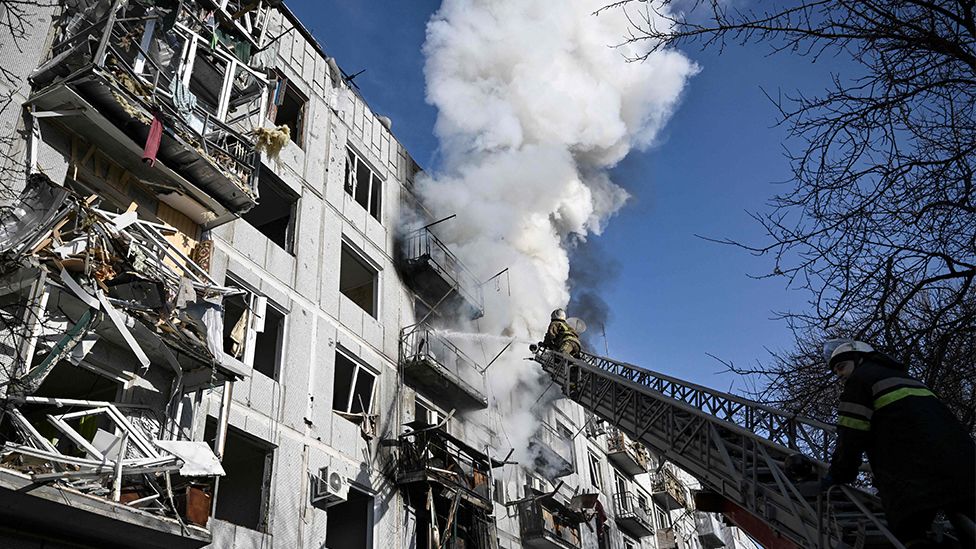
Firefighters working on a building in Chuguiv near Karkhiv
Firefighters work on a building in Chuguiv   Getty Images

By the end of the first day of the invasion an estimated 100,000 civilians had fled by train, by bus, by private vehicles, crowding  highways desperate to clear away from the combat zones. Ukraine's neighbours are prepared to give haven to Ukrainian refugees. A strategic military airfield outside Kyiv is in Russian hands. Vladimir Putin's goal is to remove the democratically elected government to re-install a Moscow-appointed replacement.
"What we're seeing right now is tantamount to Germany's invasion of Poland in 1939. And you do not respond by adding 60 new people to the sanctions list. This is at the point where the response has to be using every lever at our disposal to turn [Russia] into a self-ghettoized pariah state."
"We should be looking at things like international travel bans. 'You're travelling on a Russian passport? Nope. Sorry. Turn around and go home'. These are the kind of things that would actually start to hurt."
"This is not just a Ukraine issue. Ukraine just happens to be the human sacrifice standing between Russia and the rest of the old Eastern Bloc that Vladimir Putin also laments losing."
"There's no credible reason to think he's going to stop at Ukraine. And those next countries are NATO members, so, at a certain point, if this continues to escalate, we will have an Article 4 responsibility [invoked by NATO when a member country's security is threatened]."
"No one wants it to get to that point. But no one wanted it to get to this point, either."
Yaroslav Baran, managing principal, Earnscliffe Strategies think tank, Ottawa


Labels: , , , ,

Wednesday, July 29, 2020

Answering the Call to Patriotic Duty : World War II

Ottawa -- July 28, 2020 -- Eva Konopacki in Minto Park, Tuesday July 28, 2020. ASHLEY FRASER, POSTMEDIA
Eva Konopacki . Ashley Fraser/Postmedia
"At my age, you remember  your younger years better than the present. My memories from that time [1944] are quite sharp."
"We were waiting for that day because our underground activities were all directed to that moment, when we throw out the Germans. I was Polish, and everyone was taking risks. Everyone was engaged, it was a national thing."
"The [commanding] officer thought it's so dangerous that he cannot order anyone to do it [make personal contact with trapped/besieged soldiers]. I knew this place very well. I was restless. I liked action so I just said, 'I'll go'."
"Death became our close companion."
"War, it marks you for life. But, when you put your life on the scale, you can be proud of that."
Eva Poninska Konopacki, 94, Ottawa resident, retired schoolteacher
This is a woman who has seen a lot, had unusual experiences at a time of high danger and stress, when survival was never assured, who chose to do her part to help her country surmount the most dreadful existential difficulties at a time of war and occupation. She emigrated to Canada ten years after her courageous participation in a peoples' struggle to free itself from German occupation during World War Two, moving to Montreal from Trinidad, where she lived for several years, teaching high school.

In Canada, she met her husband, Thaddeus Konopacki, himself a decorated veteran of the 1944 Warsaw Uprising, whom she hadn't known in Poland, but found in Canada, post-war. While her husband was a professional architect, Eva Konopacki was a professional teacher. The couple had four daughters, whom their mother chose to raise as a housewife and mother. She returned to the teaching profession eventually and spent two decades teaching high school at the Ottawa Catholic School Board, while simultaneously mounting a career as an artist.

In 1944 however, as an 18-year-old she was herself a high school student, and simultaneously a soldier in the Polish Home Army -- the largest underground resistance movement in the country. An uprising against German occupying forces was launched on August 1, 1944 on instructions from the Polish government-in-exile, just as the Soviet Red Army was in the process of advancing toward Warsaw and the German military meant to stop their advance at the Vistula River on the outskirts of Warsaw.

Polish slave labour had been used to build defensive fortifications there, and it was the intention of the Warsaw Uprising to deny that opportunity to the Germans, and to impede the arrival of the Russians intending to bring communism under Soviet rule to Poland. The Home Army boasted 50,000 trained insurgents who were able to capture much of Warsaw in the first three days of the uprising, but in the end were no match for the reinforcements brought in by the German military even as planes and artillery units bombarded their positions backed by tanks and heavy machine guns, enabling the German forces to regain territory.

The Polish resistance dug trenches connecting buildings, and erected barricades against tank incursions while Russian forces restricted themselves to the Vistula River, prepared to wait out the insurgency against the German positions before involving themselves. While the Russians -- at that time part of the Allied response to the Axis forces they were once aligned with -- failed to offer air or ground support while fighting raged within Warsaw, the Allies themselves launched an airlift re-supplying the Polish resistance forces.

Based in Italy, the British-led Warsaw Airlift failed, as a reflection of the small payloads and the inaccuracy of the drop sites, where the aircraft flew long distances with no fighter support making the supply planes vulnerable to attack, resulting in over 300 Allied airmen perishing in the effort, Canadians included. For the resistance fighters, food and ammunition became scarce and the city was left without water or electricity. So many phone lines were damaged that Eva Konopacki's commanding officer decided on a course to use couriers in communication with other fighting units.

As a volunteer, Konopacki travelled through the war-torn city delivering messages, serving as a guide on nighttime missions to ammunition depots. Resistance fighters were using a fortified convent as a bulwark against German forces. By later September the convent came under assault, and an artillery shell collapsed a portion of the building and the communication line was severed. Eva Konopacki volunteered her services so that under fire she crawled through a tench to reach the convent's entrance, a gap in the foundation.

Eva Poninska Konopacki was 18 years old and a soldier in the Polish Home Army when it launched a valiant but doomed campaign to oust the Germans from Warsaw on Aug. 1, 1944. Her heroism was rewarded with one of Poland¹s highest military honours.  Photo courtesy of the Konopacki family.
Eva Poninska Konopacki . Konopacki family photo
Within she found many dead and wounded soldiers. Returning to her commander she reported on the need for medical supplies and ammunition, and was again sent to deliver the message to those left in the convent to retreat. When she made her way back, she discovered what was left of the compound smoke-filled and silent. "I realized there was no one there". They had already retreated. She ventured toward another building adjacent, to discover two wounded soldiers in an abandoned coal cellar. Finding a stretcher and a nurse, they managed between them to evacuate the men to safety.

Eventually, the Home Army had no option but to surrender, laying down their arms on October 2. "We were terribly depressed, devastated", she recalled. Later, she was recognized for her part during the resistance and uprising, receiving the Silver Order of the Virtuiti Militari for "valour in the face of the enemy", induction. Up to 200,000 people were estimated to have died during the two-month uprising, most of them civilians. The city's 650,000 inhabitants were evicted and the Germans levelled what remained of Warsaw. By January 1945 the Soviets took possession of the empty ruins.


Labels: , , ,

Saturday, May 16, 2020

The Louvre, The World's Premier Showplace of Antiquity

"If our victorious armies penetrate into Italy, then the seizure of the Apollo Belvedere and the Farnese Hercules would be the most brilliant conquest."
"It is Greece that decorated Rome: but should the masterpieces of the Greek republics adorn a country of slaves?"
"The French Republic ought to be their ultimate resting place."
Abbe Gregoire, Catholic priest, revolutionist, 1794

"Belvedere of the Vatican where, for three centuries, it won the admiration of the Universe."
"Thereupon a hero, guided by victory, came to remove it and to place it forever beside the banks of the Seine."
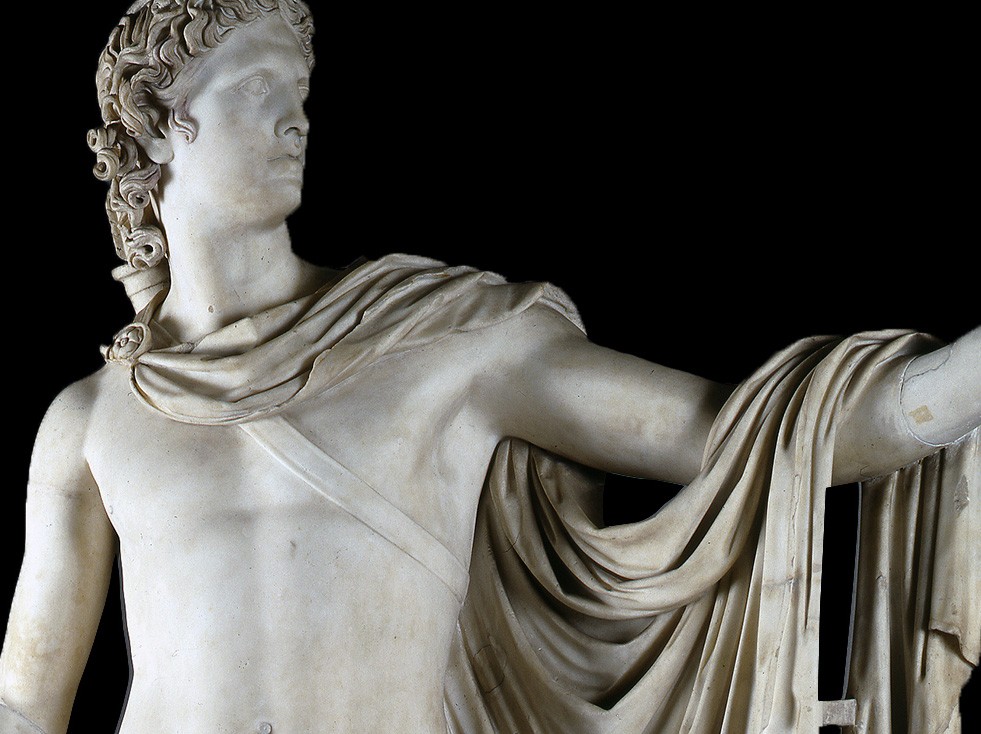
Louvre label for the Apollo Belvedere
Belvedere Apollo

The Louvre, that repository of some of the world's most priceless art treasures, a treasure-house extraordinaire, the pride of Paris and the wonder of the world where an assemblage of the world's most renowned painters' and sculptures' masterworks hang  and sit resplendently on gallery walls and pedestals where visitors view each in awe of the transcendent artistry of genius that depicted the sacred art of Christianity. The building itself absent additions, is a masterpiece of Renaissance architecture that borrows from Greek and Roman architecture, the ultimate in sublime classical design structure.

Can a whisper of shame blemish that grand structure, its administration, its heritage value, its remarkable collections, its reputation as the leading museum of antiquity and art gallery of universal distinction in the world? Yes, evidently it can, for there are such whispers, well grounded in history.
In the 1790s, the Louvre was already assuming its imperious role as the depository of the world's most elegant, famous and priceless artefacts. It employed a very special art-collection agency to do its bidding.

Over 13,000 works of art in revolutionary France were taken into possession on behalf of the Republic, from the ownership estates of 93 French aristocrats. Labels on those pieces of timeless art reflect the temper of the times: saisie revolutionnaire ... revolutionary confiscation. Looting, in another vernacular of the culture of the pillage of righteous victory. Just as the French army overran Europe, looting everywhere, returning with treasures from abroad to be placed where the Republic thought it belonged; the galleries of the Louvre.

The Immaculate Conception of the Venerables by Bartolomé Esteban Murillo, circa 1678, looted from Seville by Marshal Soult in 1810. Returned to Spain in 1941, it resides in the Prado Museum in Madrid.
Immaculate Conception of the Venerables, Bartolomé Esteban Murillo, 1678

As Napoleon's army marched across Europe, advanced into Egypt and the Levant, grand seizures were the order of the times. A novel way to acquire art treasures, but one well recognized over the centuries as conquering armies brought home confiscated loot from the vanquished enemy. "Liberty commands us to confiscate the remains of [Rome's] splendour. It is for us that time has preserved them ... Only we can appreciate them", wrote neoclassical painter, Jean-Baptiste Wicar.

The Grande Armee of Napoleon Bonaparte looted at will in Veneto, in Venice, in Rome, where the Apollo Belvedere, the Laocoon, the Capitoline Brutus and more were to become the property of France since though artists of Italian heritage may have created these works, Italy clearly didn't deserve to hold them in perpetuity as proud symbols of its artistic heritage.

When, in 1815, Napoleon found his defeat at Waterloo, over 5,000 paintings, sculptures and objets d'art sized since 1794, were soon restored to their rightful owners. Still, some of that priceless art was considered to be too fragile to be returned though needless to say this had not been a consideration when they were taken originally to be transferred to French ownership. Veronese's The Wedding Feast at Cana, Giotto's Saint Francis Receiving the Stigmata and Fra Angelico's Coronation of the Virgin remained in the Louvre.

The Tiber, part of the Papal collection confiscated by Napoleon in 1797, was considered too big to move in 1815, and thus remains in the Louvre

There was great reluctance from the Republic to return the Laocoon, the Apollo Belvedere and Raphael's Transfiguration to the Vatican, since it considered that technically through the 1797 Treaty of Tolentino negotiating the surrender to France of the Papal States, they had been 'legally' acquired, leading the pope to send the sculptor Antonio Canova, aided by English and Austrian soldiers to retrieve them.

At the Louvre's 1817 reopening, the bitter sight of galleries with empty spaces, stung. The French novelist Stendhal, claimed the Italians "stole from us what we had won by treaty".

The Wedding Feast at Cana by Paolo Veronese, 1563, plundered by Napoleon’s troops from the church of San Giorgio Maggiore in Venice in 1797, remains in the Louvre in Paris
The Wedding Feast at Cana by Paolo Veronese, 1563, plundered by Napoleon’s troops from the church of San Giorgio Maggiore in Venice in 1797, remains in the Louvre in Paris.

Labels: , , , , , ,

 
()() Follow @rheytah Tweet