Ruminations

Blog dedicated primarily to randomly selected news items; comments reflecting personal perceptions

Wednesday, July 29, 2020

Answering the Call to Patriotic Duty : World War II

Ottawa -- July 28, 2020 -- Eva Konopacki in Minto Park, Tuesday July 28, 2020. ASHLEY FRASER, POSTMEDIA
Eva Konopacki . Ashley Fraser/Postmedia
"At my age, you remember  your younger years better than the present. My memories from that time [1944] are quite sharp."
"We were waiting for that day because our underground activities were all directed to that moment, when we throw out the Germans. I was Polish, and everyone was taking risks. Everyone was engaged, it was a national thing."
"The [commanding] officer thought it's so dangerous that he cannot order anyone to do it [make personal contact with trapped/besieged soldiers]. I knew this place very well. I was restless. I liked action so I just said, 'I'll go'."
"Death became our close companion."
"War, it marks you for life. But, when you put your life on the scale, you can be proud of that."
Eva Poninska Konopacki, 94, Ottawa resident, retired schoolteacher
This is a woman who has seen a lot, had unusual experiences at a time of high danger and stress, when survival was never assured, who chose to do her part to help her country surmount the most dreadful existential difficulties at a time of war and occupation. She emigrated to Canada ten years after her courageous participation in a peoples' struggle to free itself from German occupation during World War Two, moving to Montreal from Trinidad, where she lived for several years, teaching high school.

In Canada, she met her husband, Thaddeus Konopacki, himself a decorated veteran of the 1944 Warsaw Uprising, whom she hadn't known in Poland, but found in Canada, post-war. While her husband was a professional architect, Eva Konopacki was a professional teacher. The couple had four daughters, whom their mother chose to raise as a housewife and mother. She returned to the teaching profession eventually and spent two decades teaching high school at the Ottawa Catholic School Board, while simultaneously mounting a career as an artist.

In 1944 however, as an 18-year-old she was herself a high school student, and simultaneously a soldier in the Polish Home Army -- the largest underground resistance movement in the country. An uprising against German occupying forces was launched on August 1, 1944 on instructions from the Polish government-in-exile, just as the Soviet Red Army was in the process of advancing toward Warsaw and the German military meant to stop their advance at the Vistula River on the outskirts of Warsaw.

Polish slave labour had been used to build defensive fortifications there, and it was the intention of the Warsaw Uprising to deny that opportunity to the Germans, and to impede the arrival of the Russians intending to bring communism under Soviet rule to Poland. The Home Army boasted 50,000 trained insurgents who were able to capture much of Warsaw in the first three days of the uprising, but in the end were no match for the reinforcements brought in by the German military even as planes and artillery units bombarded their positions backed by tanks and heavy machine guns, enabling the German forces to regain territory.

The Polish resistance dug trenches connecting buildings, and erected barricades against tank incursions while Russian forces restricted themselves to the Vistula River, prepared to wait out the insurgency against the German positions before involving themselves. While the Russians -- at that time part of the Allied response to the Axis forces they were once aligned with -- failed to offer air or ground support while fighting raged within Warsaw, the Allies themselves launched an airlift re-supplying the Polish resistance forces.

Based in Italy, the British-led Warsaw Airlift failed, as a reflection of the small payloads and the inaccuracy of the drop sites, where the aircraft flew long distances with no fighter support making the supply planes vulnerable to attack, resulting in over 300 Allied airmen perishing in the effort, Canadians included. For the resistance fighters, food and ammunition became scarce and the city was left without water or electricity. So many phone lines were damaged that Eva Konopacki's commanding officer decided on a course to use couriers in communication with other fighting units.

As a volunteer, Konopacki travelled through the war-torn city delivering messages, serving as a guide on nighttime missions to ammunition depots. Resistance fighters were using a fortified convent as a bulwark against German forces. By later September the convent came under assault, and an artillery shell collapsed a portion of the building and the communication line was severed. Eva Konopacki volunteered her services so that under fire she crawled through a tench to reach the convent's entrance, a gap in the foundation.

Eva Poninska Konopacki was 18 years old and a soldier in the Polish Home Army when it launched a valiant but doomed campaign to oust the Germans from Warsaw on Aug. 1, 1944. Her heroism was rewarded with one of Poland¹s highest military honours.  Photo courtesy of the Konopacki family.
Eva Poninska Konopacki . Konopacki family photo
Within she found many dead and wounded soldiers. Returning to her commander she reported on the need for medical supplies and ammunition, and was again sent to deliver the message to those left in the convent to retreat. When she made her way back, she discovered what was left of the compound smoke-filled and silent. "I realized there was no one there". They had already retreated. She ventured toward another building adjacent, to discover two wounded soldiers in an abandoned coal cellar. Finding a stretcher and a nurse, they managed between them to evacuate the men to safety.

Eventually, the Home Army had no option but to surrender, laying down their arms on October 2. "We were terribly depressed, devastated", she recalled. Later, she was recognized for her part during the resistance and uprising, receiving the Silver Order of the Virtuiti Militari for "valour in the face of the enemy", induction. Up to 200,000 people were estimated to have died during the two-month uprising, most of them civilians. The city's 650,000 inhabitants were evicted and the Germans levelled what remained of Warsaw. By January 1945 the Soviets took possession of the empty ruins.


Labels: , , ,

Thursday, December 15, 2016

"But You Never Forget and You Shouldn't Forget"

"I found humanity in Newfoundland. People were so kind to me. People helped me, people kept me in boarding houses, wouldn't charge me a penny. "They fed me."
"And I'm very happy I came to Newfoundland."
Philip Riteman, Holocaust survivor
Seventy years ago this man was in his early teens. He lived with his family in a Polish shtetl, Shershev, until 1941, when Nazi Germany invaded, driving his family along with other Jewish villagers out of the town they had always lived in generation after generation, herded to live in ghettos, those infamous collecting points from whence they eventually were shipped in cattle cars to work and death camps.
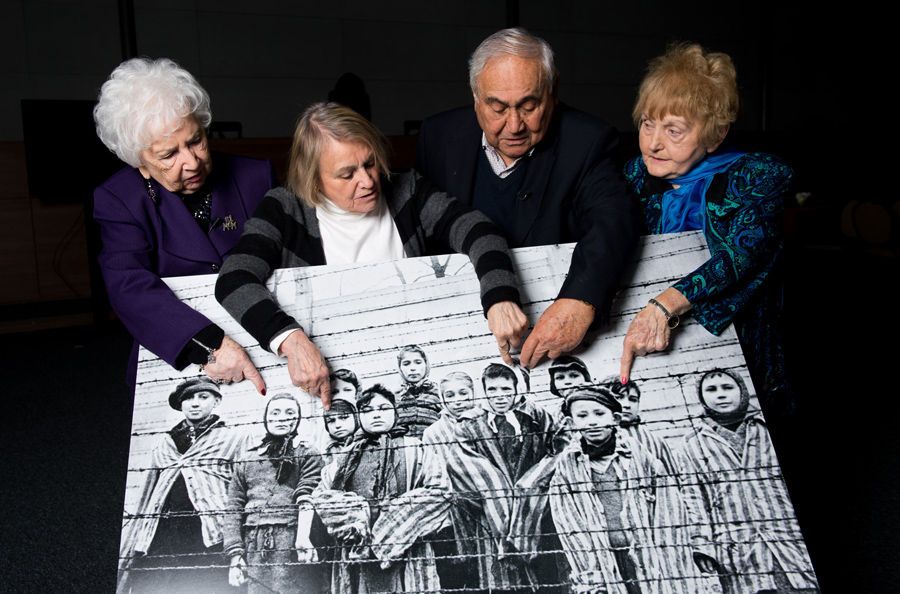
From left: 79-year-old Miriam Ziegler, 81-year-old Paula Lebovics, 85-year-old Gabor Hirsch and 80-year-old Eva Kor pose with the original image of them as children taken at Auschwitz at the time of its liberation on January 26, 2015 in Krakow, Poland. #   Ian Gavan/Getty Images

Philip Riteman's family was sent to Auschwitz. There his parents, five brothers and two sisters as well as his grandparents, aunts, uncles and cousins were put to death. "I'm the only survivor. Many times I wish I didn't survive -- why me?" he queried in a classical survivor's reminiscence and sorrow. "I think about Newfoundland all the time. People ask me where I'm from, I say, I'm a Newfie boy", he has also stated,with pride.

At age 17, weighing 75 pounds, he was liberated in May of 1945. At that time he was convinced he was without family or friends, that there was nowhere he could go to, to resume life and normalcy. But the Americans who liberated the prisoners at Auschwitz  discovered through some compassionate sleuthing that he had relatives in Canada as well as in the dominion of Newfoundland, not yet a part of Canada.

While the government of Prime Minister Mackenzie King refused entry to Canada for this refugee child, Newfoundland welcomed him, and he was united with an aunt who lived there. In recognition of his having made a success of himself through his business acumen, despite the horrible tribulations he had suffered as a child, he is slated to receive the Order of Newfoundland and Labrador at Government House in St.John's.

His is one such story, and there are countless others. No Jews, under threat of extermination by Nazi Germany, were welcomed by the-then government of Canada  under Prime Minister MacKenzie King whose principal adviser on the "alien" refugee file assured King that "none was too many" to save from certain death and in the process defile Canada with their living presence.

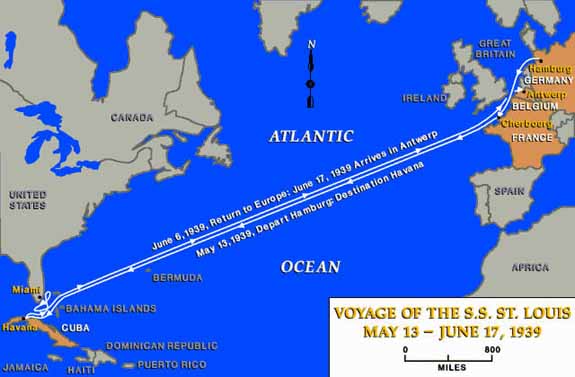
Ana Maria Gordon was another such Jew who with her family attempted to escape the dreadful fate that the Axis Powers under Nazi Germany meted out to Europe's Jews. Her family lived in Kosice, Slovakia and her father assembled enough money to buy passage on a ship along with visas to enable them to enter Cuba and find haven there. She was four years old at the time that her family boarded the SS St.Louis, leaving Hamburg on May 13, 1939.

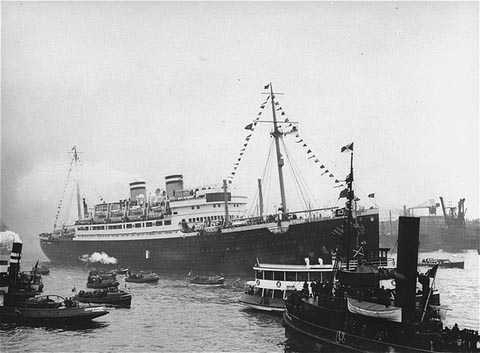
The luxury liner co-opted temporarily for a rescue mission to take desperate Jews out of Germany four months before war was declared, was bound for Havana, where the government of the day had agreed to absorb those Jews who paid for special visas. The German Captain Gustav Schroeder, happily was a decent and honourable man (later memorialized at Yad Vashem), determined to treat his passengers with respect.

"He was a wonderful man, a wonderful man. He was a real captain who said 'my passengers come first'. [However during the passage] people heard things and started getting nervous, you felt the atmosphere was changing. They [Cuban authorities] didn't let us off the ship", said now-82-year-old Ana Gordon. The Cuban authorities held up disembarkation for greater sums to be forthcoming from the passengers. But German law hadn't permitted Jews to take money or property with them, and there was no more to be had.

In desperation the passengers turned for help to the United States, which responded by refusing them entry. And then it was Canada's turn to deny entry to the Jewish passengers knowing that if they were forced to return to Germany their lives would be fraught with danger. Washington and Ottawa knew full well what awaited the returning passengers to Germany.  So the captain had little option but to return to Europe with his 907 remaining passengers.


S.S. St. Louis surrounded by smaller vessels in the port of Havana (USHMM Photo)


Captain Schroeder, however, had different ideas than to return his passengers to Germany, and so he helped to negotiate asylum for them in Britain, Belgium, France and the Netherlands. The Jews on that fated voyage were disappointed in the failure of their attempt to find haven in Cuba, the U.S. or Canada, but satisfied that they would be safe where they finally ended up. Until, of course, the troops of the Third Reich marched into Belgium, France and the Netherlands, and the nightmare resumed.

While 250 of the passengers died in the ensuing years of deliberate genocide, others managed to survive. Ana Gordon and her family ended up  in Buchenwald and Ravensbruck. Her uncle, married to a non-Jewish German, was given the choice of sterilization or camp internment, and he chose sterilization. The Gordon family survived, miraculously, were liberated by Soviet forces and eventually re-united.

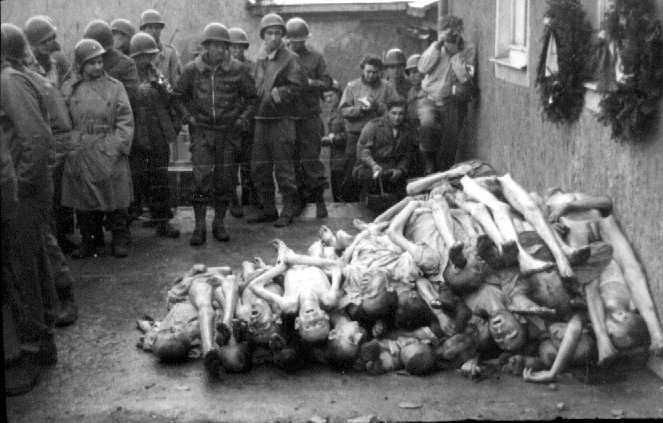
Buchenwald corpses piled high
Buchenwald corpses piled high  --  Holocaust Education and Research Team

Ana Gordon was eight years of age by the time she and her mother were released from the notorious Ravensbruck camp for women, north of Berlin. "What do remember? Too much. I was there close to two years. It was awful, just awful. At this stage after so many years, you know", she says from her home in Toronto, she cannot find it in her to harbour resentment against the Canada that shunned entry to her and the other shipload of Jews, shrugging.

"But you never forget and  you shouldn't forget. These things happen . . . and I'm afraid that they can happen [again]."

Labels: , , , , ,

Wednesday, July 22, 2015

European Maccabi Games to be held at Olympic venues built by Nazis

JTA Jewish Telegraphic Agency

http://www.jta.org

European Maccabi Games to be held at Olympic venues built by Nazis

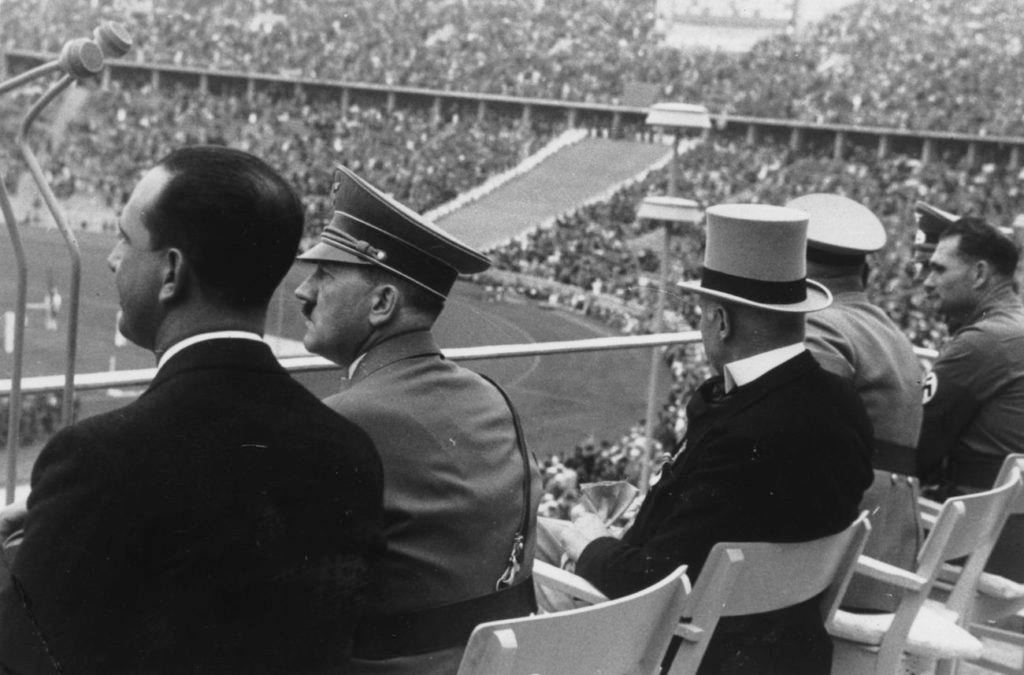
Adolf Hitler watching the Olympic Games in Berlin with the Italian Crown Prince, August, 1936. (Fox Photos/Getty Images)
Adolf Hitler, second from left, watching the Olympic Games in Berlin with the Italian crown prince, left, August 1936. (Fox Photos/Getty Images)

BERLIN (JTA) – They are roaring through Europe, raising dust as they go: Jewish bikers bearing an Olympic-style torch all the way from Israel to this German city.

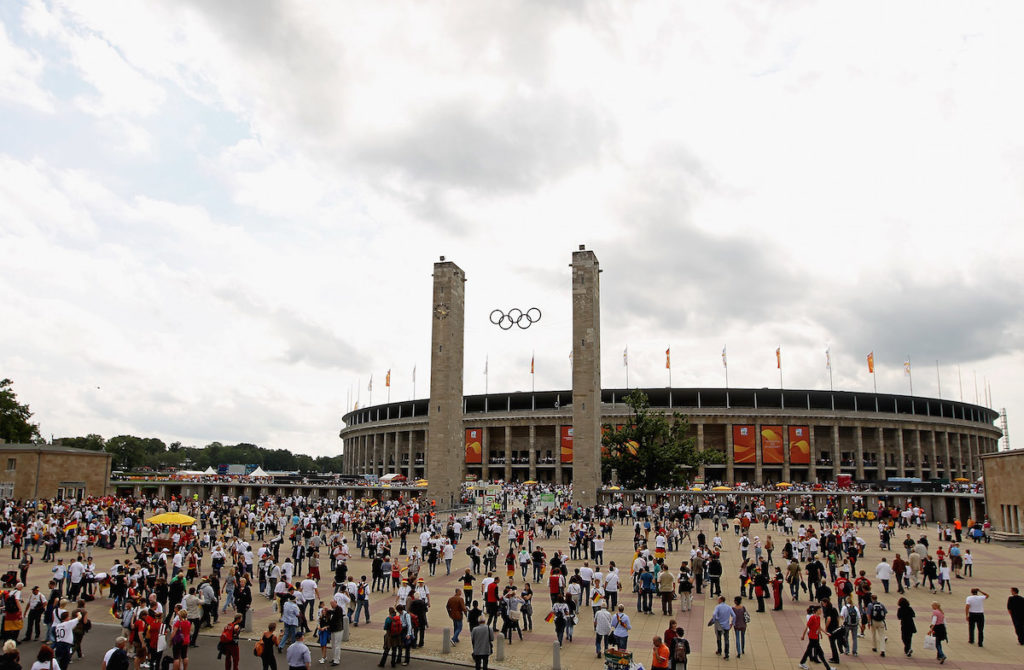
Next week, 11 core riders will pull their steel steeds into Berlin’s famous outdoor amphitheater, the Waldbuehne, to help usher in the 14th European Maccabi Games — the first ever in Germany — at a venue built by the Nazis for the 1936 Olympics. Other competitions will be held at the Olympic Stadium here, where Hitler presided over the opening of the games that year.

The riders are following in the treads of the Maccabiah Riders, who rode through Europe in the early 1930s to promote the games then being held under British mandate in Palestine.
The July 28 opening ceremony, which will feature remarks by German President Joachim Gauck and a concert featuring Matisyahu, Dana International and others, will usher in 10 days of sports, parties, a Limmud Germany learning event and more. Some 2,300 Jewish athletes from 36 countries will take part, cheered on by fans bused in from across the country by the Central Council of Jews in Germany. And the sports venues, including Berlin’s Olympiastadion, will be open to all, free of charge and under heavy security.


Elen Katz and Catherine Lurie-Alt participating in a motorcycle rally from Israel to Berlin for the opening of the European Maccabi Games. (Yosef Alony)

Athletes will compete in 19 sports, as well as a few exhibition games pitting Jewish athletes against German soccer and basketball stars. On July 31, they will try to break the Guinness World Record for the largest kiddush ever.

The European Maccabi Games grew out of the Maccabi movement, which traces back more than a century to Turkey when Jews, then shut out of local sporting clubs, founded the Israel Gymnastic Club in 1895. Jews elsewhere followed suit.

The first European Maccabi Games were held in Prague in 1929, and the second a year later in Antwerp. But with the rise of the Nazis, Jewish sports associations were banned. Germany’s Makkabi Club was reinstated only 50 years ago.

In 1969, the quadrennial competition resumed, alternating every two years with the Maccabiah Games in Israel.

Bringing the European Maccabi Games to Germany was a herculean feat, says Alon Meyer, head of Makkabi Germany.

“People told me they never could imagine setting foot in Germany because their parents and grandparents were sent away from there,” said Meyer, 41, a Frankfurt businessman whose father fled Nazi Germany for Palestine. “Now these people are coming back to see the changes [and take part in] the biggest Jewish event ever held on European ground.”

The Berlin Olympiastadion was originally built for the 1936 Olympic Games. (Scott Heavey/Getty Images)
The Berlin Olympiastadion was built for the 1936 Olympic Games. (Scott Heavey/Getty Images)

The change to which Meyer referred is the dramatic growth in Germany’s Jewish population. Only a few thousand of Germany’s prewar Jewish population of 500,000 remained in Germany after the Holocaust. Today there are some 240,000 Jews here, most of them immigrants from the former Soviet Union. Membership in Jewish sports clubs has grown, too.

Meyer wanted the competition to be held in the Olympic Stadium, those same stone halls where many Jewish athletes, though not all, were banned in 1936.

“They came all the way to Germany and in the morning they got a call, they were not allowed to run. They found out right before the race,” said Steven Stoller, 64, of New Jersey, a distant cousin of the late Jewish-American sprinter Sam Stoller, who was told he could not compete by Avery Brundage, then president of the U.S. Olympic Committee.

“I wanted to come to Berlin for my children, my future grandchildren, to have the story live on,” Stoller said.

Jed Margolis, the executive director of Maccabi USA, will fly in from Philadelphia to cheer some 200 participating American athletes aged 15 to 85.

“At one point in life I would say, ‘I will never go to Germany or buy a German product,’” Margolis said. “Yet there is a vibrant and growing Jewish community there. We want to support them and at the same time teach our next generation” about what happened there.

Security will be tight for the event, in the stadium and beyond. Berlin announced the creation of a new digital reporting system for anti-Semitic incidents just in time for the games.
“Security is the No. 1 priority,” said Lena van Hooven, spokeswoman for the games.

But Danny Maron is not worried. He and the other Jewish bikers have been traveling through Eastern Europe with Israeli flags attached to their bikes.
“We have no fear at all,” Maron said. “We are very proud.”

Maron’s father, Yoram, a Holocaust survivor, told JTA that he wanted “to show the whole world that after all the death, we are still alive, and we keep moving.”

At each stop, from Athens to Romania to Krakow, more Jewish bikers have woven into the pack. The Maccabi torch itself rides in a specially built case carried by Greek biker Kobi Samuel, 48.
“Two of our riders are descendants of actual Maccabi riders of the 1930s, nine are descendants of Holocaust survivors, and two of our bikers are actual survivors aged 73 and 78,” said filmmaker Catherine Lurie-Alt, who snagged Jewish talk show host Larry King as the narrator for her documentary about the motorcycle rally.

“This is where it all started,” Lurie-Alt said. “We are going through communities where Jewish populations were decimated, on our way to Berlin, where they will enter that stadium with jubilation and joy.”

Labels: , , ,

Thursday, February 12, 2015

Chevalier Harvey Wittenberg

"It was a horrible place to see, the ovens, the mass graves [Auschwitz]. It was hard to realize that people could make others suffer so much. But they did. I saw it. I've never forgotten it."
"It came as quite a surprise to me [receiving the French Rank of Knight of the Legion of Honour] I would be honoured in this way. I appreciate it very much, but there was a lot of men I knew in the war who should be getting it. If there was only some way I could reach them and say, 'Here. I'm getting this for you.' I accepted it on their behalf."
"Sometimes my mind goes back to the war. I don't think anyone who has served can ever really forget it. You can't really shut it out of your mind. Sometimes I still dream of things that happened int he war."
"Nijmegen was scary. [Nijmegen Salient, among the last major battles of WWII.] The Germans broke through and we were surrounded for a short while."
"We'd all heard so much about it [Auschwitz]. I had to see it for myself. They showed us where they burned the bodies in the ovens, and the mass graves. The smell was something awful. I find it difficult to believe anyone would say it never happened."
"I've had the opportunity in my 94 years to see some big changes in the world, but when I think of my grandchildren [six] I wonder what kind of world they are going to face. There's going to be another war. That's inevitable."
Harvey Wittenberg, Canadian serviceman during the Second World War
Harvey Wittenburg, 94, recently received one of France's highest honours, the Rank of Knight of the Legion of Honour, for his services as a soldier in the Canadian Army during the Second World War.
Jean Levac/Ottawa Citizen

Harvey Wittenberg visited Auschwitz after its liberation, when the Second World War was declared over. At the time he was a corporal with what remained of the Canadian occupation forces. He was assigned to drive a Jeep of senior Canadian military officers through the gates of Auschwitz, a geographic place transformed into a living hell for its unfortunate inmates. One of the most infamous of the horribly genocidal Last Solution slaughter houses of the Third Reich. Ninety percent of the estimated million people whose lives were obliterated there were Jews.

In 1939 at the age of 17 Mr. Wittenberg became a reservist in the Canadian Army Service Corps. At eighteen he walked into a recruiting office on Queen Street, Toronto, to enlist his services for active duty in the war. In 1940 he arrived with the 2nd Canadian Infantry Division in England, spending the following two years training in various camps around the British Isles, learning to drive anything on wheels; motorcycles, jeeps, troop trucks.

The 1942 Dieppe raid saw the 2nd Division providing most of the men for Operation Jubilee. Many of the almost five thousand men and officers who went ashore were taken prisoner, but 3,369 were killed or wounded. Mr. Wittenberg's role had been to load equipment on the landing craft used in the raid; he was not among those taken prisoner. In 1944 he was hiding in roadside ditches in France as German fighters and bombers struck Canadian troops during the fighting for the port city of Caen.

His division fought across the Belgian border after the Caen campaign, moving on to the Scheldt Estuary where fighting was fierce and the 2nd Division lost 3,650 men during thirty-three days of combat. This elderly man with his searing memories recalled seeing German soldiers shooting Allied soldiers as they descended in parachutes: "The Germans killed them before they even landed", he said of that mournful memory scalded into his memory.

During the final months of the war his division was struck with some of its heaviest casualties; at least 300 men were killed and over a thousand wounded between late February and March of 1945; a month before the end of the war on May 5. He remained in the army for another year, helping with the disbanding of army units and the return of troops to Canada. It was at this juncture that he had visited Auschwitz.

In late December of 2014, the Government of France honoured Mr. Wittenberg with the Legion of Honour, the country's highest decoration, as a Chevalier (Knight). A commendation long in the coming, but appreciated irrespective. This was France's undertaking reflecting on the 70th anniversary of the D-Day landings in June of 1944, in recognition of about 600 surviving Canadian veterans who had taken part in the campaigns for the liberation of France from Nazi occupation.

Labels: , , , , ,

Friday, November 14, 2014

Surviving The Holocaust

An undated photo of Anne as a young girl. She began writing in her diary on...
AP  An undated photo of Anne as a young girl. She began writing in her diary on June 12, 1943, with the words: "I hope I will be able to confide everything to you, as I have never been able to confide in anyone, and I hope you will be a great source of comfort and support."

"I compare myself often to Anne Frank. She liked writing and she would have been a better writer than I am. ... She landed in almost the same circumstances with her family Only there was one bad thing. She was discovered and she did not survive and I did."
"My father locked the door and we didn't know if we ever would come back. That was an awful feeling. We had to leave behind everything."
"My father said, 'If we have to hang, then it will be on the last gallows'."
"There was one day that we heard banging on doors. There were big trucks, German trucks. And the Germans always screamed. They could not talk normally. They always screamed. Their boots were [made of] iron. You heard them walking."
"Our hearts stopped. Then a motorbike came into the street with [an] officer and he said, 'We have to go home. We have to go home.' They all went back into the trucks and they drove off. So that was a very close call."
"My father put a little line on the wallpaper the first evening and he said if there are 100 lines we will be free again. But it took 786 days before we were free. Two years and two months."
"I will never forget that image. They came walking, they had daffodils on their helmets that they'd got from the Dutch people, and they handed out cigarettes and they handed out chocolate."
"Those are simple words: to step out of the house and go onto the street. But for us, it was a whole new adventure."
"The houses seemed so big. Because we knew so many people, we had a whole bunch of people around us who kissed us and who cried."
"And then I had that feeling. They didn't get us. They tried, they wanted to get us, but they didn't. ... We won, from the Germans, because we survived, and that was a good feeling."
Betty Laron, 85, Burlington, Ontario
Betty Laron, 12, poses with her parents Frederika and Josef outside the family home in Zevenaar, Netherlands, in the summer 1942, before going into hiding. THE CANADIAN PRESS/ HO, Betty Laron

She, among the estimated one out of every three Jews in Europe managed to survive the Nazi plan to exterminate the Jews of Europe. She is now able, at her advanced age, to state that Hitler's Third Reich did not destroy her immediate family, and she has a right to feel great satisfaction in that. The agony that she and her family experienced having to conceal their existence from a morbidly malevolent adversary was price enough to pay for survival.

Living in Zevenaar, Netherlands, her father understood by 1943 that if they were to save themselves from perishing as more than rumour had it so countless many others were doing in Nazi Germany's double-pronged war; one against the Allied Command, the other against the intolerable existence of a 'race' of people considered by the fascists to be inferior and a threat to decent society, as they themselves clearly were not; they would be forced to make themselves disappear from public view.

Betty Laron was twelve years old when she and her parents went underground; her counterpart in Amsterdam was already in hiding with her family. An episode of the History channel program War Story was dedicated to Betty Laron's story of survival. By late 1942 her family, she explained, had heard that the camps where Jews were to be sent were not work camps as they were benignly described but "destruction camps". Motivating her father to search for haven for his family.

When they finally left the only home they knew, they were in desperate grief. They moved in with a poor family to whom her father paid a modest fee to live in the small upstairs floor of the house. Mr. Franz, Betty's father, tried to help his landlord Mr. Heister's business in carpentry working in secret on the second level of the house for the wood shop. Mr. Heister was one of those good souls who felt he had no option but to help save the lives of a Jewish family. His connivance kept them out of the death camps. At risk to his own life.

The family underwent a dramatic alteration in their daily routines, communicating with one another by whispers and treading as lightly as possible across the floor of the chamber that became their refuge. They were always hungry, and became accustomed to eating rotten root vegetables, all that was left when German soldiers looted local food to feed themselves. These conditions led to Betty becoming ill with tuberculosis. The life of isolation and ebbing hope for release from their nightmare took its toll.

In the spring of 1945 they became aware of soldiers of the Allied militaries making progress across Europe. The Netherlands was liberated by the First Canadian Army. Betty Laron can still recall the agony of expectation, the urgency of hoping for a now-speedy liberation, even while progress appeared to be agonizingly slow. Then on April 3, 1945 they witnessed Canadian soldiers marching around their street corner.

That was at 6:00 a.m. but the family remained within the house fearing that German soldiers would return. Finally they felt safe enough to leave the house at 2:00 p.m., and Betty Laron recalls people crushing against one another, celebrating in the streets. And they were finally free.
Betty Laron


Labels: , , ,

Monday, April 28, 2014

Holocaust Remembered: Testimony

Holocaust survivors are a dwindling breed. They are elderly survivors of the modern century's blot on humanity. In its cold-blooded and determined sweep, institutionalized organization and rationalization the Holocaust represents the single most horrific attempt at genocide that has yet succeeded in a world gone mad with hatred.

The odiously wretched indecency of world leaders gaining knowledge of the extermination of Europe's Jews and deciding it was simply too inconvenient to grapple with the issue -- particularly at that time, and particularly as no one wanted to add to their nation's already onerous number of Jews -- gave their stamp of indifference to the cynical Nazis who knew there would be no interference with their resolute march partnering the Angel of Death.

The death camps were well considered with respect to their placement. Nazi officials involved in the Europe-wide venture to dehumanize Jews through slandering caricature as a venal, deceitful, controlling and vicious underclass of society striving to achieve dominance on the world stage of politics, economics and news promulgation, succeeded in deepening already-existing anti-Semitism. They understood where best to place the work camps, detention camps, death camps.

Among conservative, rural populations where that very specific kind of racism was already deeply entrenched.

Among the multitudes of disinterested bystanders preferring ignorance of knowledge of the proceedings to involving themselves in any manner to decry the inhuman isolation, victimization and slaughter, emerged a coterie of individuals who with their families quietly and with huge compassion risked their all to aid wherever and whenever they could those among them who were destined for slaughter; enabling some to survive the dreadful human-made cataclysm.
Detail from drawing by Warsaw Ghetto and death camp survivor Morris Wyszogrod of SS Untersturmfuhrer Reinhold Feix, commander of Budzyn camp, strangling a prisoner with the reins of his horse in 1943. - Photo:
"I remember looking down and I happened to be standing on my grandmother's tombstone. The Germans walked among us and anytime they saw a mother with a child, they tore the child from her arms and threw them into the back of trucks."
"I looked around and I just said 'Mother, this is where we are going to be separated."
"I didn't even feel it when the Germans hit me but every time they struck my mother and brother it was like they were cutting my flesh."
Asher Aud Sieradski, 86, (Poland)
"They asked me what my name was and I said 'Romka Vochick'. That is the name that saved me." Two sisters, 8 and ten fleeing the Nazi invasion of their hometown of Buchach, Ukraine. For years they hid, sleeping in fields, subsisting on scraps of food given them by non-Jews. They were eventually caught on the street and handed to the Gestapo. She lied; her sister couldn't bring herself to do the same. "She had an accent and was afraid." And so, she died.
Ester Koffler Paul, 82, (Galicia, Ukraine)
"I remember the scary things. I remember crying and being so hungry that I couldn't fall asleep."
"They burst into the house and started to search for documents, turning over furniture and tearing down wallpaper. One soldier stood and stared at me. I sat frozen, not daring to move. I was so frightened I almost couldn't breathe. Then came a Dutch policeman who was accompanying the German soldiers and he told the soldier that he saw something in another room. By luring the soldier away, he probably saved my life."
Jacob Philipson Armon, 76 (The Netherlands)
"The first thing they did was beat us and separate the women from the men. It happened so quickly, I couldn't even part from my mother and sister."
"I remember him [his father] begging: 'I am still young, I can run, I can work'. But it didn't help and I couldn't say farewell to him either."
"The hardest part is not having a Jewish grave for my parents in which to honour them."
Shmuel Bogler 84 (Hungary)

Labels: , , , , ,

Friday, April 11, 2014


Holocaust Archaeology: Yahad-In Unum

"The purpose of my organization Yahad-In Unum (Hebrew "together"; Latin "One") is to look for the victims. We are not looking for the killers; we are looking for the victims."
"In many genocides, we only remember the names of the killers. The Jews have given sanctity to the names of the victims so that we remember them."
"We are now 23 full-time in my organization. I'm not alone now. All are younger than me."
"My goal is to give back to the families so they can pray and say Kaddish on the mass graves. The second goal is to give back the Jewish victims to the Jewish people. The third one is to fight the Holocaust deniers."
"We are investigating the crimes of Hitler against the Jews ... [and] we have interviewed 3,800 neighbours who were present at the killings. They could look through the window. They were not collaborators. They were teenagers who ... saw everything."
"They are now old and they want to speak before they die. For the majority of them, it is the first time they speak. We have recorded all of them and it is accessible through our website."
"I want to say to the young people, perhaps one day you will be a doctor, perhaps you will be a soldier or a journalist, and you will be in a country of genocide. You must take a photo and send it to CNN or somewhere, and that's the way you will protect humanity ... There is a Russian proverb in all these countries that says the work is over when the last victim is buried. If we don't do this, in future we will have no evidence of this crime."
 Honoring Father Patrick Desbois, President of Yahad-In UnumFather Patrick Desbois, head of Yahad-in Unum   http://www.yahadinunum.org

Father Patrick Desbois is a French Catholic priest. He has elected himself to bear witness to a mass atrocity, to remember and to find evidence, and to record and to memorialize. It is beyond human capacity to really understand what happened, why it happened, how it happened, that during World War II Nazi Germany strayed from the focus of world domination for the Third Reich, to perfect the world they envisioned by removing from it all traces of the presence of European Jewry as a start to eliminating Jews world-wide.

What is beyond human understanding is the capacity for some humans to demonstrate their capacity for mass slaughter, and to consider it a benefit to the world. To select an ancient people that persevered through countless millennia, to retain its faith and its cohesion as an ethnic group, with its distinct culture, heritage and religion, against all adversities. And adversity was never in short supply throughout the history of the Jewish people. And nor, since the advent of the Holocaust and beyond is it now in short supply. Father Desbois has dedicated his efforts to the memory of those who perished.

The founding of Yahad-In Unum took place in 2004, a joint project between leaders of France's Catholic and Jewish communities as a measure to bring Jews and Catholics together for a common purpose in shared humanity. The major initiative of the organization is meant to investigate and identify sites of mass graves of Jews murdered by German Fascist mobile killing units, called the Einsatzgruppen. And to look for their remains in Ukraine, Russia, Belarus, Poland, Moldova and Romania.

The pathological viral mental derangement more commonly spoken of as anti-Semitism had long found fertile ground and a comfortable home in Europe. Hitler and his minions felt that Germans were too civilized, would be too squeamish about having death camps positioned on German soil, so most of those concentration, labour and death camps were located elsewhere throughout Europe, where pogroms were not uncommon, and where it was less likely that any protests would arise, should anyone find the institutionalized obliteration of a people morally offensive.

Through dedicated on-the-ground research, Yahad-In-Unum has discovered evidence of mass graves in "village after village", representing the work of the Einsatzgruppen, separating the local Jewish population from their non-Jewish counterparts and eliminating them, men, women and children, in well organized operations, and in calculated cold blood. Yahad-In-Unum has signed a contract with the American Jewish Committee to ensure that revealed sites would be respected, "the graves will be protected forever and not be desecrated".

Father Desbois wears many hats, besides his anti-racist historical-humanitarian one; he is director of the Episcopal Committee for Relations with Judaism, itself connected with the French Conference of Bishops. His grandfather was a French soldier, deported to the Nazi prison camp Rawa-Ruska during the Second World War. Father Desbois himself studied anti-Semitism at Yad Vashem in Jerusalem, as well as undertaking the study of Jewish religion and culture with a leader of the Jewish community in France.

Father Desbois embarked on a trip to Ukraine in 2002 to see for himself where his grandfather had been imprisoned, and while there he planned to pay his respects at a memorial he was certain he would find there. When he arrived he discovered to his amazement that there was no evidence, no kind of commemoration to the one-and-a-quarter-million Jews whose lives had been destroyed in Ukraine and Belarus. And he resolved to rectify that blatant oversight in respect and honour for the victims of morbidly destructive racism.

After founding Yaham-In Unum, he set about collecting information revolving around the mass killings of Jews and Roma in east Europe between 1941 and 1944. With the help of translators, Father Desbois along with others conducts interviews with witnesses. And with the use of metal detectors, he and his team have succeeded in unearthing German cartridges and bullets from pits where the bodies of the slaughtered were discarded, along with jewellery belonging to the victims, and other artifacts.

He has written a book outlining the immensity of the project: The Holocaust by Bullets: A Priest's Journey to Uncover the Truth Behind the Murder of 1.5 Million Jews.

Tuesday March the 4th, Father Desbois has been awarded the Crif award "in recognition of his commitment to the truth"

Labels: , , , , , , , ,

Monday, February 24, 2014

"Always Laughing"

"These concerts, the people are sitting there, old people, desolated and ill, and they came to the concerts and this music was for them our food. Music was our food. Through making music we were kept alive."
"When we can play, it cannot be so terrible."
"This was especially for Jews a very, very hard time. I didn't mind, because I enjoyed to be a mother and I was full of enthusiasm about being a mother, so I didn't mind so much."
"We were poor, and we knew that they will send us away, and we knew already in this time that it was our end."
"When I went home from bringing her to this place I remember I had to stop in the middle of the street and I listened to a voice, an inner voice: 'Now, nobody can help you, not your husband, not your little child, not the doctor."
Alice Herz-Sommer, oldest known Holocaust survivor, 110 years of age
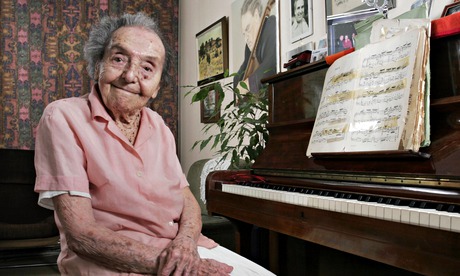
Alice Herz-Sommer, 106, at her flat in London
Alice Herz-Sommer, who has died at the age of 110. She spent two years in the Theresienstadt concentration camp during the Holocaust. Photograph: Sophia Evans for the Observer
"I hope you will come back. What I want to tell you is that I admire you, your playing, hours and hours, the patience and the beauty of the music."
Upstairs Nazi neighbour, 1943 Prague, Czechoslovakia
Just as well that Frederic Bohbot, producer of the documentary The Lady in Number 6: Music Saved My Life, felt compelled to produce a short documentary film about this extraordinary woman, a pianist to the very last year of her life. The Oscar-nominated film, which he felt certain his elderly subject would be pleased to see receive the Oscar, will now not come to pass: "There was no question in mind, 'would she ever see the Oscars'." He seized the moment, as it were, now gone forever.


No matter, she had seen much else in her life, and despite the unbelievable grief and misery that life brought her she found solace in music and believed that joy could be found anywhere, even in the grimmest, most dreadful of all possible circumstances. And she was living proof, until yesterday, Sunday, February 23, that life was worth living and in living it happiness would be gained, despite unimaginable adversities.

Alice Herz-Sommer Image from the book The Garden of Eden in Hell. Photograph: Droemer 

In 1942 her 73-year-old mother was selected for transport to Terezin. From there she would later go on to Treblinka, a notorious extermination camp located in (Terezin) Theresienstadt, Czechoslovakia. She had herself taken her mother to her destination with death, to the place where her mother was assembled along with other Jews meant for transport to the city, then the death camp. And it was then that the realization of the future hit her.

She sought to stifle the fearfully horrifying thoughts that assailed her, in understanding that she and all the Jews of the country were to be consigned to death. It was her music, playing the piano, that gave her comfort. She became engrossed in the 24 Etudes of Frederic Chopin, adapting a ritual of artistic perfection to hold at bay the full recognition of the ritual of ethnic cleansing that Nazi Germany had embarked upon.

Alice Herz-Sommer Alice and her son, Raphael. Photograph: Droemer
 
Her husband eventually died of typhus at another infamous death camp, Dachau. But before then, Alice Herz-Sommer with her son Stephan and her husband were all sent to the very same city of Terezin (Thereienstadt) where people such as she, classically trained musical professionals were encouraged to stage concerts. Of the 140,000 Jews who were dispatched to Terezin, 33,430 died there, with another 88,000 moved to Auschwitz and other death camps, where they too met their deaths.

Stephan and his mother Alice Herz-Sommer were two of the fewer than 20,000 who had somehow survived and were liberated when the Soviet army entered the camp in May of 1945. As she reminisced before the cameras for the documentary focusing on her life, she recalled herself "always laughing", despite the horrors that surrounded her. In performing the music that delighted and transported her, in performing to lift the spirits of others around her, she found joy.

She was born in Prague, and her sister gave her piano lessons when she was only five. She recalls meeting Franz Kafka, and remembers also a statement of his: "In this world, to bring up children: in this world?" She married Leopold Sommer in 1931 and their son was born two years before the Nazi invasion of Czechoslovakia. The night before her departure to Terezin, she recalled a Nazi who lived upstairs who called on her so he could tell her that he would miss her piano playing.

Alice Herz-Sommer left Czechoslovakia in 1949, moving to join her twin sister Mizzi in Jerusalem where she taught music at the Jerusalem Conservatory until 1986, the year she moved to London. Her son, Raphael, had a career as a concert cellist. He pre-deceased his mother, in 2001. A long life, a good life, despite the unspeakable tragedy that intervened between her youth and young adulthood and her final freedom from impending death.

"We are all the same", she said, "Good and bad". She held no bitterness in her soul.

Labels: , , ,

Sunday, February 09, 2014

Proudly Canadian, Shameful Background

"In the wider context of the Holocaust, here were all these people who needed a place to go, and Canada wouldn't let them in. And this handful of people who did get in became very proud Canadians and contributed through every sphere of our society."
Paula Draper, historian

"The Canadians expected prisoners of war rather than civilian internees, and [the British] certainly didn't tell the Canadians that most of us were Jewish."
"I would say it was a hugely important phase in my life. We were together with people who were extraordinarily erudite and good teachers, and one could spend time with them under conditions that were favourable to learning, especially once we could get books."
"Nobody could know what the Holocaust was going to do with our families. Many of us had parents in Germany and Austria. We could not know they were about to be murdered, but we had reason to worry, because we were cut off from them."
Eric Koch, 94, former Sherbrooke internee

"In spite of the fact that a certain percentage may be heartily Anti-Nazi, it cannot be forgotten that they are German born Jews. Jews still retain much of the same instincts they had 1940 years ago and these in particular are very apt to try and take advantage of privileges which if once given result in demands for more. The combination of this insidious instinct and the well known characteristics of the German habit of breaking every pledge ever made, is not particularly easy to handle except by maintaining strict discipline and rigid enforcement of Camp rules and regulations."
Major W.J.H. Ellwood, commandant, Sherbrooke camp
In 1940, while Nazi forces swept as a juggernaut of brutality across Europe, Winston Churchill, concerned of the possibility that Great Britain could be occupied as France, Poland, Holland, Hungary and other countries had been, wanted to give fascist Germany no insider breaks with he presence of Nazi sympathizers, people who had left Germany to settle in England. Alternately, German prisoners of war, incarcerated in Britain.

He might have considered the threat posed by members of the British aristocracy and literary set who felt huge admiration for Hitler, but he turned his attention to those of Austrian or German ancestry solely.

Unsurprisingly, there were young Jewish men who had escaped Germany, sent by their concerned families to safety, who thought they had found haven on their arrival in Great Britain. Eric Koch was interned in Sherbrooke; he had been studying at Cambridge University when Prime Minister Winston Churchill ordered the internment of German and Austrian nationals in Britain following Holland's Nazi invasion.

"Churchill wanted to demonstrate to one and all that the time of appeasement was over and a new wind was blowing, so he decided on the internment of enemy aliens", Mr. Koch explained in an interview from Toronto. Britain decided it couldn't possibly house enemy aliens on its soil as a potential fifth column and so persuaded its former colonies of Canada and Australia to take the aliens as internees. Loyal Canada agreed to take 7,000 "dangerous type" civilians and prisoners of war.

Among them were about 2,300 men whom British tribunals were adjudged to pose no risk. Among the Jewish refugees there were communists and homosexuals who had themselves fled persecution in Germany. Canada's immigration policies at the time was to deny entry to Jews; had it been known that Jews were among those to be interned, Britain understood they would have been rejected, so they were mute on the identities of the internees.

Alfred Bader’s internment shirt from Camp I in Ile-aux-Noix, Quebec, circa 1940-1941. Bader arrived in Canada aboard the S.S. Sobieski and was interned for 15 months. (Courtesy Alfred Bader / Photo by Jessica Bushey)

The internees were given shirts with huge red circles on the back to be recognized as targets for the guards in the event of a possible escape. The British commissioner of prisons was dispatched to look into conditions prevailing in the camps and he characterized the uniforms as degrading. "It was disturbing to find distinguished university professors dressed as clowns", he reported in 1940 to his superiors.
Photograph of an internee in a camp uniform, taken by internee Marcell Seidler, Camp N in Sherbrooke, Quebec, circa 1940-1942. Seidler secretly documented camp life using a handmade pinhole camera. (Courtesy Eric Koch / Library and Archives Canada / Photo by Marcell Seidler)

The fact that accomplished intellectuals were among the internees turned out a blessing for the younger men. Study halls were established in the makeshift camps, and the young men were instructed in areas as disparate as religion, and physics. Among those internees a disproportionate number proceeded after the war to become illustrious professionals in academia, law and the arts. They included two Nobel laureates.

Erwin Schild, 93, rabbi emeritus at Adath Israel Synagogue had arrived in Quebec City in July 1940, spending almost two years in camps in Quebec and New Brunswick. "I was 20 or 21 years old and here I am imprisoned, surrounded by barbed wire and armed guards. What am I doing here? I didn't know what was happening to my parents and to my sister. Psychologically, it was very, very difficult."

Rabbi Erwin Schild, who arrived in Canada during the Second World War and was placed in an internment camp in Quebec, poses for a portrait at Adath Israel synagogue in Toronto, Feb. 6, 2014.
Tyler Anderson/National Post    Rabbi Erwin Schild, who arrived in Canada during the Second World War and was placed in an internment camp in Quebec, poses for a portrait at Adath Israel synagogue in Toronto, Feb. 6, 2014.
"To be a Jew locked up as a suspected Nazi has a quality of anguish that is different from being locked up because of a bureaucratic bungle of an asinine law, or mistaken identity, or false suspicion. For all these terrible possibilities, there are precedents in our experience or concepts in our imagination. But not for the infuriating absurdity of being interned by your allies as the enemy, whom you hate even more than they."

Labels: , , ,

Wednesday, November 20, 2013

Beyond a Shadow of Doubt

"What do these people want from me? I'm just a very quiet person. All I wanted to do was live with my pictures."
"Now they are taking everything from me."
"There is nothing I have loved more in my life than my pictures."
"Saying goodbye to my pictures was the most painful of all."
Cornelius Gurlitt, Munich

This is a elderly man, a recluse by habit and inclination, incapable of forming normal emotional links with other human beings. His link to life has been the art collection that his father before him, Hildebrand Gurlitt, amassed before, during and after the Second World War. The elder Gurlitt was in fact employed on an art contract of sorts for the Third Reich, to trade 'degenerate'-designated art, art held to deviate from tradition reflecting the modernist school, which Adolf Hitler loved to hate.

It was a lucrative business, that. Though the modern art so detested by the modern world's most notorious would-be-but-failed artist, who turned instead to a campaign for Aryan world domination, could have been destroyed, practicality stepped in and whispered in the ear of the truculently odious man that money, a lot of it, could be realized to further his aspirations, with the sale of the despised art. And this is where Gurlitt senior came in.

He was himself a discriminating art collector, with an eye for art considered degenerate by the degenerate mind of the Fuhrer and he knew also, like the other three dealers granted the Nazi imprimatur for collecting-and-trading for the regime that desperate Jews hoping to fund their escape would surrender their treasure trove of art and other valuables for desperately steep discounts; what other choice had they than to relinquish what could be summarily requisitioned and mostly was?

That was then, when Hildebrand Gurlitt saw fit to align himself profitably with the reign of an implacable monster set out to destroy an entire ethnic-religious community initially by stealth and soon enough openly and viciously. A lover of art, he amassed for his own delectation his very own private collection. And on his death his only son inherited that collection. A son introverted by nature, finding gratification in his own love of art and rejection of human contact.

Mr. Gurlitt, the son, now 80, was content to live his anonymous life, fondling his treasures, admiring and valuing and treasuring them as his very own. These were 'lost' or unknown works by the great masters of traditional and modern art, among them Picasso, Chagall, Gauguin and countless others, to a total of 1,280 paintings of unbelievable value.

It was a mere happenstance that made his presence known to German authorities when customs officers questioned him and the funds he carried on his person returning to Germany from Belgium. Checking his identification on computer, they discovered no trace of a Cornelius Gurlitt, a German citizen living in Munich, and made further enquiries, finally acquiring a legal permission to inspect his apartment.
Max Liebermann's "Riders on the Beach," painted in 1901, is also part of the...
DPA/ Staatsanwaltschaft Augsburg
Max Liebermann's "Riders on the Beach," painted in 1901, is also part of the collection.

The discovery of those countless stacks of valuable works of art immediately drew attention to the potential that they might represent a treasury of wartime art theft, a thriving industry of the time, resulting in around a hundred-thousand works of art and antiquities missing, unaccounted for, and being searched out by the inheritors of those who had originally owned them.

The discovered paintings are held to likely have a tainted provenance; that is, many of them are doubtless represented by Jewish owners under duress to dispose of them, forced by circumstances to do so, if they weren't outright confiscated by the Nazi authorities. Others may be works of art legitimately bought and owned by Mr. Gurlitt's late father. Whatever they represent, to him they represent the reason for his existence.

The collection includes this painting by Wilhelm Lachnit, "Mädchen am Tisch"....
DPA/ Staatsanwaltschaft Augsburg
The collection includes this painting by Wilhelm Lachnit, "Mädchen am Tisch". The artist's paintings were labelled by the Nazis as "degenerate art".
He is said to be a highly intelligent man of gentle persuasion. Perhaps it is beyond his imagination to attempt to restore some of the paintings of questionable provenance to their rightful owners; perhaps he cannot imagine how he might embark on such a journey to rectify a very old situation that may or may not trouble his conscience. But trouble his conscience it must.

His failing health has given impetus to the need to sell off a few of his treasures. The most recent of the pieces sold was a painting by German artist Max Beckmann, The Lion Tamer, which realized $1.17 million at auction in 2011. Its proceeds would go far to ensure he had ample funds to pay for his living and medical needs. And something must have twinged his conscience for he had agreed to hand over 45% of the proceeds to the Jewish family who were the painting's original owners.
Among the works of dubious origin in the collection is this graphic from the...
AFP -- Italian painter Canaletto, city of Padua
"He wasn't just weird these last few years; he's always been that way", said the caretaker of the building where Mr. Gurlitt lives. He lived quietly, without visitors. So quietly that enquiries were made whether his apartment was empty and for sale. For the 29 years Christine Echter, the building caretaker worked there, she had never seen anyone enter that apartment but for Mr. Gurlitt's sister who died six years ago.

Cornelius Gurlitt was 23 years of age when his father Hildebrand died. "Even then, he was considered an eccentric fellow", Karl-Heinz Hering who worked for the father as an assistant at the Dusseldorf Kunstverein, the area's leading art museum, remembered. He recalled that, but not that the family enjoyed ownership of a large private art collection.

After weeks of notoriety and claims and counter-claims, German prosecutors involved in investigating the art trove have concluded that the art should be returned to Cornelius Gurlitt, once confirmation is made they are his private collection and not items taken by the Nazis from their rightful owners.

A prosecutor in Augsburg has tasked a newly-established force to identify the owners as soon as possible, returning to Mr. Gurlitt those artworks that belong him him beyond a shadow of doubt.
Nazi stolen art trove
A work by Antonio Canaletto is shown on a computer screen during a news conference on the Munich art stash. Photo by AP

Labels: , ,

Sunday, November 10, 2013

Wartime Flash

"It was so sad, because the men were all yelling and happy and you knew in another couple of weeks they wouldn't be so happy. Some would be under ground and I would be taking pictures of their funerals."
Irene Ogilvie, right, during the Second World War.
Irene Ogilvie, right, during the Second World War
"(The photographs) were so awful ... (they) had these bodies lined up like matchsticks. I remember looking at them and thinking it was just terrible. I never dreamed Belsen was as bad as it was."
Irene Ogilvie, 94, Perley and Rideau Veteran's Health Centre, Ottawa
Back then, during the Second World War, the Royal Canadian Air Force offered the young woman living in London, originally from the Canadian prairies, a job as a war photographer. With her Speed Graphic camera, courtesy of the Air Force, she became one of a group of other young women tasked to chronicle the lives of Canadian troops in film.

They were never dispatched to Europe, to the war zones. London itself became a war zone, blitzed from constant German fighter raids meant to demoralize the civilian population and destroy the government's will to resist Nazi Germany's determination to make of Britain what it had already managed in most of the rest of Europe on its way to establishing its thousand-year Reich.

She took photographs of the arrivals of Canadian troops off ships, she ventured out to hospitals and special war-time events, to funerals and weddings, wherever her presence and her camera could take photographic mementos of events later to be recalled with pride, nostalgia and regret. Some of her photographs remain with the Air Force, and some of them accompanied her to her room at the Perley.

There is another elderly woman with memories, Squibs Mercier, 89, married and widowed during the war years. Squibs Mercier was married at 18 and the war gave her widowhood by the age of 19. Her first husband was shot down in action. She met another pilot after the war, and outlived him, another resident of the Perley and Rideau Health Centre who predeceased her.

Irene Ogilvie on the other hand met a Canadian airman through an acquaintance. "It was love at first sight", she said. This was the man destined to become her husband. She and he planned a night out at the American Eagle Club in London. She dressed herself to the nines, but he simply didn't show up. And then she heard from his commander he had been shot down and presumed dead.

Eventually they learned he was in a POW camp. They met again, in Canada after the war and in 1946 they married, began a life together and had two children. Of life, says Squibs Mercier: "I don't know about staying calm, but you carried on or you sank. Whatever happens in life, you have to deal with it and carry on."

The unsung photographer: Irene Ogilvie chronicled the far-reaching effects of the war years
 A wartime portrait of Irene Ogilvie.  Photograph by: Chris Mikula , Ottawa Citizen

Labels: , , ,

A Poem For The Ages

At the age of 22 a young Ottawa man, Ewart J. Taylor, commanded a tank in Normandy during the Second World War. He survived the D-Day landing, and was one of the fortunate men in arms with the Canadian army, returning to Canada after the war ended, to marry and to raise a family.

He worked at a journalist, but he didn't, in fact, spend too much of his time raising his family. He was severely emotionally wounded by his exposure to the misery and rigours of combat, to the dreaded sight of death in all its horrible forms, to fear and constant exposure to personal annihilation.

Little was understood then about the dreadful emotional toll that war takes on sensitive souls. Because of his unrecognized emotional turmoil, a plight shared by many other returning combat veterans, his interaction at the most intimate of levels was flawed. His family remembers of him "a path of relational destruction".

He suffered a heart attack at age 35 and survived for a few more years, before dying. When he was 27 he wrote a poem, discovered much later by his oldest son. The pain expressed in the poem, the grace of its writing, may have helped his family understand a little more clearly how, why and when he suffered so grievously he was never quite there for them.

"We, his family, would have loved to see more of the sensitive side as opposed to this hurt, bitter, angry side that we were most privy to", his son remarked ruefully, during a newspaper interview.

The Prayer of the Beaches

     On cold, now silent, sacred
beaches
    We rest, while wrinkled
waters cleanse our hands
    For all that death can ever
teach us
    Lies deep within these
burdened sands.

    Oh God -- help those whose
tongue cannot reach us
    To cast the venom from
their speeches.
     Hatred's voice twists man's
sense
    And made our couch these 
blood-wet beaches.

    And -- Lord this lesson of
the sands --
    Herald it into the many
lands,
    Take it to Earth's far-flung
reaches --
    Sift it through world's 
calloused hands.


    Their grains of truth, they
need not reach us
    For we -- the dead -- are the
soil of the beaches.

Labels: , , , , ,

Tuesday, November 05, 2013

The unfinished art business of World War Two

Manet's Wintergarden in mine, inspected by US troops Manet's Wintergarden - stolen by the Nazis - was found by US troops in 1945, hidden in a salt mine
The astonishing find in a Munich flat of 1,500 paintings missing since 1939 points to two art crimes.
The first is Adolf Hitler's crusade to fill his Fuehrermuseum at Linz, Austria, with the supreme paintings of the world - looted, confiscated and purchased by the Nazis in the occupied countries of France, the Netherlands, Belgium, Austria, Czechoslovakia, Poland and Russia.
The second is the crime of covering up the truth ever since.

Cornelius Gurlitt, 80, whose hoard of paintings in Munich was allegedly hidden behind a wall of ancient cans of food, has kept his secrets for 68 years.
What they tell us about Hitler is more important than what they reveal about Gurlitt.

His pictures descend from his father, Hildebrand, one of four senior Modern Art dealers in Germany who were appointed in March 1938 to the Nazis' Confiscation Committee - with orders from Hitler and Herrmann Goering to sell "degenerate art" (entartete Kunst) for foreign currency.

Hildebrand Gurlitt, Karl Buchholz, Ferdinand Moeller and Bernhard Boehmer set up shop in Schloss Niederschonhausen, just outside Berlin, to sell the near-16,000 cache of paintings and sculptures which Hitler and Goering removed from the walls of German museums in 1937-38.

They were first put on display in the Haus der Kunst in Munich on 19 July 1937, with the Nazi leaders inviting public mockery by two million visitors.

Propagandist Joseph Goebbels in a radio broadcast called Germany's degenerate artists "garbage".
Hitler opened the Haus der Kunst exhibition with a speech, at the end of which saliva fell out of his mouth in rage. In it he described German art as suffering "a great and fatal illness".
Nazi "Degenerate Art" exhibition in Berlin, 24 Feb, 1938 The Nazis put modern art deemed "degenerate" on show in Berlin in 1938
 
Hildebrand Gurlitt and his colleagues did not have much success with their sales, mainly because art labelled "rubbish" had small appeal.

So on 20 March 1939 they set fire to 1,004 paintings and sculptures and 3,825 watercolours, drawings and prints in the courtyard of the Berlin Fire Department.

The propaganda act raised the attention they hoped. The Basel Museum in Switzerland arrived with 50,000 Swiss francs to spend. Shocked art lovers came to buy.

What is unknown after these sales is how many paintings were kept by Gurlitt, Buchholz, Moeller and Boehmer and sold by them to Switzerland and America - ships crossed the Atlantic from Lisbon - for personal gain.

Gurlitt was arrested by the Allies near Bamberg in 1945, hiding in the castle of Baron von Pollnitz. He turned down an offer from the baron to hide his art collection in a new secret place. Or so he let a writer know.

What we now know is that he did successfully hide more than 1,000 paintings - or his teenage son did.

It is possible they were cached in France. Gurlitt's chief job on the Confiscation Committee was to work in Paris during the war, where he lived from 1941 to 1945 in the Hotel de Jersey.

He had two ways of collecting for Hitler's Fuehrermuseum. One was to visit abandoned Jewish homes and remove their artworks; his licence was a Nazi law declaring that French nationals who had fled had lost French citizenship.

The other was to spend Reichsmarks at the Drouot auction house in Paris, where distress sales were big business.

Gurlitt was no small buyer. He paid more than one million French francs for the four most expensive paintings in the highest-value Paris sale of the war - the Georges Viau Impressionists auctioned by Etienne Ader between 11 and 14 December 1942, which fetched £922,000 in wartime values.

The sale's top price of 5m francs was paid by Gurlitt for Cezanne's Vallee de l'Arc et Mont Sainte Victoire. It demonstrated Nazi purchasing power. Unfortunately the tiny painting, for which Gurlitt gave 94 times the then record for a Cezanne, proved to be a fake.

So what was stored in his son's Munich flat? It is highly likely that pictures acquired in France are foremost and it is French families who will emerge to make claims for them.

But there must also be German museum confiscations of Picasso and Matisse and paintings taken from Jewish owners in both Germany and Austria.
Nazi-looted art guarded by US soldier in church in occupied Germany, 1945 In 1945 US forces used a church in Ellingen to store some Nazi-looted art
 
Gurlitt would have intimately known their value. The top price for Matisse reached £2,600 at auction in 1941, that for Picasso was £880 (paid for a Blue Period Blind Man by the Toledo Museum in Ohio). Gurlitt did not set fire to these nor hand them over. He kept them for himself.

Art is the last unfinished business of World War Two. Though the Allies uncovered large numbers of stolen paintings in 1945 in the Alt Aussee salt mines near Salzburg, and in a castle south of Munich, an unknown number have been lost forever. Russia holds more than 120,000 wartime art objects in three museums round Moscow.

In many cases, the quality of vanished art was the highest. An important Raphael - Portrait of A Young Man - taken from Catholic owners in Poland heads a list of missing art which amounts to a small National Gallery: paintings by Rubens, Van Dyck and Rembrandt to the fore.

Five years ago Austria revealed the existence of more than 10,000 paintings and sculptures, hidden since 1945 in monasteries along the Danube and in state institutions.

In 1937, the Nazis staged an exhibition to ridicule modern art - it went on to be one of the best attended modern art exhibitions of all time.

Their Jewish owners had not been traced; how hard the Austrian government had tried to trace them was not made clear. 

An Austrian list exists on the internet for descendants of the original owners to come forward - if, that is, they can prove the ownership of Jews in concentration camps, or who fled in panic without documents or photographs as Nazi forces approached.

London dealers close to the "restitution" business predict that 100 to 150 paintings will come off the walls of German museums in the next 25 years and be restored to the families of their original owners.

As paintings washed around Europe in the 1950s without clear ownership, German museums whose collections of the 20th Century had been wiped out by Hitler bought what they could, at cheap prices, without asking too many questions.

The past now catches up with the present. Lawyers in Vienna and Berlin now offer "no win no fee" deals to the descendants of concentration camp victims.
The Nazis and their art collecting will continue to make headlines.

Labels: , , ,

 
()() Follow @rheytah Tweet