Ruminations

Blog dedicated primarily to randomly selected news items; comments reflecting personal perceptions

Saturday, February 07, 2026

Lapsed START Treaty ... World Doomsday Clock


https://thebulletin.org/wp-content/uploads/2026/01/Featured-Image-1024x768.jpg.optimal.jpg
89 SecsMidnight Doomsday Clock
"The last nuclear arms control deal between the United States and Russia is set to expire today— [Feb.5] though eleventh-hour talks are reportedly working to prolong it. Unnamed sources told Axios the two countries were weighing an extension of the New START treaty, which limits the size of both countries’ nuclear arsenals and provides for inspections and information exchanges. Russia had halted inspections in 2023 in response to U.S. military support for Ukraine, and Trump did not formally respond to a proposal from Moscow last September to extend the treaty for a year. As China expands its own nuclear arsenal and U.S. allies in Europe question the reliability of Washington’s nuclear umbrella as a deterrent, UN Secretary-General António Guterres said yesterday that “the risk of a nuclear weapon being used is the highest in decades.”   
"Details on the reported talks to extend the deal were not immediately available. In January, Trump had told the New York Times that the United States would seek “a better agreement” than New START that should also include China. A Chinese foreign ministry spokesperson said yesterday that it would not be fair for Beijing to join nuclear disarmament talks given its nuclear arsenal was smaller than the United States’. Russia said it remained open to diplomacy to “comprehensively stabilize the strategic situation” and that it regretted the lapse of the deal."
Council on Foreign Relations  
"[Trump has made it clear that] in order to have true arms control in the 21st century, it's impossible to do something that doesn't include China because of their vast and growing stockpile."
U.S. Secretary of State Marco Rubio
 
"[Russia will maintain its] responsible, thorough approach to stability when it comes to nuclear weapons."
"Of course, it will be guided primarily by its national interests."
Dmitry Peskov, Kremlin spokesman
 
"[Moscow] remains ready to take decisive military-technical measures to counter potential additional threats to the national security."
"At the same time, our country remains open to seeking political diplomatic ways to comprehensively stabilize the strategic situation on the basis of equal and mutually beneficial dialogue solutions, if the appropriate conditions for such cooperation are shaped."
Russian Foreign Ministry   
https://assets.cfr.org/images/w_640/t_cfr_3_2/f_auto/v1770303509/RUSSIA-USA-NUCLEAR-TREATY_381173af4e3/RUSSIA-USA-NUCLEAR-TREATY_381173af4e3.jpg?_i=AA
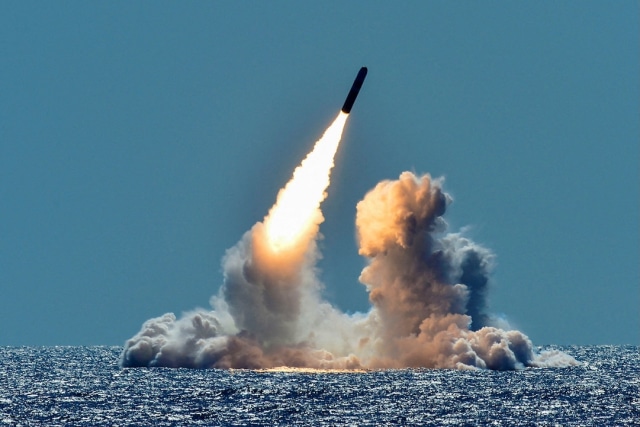
An unarmed Trident II D5 missile is test-launched from the Ohio-class U.S. Navy ballistic missile submarine USS Nebraska off the coast of Californi-a, U.S. March 26, 2018. U.S. Navy/Mass Communication Specialist 1st Class Ronald Gutridge/Reuters
 
"If the president supports, or is willing to tolerate, the prospect of nuclear proliferation by allies, a post-American nuclear order may materialize quickly…Such an outcome would rapidly accelerate Trump’s push to shift defense burdens to allies by diminishing their reliance on U.S. conventional and nuclear deterrence."
"But in doing so, it would also undercut the United States’ influence over allied policies while creating significant new nuclear risks."
Rebecca Lissner/Erin D. Dumbacher, CFR experts, Foreign Policy 

The last remaining nuclear arms pact between Russia and the United States has now expired, leaving no limits on the atomic arsenals of the two largest holders of atomic arms in the world, for the first time in over a half-century. Termination of the New START Treaty took place on Thursday, February 5, 2026, leading arms control experts to the opinion that an unconstrained nuclear arms race may now proceed.

Last year, at a similar expiration juncture, Russian President Vladimir Putin stated his readiness to cement the limits the treaty imposes for another year, should Washington agree. This year, American President Donald Trump appears noncommittal-to-indifferent over extending the Treaty once again, indicating he is holding out for China to become an integral third-party of a new pact. Beijing's response to that expectation was a clear 'not interested'.  

The pact's expiration occasioned President Putin to discuss the matter with Chinese President Xi Jinping the day before the treaty expired, emphasizing the U.S. failure in responding positively to Mr. Putin's recommended overture for another extension for the limitations, emphasizing that Russia "will act in a balanced the responsible manner based on thorough analysis of the security situation".

With the expiration of the New START, the United States and Russia reached an agreement to re-establish high-level military-to-military dialogue following a meeting between senior officials representing both sides that took place in Abu Dhabi, according to the U.S. military command in Europe. New START restricted each side to no greater numbers than 1,550 nuclear warheads on no more than 700 missiles and bombers.

The treaty was signed by then-U.S. president Barack Obama and Dmitry Medvedev, his Russian counterpart, in 2010. The treaty was originally meant to expire in 2021, but had been extended on mutual agreement for an additional five years -- now elapsed. 

"Today, I can reveal that the U.S. Government is aware that China has conducted nuclear explosive tests, including preparing for tests with designated yields in the hundreds of tons."
“China conducted one such yield producing nuclear test on June 22 of 2020,” he said, without providing further details. A former senior US official told CNN that information about China’s 2020 test had been declassified.
"[The Chinese military sought] to conceal testing by obfuscating the nuclear explosions because it recognized these tests violate test ban commitments."
"China has used decoupling – a method to decrease the effectiveness of seismic monitoring – to hide their activities from the world."
U.S. Undersecretary of State for Arms Control and International Security Thomas DiNanno  
https://media.cnn.com/api/v1/images/stellar/prod/gettyimages-2233529223.jpg?c=original&q=w_860,c_fill/f_avif
Land-based intercontinental ballistic missiles at V-day ceremony Tienanmen Square, Beijing, September 3, 2025. Getty Images

Labels: , , , , ,

Monday, February 02, 2026

Terra Nullius, Svalbard: Cold Shore

"Norway now finds itself in the most serious security situation since 1945."
"[Svalbard has for too long been seen by nations as a place where] everyone who wants to can come up and do almost whatever they want."
"That's not the fact. This is Norwegian sovereign territory. So we're making that a bit clearer."
Eivind Vad Petersson State Secretary, Ministry of Foreign Affairs, Norway 
https://csis-website-prod.s3.amazonaws.com/s3fs-public/styles/1400x600/s3/2023-09/GettyImages-1240741560_Crop1.jpg?VersionId=mWKSkGPe0GKiiz9cG_mcY1Bo2xQci7Ps&h=266da715&itok=RNVD8uor
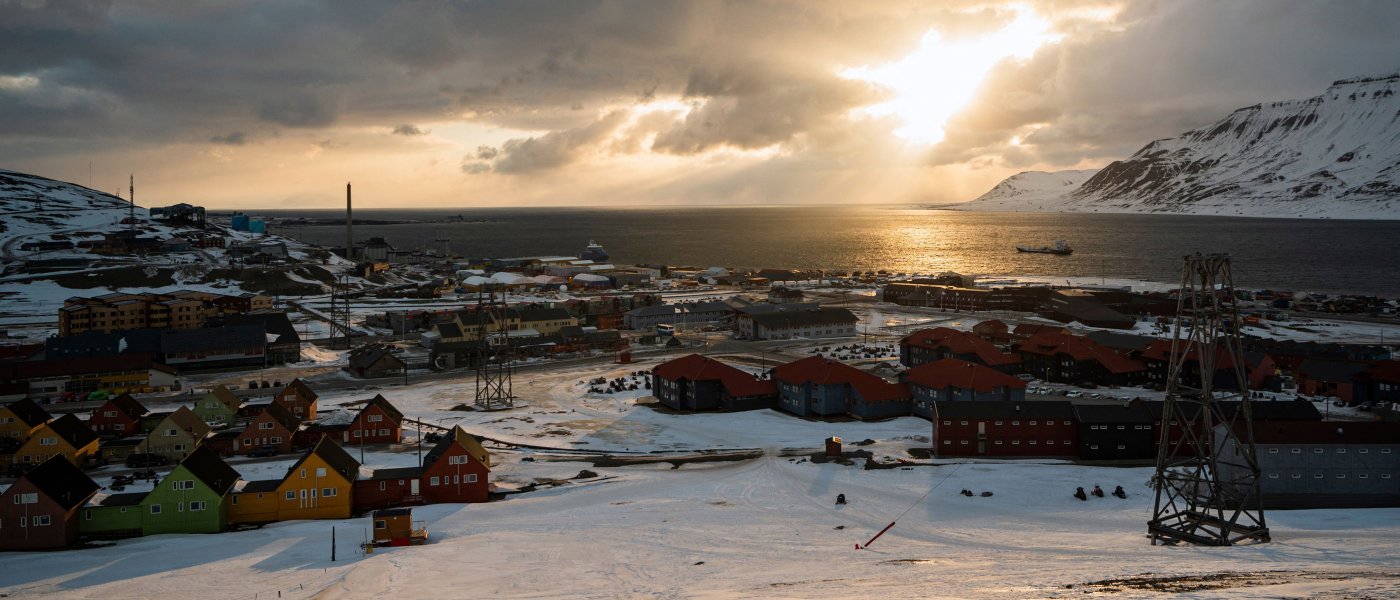
The Svalbard Archipelago   Photo: Jonathan Nackstrand/AFP via Getty Images
 
Following World War 1, Norway's claim to the Arctic archipelago and its islands was officially recognized. The Svalbard Treaty of 1920 banned the presence of activity linked to the military while granting all other nations choosing to sign on to the agreed-upon treaty access to hunting, fishing, mining and land ownership. Over the years, close to fifty countries added their names to the treaty which allowed them access.
 
Of late, studies of the geology of Svalbard and the ocean floor surrounding it have identified vast amounts of copper, zinc, cobalt, lithium and rare earth elements buried in the ocean floor. These are eagerly-sought-after minerals that power electric car battery technologies and wind turbines. It was  generally taken that the Svalbard Treaty granted signatories rights to its surrounding seas and seabed. Until January 2024 when Norway's governing party announced it would pursue deep-sea mineral exploration in an enormous sweep of its seabed.
 
The remote, frigid island, viewed as hostile to human life on a prolonged basis where minus 34 Celsius temperatures were not unknown, were initially home to Norwegian miners and Russian fur trappers. Longyearbyen, Svalbard's largest town, these days boasts candlelit restaurants, hotels, daily flights to the mainland, and is home to 2,500 people from 50 countries. According to the town's mayor, a surge in investment, official visits and strategic attention has recently focused on Svalbard.
 
https://csis-website-prod.s3.amazonaws.com/s3fs-public/styles/original_aspect_ratio_style/s3/2023-09/230913_ERE_Svalbard_Map.jpg?VersionId=6St.B4o5DWrkzOdGqX9xuMpPNfkmFdoO&itok=OWDx1xTK
 
Recently, the Energy Ministry of Norway publicly declared that Norway's goal in exploiting the natural geology of the area had a defined purpose; the goal of "profitable and sustainable" pursuit of seabed minerals, including the seabed around Svalbard. As Norway moves toward consolidating its sovereign rule over the island, its attitude toward foreigners and civil rights has hardened. Foreigners since 2021 were able to cast a vote in the political arena. 
 
That changed when authorities declared that voting in local elections would be off limits to foreigners living on Svalbard if they had not lived on Norway's mainland for the previous three years. "Should have been done a long time ago", said Mr. Petersson. The Svalbard Treaty guaranteed "equal access, not equal rights", he said, pointing out that in other countries foreigners are not given the right to vote. 
 
Svalbard is located about 800 kilometers from the North Pole, one of the only places on Earth where instant connection is possible with polar-orbiting satellites, leading to uninterrupted, clearer feeds and faster downloading speeds; more advantageous than anywhere else on the planet. In fact SvalSat, the world's largest satellite downloading station is based on Svalbard. 
 
https://csis-website-prod.s3.amazonaws.com/s3fs-public/styles/original_aspect_ratio_style/s3/2023-09/GettyImages-1240634673.jpg?VersionId=QZhSaW8ej6MSzDQa6fE02YGYNHnnPq6Z&itok=xu5dbLeF

Telecommunications domes of KSAT, Kongsberg Satellite Services, on a mountain near Longyearbyen. Photo: Jonathan Nackstrand/AFP via Getty Images 

Fur traders from the Pomor region in northwestern Russia arrived at Svalbard some 300 years ago. The Soviets established several coal mining towns in Svalbard a century ago and had signed the Treaty. Of the mining towns, only one, Barentsburg, remains and still operates minimally. Once there was a population of 1,000, now reduced to around 300. One Russian official claimed the archipelago should be renamed the "Pomor Islands".
 
A powerful radar system monitoring space weather and the atmosphere is at the service of Chinese scientists. Data gathered from this equipment have been shared with the China Research Institute of Radiowave Propagation, a Chinese defense organization. Members of the U.S. House Select Commission on the Chinese Communist Party are convinced China is performing military research on Svalbard in defiance of the Treaty proscription. 
 
Outside the Yellow River Station where the Chinese scientists live a pair of granite lions stands guard.  
Norway ordered the Chinese to remove the lions, each of which weighs 900 kilograms, installed 20 years ago when the Chinese government agents arrived on Svalbard. For the first time last summer, the archipelago's sole university,   the University Center, operated by the Norwegian government, barred entry to Chinese students, identified by Norwegian intelligence agencies as a potential security risk. 
 
Criticisms of China's activities represent "nothing but distortion of facts and groundless speculation", according to officials at the the Chinese Embassy in Norway. As for the lions standing guard, they continue to remain where they were placed two decades earlier. 
"While the Russian geopolitical threat remains paramount, Chinese encroachments facilitated by an isolated Russia may complicate the Arctic security landscape in the longer term. The coast guard agencies of Russia and China recently signed a cooperation agreement on strengthening maritime law enforcement to great fanfare in Murmansk, a city on Russia’s western flank close to Norway."
"Moreover, when all other Arctic coast guard agencies suspended their participation in the Arctic Coast Guard Forum, Russia invited China to join the forum—clear signs of China’s expanding presence in the High North."
"As Iris A. Ferguson, U.S. deputy assistant secretary of defense for arctic and global resilience, has put it, Chinese efforts aim “to normalize its presence and pursue a larger role in shaping Arctic regional governance and security affairs.”"
Center for Strategic and International Studies  
https://www.thearcticinstitute.org/wp-content/uploads/2019/12/Lenin-statue_Pyramiden-Svalbard.jpg
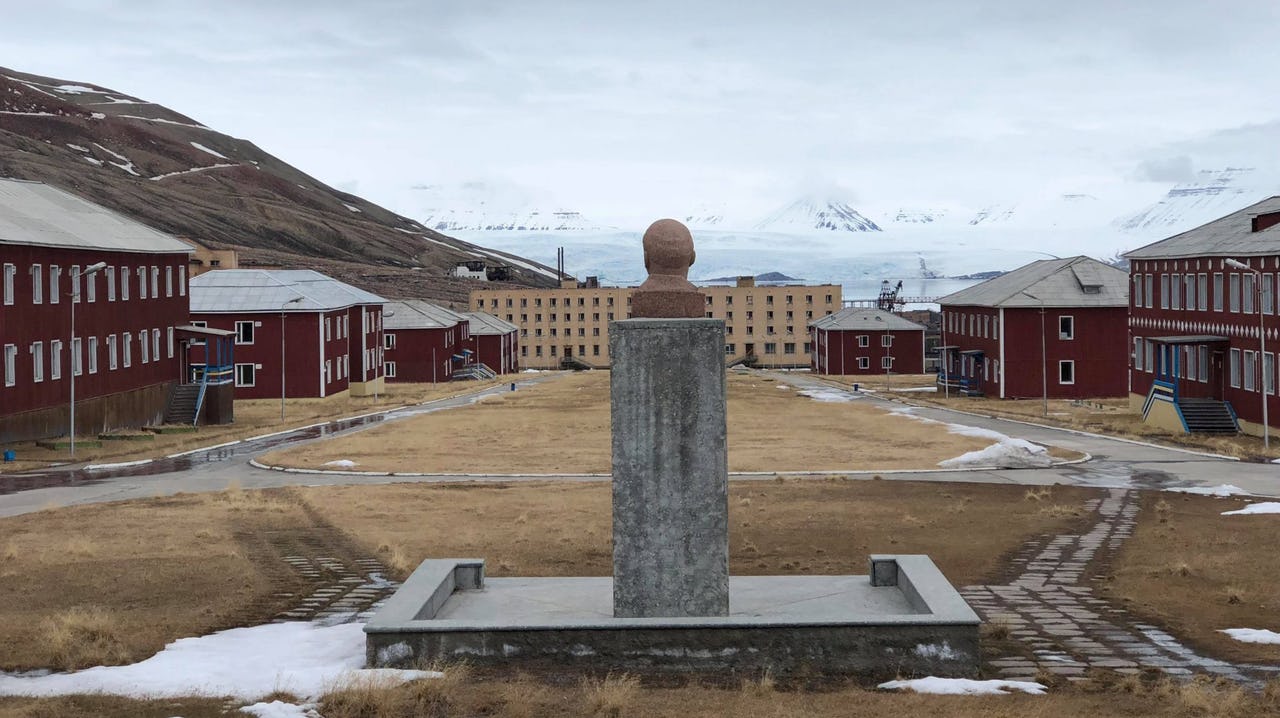
The world’s northernmost Lenin statue looks over the abandoned Russian city of Pyramiden on Svalbard, summer 2018. Photo: Alina Bykova
 

Labels: , , , , ,

Friday, January 30, 2026

Canada, Diminished and Faltering

"One could argue that we've lost that unifying sense of right and wrong."
"The very sense of [the] liberal, permissive, non-judgmentally embracing society that our countries were fundamentally founded on is now being openly exploited for the purpose  of reshifting the balance." 
Former Vice-Chief of the Canadian Defence Staff, Mark Norman
 
"Symbolic politics has never been sufficient, it is a sign of weak leadership. Condemnations without enforcement, statements without consequences and gestures without policy are not leadership."
"Canadians do not need additional legislation layered over existing statutes. We need the consistent application of the laws already in force.e"
"Canada is lost and no longer immune. A nation cannot remain open if it forgets how to be a nation. The choice is not between tolerance and cohesion. It is between a confident pluralism anchored in shared civic norms, and a politics of endless accommodation that dissolves the very framework that makes diversity possible."
Larry Maher, CEO, Exigent Foundation
https://smartcdn.gprod.postmedia.digital/nationalpost/wp-content/uploads/2024/12/protest-prayer-1.jpg?quality=90&strip=all&w=564&h=423&type=webp&sig=cR05VijxOvQxlyMLZ2mhaQ
 
It took no more than a  decade to fundamentally alter Canada, reverse many of its values, not the least the outstanding human right assurance of equality and rights under the Canadian Charter of Rights and Freedoms. With that assurance came the expected responsibility of each member of society to respect the social contract that ensured equal opportunities (if not equal outcomes) to succeed and prosper for Canadian citizens who obeyed Canadian laws and whose experience in the general education system helped them to understand their citizen obligations to the country. 
 
In an earlier era those rights and obligations were unevenly applied and issues of discrimination against minority groups reflected a European heritage of entitlement and belittlement of the exotic 'others' who had made their way into North America, many as refugees fleeing persecution and conflict. Under moderately good governance evinced by leaders who at best understood their own guiding obligations to the people they served, laws were passed that ushered Canada into an era of fair justice and social cohesion.
 
Migrants from abroad who entered Canada in the first half of the 20th century as immigrants from impoverished backgrounds to make a home for themselves in a new country where opportunities abounded worked hard, obeyed laws, and accommodated themselves to a new culture with values that suited their own notions of being and belonging. Canadian authorities refined immigration rules to eventually reflect Canada's needs in a point system that rewarded education, professional qualifications, age suitability and an assessed philosophical fit.
 
A succession of Liberal governments in more recent times gradually morphed toward the kind of liberal progressivism that loosened qualifications and requirements of suitability to join the Canadian population. Sympathy for people searching for haven from authoritarian governments, from endemic poverty, from societal crime rates, from conflict zones opened the gates of entry to Canada wide, including the refugee class and illegal migrants who bypassed normal entrance procedures to declare themselves refugees. 
 
https://smartcdn.gprod.postmedia.digital/nationalpost/wp-content/uploads/2026/01/CP175643100-1.jpg?quality=90&strip=all&w=564&h=423&type=webp&sig=6A6W4-uztecW2wA-YBVNKQ
 
The intake swelled, fulfilling what government and business leaders professed to be a need to replace an aging, low-child-bearing population with new recruits to build Canada's working population. Entry to the country no longer relied on screening for adaptability and suitability for integration into the prevailing culture, its values and its laws. To the point where landed immigrants and new citizens openly declared their defiance of those values and accompanying laws, bringing havoc and division and open discrimination to the very streets of the cities throughout the country where they settled in influential numbers.
 
Newcomers to the country felt no loyalty to the country that had adopted them and there were no expectations from government that they should integrate and accept the prevailing social order as it was. Instead religious and ideological divisions erupted and with no amending reaction from government and institutions at any level, those divisions deepened, becoming more publicly expressed, including through deliberate acts of law-breaking.   
 
Canadians of long standing were treated to displays of overt challenges to the  public order in universities and cultural institutions where mass protests took to the streets, bringing foreign campaigns, conflicts, ideological convictions averse to Canada's own, to the fore, with no government intervention at any level. All the while Canada congratulated itself as a bastion of liberal democracy. Politicians rather than applying themselves to Canada's and its populations' defense, eyeing the numbers of voluble protests and the votes they represented, chose appeasement of activist groups.
 
https://static01.nyt.com/images/2026/01/17/multimedia/17canadaletter-CX-mfgv/17canadaletter-CX-mfgv-superJumbo.jpg?quality=75&auto=webp
Canadian PM Mark Carney : China's President Xi Jinping AP
 
And from the outside world, lax attention to the actions of foreign powers that invaded Canada's sovereignty through the infiltration of foreign agents acting on their behalf on the social, academic and political levels exercised the 'soft power' of authoritarian regimes and of extremist movements, effectively interfering in Canada's politics as well as the social contract unique to Canada. Russia, China, Iran, 
Qatar, Turkey and the Muslim Brotherhood all have made an indelible impact within Canada with their malign presence. 
 
The moral, institutional foundations of Canada's principles of equality and human rights have been assailed by Islamist, Marxist, socialist and other radical engagements in destabilizing Canada, as well as other Western nations they have entered both legally and under the radar. What all these Western nations appear to have in common is an attitude of oblivious disinterest in the interference and subtle changes being wrought in normalizing abnormal social behaviour and its effect on their institutions.
 
The exploitation of liberal societies, priding themselves on their Democratic principles of inclusion appear willing to accept the slow erosion of their adherence to the public weal rather than risk being labelled racist, exclusionary or 'Islamophobic'. Identity politics, moral relativism, and DEI guide governments content to do nothing in response to the unravelling of their nations' stability and social coherence. If there is a solution to Western democracies' inaction in the face of this dilemma, it has not yet shown its face. 
 
https://universityaffairs.ca/wp-content/uploads/2024/11/644x374-McGill-supporting3.jpg
Canadian universities have seen a surge of pro-Palestinian protests following similar demonstrations across North America.  University Affairs
 

Labels: , , , , , , , , ,

Thursday, May 22, 2025

Militarizing Space -- Oblivious to Malevolent Internal Threat

"[The new American 'Golden Dome' defence system will] deploy next generation technologies across the land, sea and space, including space-based sensors and interceptors."
[The Trump administration is prepared to work with Canada on] pricing [and] they'll pay their fair share."
"We are dealing with them on pricing. They know about it very much."
U.S. President Donald Trum
 
"[Canadians gave Prime Minister Mark Carney] a strong mandate to negotiate a comprehensive new security and economic relationship with the United States." 
"To that end, the prime minister and his ministers are having wide-ranging and constructive discussions with their American counterparts."
"These discussions naturally include strengthening NORAD and related initiatives such as the Golden Dome."
Prime Minister's Office 
https://i.cbc.ca/1.7506442.1744244556!/fileImage/httpImage/image.JPG_gen/derivatives/16x9_1180/donald-trump.JPG?im=Resize%3D780
President Donald Trump says Canada has asked to join the U.S. missile defence program. (Nathan Howard/Reuters)
 
The new missile defence system that the U.S President has announced to the world is touted to have far more advanced technology than anything in its class heretofore, including the ability to ward off missiles and even threats from outer space. The multilayered system has been costed at US$175 billion, according to the president, to be completed within his term, ending in 2029. The system, the president emphasized, will have the capability of intercepting missiles launched from the other side of the globe, or even from space.
 
The 'Golden Dome' has been in the works since President Trump's first administration, when critics panned it as too expensive, and too complicated to deploy over such a large land mass. Based on Israel's "Iron Dome" defence network, the American updated version is on the cusp of operability. Mr. Trump's cost claims aside, the Congressional Budget Office estimates just the space-based components alone could cost up to US$542 billion over 20 years. 

For years the Pentagon issued warnings of the newest missiles developed both by China and Russia, to be sufficiently advanced to require updated countermeasures. Satellites and interceptors, where the bulk of the program's cost lie for the Golden Dome, are to be focused on stopping those very same advanced missiles early, or in the midst of their flight. Golden Dome's space-based weaponry "represent new and emerging requirements for missions that have never before been accomplished by military space organizations", stated head of the U.S. Space Force, General Chance Saltzman.
 
Offensive Chinese and Russian satellites with the capacity to disable critical U.S. satellites have the potential to make the United States vulnerable to attack. It was revealed through the United States last year that Russia was developing a space-based nuclear weapon able to loiter in space for long periods, then be triggered to release a burst to destroy satellites in proximity. Trump mentioned he had not yet discussed the issue with Russian President Vladimir Putin "but at the right time, we will".
 
https://smartcdn.gprod.postmedia.digital/ottawacitizen/wp-content/uploads/2025/05/trump_295698273.jpg?quality=90&strip=all&w=564&type=webp&sig=VzAl2LEm9ijWVXbwJ7RFzg
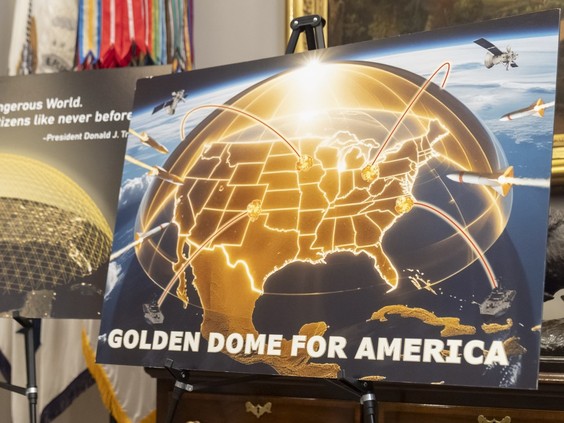
Posters for the proposed Golden Dome for America missile defense shield are displayed before an event with President Donald Trump in the Roosevelt Room at the White House. Photo by MARK SCHIEFELBEIN /AP
 
A joint statement by Russia and China issued earlier in the month spoke of the Golden Dome as "deeply destabilizing in nature", with the warning it would transform "outer space into an environment for placing weapons and an arena for armed confrontation"
 
President Trump's repeated complaints of the U.S. protecting Canada, and his calls for more Arctic security to push back on an increase in Russian and Chinese presence in the region, have led to the new Canadian administration becoming more attentive to the situation. According to some experts Mr. Trump's musing threats of annexation of Greenland and Canada could be rooted in part in concerns over the Arctic.
 
What if, just what if the threats seen to be posed by Russia and China toward North America are for the most part rooted in trade advantages and a challenge to a unipower represented by the United States dominating world affairs? As opposed to the equally imminent and possibly in the long view more dangerous threat constituted by the ongoing infiltration through immigration, migrant and refugee intake sweeping the West from Europe to North America, Asia and Africa by Islamist jihadists whose numbers are overwhelming and whose dedication to conquest is unquenchable?
 
https://i.cbc.ca/1.7541699.1747957222!/cpImage/httpImage/image.jpg_gen/derivatives/16x9_1180/trump-golden-dome.jpg?im=Resize%3D780
Experts say U.S. President Donald Trump's proposed Golden Dome missile defence system could take decades to build and cost hundreds of billions of dollars. (Alex Brandon/The Associated Press)

Labels: , , , ,

Saturday, February 22, 2025

Sounds Like an Approach to Regional Conflict...

"There must be a U.S. backstop because a U.S. security guarantee is the only way to effectively deter Russia from attacking Ukraine again."
U.K. Prime Minister Keir Starmer
 
"Russia is preparing for a long war. They have now three times the manpower and their defence industry is moving quicker than that of Europe."
"Does anybody believe that this is only aimed at Ukraine?"
"What is the use of security guarantees from a weak party? Europe needs to muscle up right now to be actually able to provide security guarantees that will hold."
Lithuanian Defence Minister Dovile Sakaliene
French President Emmanuel Macron, right, and British Prime Minister Keir Starmer attend ceremonies marking the 106th anniversary of the Armistice, a celebration of their countries' friendship, as nations across the world pay tribute to their fallen soldiers in World War I, on Nov. 11, 2024 in Paris, (AP Photo/Michel Euler, Pool File)
UK PM and French President at 106th anniversary of Armistice Day. Nov2024   AP

In Europe, political and military leaders are busy fleshing out details of a plan for European forces -- on the sidelines of the United States and Russian talks, to which Ukraine has not been invited -- to vigilantly prepare to ensure that Moscow will not attack again. The issue of a united European force is likely to be high on the agenda when U.K. PM Keir Starmer and French President Emmanuel Macron visit Washington for talks with U.S. President Donald Trump, next week.
 
The proposed force would only be workable if the U.S. military could be relied upon for backing, and persuading Donald Trump to that opinion will be a difficult proposition. What Ukrainian President Volodymyr Zelenskyy is really invested in is NATO membership to ensure the security guarantee he is looking for. Yet while NATO's European members are fully invested in backing Ukraine in its NATO ambition, it seems the U.S. has no intention of paving the way for Ukraine in NATO.
 
With NATO membership closed off to  him, Zelenskyy feels that over 100,000 European troops would be required to guarantee the conflict will not flare up once more following a ceasefire. According to Western officials what is under discussion is not an army of peacekeepers to be posted along the 1,000 kilometr front line in Ukraine's east, but rather a "reassurance force". Fewer than 30,000 European  troops on the ground in Ukraine, distant from the front line at key infrastructure sites, backed with western air and sea power is what the UK and France envision.
 
The front line would, under the plan, be monitored remotely. Based outside Ukraine, air power would be in reserve for the purpose of deterring breaches and to reopen Ukrainian airspace to commercial flights. Presumably U.S. air power could be included, in the opinion of the U.K.'s Starmer. However, U.S. Defence Secretary Pete Hegseth informed European allies "there will not be U.S. troops deployed to Ukraine", without completely ruling out U.S. support like air transport or logistics.
 
French President Emmanuel Macron speaks with Ukrainian soldiers in a military camp in eastern France, Wednesday, Oct. 9, 2024. (AP Photo/Thibault Camus, Pool File)
French President Macron speaks with Ukrainian soldiers at military camp in France, Oct2024  AP

"Different people in the administration are sending different signals ... Who do you believe, is an issue", commented former senior NATO official Jamie Shea. The closest NATO countries in proximity to Russia, the U.K., France, the Nordic and Baltic states, are likely to be assigned the major roles in any such force as is being proposed. Poland, a key logistics base for support to Ukraine since Russia's invasion does not intend to send  troops into Ukraine, according to Polish Prime Minister Donald Tusk.
 
German Chancellor Olaf Scholz commented that discussion of a Europe-led security force is "premature", and he was "a little irritated" that peacekeeping forces were being discussed "at the wrong time", insisting NATO, and not an independent European force, must remain the foundation of Ukrainian security. Russia has a fighting force of some 600,000  troops in Ukraine; according to analysts any ceasefire leaving the bulk of that force in place would be a guarantee of renewed conflict.
 
The French military is comprised of just over 200,000 personnel, the U.K.'s fewer than 150,000; Europe would struggle to mount a force of even tens of thousands, according to Matthew Savill, director of military sciences, Royal United Services Institute. 

https://dims.apnews.com/dims4/default/9977b3f/2147483647/strip/true/crop/7463x4975+0+0/resize/1440x960!/format/webp/quality/90/?url=https%3A%2F%2Fassets.apnews.com%2F24%2Ffb%2Fe96730ab3ca411b214cd153ed15b%2Ff466599babfe459eaf86407dfc0afbbd
British PM Keir Starmer speaks to British soldiers at base in Cyprus, Dec.2024   AP
 

Labels: , , , , ,

Tuesday, December 17, 2024

Georgia, Appealing to Canada for Help

"We are straightforwardly moving towards Russia."
"They're arresting doctors, beating journalists, and threatening to close down the opposition media."
"I do remember the time when the Soviet Union was collapsing and they were dispersing demonstrators, but they never did anything like this. This is brutal."
"[And, because few countries recognize Georgian Dream's re-election as legitimate], there are no institutions that will follow their orders except the police and special forces."
"But they are using special forces against people. We have this generational trauma already. And this just adds to our trauma even more."
Maya Purtskhvanidze, activist, Georgian Women's Initiative Group 

"The criminal acts of inhuman and degrading treatment and targeted persecution of peaceful protesters, as depicted in the video footage distributed by the media are disturbing."
"The video footage and information released clearly reveal numerous episodes of unjustified use of special equipment against protesters, including politicians as well as journalists and detainees, cases of alleged unjustified detention, direct intent to commit violence, and targeted persecution during the dispersal of the peaceful protest."
Public Defender of Georgia statement
 
"By suspending Georgia's EU accession process, Georgian Dream has rejected the opportunity for closer ties with Europe and made Georgia more vulnerable to the Kremlin."
"It's a textbook Russian way of destabilizing civil society and establishing dictatorship and the regime of the country."
"First, they attack international organizations, watchdog organizations, political parties, and human rights defenders."
"All the boxes are checked right now."
U.S. State Department
https://assets1.cbsnewsstatic.com/hub/i/r/2024/12/12/798f17c6-9c5b-4820-8286-2c2ea8b995a2/thumbnail/1240x826/6194cdbf604f49a309fd3fe92b4e56b2/georgia-protests-russia-tibilisi-2188828864.jpg?v=564e83c5974b3893ba1bcac5fe5947af
Pro-European Union demonstrators hold Georgian and EU flags during a protest against the government's postponement of European Union accession talks until 2028, outside the Parliament in central Tbilisi, Georgia, Dec. 11, 2024. Jerome Gilles/NurPhoto/Getty

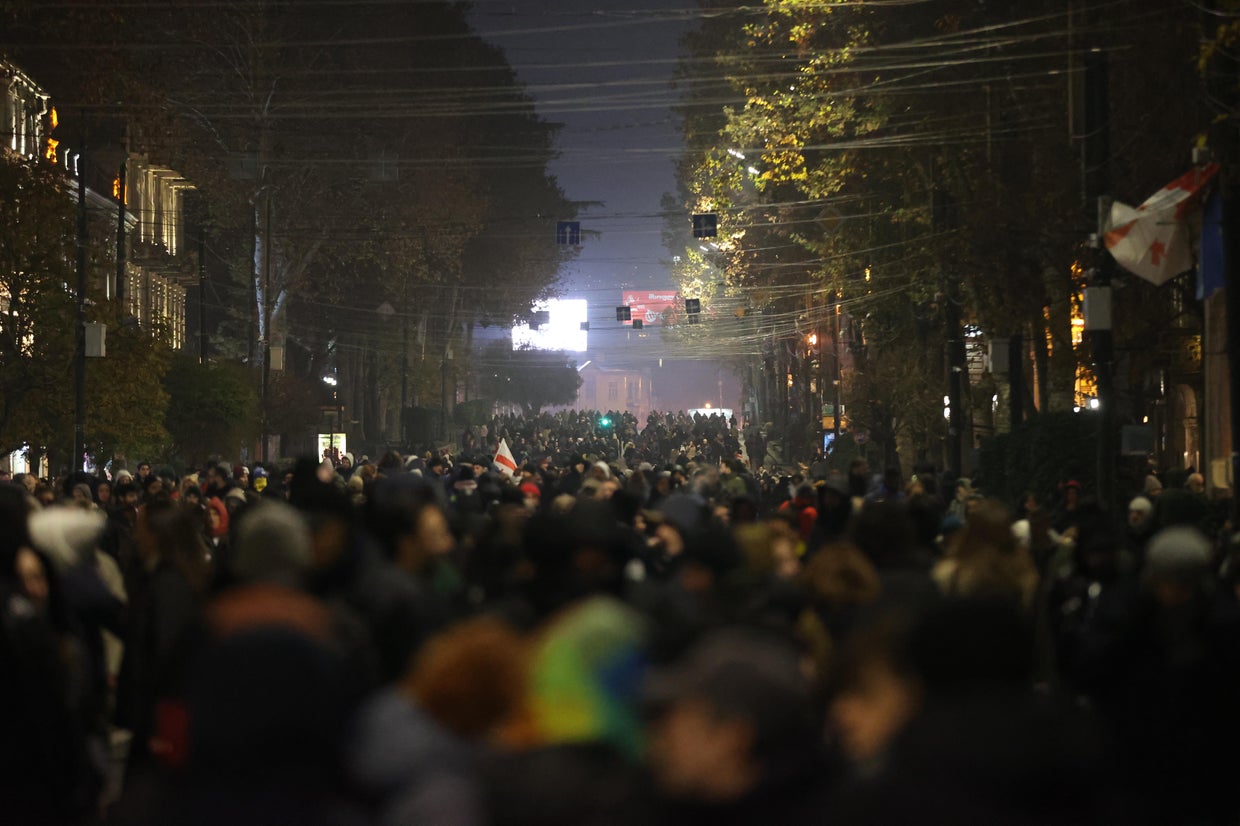
Violent protests of Georgian citizens against vote-rigging in their recent election, allied with the decision by the leading governing party, Georgian Dream, to abandon the country's talks of joining the European Union, seem like a reprise of a similar situation a decade earlier in Ukraine. The reversal is that Ukraine wanted to join the EU, and to create a separation between itself and Russia, and in Georgia the ruling party is moving closer to Russia, abandoning the country's aspiration to join the European Union.

Weeks of protests in the country of 3.7 million people has seen Tbilisi punished by an increasingly authoritarian government re-installed by the election on October 26 in parliamentary elections ostensibly favouring Georgian Dream. Voter intimidation, vote-buying allegations and associated voting irregularities were reported by the OSCE Office for Democratic Institutions and Human Rights.

Georgian Dream, in its 12th year in government, announced a day following the election its intention to halt accession talks with the EU until some time in 2028. This, despite its constitution which promises to pursue full integration into the European and NATO. The European Parliament had issued a resolution critical of the election it characterized as unfair. The EU suspension announcement saw a wave of protests and a violent response in the past several days where tear gas, water cannons and police beatings broke up the protests.

In recent weeks, a constitutional institution independent from government, the Public Defender of Georgia, spoke with 327 detainees who were injured during the protests. Of that total, 225 protesters spoke of ill-treatment suffered from the police, with 157 of that number having visible injuries. "I don't know why the government thought they had to use force", said Moreta Bobokhidze, a Georgia activist.
 
https://assets3.cbsnewsstatic.com/hub/i/r/2024/12/12/a3c654e4-6c8e-4aec-9fd0-92ebd04fff16/thumbnail/1240x826/7a79a0146c1954898e2d283f1aa0058e/georgia-protest-tibilisi-eu-russia-2188834372.jpg?v=564e83c5974b3893ba1bcac5fe5947af
Protests over delays in the country's European Union negotiations have stretched into their 14th consecutive day, as demonstrators demand swift action from the government to advance membership talks, in Tbilisi, Georgia, Dec. 11, 2024. Davit Kachkachishvili/Anadolu/Getty
 
A 28-year-old film and theatre actor, Andre Chichinadze, was arrested when 6 police officers appeared at his house. He was arrested on charges of organizing, leading, participating and publicly calling for violence. His mother explained: "He was just standing in the front line, right in front of the police or the mob, because there were girls he was trying to protect." The government's intention to suppress peaceful protest, intimidate the public and "target positive faces" is part of its plan to subdue protest.
"They could have arrested him during the demonstration, but no. They specifically organized this home arrest and created this propaganda around him as if they were investigating something."
"For so many years, people were patient, or trying to be patient, because they didn't want to fight on the street, they didn't want to demonstrate."
"They wanted peaceful development."
Maya Purtskhvanidze
The public is fearful that suspension of EU accession talks would result in an increasingly vulnerable Georgia, ripe for Russian interference. In desperation, activists in Georgia have called on the Canadian government to "publicly condemn backsliding in Georgia, support targeted sanctions on officials responsible for undermining Georgia's democratic integrity, advocate for peaceful protests and bolster Canadian support for Georgia's Euro-Atlantic integration".
"Canada remains open to co-operation with Georgia, as long as the Georgian leadership respects democracy, human rights, rule of law and addresses the recent democratic backsliding."
"We call for calm by all parties and for the Georgian authorities to respect the rights and security of individuals in the context of peaceful protests."\
"[There is a need for] free, fair and independent elections [in democratic societies]."
Canadian government statement
Canada itself is undergoing a situation not entirely dissimilar to Georgia's. The current Liberal government of Prime Minister Justin Trudeau is dysfunctional and has led the country into financial ruin, exacerbated relations between its disparate provinces, mismanaged immigrant intake so that housing, medical care, social services are well beyond breaking point. Rising crime, religious, ethnic turmoil has taken over the streets, while the governing body does nothing to put a stop to the chaos and violence. Hardly the country to turn to for help in Georgia's travails.

Georgia fears the smothering tentacles of  the Russian Federation with designs to once again incorporate Georgia into a greater union with Russia to fulfill Russian President Vladimir Putin's wish to emulate the Soviet Union's control of its eastern European neighbours. Canada, on the other hand, is concerned and restive over a change in the Presidency in Washington that will impact, they fear, deleteriously on Canada's trade and independence. 
 
Perhaps Canada should call on Georgia to condemn the Canadian Prime Minister's refusal to step down from high executive office in favour of alternative governance to return Canada to its center of gravity as a law-abiding, secure and equality-ensuring nation. The vast majority of the Canadian voting public has no trust in this government led by a man whose vision is that of a 'post-National' country whose values, laws, culture and history is to be erased.

https://substackcdn.com/image/fetch/w_1456,c_limit,f_webp,q_auto:good,fl_progressive:steep/https%3A%2F%2Fsubstack-post-media.s3.amazonaws.com%2Fpublic%2Fimages%2F27ae974d-0915-46ce-a03f-45dea055a19e_1024x712.jpeg
Pro-Palestine supporters at a Hands Off Rafah rally in Edmonton, Alberta, on March 10, 2024. (Artur Widak via Getty Images)

Labels: , , , , , ,

Wednesday, November 20, 2024

Fibreoptic Cables in the Baltic Sea

"[The incidents are] a very clear sign that something is going on here."
"Nobody believes that these cables were accidentally severed."
"We have to state, without knowing exactly who it came from, that this is a hybrid action."
"We also have to assume ... that it is sabotage."
Boris Pistorius, German defence minister
https://ichef.bbci.co.uk/news/1024/cpsprodpb/156b/live/9d549f70-a5e4-11ef-b819-899019350076.jpg.webp
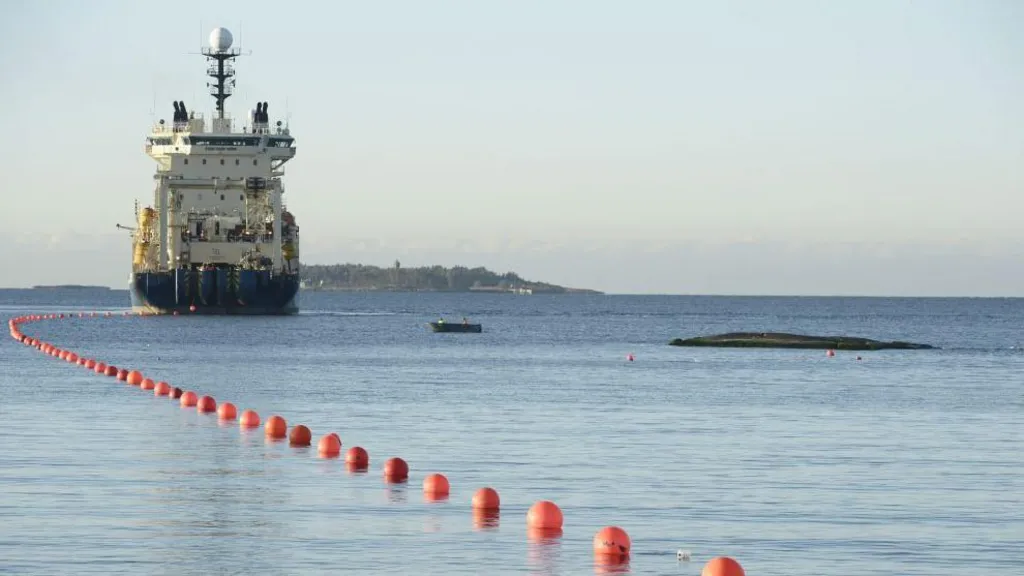
The undersea cable between Helsinki and Rostock was laid in 2015   Getty Images
 
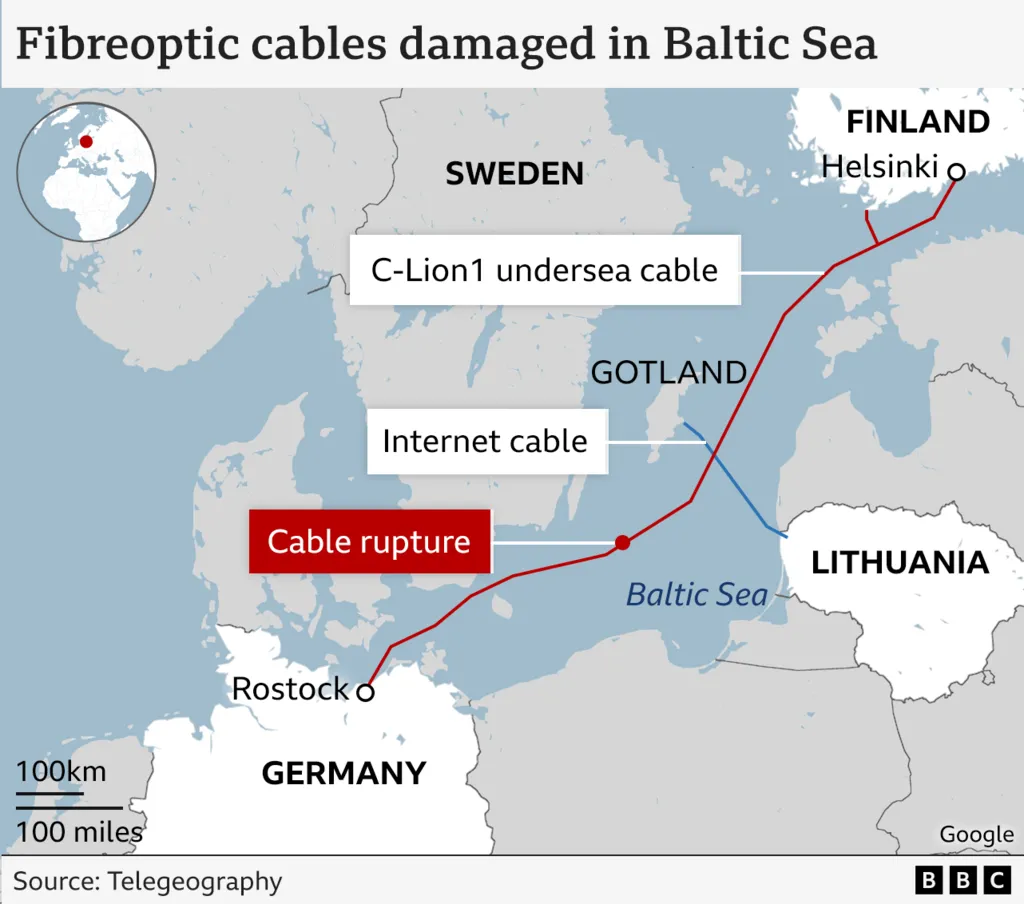
The C-Lion1, two undersea internet cables linking Finland and Germany, saw completion in 2016, a 1,175-kilometre undersea cable providing telecommunications connectivity between Central Europe and the Nordic countries. Germany's minister of defence stated that the two undersea internet cables disruption appear to have been deliberate acts of 'sabotage'. Tension are already high across eastern Europe and this incident will only serve to raise them even higher. 

The cable operator, Cinia, reported the underwater communications cable functioning to connect Finland and Germany had been severed early Monday. A separate communications cable linking Lithuania and Sweden, in the Baltic Sea as well, had sustained damage a day earlier. What precisely occurred with the two cables is not yet fully clear, but German defence minister Pistorius suspects the damage was deliberately inflicted.
 
The Finnish C-Lion1 cable operator, Cinia, stated that the 'cut' to its communications cable had been detected after 4:00 a.m. on Monday, east of the southern tip of the Swedish Island of Oland. A vessel was dispatched after due preparation, to repair the damage, while the firm is conducting an investigation. 
 
While the Finnish and German foreign ministers stated that they remained "deeply concerned", neither official assigned blame for the severed cable.
"The fact that such an incident immediately raises suspicions of intentional damage speaks volumes about the volatility of our times."
"Our European security is not only under threat from Russia's war of aggression against Ukraine, but also from hybrid warfare by malicious actors."
Joint statement, Finnish and German foreign ministers
https://ichef.bbci.co.uk/news/1024/cpsprodpb/91ff/live/f6696060-a66a-11ef-a4fe-a3e9a6c5d640.png.webp

Labels: , , ,

Tuesday, November 05, 2024

"And we're not taking the Russian threat seriously."

"We absolutely need to be clear-eyed that Russia considers us an enemy. This goes beyond Russia's desire to conquer Ukraine."
"It's waging this war on Western democracies as a whole. The idea is not just to be allowed to win in Ukraine. It would be a big mistake to draw the lesson that if we maybe stop helping Ukraine, things will be fine and we're going to go back to a normal relationship with Russia."
"I think what's much more likely are things getting blown up in countries that are closer to Russia in eastern Europe. [Russia wants to signal] that maybe it's not worth it for NATO to defend three small Baltic countries. It's definitely a test of NATO's resolve."
Maria Popova, associate professor of political science, McGill University
https://d3i6fh83elv35t.cloudfront.net/static/2024/11/GettyImages-2168429568-1200x798.jpg
Associated Press
"[Western security officials] believe that two incendiary devices, shipped via DHL, were part of a covert Russian operation that ultimately aimed to start fires aboard cargo or passenger aircraft flying to the U.S. and Canada, as Moscow steps up a sabotage campaign against Washington and its allies."
"Investigators and spy agencies in Europe have figured out how the devices -- electric massagers implanted with a magnesium-based flammable substance -- were made and concluded that they were part of a wider Russian plot." 
"[Security officials are saying the devices] sent to the U.K. from Lithuania, appear to have been a test run to figure out how to get such incendiary devices aboard planes bound for North America."
The Wall Street Journal
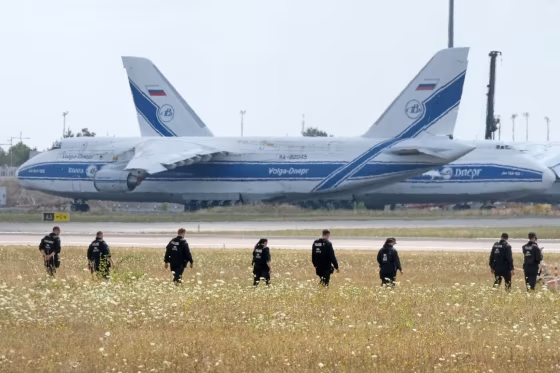
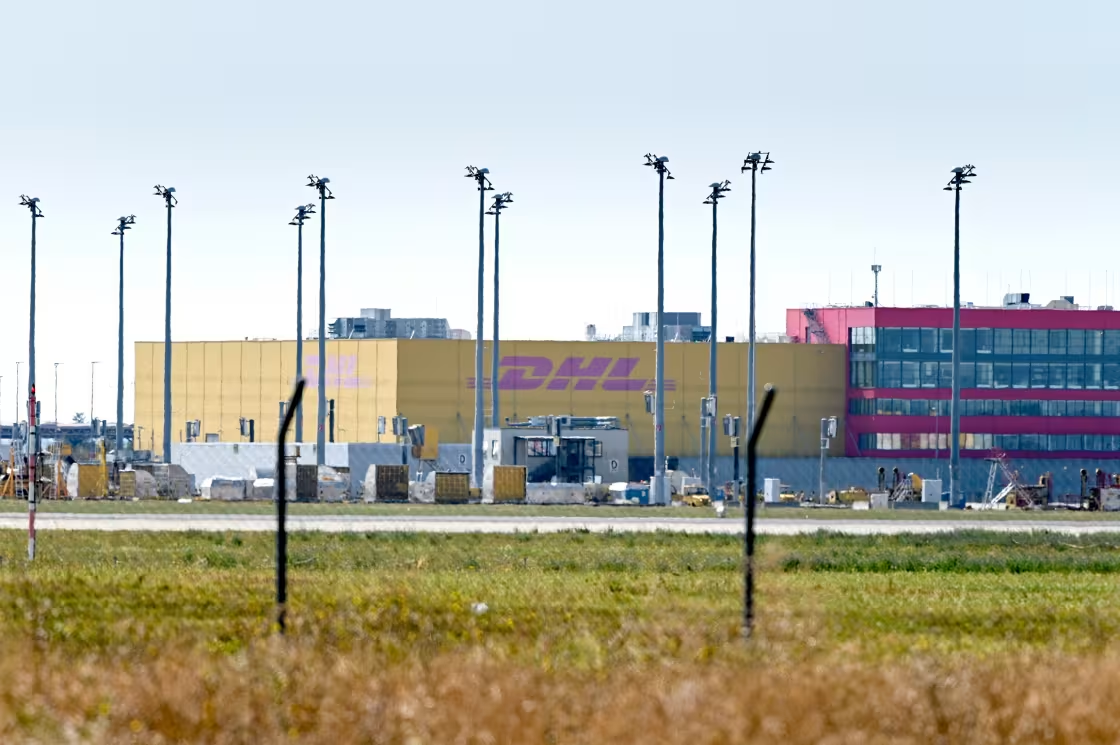
According to the Wall Street Journal, the devices in question alarmed authorities when they ignited at DHL logistics hubs in Leipzig, Germany and Birmingham England this past July: "The explosions set off a multinational race to find the culprits." Subsequently four people were arrested by Polish authorities in connection with the fires, and "charged them with participating in sabotage or terrorist operations on behalf of a foreign intelligence agency".
 
https://i.cbc.ca/ais/026d191d-abff-42cd-b6c5-19f0a22633a5,1729905962691/full/max/0/default.jpg?im=Crop%2Crect%3D%280%2C0%2C1919%2C1079%29%3BResize%3D%28620%29
Authorities in Poland have arrested four people in connection with an alleged plot to mail explosives to Canada and the United States. CBC still from video
 
"We have never heard any official accusations" of Russian involvement was the response by a Kremlin spokesman. As in: 'who ... us? ...' And according to Maria Popova, the Russia expert, the plot now revealed is meant to bring down aircraft on their way to Canada and the United States, but its purpose is not just related to Western opposition to the Russian invasion of Ukraine, but to completely erode Western democracies altogether, as inimical not only to the Kremlin's ambitions of territorial and influence expansion, but to remove the source of opposition entirely.

There will be, Ms. Popova predicts, an escalation of "hybrid attacks meant to chip away and erode NATO's unity". To that end, one possibility is that Canada will be confronted with "hostile moves" from Russia in the Arctic. "We're not fully aware that Russia is aggressive as opposed to insecure and defensive".  
"[The West keeps] hoping that restraint on our part will create goodwill in Russia, and I think that is just fundamentally mistaken. Only strength on our part can create respect and can contain Russia."
"They see that we're not, in fact, shoring up our capability to ... defend the Arctic. We're continuing to count on the NATO umbrella and count on the fact that the United States provides security for us."
"And we're not taking the Russian threat seriously."
Maria Popova, Russia expert
https://media-cldnry.s-nbcnews.com/image/upload/t_fit-560w,f_avif,q_auto:eco,dpr_2/rockcms/2024-11/241104-Leipzig-Germany-DHL-logistics-center-ac-728p-dcf1db.jpg
The DHL Air Hub, the air freight center at Leipzig/Halle Airport in Germany.   Heiko Rebsch / picture-alliance/dpa/AP file

Labels: , , , , ,

Saturday, September 21, 2024

Canadian Arctic -- Defend It Or Lose it

"I look forward to seeing those actions [Canadian Liberal government promises of new fighter jets and submarines] but there's not a history of [Canada] taking those actions."
"There is no sense of urgency, for the most part, from the leadership of the government of Canada. It is easy to say we're going to buy F-35 [fighter jets], we're going to buy submarines. But with that comes a lot of requirements to build infrastructure, set up logistics pipelines, set up training pipelines."
"And my question is, is Canada ready to do that?"
U.S. (ret) General Glen Vanherck, former commander NORAD
 
"[Alliances like NORAD and NATO are particularly important with authoritarian leaders like Russia's Vladimir Putin] on the prowl [but Canada's part in those groups is] sorely lacking."
"You have to contribute your fair share and, quite frankly, Canada, over the last nine to ten years has not done so."
"There's one issue that seems to galvanize and unify [U.S.] Republicans and Democrats, both in the House of Representatives and the Senate. That is their concern and dismay over Canada's paltry contributions to international peace and security and the unacceptable -- and I'll use that word again, unacceptable -- levels of money spent on defence capabilities."
"[The Army is short 16,000 personnel, while] 70 percent of the army's vehicles don't work because they're either waiting for spare parts or they don't have the mechanics to fix them."
"Half our Navy's fleet, their ships can't actually set sail because they don't have the sailors or the spare parts to get them out of port."
Retired Canadian General Andrew Leslie, former Liberal MP
 
"[The U.S. Defense Department] is focused on fighting the away game, hamstringing the commander of NORAD, U.S. Northern Command [USNORTHCOM], and belying the vulnerability of our homeland."
"As the Middle East missions evolved -- ISIS, al Qaeda, the Taliban, whatever it was -- Russia began flexing its muscles with each and every incursion into the air defence identification zones of Canada and the United States."
"They approach our coastlines from all sides. They still do. And the most recent incursions -- include Chinese aircraft along with them."
"I have long said, where you see the intersection of Russian and Chinese interests, especially in military cooperation, we should be worried."
Retired Major General Scott Clancy, formerly NORAD director of operations
https://i.cbc.ca/1.3776785.1678031639!/fileImage/httpImage/image.jpg_gen/derivatives/16x9_780/canada-sovereignty.jpg
A Canadian part-time military volunteer drives over the frozen sea past an abandoned landing craft off Cornwallis Island, Nunavut on April 9, 2006. (David Ljunggren/Reuters)
 
A Mackenzie Institute forum on security in the Arctic taking place in Toronto brought together speakers all of whom contended Canada has a requirement to expeditiously increase lagging investment in defence, or risk seeing its control slip away of the Canadian Far North, leaving it in the hands of foreign adversaries. The Canadian Arctic comprises about 40 percent of Canada's geography. A military presence along with transportation infrastructure and resource development benefiting local Indigenous populations would counter increasing incursions by Russia and China. 

Alison LeClaire, one-time Canadian ambassador to Moscow, and before that one of the country's recognized Arctic officials, feels that Russian interest is primarily an ambition to exploit the Arctic for economic gain, to take command of its natural resources. While Canada derives less than one percent of its GDP from its Arctic, Russia counts upon 20 percent of the GDP from its part of the Arctic: "The reality is that everybody wants into the Arctic, and it's ours to protect. We need to stand up for ourselves and be present."

If there was one thing that all present agreed upon, it was that the current Liberal government under Justin Trudeau as prime minister will commit to nothing more than lip service. Stating that in its spring defence policy the government would acquire new fighter jets and submarines, yet no one has any expectation that these are any more than vague promises. 

Leona Alleslev, a former air force officer, former MP, felt that Canadian citizens, companies and think tanks have an obligation to strenuously support "nation building" in the country's north to protect it. Concerns that as climate change makes the Arctic more navigable for ships move countries like Russia with its recently rebuilt Arctic bases, and China, which represents itself as a "near-arctic" nation, albeit thousands of kilometres' distance, send military vessels and aircraft into the region. Incursions meant to deliver a message provocative challenging North America.

American airspace in Alaska can be reached within a half-hour by Russian planes, while in reverse the closest F-22 Raptor American fighter jet, would take two hours to arrive full-speed, at the same spot. The idea that Russia is a "paper tiger" given its long attrition-type conflict with Ukraine is misguided, according to General Vanherck. "In my three and a half years in command of NORAD and NORTHCOM, what I saw was exactly the opposite."

"Strategically, they deplored more, they deployed more bombers, they deployed more submarines.  They're still very capable, with the world's largest nuclear arsenal and hypersonic weapons." Others argued that Russia or China would actually attempt to invade the Canadian Arctic or otherwise attack North America, to be unlikely. Given that their goal is canted toward imposing themselves in the region with resource development and infrastructure such as ports and roads. 

Narratives from Indigenous organizations and other authorities in the North, report being offered major funding from Chinese interests, commented Mackenzie president Brian Hay.
 
https://gdb.voanews.com/a4543e69-52ba-4059-8d97-e1dfc0f98aa9_cx0_cy8_cw0_w1023_r1_s.jpg
A Finnish icebreaker sails through sea ice floating on the Victoria Strait along the Northwest Passage in the Canadian Arctic Archipelago, July 21, 2017. The U.S., Canada and Finland on July 11, 2024, announced they will build up their icebreaker fleets.
 
"The actions that are ongoing are for influence -- Russian influence, Chinese influence."
"They're seeking to change international haw norms, get after resources through claims that put them in a better position globally, economically, diplomatically, than they are today."
"This is about influence and changing the world order."
General Glen Vanherck
https://d.newsweek.com/en/full/2474292/russian-ballistic-missile-submarine.webp?w=790&f=4abac35108b873dc773dd86fc2ef48ae
In this photo taken from video released by the Russian Defense Ministry on September 16, Russian Borei-class ballistic missile submarine Imperator Aleksandr III sails toward the Rybachiy submarine base on the Kamchatka Peninsula. Russian defense ministry


Labels: , , , ,

Sunday, June 09, 2024

The Inevitability of Real Star Wars

"We must protect our space capabilities while also being able to deny an adversary the hostile use of its space capabilities."
"Because if we do not have space, we lose."
"[By 2026 the intention is to have] substantial on-orbit capabilities that allows us to compete in full-spectrum operations."
General Chance Saltzman, chief, space operations. U.S. Space Force
https://live-production.wcms.abc-cdn.net.au/fe56586efd7c3e901137f0f068e52d0f?impolicy=wcms_crop_resize&cropH=1080&cropW=1920&xPos=0&yPos=209&width=862&height=485
Space is becoming an increasingly contested domain and more countries are preparing for war there.()
 
In the conviction that China and Russia are achieving advances at a rapid rate on space-based operations that would inevitability present a growing threat to American military ground assets as well as orbiting American satellites, the United States is feverishly involving itself in an expansion of its capability to fight a potential war in space. Officials at the U.S. Defense Department obliquely but increasingly acknowledge the initiative is there, and on track as a major shift in American military operations, in the anticipation that space will inevitably become a battleground for supremacy. 

It is, in fact, a reprise of the historical U.S. hysteria that surrounded the secret, high-impact research at Los Alamos when Robert Oppenheimer was given his Army orders to develop an Atomic bomb. Convinced that the Soviet Union had its research on atomic weaponry well underway, the U.S. military under President Roosevelt's administration, then Truman's presidency, pursued the goal of discovery and even played with the idea of unleashing an atomic weapon as an experimental thrust in Germany figuring a million or so civilians were expendable to their program to present a show of implacable force.
 
Saner heads prevailed and the tentative initiative was shelved, since it was clear at that point that the Second World War Allies were prevailing, and war was certain to end shortly. Yet the urge to display the power of their newfound weapon's awesome might was irresistible to those who made the final decision to bomb Japan and demonstrate at Hiroshima and Nagasaki that the United States wasn't merely playing around -- even though it was known that Japan was on the verge of surrender. 

At the present time, while the American military is in pursuit of space domination in competition with Russia and China with their own similar aspirations, their plans are in the realm of classified information. The U.S. military is in search of a new generation of ground- and space-based communication tools to enable it to defend their satellite network from attack and/or to disrupt or disable enemy spacecraft in orbit.
 
https://i.insider.com/64747cfc3be3b50019f72bdf?width=1300&format=jpeg&auto=webp
The Soyuz TMA-19M rocket launching into space from Baikonur, Kazakhstan in 2015. NASA/Joel Kowsky via Getty Images
 
Through the U.S. director of national intelligence's recent unclassified assessment and American defense officials' confidence that Russia and China have tested or deployed systems like ground-based high-energy lasers, anti-satellite missiles or maneuverable satellites with the potential for their use in disrupting American space assets helped to propel the initiatives. Reports have emerged that Russia may be in the development stages of a space-based nuclear weapon capable of wiping out satellites.

It is, however, China's expanding fleet of military space tools that grips American military interest. China has proven its capabilities in space with its first-ever landing on the far side of the moon and related geological sampling. "China has fielded a number of space capabilities designed to target our forces", U.S. Air Force Secretary Frank Kendall claims. China tripled its network of intelligence, surveillance and reconnaissance satellites since 2018, according to General Stephen N. Whiting who oversees Space Command. 
 
Responsible for the use of space assets in defense of the U.S., General Whiting  described the Chinese satellites as a "kill web over the Pacific Ocean to find, fix, track and, yes, target United States and allied military capabilities". Charges that both Russia and China deny. They are concerned that it is the United States driving the militarization of space.

Both Russia and China urged the United Nations Security Council "to prevent for all time the placement of weapons in outer space". A failed precaution. After the U.S. itself sought a resolution reiterating that nuclear weapons not be deployed in space, John Plumb, assistant secretary of defense for space policy characterized the Russia/China proposal as "hypocritical because both Russia and China are deploying weapons."

The American solution? Pursuit of what American officials call "responsible counterspace campaigning", avoiding confirmation that the United States has plans to place weapons in space. The U.S. has also committed to the avoidance of creating massive debris fields in space resulting, should an explosive device or missile be used to blow up an enemy satellite. Such missiles have been tested by the U.S., China, India and Russia, but the U.S. vowed it would not again conduct such anti-satellite tests.

Some of the American concerns seem somewhat misplaced given that it possesses ground-based systems that allow the jamming of radio signals, disrupting the ability of an enemy to communicate with its satellites. The modernization of these systems, long in use, is also taking place. There has never been confirmation by the United States that it is in possession of space-based weapons. The Defense Department has a crewless space plane (the secretive X-37B), used on seven missions which speculation has it could be designed as a weapons platform.

On the drawing board is a new generation of military satellites that can manoeuvre, be refueled while in space or have a robotic arm that could grasp an enemy satellite. Two private companies have been awarded contracts to launch two specialized spacecraft, one acting as a mock enemy, the other equipped with cameras to observe the threat it could pose. No weapons will be present on the intercept satellite, though it has a cargo hold capable of carrying weapons. 
"By no means do we want to see war extend into space."
"But if it does, we have to be prepared to fight and win."
Lieutenant General DeAnna M. Burt, deputy chief, space operations
https://images.axios.com/R3kVqcRi0pP5LL-Cp74lN_LHXqE=/1920x1080/smart/2017/12/15/1513301411295.jpg?w=1920
NOAA Photo Library via Flickr CC

Labels: , , , , , ,

 
()() Follow @rheytah Tweet