Ruminations

Blog dedicated primarily to randomly selected news items; comments reflecting personal perceptions

Friday, March 17, 2023

Harvesting The Seas

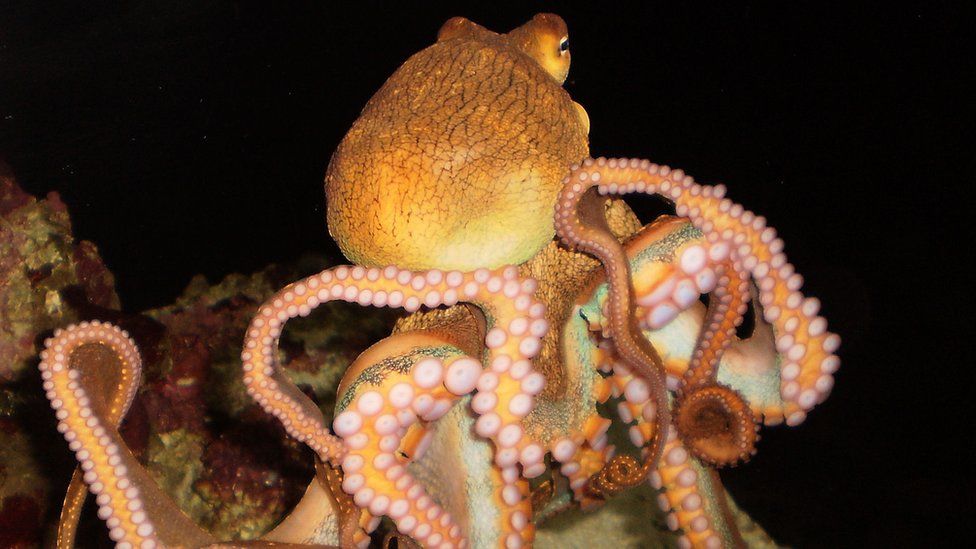
octopus swimming at night
Octopuses are highly intelligent, and have been observed trying to escape from aquariums  Gabrielle Yap / EyeEm
"[The octopus farm] will inflict unnecessary suffering on these intelligent, sentient and fascinating creatures, which need to explore and engage with the environment as part of their natural behaviour."
"[Octopuses' diets require large quantities of animal protein to sustain], contributing to overfishing at a time when fish stocks are already under immense pressure."
Elena Lara, Compassion in World Farming

"Were calling on the EU to include a ban on octopus farming before it ever sees the light of day, in order to avoid plunging more sentient beings into a living hell."
Reineke Hameleers, CEO, Eurogroup for Animals   
 
"To kill them with ice would be a slow death … it would be very cruel and should not be allowed."  
"They are] as intelligent as cats. [A more humane way would be to kill them as many fishermen do, by clubbing them over the head]."
Prof. Peter Tse, cognitive neuroscientist, Dartmouth University
 
"[High-welfare octopus farming is] impossible [killing in ice slurry] would not be an acceptable method of killing in a lab." 
 "Large numbers of octopuses should never be kept together in close proximity. Doing this leads to stress, conflict and high mortality … A figure of 10-15% mortality should not be acceptable for any kind of farming."
Jonathan Birch, associate professor, London School of Economics
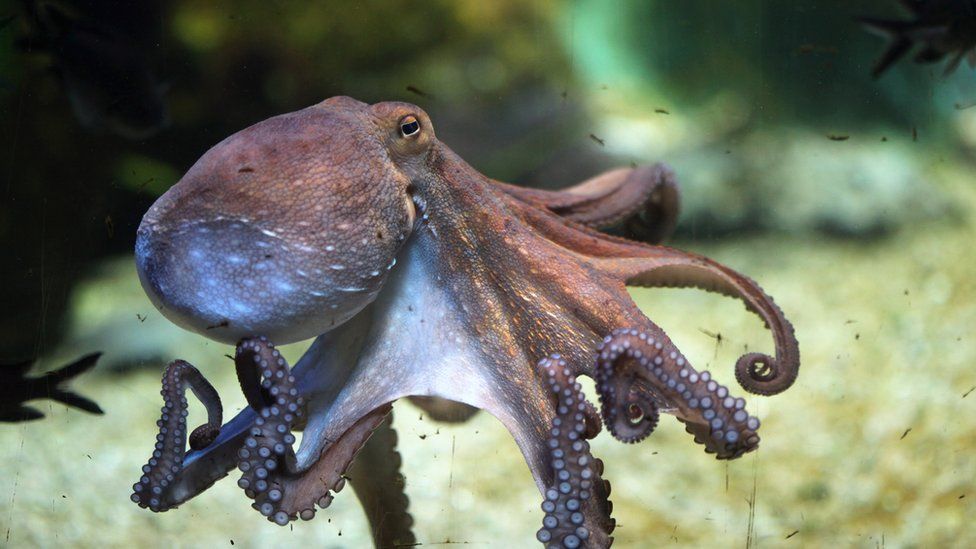
common octopus swimming along
Wrangel

 A Spanish seafood company, Nueva Pescanova, is preparing to establish the world's first octopus farm to be built in the Canary Islands. Its plan to harvest the animals by freezing them to death has been universally condemned as cruel. Plans by the company include the production of roughly a million octopuses for human consumption annually. According to Nueva Pescanova, the octopuses would be maintained in tanks shared with others under constant light. In the animals' natural environment they are solitary, preferring a dark ambience.

Plans are to kill the octopuses by placing them in water at a temperature of -3C -- already in use commercially in the slaughter of fish. Studies on this methodoligy of harvest show that it results in a slow, stressful death. The "ice slurry" method, according to the World Organization for Animal Health, "results in poor fish welfare". The technique should be banned unless fish are first stunned, argues the Aquaculture Stewardship Council.

octopus being cut up
The global octopus trade is now estimated to be worth more than £2.2bn    Gerardo G. Mourín - ggmourin@gmail.com
 
According to animal rights groups responding to the planned octopus farm, it is to be condemned since confining octopuses in barren underwater tanks will cause the animals suffering. It also risks stress-induced reactions of aggression, territorialism and cannibalism; conditions forced upon the animals by corrupting their living arrangements. Experimental trials to farm octopuses indicate the mortality rate in these systems would end up around 20 percent. 

The General Directorate of Fishing of the Canary Islands must come to a decision whether to approve the new facility which is planned to be comprised of around a thousand tanks located in the port of Las Palmas de Gran Canaria. Animal rights groups are calling on the Authority to refrain from issuing a license for the farm. The European Union has been asked to ban such facilities.\

In 2019, Nueva Pescanova made an announcement to the effect that it had achieved a breakthrough in research, that it could be possible to farm and breed octopuses in communal tanks. Their plan is to supply international markets, including the United States and Japan.

giant pink puppet octopus being marched down street in London
People in London march against octopus farming - there have been protests in other countries   Animal Rebellion


Labels: , , ,

Monday, March 05, 2018

 Sunscreen and Coral Bleaching

"Big Blue will ONLY ALLOW the use of 100 percent biodegradable sunscreen on all of our trips."
"Non-biodegradable sunscreen IS NOT TO BE USED on Big Blue trips."
Big Blue Unlimited, tour operation, Turks & Caicos Islands

"We make it mandatory, which is easier said than done."
"The key is telling people well in advance, putting it on the website and saying this is our policy and giving them a chance to shop at home."
Mark Parrish, co-owner, Big Blue Unlimited

"This is one impact [on the environment] that we can control."
"If we are to be successful in bringing coral reefs back to a healthy state, it is incredibly important that people visiting them choose sunscreens that do not contain oxybenzone."
"More important, choosing to cover up with UV protective clothing, rash guards and hats can also reduce the amount of sunscreen needed [for sun protection]."
R. Scott Winters, chief executive officer, Coral Restoration Foundation, Tavernier, Florida
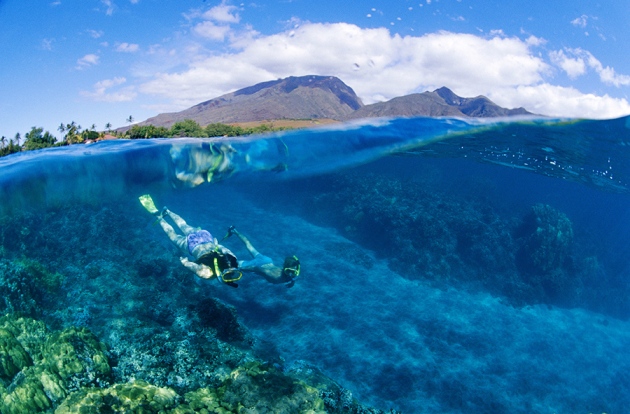
Some scientists are concerned that certain UV-filters in sunscreens may wash off snorkellers and damage coral.   Fleetham Dave/Getty Images

So, this is the story: most of the popular sunscreens marketed for skin protection from the sun's harmful rays work to ensure that human skin doesn't burn and that people seeking healthy-in-appearance tans for summer don't come away with that pigment-darkening effect signalling not healthy but foolish exposure. The very chemicals that stop the sun's UV effects from darkening [burning] sun worshippers' skin, do the opposite with coral reefs; they bleach them and the effect is to kill the coral; multitudes of living organisms over a calcium carbonate scaffold.

A 2008 European study published in Environmental Health Perspectives reached the conclusion that sunscreen is responsible for the promotion of viral infections in corals leading to bleaching. An estimate of over 12,000 metric tons of sunscreen is deposited annually in the world's oceans. And  here you were thinking, what on Earth? How can the small smudges of sunscreen you smooth over your sun-exposed epidermis possibly pose a threat to aquatic life? Yours and everyone else's does just that, it would seem.

According to Craig Downs, executive director of the Haereticus Environmental Laboratory in Clifford, Virginia the chemicals representing the active ingredients in protecting skin from the damage known to be caused by ultra violet rays wash off as people swim in the ocean; alternately wash away in the shower, and represent an environmental threat "bigger than climate change" in damage caused to coral reefs. Studies have verified those links with the active ingredients and coral bleaching with the result that a global demand has arisen for the production of reef-safe sunscreens.
Many different factors affect coral bleaching.   The Ocean Agency/XL Catlin Seaview Survey

Mr. Downs himself headed a research team in 2015 whose report that oxybenzone, a common chemical used in sunscreens, is toxic to the symbiotic algae that thrive within corals, giving them their distinctive colour, as well as performing other vital services to the coral; disrupting the process with chemicals in sun screen results in stuned growth of corals. As a result of the growing awareness of the damage caused by this chemical, lawmakers in Hawaii are working on banning oxybenzone-containing sunscreens.

Although sunscreen in and of itself certainly doesn't represent the only harmful effect on coral bleaching, where rising sea temperatures resulting from global warming is considered to be the greatest threat to the survival of corals, a campaign has been undertaken by environmental advocates and the travel industry to educate the public and persuade them that their awareness and resulting reaction in setting aside the use of oxybenzone-containing sunscreens can have a positive impact.

Corals are bleached on a seabed near Okinawa island on Aug. 26, 2013.
The Yomiuri Shimbun—AP

Labels: , ,

Friday, September 29, 2017

Microplastics Effects on Bivalves; Clams, Oysters, Mussels

"We're finding most shellfish have plastic in them."
"Shellfish aquaculture uses a lot of plastic infrastructure."
"I wouldn't be overly concerned about eating shellfish specifically. Microplastics are everywhere."
"The ability of microplastics to absorb and concentrate chemicals that may be eaten by organisms makes them a serious emerging threat to wildlife and natural ecosystems and potentially, human health."
"We are looking at shellfish because they are filter-feeding organisms. They accumulate anything that is in the water and they live on the coast where the most drastic changes are happening, which makes them excellent sentinels of ecosystem health."
Dr. Sarah Dudas, Canada Research Chair in Shellfish Aquaculture Ecosystem,Vancouver Island University, Nanaimo, British Columbia
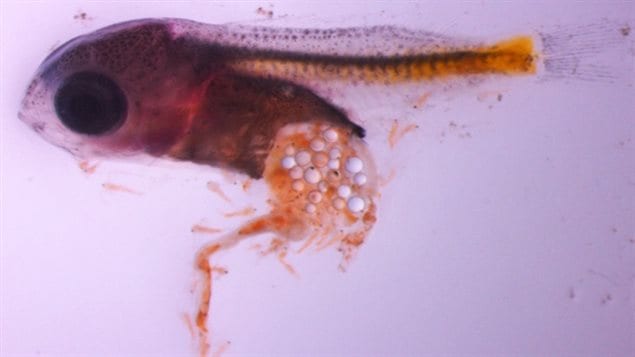
A larval perch with microplastic in its gut. Vancouver Island University professor Sarah Dudas says the effects of microplastics still aren’t fully understood, but they are believed to have impacts on the reproductive abilities of fish.
Photo Credit: (Oona Lönnstedt)
"Microplastics are an added factor to plastic pollution. The beading in toothpaste, confetti from parades, the glitter people put on their faces, the sources are endless and the hardest part is educating people about it."
"Since I started the project I’ve been going home and talking to my friends and family about this. I want to get the word out and start them thinking about where the plastic products they buy end up." "Shellfish are resilient so I ask myself, if they are being affected by microplastics then what are the microplastics doing to the more vulnerable organisms in the oceans?"
Maggie Dietterle, university student, research study
In 2016, Dr. Dudas assembled a team of students to help her analyze the contents of thousands of clams and oysters found in the Strait of Georgia. Their study affirms that in consuming clams or oysters, a decided seafood delicacy appreciated by many people for their delicious taste and nutrient utility along with the protein inherent in their constituency, is an unexpected and decidedly un-nutritious element, plastic.

Correct, plastic. The same substance in various forms found contaminating and polluting the earth and the oceans everywhere from the tropics to the Arctic regions of the two poles. On land the presence of plastics represent an existential threat to wildlife, killing many which become trapped, or attempt to ingest it in its various forms, and in the oceans, even whales are known to die from having consumed plastic which their alimentary canals cannot process, and which in any event, provide them with no sustenance.

There are predictions that the rising tide of plastics everywhere on this planet will eventually pose an even steeper threat to the biosphere. Which hasn't yet put a brake on the use of plastics and their ubiquitousness in packing and containerizing, convenience and manufacturing of durable products. Durable indeed; their shelf life might not be long, but their capacity to endure without breaking down in the environment is endless.

According to Dr. Dudas, the research her team has been engaged in finds no differences in the plastics discovered in fish, whether the aqua-creatures are those raised in commercial fish farming or those found in the wild. Her study, as with that of the Vancouver Aquarium's Ocean Pollution Research Program, have come up thus far with no solution to the question looking for a definitive answer as to a source.

While it is true that fish aquaculture uses plastic extensively in the manufacture of nets and ropes that with use shed flake fibres, identifying with any degree of accuracy what it is that pollutes fish habitat remains elusive. Other than the generalized fact that plastics in various presentations are not just in garbage landfills, but carelessly strewn about, blown about, everywhere.

The study is being conducted based at the VIU Deep Bay Marine Research Station on Vancouver Island
The study is being conducted based at the VIU Deep Bay Marine Research Station on Vancouver Island © VIU Facebook
The purpose of Dr. Dudas's study is clear enough; to determine the source of the plastics, and if possible prove or disprove a suspicion that fish farms are largely responsible. The suspicion of those who have undertaken these studies is that microfibres shed and pass through filters in domestic washing machines when clothing is being washed, and make their way to water treatment plants and the water supply.

The preliminary results of Dr. Dudas's study indicate the existence of an average of eight microplastic particles resident in each clam or oyster. Despite which, she is of the opinion that though these minuscule specks and strands of plastic are overwhelmingly everywhere, there should be little concern over eating the shellfish containing them. Doubtless, given the presence of plastics everywhere they end up in some invisible form in everything we eat.

Remember the scandal out of China in 2008 when it was discovered that powdered plastic (melamine) had been put in baby formula and other foods which had been adulterated, (even fed to animals and appearing in eggs) with the end result that some babies died because of their intake of formula whose manufacturers used the plastic to have their product appear more wholesome.

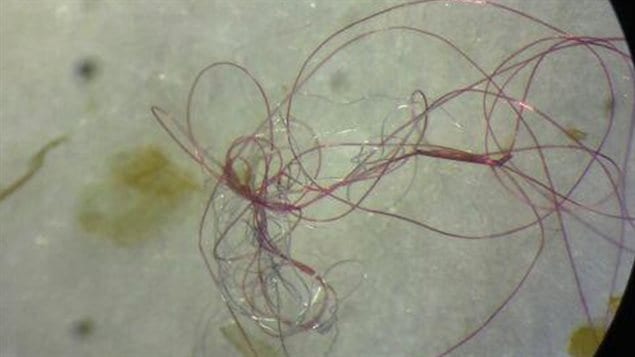
Exceedingly fine plastic fibres found inside the body of a Great Lakes fish. Scientists who have reported that the lakes are awash in tiny bits of plastic are raising new alarms about a little-noticed form of the debris turning up in sampling nets: synthetic fibres from garments, cleaning cloths and other consumer products.
Exceedingly fine plastic fibres found inside the body of a Great Lakes fish. Scientists who have reported that the lakes are awash in tiny bits of plastic are raising new alarms about a little-noticed form of the debris turning up in sampling nets: synthetic fibres from garments, cleaning cloths and other consumer products. © Rachel Ricotta/Associated Press

Labels: , , , ,

 
()() Follow @rheytah Tweet