Ruminations

Blog dedicated primarily to randomly selected news items; comments reflecting personal perceptions

Tuesday, June 08, 2021

Directly to the Heart of the Matter

"They are certainly a beacon to other communities on how to improve survival."
"You can do the math: If a neighbour can get to the scene and start CPR within three to five minutes of a collapse, there's a reasonable chance of successful resuscitation."
"If nothing is done for ten minutes, it's a very low probability of success [survival]."
Dr.Mickey Eisenberg, prehospital resuscitation, professor, University of Washington

"The patient is dead [meaning his or her heart has stopped due to cardiac arrest] and if you don't do anything, nine out of ten will be dead forever."
"Hospitals didn't believe ordinary people could make a difference."
Freddy Lippert, director, Copenhagen Emergency Medical Services
cardiac arrest app
Lead Image © THANAGON / Adobe Stock
 
They did, and they do, however. Civilians in Denmark respond faster than do professionals to over four in ten cardiac arrests out of hospitals, according to data from the Danish Cardiac Arrest Registry. The Heartrunner app used in Denmark enabled a swift response of neighbours to save the life of 81-year-old Erik Harry Kaxe whose heart stopped while at home on the outskirts of a small town in western Denmark. Within minutes of being alerted ten strangers who lived close by had arrived to give assistance, before the arrival of the ambulance 17 minutes later.

A social and health-care assistant, Hannelene Kortegaard received the alarm sounding from her Heartrunner app. She and her husband drove to the address given, a map shown on the app's screen while an emergency services operator dispatched an ambulance and guided Mrs. Kaxe to perform CPR. Other volunteers the app notified arrived on scene with a number of AEDs. As Kortegaaard performed CPR, another volunteer prepared a defibrillator. Kortegaard assigned volunteers to wait outside to direct the ambulance.

Others comforted Mr. Kaxe's wife, while someone was delegated to take care of the family dog. Kaxe survived his ordeal. "Dying wasn't difficult, but waking up is", he said in an interview. In 2001 in
Denmark, witnesses used CPR in one of five cardiac arrests occurring outside a hospital. That number is now four in five. And the citizens of Denmark have their dramatic upswing in survival from heart attack courtesy of smartphone technology alerting volunteers to an emergency cardiac arrest.
 
Get involved and help highlight these important issues. We are grateful for any and all awareness that can be raised around matters of the heart. We are happy to provide facts, information and research on our area and our important contacts. You are more than welcome to share our materials just so long as you reference Heartrunner Sweden.
 
The app alerts volunteers to the occurrence of nearby cardiac emergencies, directing them to the location of automated external defibrillators (AEDs). The app asks volunteers to enter residences and perform CPR until the arrival of an ambulance. Concerns of safety and the acceptance of people who are untrained volunteers to enter private homes have largely prevented a similar use of PulsePoint, a North American responder app, to take place in the United States. Should such concerns be overcome according to leading experts, the U.S. could "significantly improve" its own survival rate.

The out-of-hospital survival rate in Denmark increased from four percent to 15 percent over the course of the past twenty years. Before the pandemic occurred the survival rate in the United States stood at 9.8 percent. 70 percent of all cardiac arrests that occur out of hospital in the United States occur in residences; persuading volunteers that it is a necessary requirement in saving lives to enter homes to improve survival rates in the U.S. represents a life-saving goal.

Pulse Point is designed to alert volunteers who happen to be nearby, who had taken CPR training, or who are off-duty emergency responders, notifying them through a distinctive alert tone when someone has gone into cardiac arrest in their near vicinity in places such as shopping malls, workplaces or streets. The function of the app is also to guide them on a map to the precise address and the location of the closest AED.

PulsePoint alerts verified responders who happen to be professionals, to cardiac arrests in residences whereas civilian volunteers are not called to residences reflecting safety concerns on entering the home of a stranger. "Maybe we're not thinking forward quite as fast as we could", commented professor of medicine Dr.Thomas Rea, who studies prehospital emergency care at the University of Washington. 

Smartphone App Boosts Bystander Response to Cardiac Arrest 
 
The app in Denmark allows dispatchers from the national health emergency number 112 to contact up to 20 volunteers within a 1.77km radius from the scene of a cardiac arrest where the dispatcher goes on to alert ambulance services while guiding the person who called in to commence CPR  until the arrival of volunteers. "Can you run?" asks the app as volunteers respond "yes" and are then directed to the address shown on the screen or alternatively to the nearest available AED and then toward the scene of the emergency.

There are over 100,000 registered Danish volunteers, 74 percent of whom have no professional background in health care, according to surveys. Danish volunteers have taken to the app and the responsibility that falls to volunteers, a sign of a change in attitudes to civilian response ... to become a cornerstone in the nation's improved survival rate.


Labels: , , , ,

Monday, February 24, 2020

Spare No Efforts in Cardiopulmonary Resuscitation Following Cardiac Arrest in the Elderly -- Though Doomed to Fail

"It's a common scenario. And it's not going to have a good outcome."
"She was trying to die, and it was only a matter of time before she arrested again."
"Should CPR even have been started for this patient?"
Dr.Kei Ouchi, emergency physician, researcher, Brigham and Women's Hospital

"Many of us in daily practice have the perception that we regularly do resuscitations that are futile from the inception."
"We wanted to examine that."
Dr.Patrick Druwe, physician, Ghent University Hospital, Belgium

"The big ethics discussion has been around, 'When do we stop'?"
"Only recently have there been discussions about, 'When do we start it'?"
Dr.Monique Starks, cardiologist, Duke University School of Medicine, North Carolina
James Steinberg

Recently, an international network was organized by a team led by Dr.Patrick Druwe at Ghent University, for the purpose of surveying health care professionals in Europe, Japan, Israel and the United States. A study, published in The Journal of the American Geriatrics Society considered CPR for adults over 80 who had experienced out-of-hospital cardiac arrest.

The results of the study shone a spotlight on a number of issues, none very favourable, respecting physician reaction to elderly patients in cardiac arrest. The survival rates were dismal; an outcome reported previously in the medical literature. What the study pointed out was how frequently health care professionals automatically support resuscitation, despite knowing beforehand through experience that the outcome will have poor results. Results though well known to the health community are not shared with the general public.

Roughly 600 clinicians, half of whom were paramedics and emergency technicians, the remainder representing emergency physicians and nurses, were tasked with recalling their most recent patient    aged 80 or more who had undergone CPR. The question put to them was whether they were in agreement with beginning cardiopulmonary resuscitation, and did they feel certain that resuscitation should not have been started, or were they uncertain?

Of the patients in the specific age category suffering cardiac arrest and immediately subjected to CPR,  a mere two percent survived and were able to leave hospital. Despite which over half the clinicians felt CPR was appropriate in those instances, while only 18.5 percent felt it inappropriate. A minority of patients have a 'shockable' rhythm in cardiac arrest, where the heart is moving but abnormally and it is not pumping blood effectively.

With the use of CPR, along with a defibrillator to shock the heart, circulation can be restored and the patient's life saved. Most patients, however, have non-shockable rhythms; their hearts show electrical activity, despite which they aren't pumping at all, and in these instances survival rates tend to fall sharply.  Age increases the proportion of cardiac arrests involving non-shockable rhythms.

Over 40 percent of the cases of cardiac arrest followed by CPR had been 'unwitnessed', which is to say rescuers had no idea how long the patients had been in arrest -- when reality is that the odds of successful resuscitation become increasingly diminished ten percent with each minute that passes while in cardiac arrest. Of the elderly patients with non-shockable rhythms and unwitnessed arrests, none survived hospitalization.

Irrespective of which, 44 percent of the clinicians taking part in the study felt those efforts under those circumstances, to be appropriate. Bleak outcomes following CPR for out-of-hospital cardiac arrest at advanced ages has been documented by other research, even though improvements have been seen in resuscitation results where hospitalized patients have better rates of survival.

cardiac arrest in the rain
Bruce Ayres / Getty Images

Labels: , , , , ,

Tuesday, October 08, 2019

Running a Marathon -- Cut the Run-Distance by One-Third!

"In one of the largest recent studies, published in January, Canadian researchers recruited 129 non-elite runners in Winnipeg and tested their blood just before they ran a half or full marathon. Their blood markers for heart injury were normal. By the time they’d reached the finish line, though, according to blood tests done there, most of the half-marathoners and even more of the marathoners displayed elevated troponin and other blood markers of heart damage, and after an hour, when they were tested yet again, even more of both groups, especially the marathoners, showed blood indicators of cardiac damage."
"'We measure those same blood markers when someone comes in to the emergency room and we suspect a heart attack', says Davinder S. Jassal, MD, an assistant professor of cardiology, radiology, and physiology at the University of Manitoba medical school in Winnipeg and lead author of the study. Blood profiles like those displayed by the runners, he says, 'are similar to those in a very mild heart attack'."
PhysEd columnist Gretchen Reynolds,  “Are Marathons Good for the Heart?" 

Detroit marathon starting line.
Susan Tusa/Associated Press The starting line of the 2009 Detroit Marathon


"There’s no doubt the marathon is a very hard, stressful event."
"We’re confident that exercisers have lower heart risks than non-exercisers, but the truth is we don’t know this for sure about marathoners."
Dr. Paul Thompson, director of cardiology, Hartford Hospital, Hartford, Conn.
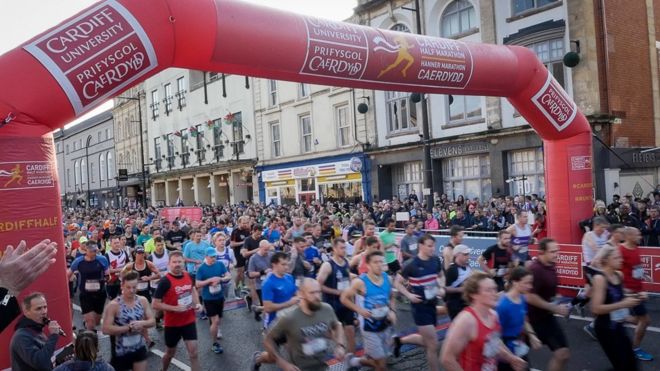
"We've done an incredible amount of work in terms of raising the profile... flagging that anyone that had any symptoms or history in their family or felt unwell in the run up to it that they would go to the doctor, they would get checked out and no one would come to the start line with any risk to their health."
"We can only reiterate that really, it's cast obviously a big shadow on what was otherwise a very good day for Cardiff."
"We've had 16 years and until last year we hadn't had incidents of this kind, they have happened before in big events, unfortunately it is something that does happen when you get this volume of people running."
"Everyone at Run 4 Wales is devastated. It's terribly sad news... not just our thoughts but our support is with the family at this really difficult time."
"It was an incident at the finish line, yards away from the primary medical centre so it was an instant response."
Run 4 Wales chief executive Matt Newman  October 7, 2019
The race
A record number of runners took part in Sunday's Cardiff Half Marathon   BBC

In two half-marathons, one taking place in Montreal the other in Ottawa, both on the same day, male runners collapsed at or close to the finish line, leaving both men, in their 20s, dead of sudden death syndrome. Rare, but events that do disconcertingly occur from time to time at marathons and half-marathons. What shocks people hearing of these events, rare though they are, is that these are young, robust people in excellent physical shape who suddenly perish while engaged in exercise.

This is a phenomenon that has attracted the attention of researchers in the hopes of extracting valuable insights into the incidents with the hope of prevention. One of the initial studies reviewed 26 marathons that took place across the United States over a 30-year period and based on 3,292,268 runners. The result was that the overall risk was calculated as one death for every 126,626 marathon finishers and that the average age of the runners who failed to survive the events was 41, with 81 percent being men.

Another study published in 2012 included 10.9 million runners who competed in 40 marathons and 19 half-marathons, with the outcome of the research concluding the incidence of sudden death to be 1.01 per 100,000 runners in the marathon category as opposed to 0.27 per 100,000 in the category of half-marathon races -- with most victims male; the average age of death calculated as 39. While determination of age and gender are vital statistics, what else emerged from the studies was of critical importance.

The majority of cardiac arrests occur between the 37-kilometre mark and the end of the 42-km distance. It is the latter part of the race when the majority of cardiac arrests take place. Cardiovascular disease being the common reason for the most part, that runners' hearts fail when an endurance event takes place and no one knows precisely how the event is triggered. A common theory that running stress initiates a release of inflammatory biomarkers which can increase the chances of cardiac arrest, particularly in men over 40, stands out as the likeliest answer.
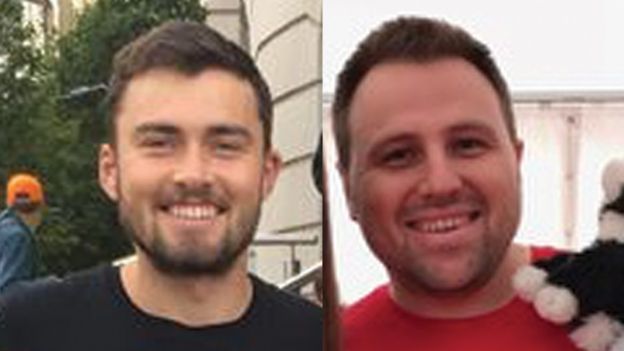
Ben McDonald and Dean Fletcher
Ben McDonald and Dean Fletcher died after crossing the finish line within minutes of each other in 2018   Family Photos

How such adverse health events build toward the final blow is perhaps attributable to the physical stress inherent in the buildup of training distances, where the possibility exists that daily stress with the additional stress of race day itself may be responsible for the creation of a very special set of conditions, adding additional strain on a compromised heart. Until the day of the race itself, most marathoners don't make the full effort of the 42-km distance. Most training programs bring runners to about 30 km, or three hours of running.

It is the final 10 km when the body begins to feel the influence of the stress of a prolonged run at race pace. Hypertrophic cardiomyopathy, a structural abnormality seen in a thickening of the heart muscle, making it more difficult to pump blood represents yet another cardiac condition known to increase risk of sudden death during extreme exercise. Also rare, this is the condition that often strikes younger marathoners, running without knowledge of their 'hidden' condition.

Whether or not runners who experience sudden cardiac arrest are known to experience symptoms during training or during the marathon event itself is not known, given that those symptoms can readily be taken as the results of physical exertion, not just a poorly functioning heart. Fatigue and shortness of breath, symptoms of a faltering heart, are also symptomatic of transitory stress results of extreme exercise.

Among women and slower runners, hyponatremia, caused by the intake of excess fluid, can be a common condition which can be fatal, but runners are advised to drink only when thirst calls, rather than to prevent thirst. Another serious health issue faced by runners is the possibility of heat stroke, though rarely does this result in death. In recent years race organizers take steps to deal with overheated temperatures on marathon day, through increased water station numbers, modifying race time, cooling stations and cancelling races.

According to a cardiologist at the Montreal Heart Institute, Rafik Tadros, thoughts of the finish line can bring on a flood of adrenalin or a sudden surge in speed, each capable of triggering heart arrhythmia, which can cause cardiac arrest at later stages of the race. His recommendation is that more volunteers trained in CPR be stationed, as well as the strategic placement of defibrillators along the race route. Dr. Tadros feels the health risks of inactivity outweigh risks associated with running a marathon.
A Montreal cardiologist reminds runners that heart disease or structural abnormalities of the heart — not running a marathon — is the real cause of cardiac arrest on race day. Dylan Buell / Getty Images

Labels: , , , ,

 
()() Follow @rheytah Tweet