Ruminations

Blog dedicated primarily to randomly selected news items; comments reflecting personal perceptions

Friday, July 02, 2021

Lytton, B.C.: Hell on Earth: Fire and Brimstone


"I am crying really ... sometimes I just pinch my skin to make sure it's not a dream, it's really happening ... 30 years working in this job, never seen anything like this madness ..."
Maximiliano Herrera, world weather records expert

"Sydney [Australia] sits at 33 latitude, Lytton [British Columbia, Canada] at 50."
"Temperatures this high should not be occurring here!"
Sarah Perkins-Kirkpatrick, climate scientist, University of New South Wales
Located about 250 km northeast of Vancouver, Lytton broke previous all-time temperature records on three consecutive days, soaring to 46.6C on Sunday, 47.7C Monday and 49.6C on Tuesday. In 1937 it had hit a high temperature of 45C. And then the following day as the heat dome began to move and Lytton experienced brief relief from the searing heat its one thousand residents were forced to evacuate as a wildfire swept into the town and completely obliterated it.

The heat record that Lytton reached is hotter even than the all-time high of 47.2C experienced by Las Vegas, California and 48.3C in Phoenix Arizona, states considerably south of Canada, across the southern border into the United States. According to Mr. Herrera, only 26 countries have been as hot or hotter, ever. Nowhere in Europe or South America has the temperature ever registered that extremely hot, the most extreme high temperature north of 45 degrees latitude.
"I am incredibly overwhelmed by the news of the fire. It happened so fast and is completely devastating almost everyone I've ever known."
"The town itself and surrounding reserves have been severely hit. Fire continues up towards other surrounding reserves between Lytton and Lillooet and Lytton and Shackan."
"Many people in the community expressed concerns that the railways were still up to their usual traffic when the temperatures in Lytton were reaching the high forties [Celsius] this week."
Shianna McAllister, a Nlaka'pamux from the Lytton First Nation
A building in Lytton, B.C., is engulfed in flames on Wednesday. (2 Rivers Remix Society)
 
The province's Coroners Service received reports of 486 sudden deaths -- according to chief coroner Lisa Lapointe -- between June 25 and the afternoon of June 28, over double their usual number of such reports. When the fire struck, its spread was so rapid that people were forced to sprint off within 15 minutes of having been ordered to leave, taking nothing with them but what they were wearing. In minutes buildings were erupting in flames.

Residents aimed for the nearest towns, in their anxiety to find shelter; Lillooet or Merritt, finding emergency shelters awaiting them. Not quite everyone left, some decided to try to save their homes. Some residents are unaccounted for, the RCMP investigating. A small convoy of vehicles was videoed leaving the area, two separate fires behind them, one a wildfire on the mountain slope above the town, burning the last two weeks, the second in the valley, swiftly consuming the town.

The convoy had to drive a curving road, past burnt-out and still-burning buildings, cars, trucks, recreation vehicles and huge old trees enveloped in flame. Blowing smoke and ash buffeted the vehicles and visibility became so dark with billowing smoke at times it was reduced completely. Apart from the extreme heat and the dry condition of the surrounding forest where electrical storms easily ignite wildfires. there are two railways intersecting either side of Lytton.
 
The fire is seen burning in the Lytton, B.C., area on Wednesday. Conditions in the area were dangerously dry and windy after the record-breaking heatwave. (Facebook/Edith Loring Kuhanga)
 
That proximity of crossing railway lines is a danger of itself -- occasionally in hot atmospheres setting fires by sparks set off from the metal wheels of passing trains grinding on the metal rail lines and then lighting dry areas of brush. Meteorologists explained as well, that the unusual weather contributed to thousands of lightning strikes in the interior elevating the risk of wildfires. And dozens spontaneously erupted.

"This is so devastating -- we are all in shock", said Edith Lorin-Kuhanga, administrator at the Stein Valley Nlakapamux School. "Our community members have lost everything. I understand our band office is also gone", she lamented of the carnage brought to the Lytton First Nation reservation. An area spanning about 80 square kilometres in the interior beyond Lytton is raging out of control, according to the B.C. wildfire Service.

Around what is left of Lytton, ("The town has sustained structural damage and 90 percent of the village is burned, including the centre of town", Brad Vis, MP for Mission-Matsqui-Fraser Canyon), electrical, cellphone, rail and  highway infrastructure are all badly damaged, hampering both travel and communication. The town's main intersection is littered with burnt building debris; gutted vehicles stand where a village was once located.
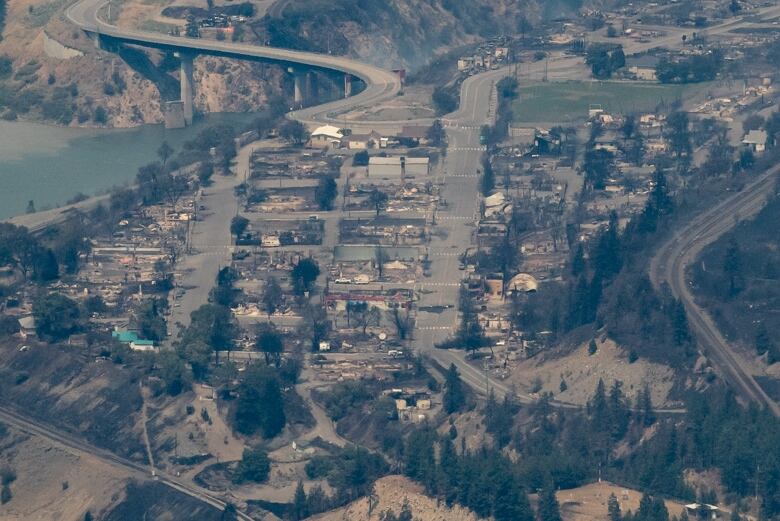
Structures destroyed by fire in the heart of Lytton, B.C., are seen from a helicopter on Thursday. (Darryl Dyck/The Canadian Press)

Labels: , , , , , ,

Tuesday, October 08, 2019

Running a Marathon -- Cut the Run-Distance by One-Third!

"In one of the largest recent studies, published in January, Canadian researchers recruited 129 non-elite runners in Winnipeg and tested their blood just before they ran a half or full marathon. Their blood markers for heart injury were normal. By the time they’d reached the finish line, though, according to blood tests done there, most of the half-marathoners and even more of the marathoners displayed elevated troponin and other blood markers of heart damage, and after an hour, when they were tested yet again, even more of both groups, especially the marathoners, showed blood indicators of cardiac damage."
"'We measure those same blood markers when someone comes in to the emergency room and we suspect a heart attack', says Davinder S. Jassal, MD, an assistant professor of cardiology, radiology, and physiology at the University of Manitoba medical school in Winnipeg and lead author of the study. Blood profiles like those displayed by the runners, he says, 'are similar to those in a very mild heart attack'."
PhysEd columnist Gretchen Reynolds,  “Are Marathons Good for the Heart?" 

Detroit marathon starting line.
Susan Tusa/Associated Press The starting line of the 2009 Detroit Marathon


"There’s no doubt the marathon is a very hard, stressful event."
"We’re confident that exercisers have lower heart risks than non-exercisers, but the truth is we don’t know this for sure about marathoners."
Dr. Paul Thompson, director of cardiology, Hartford Hospital, Hartford, Conn.
"We've done an incredible amount of work in terms of raising the profile... flagging that anyone that had any symptoms or history in their family or felt unwell in the run up to it that they would go to the doctor, they would get checked out and no one would come to the start line with any risk to their health."
"We can only reiterate that really, it's cast obviously a big shadow on what was otherwise a very good day for Cardiff."
"We've had 16 years and until last year we hadn't had incidents of this kind, they have happened before in big events, unfortunately it is something that does happen when you get this volume of people running."
"Everyone at Run 4 Wales is devastated. It's terribly sad news... not just our thoughts but our support is with the family at this really difficult time."
"It was an incident at the finish line, yards away from the primary medical centre so it was an instant response."
Run 4 Wales chief executive Matt Newman  October 7, 2019
The race
A record number of runners took part in Sunday's Cardiff Half Marathon   BBC

In two half-marathons, one taking place in Montreal the other in Ottawa, both on the same day, male runners collapsed at or close to the finish line, leaving both men, in their 20s, dead of sudden death syndrome. Rare, but events that do disconcertingly occur from time to time at marathons and half-marathons. What shocks people hearing of these events, rare though they are, is that these are young, robust people in excellent physical shape who suddenly perish while engaged in exercise.

This is a phenomenon that has attracted the attention of researchers in the hopes of extracting valuable insights into the incidents with the hope of prevention. One of the initial studies reviewed 26 marathons that took place across the United States over a 30-year period and based on 3,292,268 runners. The result was that the overall risk was calculated as one death for every 126,626 marathon finishers and that the average age of the runners who failed to survive the events was 41, with 81 percent being men.

Another study published in 2012 included 10.9 million runners who competed in 40 marathons and 19 half-marathons, with the outcome of the research concluding the incidence of sudden death to be 1.01 per 100,000 runners in the marathon category as opposed to 0.27 per 100,000 in the category of half-marathon races -- with most victims male; the average age of death calculated as 39. While determination of age and gender are vital statistics, what else emerged from the studies was of critical importance.

The majority of cardiac arrests occur between the 37-kilometre mark and the end of the 42-km distance. It is the latter part of the race when the majority of cardiac arrests take place. Cardiovascular disease being the common reason for the most part, that runners' hearts fail when an endurance event takes place and no one knows precisely how the event is triggered. A common theory that running stress initiates a release of inflammatory biomarkers which can increase the chances of cardiac arrest, particularly in men over 40, stands out as the likeliest answer.
Ben McDonald and Dean Fletcher
Ben McDonald and Dean Fletcher died after crossing the finish line within minutes of each other in 2018   Family Photos

How such adverse health events build toward the final blow is perhaps attributable to the physical stress inherent in the buildup of training distances, where the possibility exists that daily stress with the additional stress of race day itself may be responsible for the creation of a very special set of conditions, adding additional strain on a compromised heart. Until the day of the race itself, most marathoners don't make the full effort of the 42-km distance. Most training programs bring runners to about 30 km, or three hours of running.

It is the final 10 km when the body begins to feel the influence of the stress of a prolonged run at race pace. Hypertrophic cardiomyopathy, a structural abnormality seen in a thickening of the heart muscle, making it more difficult to pump blood represents yet another cardiac condition known to increase risk of sudden death during extreme exercise. Also rare, this is the condition that often strikes younger marathoners, running without knowledge of their 'hidden' condition.

Whether or not runners who experience sudden cardiac arrest are known to experience symptoms during training or during the marathon event itself is not known, given that those symptoms can readily be taken as the results of physical exertion, not just a poorly functioning heart. Fatigue and shortness of breath, symptoms of a faltering heart, are also symptomatic of transitory stress results of extreme exercise.

Among women and slower runners, hyponatremia, caused by the intake of excess fluid, can be a common condition which can be fatal, but runners are advised to drink only when thirst calls, rather than to prevent thirst. Another serious health issue faced by runners is the possibility of heat stroke, though rarely does this result in death. In recent years race organizers take steps to deal with overheated temperatures on marathon day, through increased water station numbers, modifying race time, cooling stations and cancelling races.

According to a cardiologist at the Montreal Heart Institute, Rafik Tadros, thoughts of the finish line can bring on a flood of adrenalin or a sudden surge in speed, each capable of triggering heart arrhythmia, which can cause cardiac arrest at later stages of the race. His recommendation is that more volunteers trained in CPR be stationed, as well as the strategic placement of defibrillators along the race route. Dr. Tadros feels the health risks of inactivity outweigh risks associated with running a marathon.
A Montreal cardiologist reminds runners that heart disease or structural abnormalities of the heart — not running a marathon — is the real cause of cardiac arrest on race day. Dylan Buell / Getty Images

Labels: , , , ,

 
()() Follow @rheytah Tweet