Ruminations

Blog dedicated primarily to randomly selected news items; comments reflecting personal perceptions

Friday, July 31, 2026

Russia, Diving Nuclearshod Over Its Arctic Neighbours

"Russia is determined to control access, setting the terms for exploiting regional shipping and resources. It wants to extend command over stretches of Arctic water, with little justification under international law."
"If Canada wants stronger maritime security -- as the Canadian Coast Guard's transfer to the Department of National Defence last September suggests -- it must grasp Russia's Arctic plans and the long-term persistent threat they pose." 
Alexander Dalziel, Macdonald-Laurier Institute
Sergey Sukhankin Jamestown Foundation 
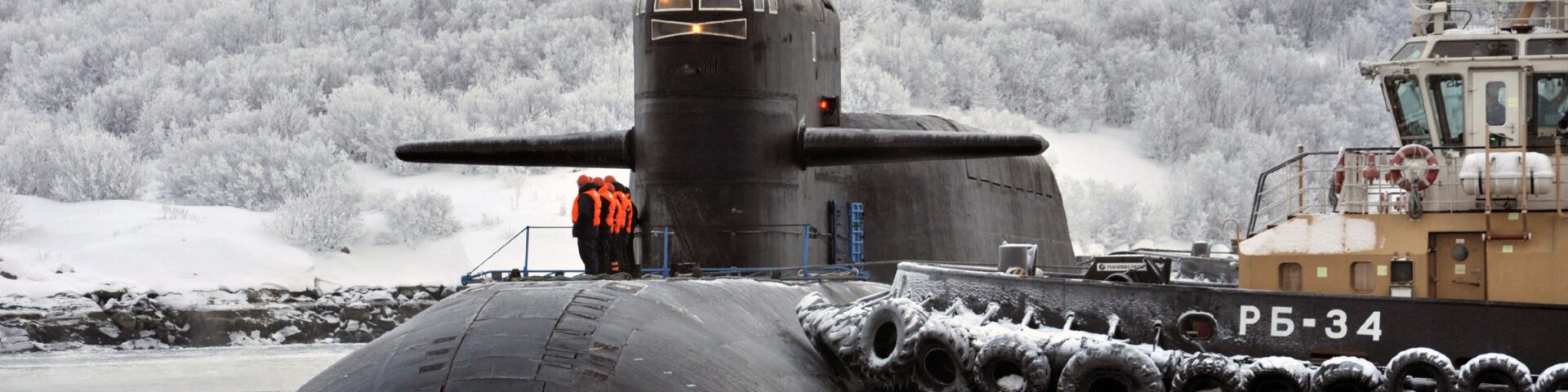
 https://www.fpri.org/wp-content/uploads/2026/07/2013-02-06t000000z-1041876735-mt1zuma00095rac9-rtrmadp-3-zuma-1-1920x480.jpg
Canada has for too long neglected its share of the Arctic against the predatory plans of Moscow which has made no secret of its determination to extend its recognized territorial claims by rebuilding its old semi-abandoned bases, investing in nuclear-powered ice-breakers, strengthening its air capabilities in its long-range plans of controlling shipping lanes, and harvesting minerals and oil in their oceanic fastness. 
 
The provocative act of planting its titanium Russian flag on the Arctic seabed in 2007 was a signal of its entitled 'ownership' of an extended, contested area alerting placeholders, Canada, United States, Denmark and Norway that their own long-acknowledged territory at sea can no longer be taken for granted.
 
Securing and safeguarding the Arctic was a major topic for discussion, along with strengthening maritime security in the Arctic and North Atlantic oceans during the recent NATO summit in Turkey. Russian President Vladimir Putin's territorial ambitions focused the discussion on setting global terms for regional exploitation of the undersea resources, and the associated need to agree on how best to ensure maritime security in the face of a national leader unconcerned with international law. 
 
https://gcaptain.com/wp-content/uploads/2024/07/project-23550-combat-icebreaker-1536x981.jpg
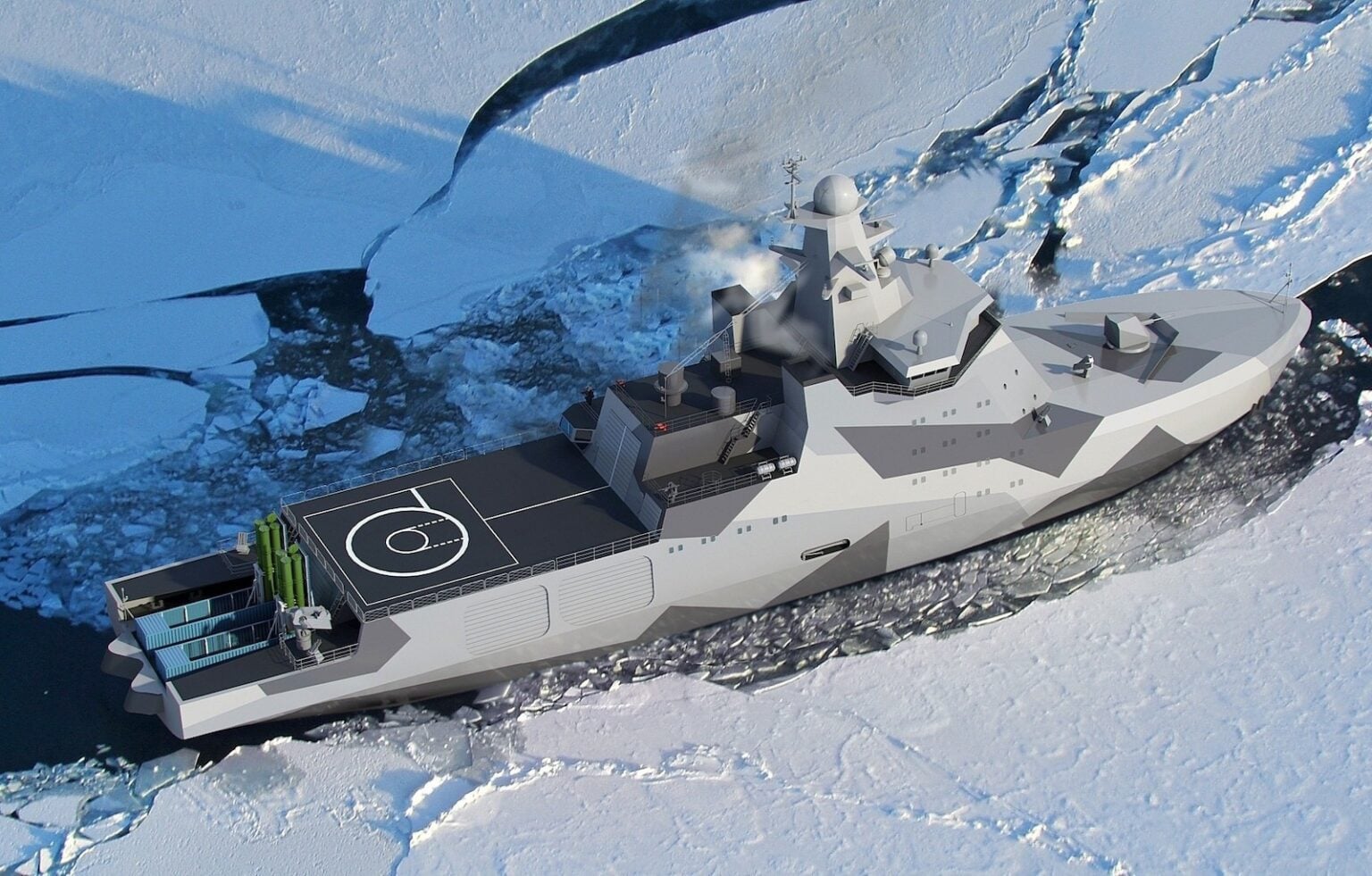
Ivan Papanin was laid down in 2017 and is expected to join Russia’s Northern Fleet by the end of 2024. Two additional vessels of the type are under construction for the naval units of the country’s border patrol. gCaptain
 
Russia makes no secret of its intention to resort to military means with its formidable nuclear submarines in play and its paramilitary Russian Coast Guard prepared to control access to the Northern Sea Route, north of Russia, bordering on U.S. territory in the east, Norway in the west. Russia's focus is the promotion of year-round shipping through the Arctic. Its investment in ice-class liquefied natural gas carriers illustrate its regional power assertion.
 
Norwegian and European authorities sanctioned Russian fishing industries on suspicion of espionage and infrastructure sabotage. The Russian proposed "Transarctic Transport Corridor" to connect southern industrial centres and Siberian resource projects to foreign markets through the Northern Sea Route is a marked concern, while offshore drilling and underwater mining are seen as insurance against dwindling land resources. 
 
While Russia polishes its credentials as the only serious player in the Arctic, entitling it to expand its boundaries and without consultation with the other Arctic nations set standards running loops around its Arctic neighbours, its state media invested in propaganda elevating Russian plans, express contempt for Canadian, American or Danish development plans in the North American Arctic, marking them with a hostile purpose, a potential "bridgehead" with which to threaten Russia; its own three-decade military presence aside. 
 
https://gcaptain.com/wp-content/uploads/2025/12/three-nuclear-icebreakers-Atomflot-Telegram.jpeg
Three Russian nuclear icebreakers in the Arctic. (Source: Atomflot)
 
"The Arctic is central to Russia's deepening partnership with China and its broader authoritarian agenda. Moscow is courting Chinese investment while giving Beijing access denied by Arctic democracies."
"China  is using Arctic waters to diversify its export routes while gaining experience operating in the region."
"The Canadian Security Intelligence Service says that both countries are increasing their espionage activities."
Alexander Dalziel/Sergey Sukhankin 

Labels: , , , , , , , ,

Sunday, January 18, 2026

Controlling The Arctic

"In fact, I think it would be fair to say that Denmark's claim to sovereignty over Greenland is far stronger than Canada's claim to sovereignty up to the North Pole for the entire archipelago."
"Whether it's enough [$1B in funding over 4 yrs to improve military transportation infrastructure in the Arctic and a partnership with Australia to develop Arctic Over-the-Horizon Radar] to offset American desire to own territory in the north? I don't know." 
Former chief of the Defence Staff Gen. Tom Lawson
 
"If they were to acquire Greenland, it would be the first step in eventually acquiring control over all of northern North America."
"It's such a bizarre distortion of the Monroe Doctrine, which was about not allowing non-North American powers to assert and control North America."
"It's telling that the Trump White House has not come back with any specific asks. And that, to me, points to the fact that this is smoke and mirrors and this is about America wanting to grow."
Whitney Lackenbauer, research chair, study of Canadian North, Trent University
 
"The first part that we've always been concerned with is that the Americans would say we're not pulling our weight, and they would go to systems that don't need Canadian territory."
"In other words, cut us out, so that NORAD either becomes hollow or doesn't even become functioning."
Robert Huebert, director, Centre for Military, Security and Strategic studies, University of Calgary 
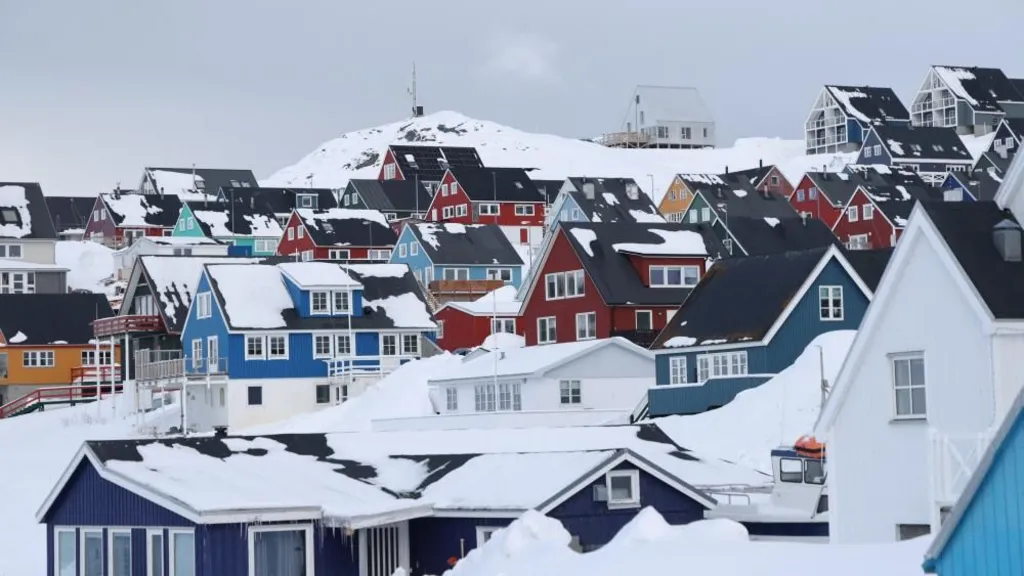
https://ichef.bbci.co.uk/news/1024/cpsprodpb/14b8/live/13b0e3b0-ea48-11f0-a422-4ba8a094a8fa.jpg.webp
A new settlement was established near the present-day capital, Nuuk, after Danish colonization in the 18th Century. Reuters
 
A precedent is on the verge of being set, with U.S. President Donald Trump rumbling about taking Greenland from Denmark, and in the consternation over his belligerent assertions that the U.S. will, one way or another achieve that goal, in the process alienating his European allies and risking the dissolution of NATO, while other nations will likely begin to feel the pressure of the president's territorial acquisition aggression.
 
Mette Frederiksen in Paris last week during a bilateral meeting, met the not-unexpected support of Canada's prime minister with Mark Carney stating the position that the future of Greenland should be a matter between Denmark and Greenland with the exclusion of any others. Recent investments by the Carney government under pressure by Trump to meet NATO's minimum GDP investment in military preparedness doesn't equate to Canada being let off the hook of Trump's gimlet eye.
 
The initial investment in developing next-generation military satellite communications for Arctic operations may not insulate Canada to the extent it hopes for, from President Trump's continued gibes about Canada's irrelevance. Canada -- like Greenland, an autonomous territory under the Kingdom of Denmark's protection is also a member of the North Atlantic Treaty Organization, as an island of strategic importance in the Atlantic Ocean -- faces similar challenges from Mr. Trump..
 
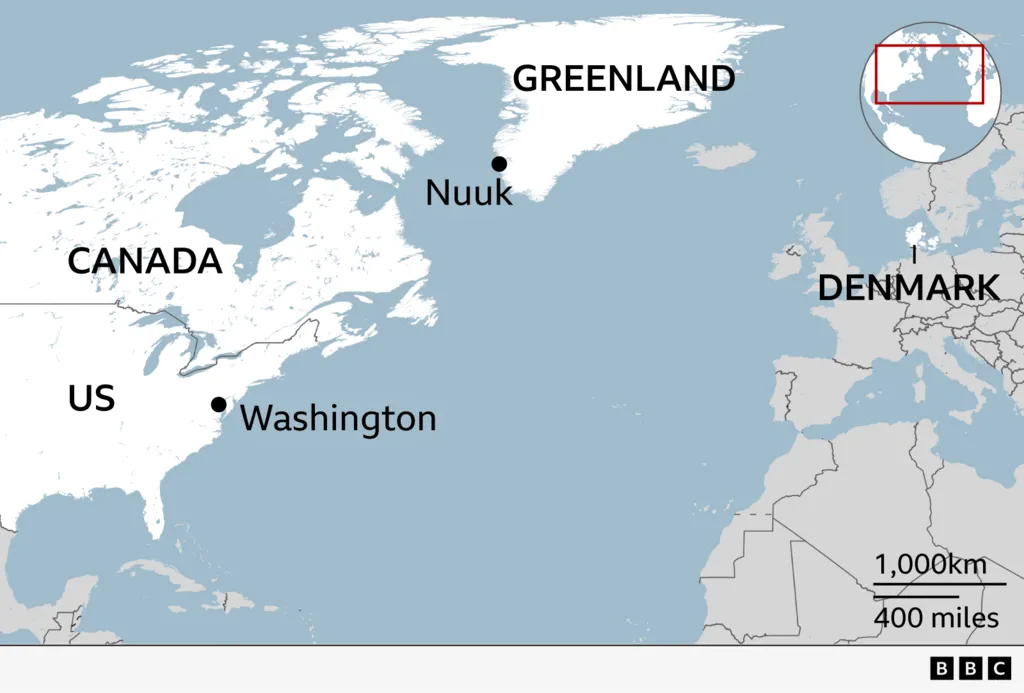
https://ichef.bbci.co.uk/news/1024/cpsprodpb/f7dd/live/2f1bccb0-ebbe-11f0-b385-5f48925de19a.png.webp 
"One way or another, we will have Greenland", President Trump stated yet again, accelerating his threats in recent weeks to take over the largest island in the world. Ostensibly to prevent Russia and China from attempting to do the same, he cautions. Under the rationale of the imperative to ensure American security interests in the Western Hemisphere a repurposing of the Monroe Doctrine has been cited as the security instrument motivating and legitimizing a Greenland takeover.
 
That Denmark's Frederiksen vehemently opposes the proposed encroachment by the U.S., spurning its sovereignty in Greenland, and that Greenlanders themselves have no wish to become a U.S. protectorate is of no moment to Mr. Trump. The U.S. has an established military presence in Greenland through a 1951 agreement with Denmark, in the presence of a  remote airbase. Speculation over the manner in which the U.S. might assert its claims on the North abound.
 
The U.S. military raid in Venezuela that resulted in the scooping up of the country's President Nicolas Maduro and his wife and taking them to the U.S. to stand trial for narcotics trafficking appears to have put the U.S. President in the mood to flex his military muscles and exert pressure on both enemies and allies alike.  While Cuba and Colombia are in his crosshairs, so too are Denmark/Greenland and Canada, Trump's fanciful '51st State'. 
 
Trump is reportedly taking aim at Canada and expressing concern about its 'vulnerability' to adversaries after his previous threats to make the country the ‘51st state’
Trump is reportedly taking aim at Canada and expressing concern about its 'vulnerability' to adversaries after his previous threats to make the country the ‘51st state’   Getty Images 
 
"I think the EU and Canada, all of us are tiptoeing around Trump because we know he is very volatile." 
"We are all economically very dependent on the U.S. and militarily dependent on the U.S."
"[A potential rupture in NATO and Trump's] Donroe Doctrine [runs the risk of creating] strong men [spheres of influence across the world]."
"This then gives the nod to Russia to continue to control its sphere of influence and perhaps continue to try and annex Ukraine. And China is going to take this as a licence to be able to dominate its area of the world."
"We've seen in history when you have this multipolarity and these multiple spheres of influence, there's the greatest likelihood of conflict because of this increased great power competition."
"And then accidents and incidents are more likely to be interpreted as nefarious, and everybody comes out swinging."
Andrea Charron, director, Centre for Defence and Security Studies, University of Manitoba

Labels: , , , , , ,

Friday, January 09, 2026

Acquiring Greenland: Coercion or Military Action

"RUSSIA AND CHINA HAVE ZERO FEAR OF NATO WITHOUT THE UNITED STATES, AND I DOUBT NATO WOULD BE THERE FOR US IF WE REALLY NEEDED THEM."
"We will always be there for NATO, even if they won't be there for us."
"We are going to do something on Greenland whether they like it or not. Because if we don’t do it, Russia or China will take over Greenland, and we’re not going to have Russia or China as a neighbor."
"I would like to make a deal the easy way, but if we don’t do it the easy way we’re going to do it the hard way."
"You defend ownership. You don’t defend leases. And we’ll have to defend Greenland. If we don’t do it, China or Russia will. Not going to happen."
"I think that ownership gives you a thing that you can’t do with, you’re talking about a lease or a treaty. Ownership gives you things and elements that you can’t get from just signing a document [expanding its leased military base in Greenland]." 
"We need Greenland from the standpoint of national security, and Denmark isn't going to be able to do it. It's so strategic."
U.S. President Donald Trump
 
"If the United States chooses to attack another NATO country militarily, then everything stops."
"That is, including our NATO and thus the security that has been provided since the end of the Second World War."
Danish Prime Minister Mette Frederiksen
 
"The president and his team are discussing a range of options to pursue this important foreign policy goal, and of course,  utilizing the U.S. military is always an option at the commander-in-chief's disposal."
"[The president and his national security aides are] looking at what a potential purchase would look like."  
White House Press Secretary Karoline Leavitt 
Nuuk, capital of Greenland
The Aurora Borealis (Northern Lights) is seen behind a building with social housings with a mural in Nuuk, Greenland. REUTERS/Hannibal Hanschke/
 
Clearly, Danish Prime Minister Frederiksen's statement that the U.S. in agitating to take over Denmark's Greenland territory would result in the dissolution of the military alliance of NATO did not sit well with President Trump. There are dim echoes of his persistent declarations of security demanding U.S. total possession of the island -- not that its abundance of rich resources in rare earth minerals doesn't come far behind in a race with China over the wherewithal to produce electronics -- with the Third Reich's 1938 insistence that security and protection of German Sudetenlanders made it imperative to force its surrender from Czechoslovakia. When Europe, represented by Britain and France, boasted that by persuading Czechoslovakia to voluntarily hand it to Germany 'war was avoided'.
 
Fast forward to the present, and Europe is once again faced with a similar conundrum; avoiding military conflict to preserve the military alliance of NATO. And although a Europe, nervous in the wake of the U.S. night-time bombing of Venezuela and the scooping up of Maduro and wife, signalling that the U.S. is on a roll, France, Germany, Italy, Poland, Spain, Britain and Denmark responded to the tense situation in support of Greenland and Denmark alone deciding the trajectory of their joint relations.
 
Now, discreet White House sources whisper of internal discussions with respect to the potential of 'buying' Greenland through lump sum payments, where guidelines revolving around $100,000-per-person payments which would cumulatively result in a total payout close to $6 billion may be a solution but one still in essence 'forced' on an obviously reluctant Denmark and Greenland. Greenlanders in particular are far more invested in their total independence, yet would still prefer a linkage with Denmark over the United States.
 
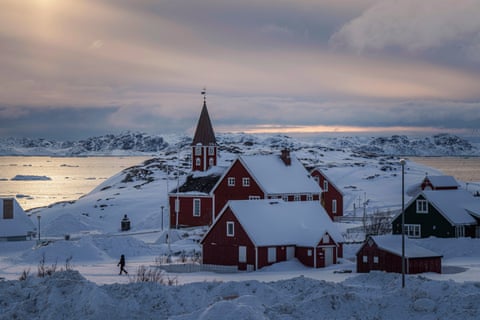
houses on the water
A woman walks near a church in Nuuk, the capital of Greenland. Photograph: Evgeniy Maloletka/AP
 
Although the White House has not totally discounted the possibility of 'military intervention', there are those who have declared a definite preference for paying for the island outright, if not acquiring it through diplomatic negotiations. Only one of which choices would force NATO to make good on its mutual-defence mechanism, Article 5. Its lone invocation and action took place after the shock waves of 11 September 2001. On such an occasion where a member of NATO -- its most powerful and influential member -- itself would take hostile military action against another member, the very thought of a unified reaction is out of the question, altogether neutering the group.
 
The always-mercurial Donald Trump remains aggrieved with another NATO founding member whose Nobel Committee deigned to overlook the American president's qualifications to be chosen as 2025's outstanding nominee for the Peace Prize; a "foolish" decision, he said scornfully. When Nicolas Maduro was captured by military force, Europe nervously eyed the potential for Mr. Trump's next acquisitive eye in his increasingly unrestrained willingness to deploy the U.S. military to achieve  his ends.
 
The joint warning issued by European leaders reminding the American president that the territorial integrity of Greenland and Denmark must be respected would no doubt have fallen on Mr. Trump's notice as a particularly grievous irritant. More so, the nudge to his consciousness that as part of the Kingdom of Denmark, Greenland falls under NATO's defence umbrella, with NATO allies collectively prepared to achieve Arctic security. 
 
https://ichef.bbci.co.uk/news/1024/cpsprodpb/be27/live/96225880-eda7-11f0-a422-4ba8a094a8fa.jpg.webp
Greenland and Denmark have rejected Trump's offer to buy the semi-autonomous territory   Reuters


Labels: , , , , ,

Thursday, December 23, 2021

Early Consensus on Omicron? Not Quite!

"There is something going on ... in terms of the difference in the immunological response for Omicron vs Delta."
"[Findings suggested breakthrough infections and reinfections from Omicron were] less severe [and that immune protection from T-cells and B-cells] mediated [Omicron's] progression to severe disease [despite diminished antibody protection]."
"It's about what [it] means in terms of absolute numbers as, if the numbers are so big it can still cause a substantial public health problem even if, per case, the risk of severe disease is less."
Professor Cheryl Cohen, epidemiologist, University of Witwatersrand, South Africa
 
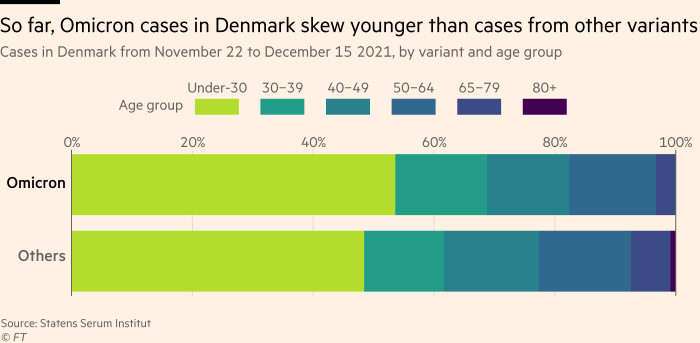
"It is primarily young and vaccinated people who are infected with Omicron, and when we adjust for this, we see no evidence that Omicron should result in milder disease."
Henrik Ullum, director, Statens Serum Institut, Denmark
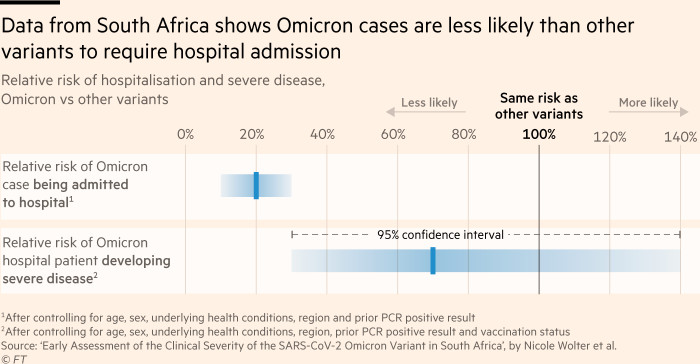
Chart showing that research from South Africa finds Omicron cases are less likely than other variants to require hospital admission

According to health-care data out of South Africa, Denmark and the United Kingdom, findings appear to indicate by separate research teams that fewer cases of severe disease will erupt from Omicron, despite its higher rate of infectiousness, than the previous COVID-19 iteration, Delta. Despite that finding, there remains insecurity of knowledge about the ever-mutating, ever surprising SARS-CoV-2 virus to the point that these same researchers caution that health services can still be strained owing to the new variant's high degree of infectiousness.

All are in agreement that unvaccinated groups remain the most at-risk for infection. And that the proportion of all cases developing severe disease remains lower than with other variants, despite Omicrons breakthrough infections and reinfections causing mild symptoms. Omicron now accounts for a major proportion of COVID-19 cases in a growing number of countries, including the United States. The study carried out by South Africa's National Institute For Communicable Diseases found among those who tested positive in October and November, Omicron was 80 percent less likely to be admitted to hospital than Delta cases.

The same research team released a second analysis controlling for vaccination status, finding that once admitted to hospital Omicron and Delta cases from recent weeks held similar likelihood of progressing to a serious condition. Over 10,000 Omicron cases formed the basis for the analyses, including over 200 hospital admissions. Research out of Denmark indicated that among those who tested positive between November 12 and December 15, Omicron cases appeared three times less likely for hospital admission than cases with other variants, while cautioning that outbreaks among  younger groups could skew data.
 
Chart showing that so far, Omicron cases in Denmark skew younger than cases from other variants
 
Omicron -- in the absence of evidence for any intrinsic reduction in severity -- is not precluded from resulting in less severe outcomes at the population level, given that a greater share of cases are among people with some protection against severe disease through prior infection or vaccination. "Due to Omicron's higher immune evasion, this pattern will persist in a population-level assessment", explained Professor Samir Bhatt, at University of Copenhagen.

The British study analyzed data from PCR-test confirmed cases in England between Dec.1 and Dec.14, concluding that "Overall, we find evidence of a reduction in the risk of hospitalization for Omicron relative to Delta infections, averaging over all cases in the study period". According to Imperial College researchers, risk of any visit to hospital with Omicron was between 20 and 25 percent lower than with the Delta strain. Britain reported over 100,000 new cases of COVID-19 on Wednesday, the first time since wide-spread testing was available.

People who had received at least two vaccine doses remained substantially protected against hospitalization, even if protection against infection has largely been lost against the Omicron variant, according to their estimates. Denmark on Sunday introduced a suite of measures to contain Omicron's spread; among which was theatre and museum closures and capacity limits in bars, restaurants and shopping centres.

A drop-off in severity could make the decision of countries like Britain and the United States not to impose restrictions "just about tenable", according to Professor Peter Garred, clinical immunologist at Copenhagen's Rigshospitalet, Denmark's largest hospital.

Technicians in Durban, South Africa, conduct antibody testing in a laboratory at the African Health Research Institute
Technicians in Durban, South Africa, conduct antibody testing in a laboratory at the African Health Research Institute Technicians conduct antibody testing at the African Health Research Institute in Durban, South Africa Waldo Swiegers/Bloomberg
"[Policymakers should be a] little careful about making the narrative that it's more mild [because it would be] some weeks [before the variant's impact on hospitals becomes clear]."
"I fear that because of the infectiousness of Omicron ... what we see right now will be very different n just about two weeks' time."
Professor Thea Kolsen Fischer, head, virus and microbiological specialist diagnostics, Staten Serum Institut, Denmark

Labels: , , , , , , , ,

Tuesday, June 08, 2021

Directly to the Heart of the Matter

"They are certainly a beacon to other communities on how to improve survival."
"You can do the math: If a neighbour can get to the scene and start CPR within three to five minutes of a collapse, there's a reasonable chance of successful resuscitation."
"If nothing is done for ten minutes, it's a very low probability of success [survival]."
Dr.Mickey Eisenberg, prehospital resuscitation, professor, University of Washington

"The patient is dead [meaning his or her heart has stopped due to cardiac arrest] and if you don't do anything, nine out of ten will be dead forever."
"Hospitals didn't believe ordinary people could make a difference."
Freddy Lippert, director, Copenhagen Emergency Medical Services
cardiac arrest app
Lead Image © THANAGON / Adobe Stock
 
They did, and they do, however. Civilians in Denmark respond faster than do professionals to over four in ten cardiac arrests out of hospitals, according to data from the Danish Cardiac Arrest Registry. The Heartrunner app used in Denmark enabled a swift response of neighbours to save the life of 81-year-old Erik Harry Kaxe whose heart stopped while at home on the outskirts of a small town in western Denmark. Within minutes of being alerted ten strangers who lived close by had arrived to give assistance, before the arrival of the ambulance 17 minutes later.

A social and health-care assistant, Hannelene Kortegaard received the alarm sounding from her Heartrunner app. She and her husband drove to the address given, a map shown on the app's screen while an emergency services operator dispatched an ambulance and guided Mrs. Kaxe to perform CPR. Other volunteers the app notified arrived on scene with a number of AEDs. As Kortegaaard performed CPR, another volunteer prepared a defibrillator. Kortegaard assigned volunteers to wait outside to direct the ambulance.

Others comforted Mr. Kaxe's wife, while someone was delegated to take care of the family dog. Kaxe survived his ordeal. "Dying wasn't difficult, but waking up is", he said in an interview. In 2001 in
Denmark, witnesses used CPR in one of five cardiac arrests occurring outside a hospital. That number is now four in five. And the citizens of Denmark have their dramatic upswing in survival from heart attack courtesy of smartphone technology alerting volunteers to an emergency cardiac arrest.
 
Get involved and help highlight these important issues. We are grateful for any and all awareness that can be raised around matters of the heart. We are happy to provide facts, information and research on our area and our important contacts. You are more than welcome to share our materials just so long as you reference Heartrunner Sweden.
 
The app alerts volunteers to the occurrence of nearby cardiac emergencies, directing them to the location of automated external defibrillators (AEDs). The app asks volunteers to enter residences and perform CPR until the arrival of an ambulance. Concerns of safety and the acceptance of people who are untrained volunteers to enter private homes have largely prevented a similar use of PulsePoint, a North American responder app, to take place in the United States. Should such concerns be overcome according to leading experts, the U.S. could "significantly improve" its own survival rate.

The out-of-hospital survival rate in Denmark increased from four percent to 15 percent over the course of the past twenty years. Before the pandemic occurred the survival rate in the United States stood at 9.8 percent. 70 percent of all cardiac arrests that occur out of hospital in the United States occur in residences; persuading volunteers that it is a necessary requirement in saving lives to enter homes to improve survival rates in the U.S. represents a life-saving goal.

Pulse Point is designed to alert volunteers who happen to be nearby, who had taken CPR training, or who are off-duty emergency responders, notifying them through a distinctive alert tone when someone has gone into cardiac arrest in their near vicinity in places such as shopping malls, workplaces or streets. The function of the app is also to guide them on a map to the precise address and the location of the closest AED.

PulsePoint alerts verified responders who happen to be professionals, to cardiac arrests in residences whereas civilian volunteers are not called to residences reflecting safety concerns on entering the home of a stranger. "Maybe we're not thinking forward quite as fast as we could", commented professor of medicine Dr.Thomas Rea, who studies prehospital emergency care at the University of Washington. 

Smartphone App Boosts Bystander Response to Cardiac Arrest 
 
The app in Denmark allows dispatchers from the national health emergency number 112 to contact up to 20 volunteers within a 1.77km radius from the scene of a cardiac arrest where the dispatcher goes on to alert ambulance services while guiding the person who called in to commence CPR  until the arrival of volunteers. "Can you run?" asks the app as volunteers respond "yes" and are then directed to the address shown on the screen or alternatively to the nearest available AED and then toward the scene of the emergency.

There are over 100,000 registered Danish volunteers, 74 percent of whom have no professional background in health care, according to surveys. Danish volunteers have taken to the app and the responsibility that falls to volunteers, a sign of a change in attitudes to civilian response ... to become a cornerstone in the nation's improved survival rate.


Labels: , , , ,

Thursday, April 16, 2020

Re-Opening the Economy in Denmark

"I won't be sending my children off no matter what."
"I think a lot of parents are thinking, 'Why should my little child go outside first'/"
Sandra Andersen, founder, My kid is not going to be a Guinea Pig, Facebook

"I don't think it's right for the kids not to hug their friends."
"We keep the kids home, because the situation in the day cares before the COVID-19 outbreak were not OK, and the conditions they are setting up now are even worse."
Nonne Behrsin Hansen, Copenhagen, Denmark

"Suddenly, these moms feel like they just have to throw their kids to the front line and I think their reaction is: 'Don't mess with our kids."
Esme Emma Suteu, founder, Momster

"We're all a bit nervous and we'll have to ensure that we stick to hygiene rules."
"We have a lot of washing hands during the day. We don't have masks and we have to keep a good distance from each other so that's a very difficult task."
Elisa Rimpler, Danish Union of Early Childhood and Youth Educators

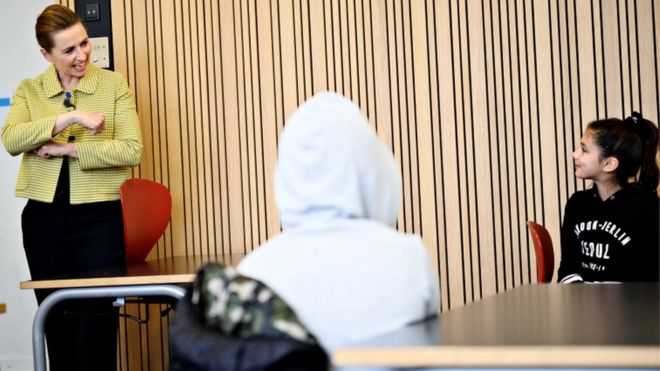
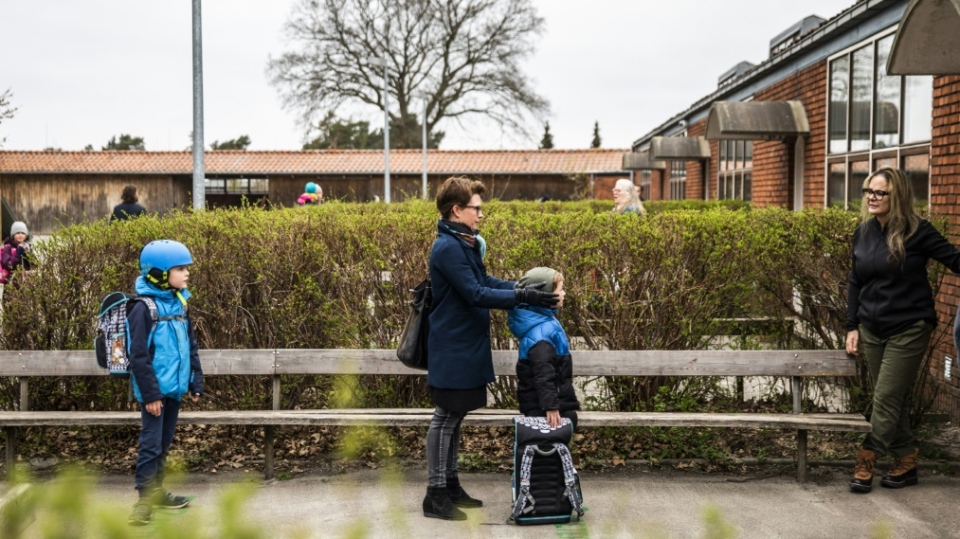
The Danish prime minister welcomed children on their return to school in Valby on Wednesday
The Danish prime minister welcomed children on their return to school in Valby on Wednesday     Reuters  

One of the first countries in Europe to decide to close down its schools in reaction to the influx of novel coronavirus cases, Denmark with its population of just under 6 million now feels the time is right to re-open them for children up to the fifth grade to "get the economy going again", according to Prime Minister Mette Frederiksen. To free up parents by allowing the children to return to school, so their parents can return to the workforce to rescue a faltering Danish economy.

Instructions have gone out to teaching staff to ensure that social distances are maintained between children. Among the population there are many who are less than pleased, even while others express confidence in the move. An online network of thousands of Danish mothers signed onto Momster have little confidence that Danish authorities have matters relating to the novel coronavirus under control.

Concerns that newly reopened schools and daycare centres may serve to open a new front of COVID transmission leading to a second wave of cases has moved thousands of Danish parents to express their foreboding by keeping their children at home, despite the official re-openings. Denmark has not seen the kind of flood of coronavirus cases seen elsewhere in Europe, like Italy or Spain, France or Britain, but the decision has brought a heated debate over priorities; health safety or the economy.

Denmark first in Europe to reopen schools after coronavirus lockdown
Children distancing at Korshøjskolen in Randers . Bo Amstrup/Ritzau Scanpix

Up to Tuesday the virus had infected over 6,600 Danes and resulted in close to 300 deaths. Shops were ordered closed, along with bars, restaurants, cinemas and gyms.

It was when the Danish health authority recommended an easing up after the lockdown of a month's duration had succeeded in reducing the rate of new cases, to relax the lockdown by opening up schools to children up to age eleven.

At the department of infectious diseases, Aarhus University, scientist Christian Wejse acknowledged parents' concerns "because we've spend a month trying to avoid contact". But he stated that the age group of children in question fall into a category "where few fall ill, and those who do won't get very sick". He points to Sweden as an example, where schools have remained open and no dramatic rise in infections has arisen. Children, he assured the skeptical, seem not to be a major driver of infections.
"I feel great, really good about the kids going back to school."
"I think we're all going to be sick at one point and they told us the children are going to be less sick and affected by this virus."
"I think it's good that they're going back to school... We need to go back to daily life."
Caroline, 38, mother of two, Copenhagen

Denmark schools
Schools in Denmark were closed on March 17 in an effort to curb the COVID-19 epidemic, though many had shut before then. (AFP)

Labels: , , , , ,

Friday, October 16, 2015

Different Strokes for Different Folks

"Zoos routinely over-breed and kill lions and thousands of other animals deemed surplus to requirements."
"[Zoos have an ethical responsibility] to manage reproduction, prevent inbreeding [and] maintain genetically healthy populations."
Joanna Swabe, head, Humane Society International/Europe
Children watch the dissection of a lion at Odense zoo
For years, animals have been regularly dissected in Odense in order to teach children about nature. Photograph: Julia Wäschenbach/DPA/Corbis

It was unspeakably ugly when in February of 2014 the Copenhagen Zoo killed a healthy giraffe that was surplus to its needs and staged a public event to feed the dissected carcase of the giraffe to lions. Presumably, a life lesson in real-time for the children who happened to be in the audience for the spectacular presentation. Concerned no doubt, with teaching children how much a part of the natural world we are, and that empathy for animals other than ourselves and their compassionate treatment is an imperative in an ever-shrinking world.

As though to outdo the event of 2014, another staged dissection took place more recently in Odense, Denmark. The year-old male lion together with its siblings, another male and a female, were designated surplus as well. The zoo, according to its explanation, had been unable to persuade other zoos to give these redundant species of large cats new homes. Two of the lion cubs were put to death out of public view, and frozen, their final disposition evidently not yet decided. But for the animal that was killed and dissected a few days ago, the event was considered a 'teaching moment'.

An employee of the zoo, Lotte Tranberg, explained the rationale behind killing the three lions; they were becoming sexually mature. The zoo was alert to the potential of sexual activity between the three and in the interests of avoid inbreeding decided it was time to dispatch the animals. Which, they also said, could have killed one another, as they were maintained in a single compound. Ms. Tranberg knowledgeably explained to the waiting audience, no doubt spellbound with anticipation, the life of the big cats.
A zoo employee carries out the dissection.
A zoo employee carries out the dissection. Photograph: Scanpix Denmark/Reuters

In the city of Odense, 170 kilometres west of the capital of Copenhagen, the crowd of onlookers, thick with children in attendance for the educational aspect of a lecture that included a very hands-on performance of dissection, the removal of organs, held up for visual inspection as they and their functions were being described, had their lesson in death following hard on life. No lecture should conclude without a question-and-answer session and this one was no exception; the obligatory Q&A saw children asking, the zoo employee responding.

The performance, it would appear, was greatly applauded for its quality and directness. "For all the kids living in towns, it’s wonderful for them to see and it’s only natural", Gitte Johanson, 28, an onlooker who grew up on a farm stated, waxing enthusiastic. A 54-year-old military officer, Ole Hanson, who carried his 5-year-old grandson Frej on his shoulders so he could watch the dissection explained: "But he wanted to get down and have a closer look. So he ended up [at the] front, right before the lion."

Portraying such an event as perfectly natural stimulates the curiosity of children with a real-life version of life-and-death. Direct exposure and the relaxed attitude toward life and death as natural and inevitable perhaps explains why it is that a study published in 2003 reflected that 41% of deaths under medical supervision involved doctors taking "end-of-life" decisions to help ease their patients' suffering before death (about 1% of which were via prescription drugs) in Denmark.

Oddly enough, psychiatrists consider that children who indulge their curiosity by 'dissecting' animals often turn out to be psychotic killers. Evidently, only in North America.

On the Facebook page of the Odense Zoo, which just happens to be one of central Denmark's most popular tourist attractions, public dissections, it was revealed, have been carried out for decades. And Danes have defended these public dissection events. They have, evidently, become a show-and-tell tradition, a teaching moment directed toward children. An open-air museum in Odense slaughtered and dissected a pig the day before the lion's dissection. At the museum children were treated to an explanation about which parts of a pig are eaten.

Different culture, different traditions, different perspective on life and death. With that kind of direct exposure to animal slaughter clearly identified for human consumption as being quite ordinary and a part of life, taking place in North America, it's a fair bet that the number of committed vegetarians would swell to the point that the meat industry would campaign to have public displays of that ilk outlawed.

Labels: , , ,

 
()() Follow @rheytah Tweet