Ruminations

Blog dedicated primarily to randomly selected news items; comments reflecting personal perceptions

Wednesday, July 03, 2019

Why Vaccinate? Proven Utility in Prevention

"Vaccine injuries are rare."
"They are pharmaceuticals and people can react to them -- you can have a bad reaction to aspirin."
"We've been called all kinds of crazy things, including anti-vax."
"We're not. My law partner's sister spent her life in a wheelchair because she had polio. I wish she had that vaccine."
Renee Gentry, vaccine claims lawyer and director of a vaccine injury clinic, George Washington University Law School, Washington

"The overwhelming number of vaccine injections are completely safe and not associated with any adverse events."
"This is in marked contrast to what the anti-vaccine movement is trying to promulgate."
Dr. H. Cody Meissner, advisory commission official, National Vaccine Injury Compensation Program, U.S.A.
CreditJohannes Eisele/Agence France-Presse — Getty Images
After receiving a tetanus shot, 58-year-old teacher Angela Barry experienced intense pain, was barely able to lift her arm. Her condition became serious enough that she required cortisone shots, surgery and then months of follow-up physical therapy. Her medical costs were covered by the federal injury compensation program. Her experience failed to convince her that vaccinations might be dangerous. "I would not want anybody to hear this story and say, 'Oh, there's another reason not to go get vaccines'", she says. And so, she continues to get vaccinated.

Measles outbreaks in Israel, Ukraine, the Philippines and the United States have brought heightened attention to the failure of many parents to immunize their children. In the United States over the past dozen years or so, people have received roughly 126 million doses of vaccines against measles. At one time in the not-so-distant past, measles represented a disease infecting millions of American children. Measles killed 400 to 500 people every year.

More latterly, over a recent period of a dozen years, 284 people filed claims of having been harmed from the immunizations they received. A federal program to compensate people injured by vaccines was created to respond to those claims. And of those filed, about half of the claims were dismissed according to the National Vaccine Injury Compensation Program, developed to cover claims related to 15 childhood vaccines as well as the seasonal flue shot.

Hundreds of millions of Americans have received billions of doses of vaccines over the past three decades. And the program has been used to compensate about 6,600 people in view of personal injury they claim to have been caused by vaccines. Even so, an estimated 70 percent of the awards were settled in instances where program officials failed to find sufficient evidence of fault attributed to vaccines.

Flu shots in recent years mostly involving adults have been involved in many of the program's pay-outs, to a total of $4.15 billion. About 520 death claims were compensated throughout the period of thirty years. Vaccines prevented over 21 million hospitalizations and 732,000 deaths among children over a twenty-year period, to place matters in perspective, according to the Centers for Disease Control and Prevention.

Data shows that should an individual contract measles the likelihood of serious harm is greater than the chance of injury from the measles vaccine. An estimated one in four people who contract measles are potential candidates for hospitalization, with one to two of every 1,000 people with measles likely to die from the disease. Claims of harm have been filed for about two of every million doses of the measles vaccine, as a counterpart to the foregoing.

From 2006 through to 2017, about two claims of injury for every million doses of all vaccines were filed. A list of injuries and conditions that might be caused by each vaccine includes fainting and brain inflammation, but autism is definitely absent from the list used by the National Vaccine Injury Compensation Program. Federal courts have ruled that evidence indicates conclusively that autism is not caused by vaccines.

On the other hand, the very existence of the program itself is cause to believe that vaccines are more dangerous than medical evidence indicates, according to the logic of vaccine opponents. "If vaccines do not cause injuries, why has the vaccine injury trust fund paid out $4,061,322,557.08 for vaccine injuries?", a Florida Republican Representative asked in a letter defending the right of parents to make their own decision on shots for their offspring.

The data itself speaks as evidence of vaccine safety, point out public health experts. Some half of all claims since 2017 relate to shoulder injuries, generally in adults, occurring as a result of a health provider injecting a vaccine too high on the shoulder, or into the joint space, rather than into muscle tissue, as is required by sound medical practise. A tax is levied by vaccine manufacturers of 75 cents per dose, and this tax finances the program.

Centers for Disease Control and Prevention

Labels: , , ,

Monday, December 19, 2016

Occupational Disease Claims for Compensation

"I didn't know what to do or say. I was stunned. Literally sick, mentally and physically sick, because of the answer [Ontario Workplace Safety and Insurance Board refusing benefits based on workplace-inspired illness]."
"The system has failed us all [General Electric Peterborough employees]. And one [report] saying everything is fine has defeated everyone who got sick or died. It's gut wrenching."
"What we say doesn't carry any weight."
Roger Fowler, cancer survivor, former GE employee

"I didn't know it was asbestos, but I mean when Roger would come home, he'd go right downstairs and strip his clothes off and throw them in the washing machine."
"You could see the fibres too."
Gladys Fowler, Peterborough 
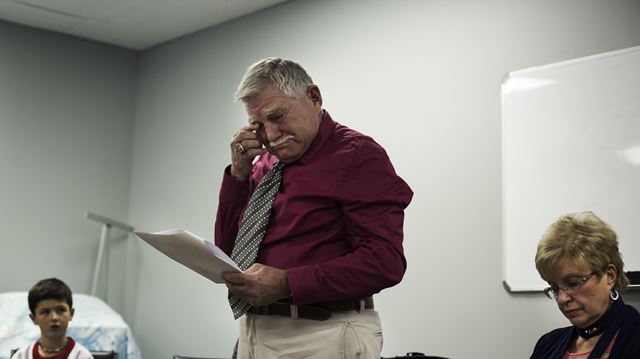
Roger Fowler wipes away his tears while reading one of his poems during the Celebration of Life, which is an annual event organized by former GE employees to honour those who have passed from cancer.

"There's a systematic barrier to actually looking at what's happening to these blue-collar workers behind factory walls."
"If compensation boards recognize these cases, then the onus is on the government to go do something about them. We're caught in this vicious cycle."
Dr. Jim Brophy, occupational disease expert

"It is no longer accepted that you do published science when you're being paid by one side and the outcome of that science reflects on the future of your boss."
Dr. Noel Kerin, representing Occupational Health Clinics for Ontario Workers
In the past decade over half of the 660 occupational disease claims registered for a range of conditions including brain, bowel and lung cancer brought against General Electric Peterborough by former employees were refused or withdrawn citing insufficient evidence. Of that total, 280 were accepted. One scientist describes what those workers were regularly exposed to as a "toxic soup" of chemicals. That toxic soup has impacted their lives causing dreadful disease onset and early death.

Roger Fowler, at age 46 had his rectum removed as a result of colorectal cancer and now depends on a permanent colostomy bag. Two years later, from so many surgeries he had undergone, he was forced to deal with huge hernias applying pressure on his bladder. By the time he reached 56 he was free of all symptoms of colorectal cancer, caused, he is clear, by his work under asbestos-wrapped pipes that scattered chunks of that toxic material over him.

He and all the other former GE employees cast blame on a system which expects a rigid standard of proof before compensation is won. A GE report issued in 2002 that pointed out that "no significant excesses" of cancers resulted from work at its facility, appears to have been accepted as fact, belying the anecdotal and medical reports supporting the workers' absolute belief that it was the quality of their employment that led to their disease onset.

The GE study analyzed the link between eight of the carcinogens commonly in use at the plant and the episodes of cancer deaths, to find excesses of some types of cancer such as lung cancer mortality up to 57 percent higher than the general population occurring among GE male employees. But a study that followed claimed that the cancer excesses identified in the first study, when controlling for factors such as age and smoking, were significantly diminished.

Marilyn Harding at General Electric

photo by Melissa Renwick     Marilyn Harding worked at General Electric for almost 40 years and has survived bladder and breast cancer. A photo taken a few months after her daughter's birth shows her assembling lead heating cables, beside an asbestos machine, which she says contaminated the entire work station.

The study was supervised by GE's staff industrial hygienist, Dr. Roland Hosein, who held the position of vice-president of environment, health and safety for General Electric, eventually becoming a member of the Workplace Safety and Insurance Board Research Advisory Council. Dr. Hosein is also an adjunct occupational health professor at University of Toronto. A spokesman for GE stated that allegations of conflict of interest in the matter were unfounded, a statement that Dr. Kerin who studied the workers at GE with cancer in 2004, categorically rejects.

The Peterborough plant, furthermore, has a long history of environmental disturbances resulting from its operation. A chemical reaction to a 2,000-gallon resin tank at the GE plant in 1972 was responsible for a plume of gas rising across the city. Firefighters dispatched to the factory developed recurring illnesses like lung diseases and heart problems; whether they were ever compensated is not generally known.

Yet again, in 1982, the plant was responsible for dumping 20 gallons of poisonous cyanide solution through a leaking pipe into the sewer system in Peterborough. And in 1994 the company was unable to sell land it held, to the city of Peterborough for a new arena since the soil was discovered to be contaminated with polychlorinated biphenyls (PCBs), a cancer-causing substance almost impossible to flush out of soil and sediment.

A Ministry of Environment 2015 report stated that the plant's storm sewers failed to meet "site criteria" for PCBs. Those sewers drain directly into the Otonabee River which runs through Peterborough and on into Rice Lake.  GE halted the use of PCBs, now banned province-wide, in the 1970s, but the soil around the plant remains saturated with them, next to impossible to dislodge from the environment.

At the GE plant, work placed those who were employed there exposed to an array of carcinogens  decades ago, causing dire disease onset. Proof of the absolute evidence that the compensation board calls for is difficult to gather. The risks to health documented at the plant make it clear that workers making their claims for compensation should be offered the benefit of the doubt, and the plant not be given a free pass on its use of those chemicals with the resulting exposure.

"The whole question is, what do you do in the face of scientific uncertainty? And that's no longer a scientific question. It's a question of values and whether you value human life or you don't", said Bob Matteo, former director of health and safety with the Ontario Public Service Employees Union.

General Electric plant in Peterborough
General Electric plant in Peterborough | Photo by Melissa Renwick

Labels: , , ,

 
()() Follow @rheytah Tweet