Ruminations

Blog dedicated primarily to randomly selected news items; comments reflecting personal perceptions

Sunday, July 08, 2018

The Conception "Problem" Partner : Fragile Psyches

"We had just gotten married and a thousand things were going through my mind: Will we stay married? Will she leave me? What's going to happen to our relationship?"
"It's hard for a man to express what he's going through and [to] say, 'I'm the problem'."
Bryan Dube, 40
While the average sperm counts have dropped for all men, that i€™s still considered within the normal range needed to conceive. Getty Images

"When I see patients in my office, women often say, 'I hope it's me and not him'. The reality is that it's 50/50."
"More people who come to us have a male factor for infertility than ever before."
Dr. Arthur Leader, OB-GYN, Ottawa

"Something is very wrong with the way we live."
"It's amazing that so many people can't conceive naturally -- it's really something we should pay attention to."
"One possible explanation is that men residing in Western countries over the last decades were exposed to new man-made chemicals during their life course, and there is more and more evidence that these chemicals hurt their reproductive function. We don’t know for sure why this is happening, but our findings should drive massive scientific effort to identify the causes and modes of prevention."
Hagai Levine, epidemiologist, professor, Hadassah University Medical Center, School of Public Health, Jerusalem

"The general consensus is that 'real men' gush sperm."
"Male infertility destabilizes the presumed fundamental basis of masculinity disrupts traditional gender roles and hits personal masculine identities right where it counts."
"These doctors [male infertility specialists] put a lot of effort into making men feel manly in their clinics [avoiding using words such as 'infertile', or 'infertility'."
"Instead, they would say 'Your sperm count is at three million and I was hoping for 15 million'. When a man hears that, they could think that's really good, but in fact it's terrible."

Liberty Barnes, medical sociologist, University of Oregon

"We need to help them [men] too."
"No one talks to young men about the fact that they could be infertile or why they might be infertile."
"These are medical situations that they should be aware of."
Marcia C. Inhorn, medical anthropologist, Yale University

 Life begins … but for western couples the process is becoming more and more difficult.
Life begins … but for western couples the process is becoming more and more difficult. Photograph: Mark Evans/Getty Images

Bryan Dube most certainly was not aware of, nor made aware of the fact that there was nothing wrong with his masculinity, and that he is among the modern cohort of young men whose sperm count is low because of circumstances he knows nothing about, but shares with a multitude of others. His lack of knowledge steeped him in doubt about himself, about his value as a man, about his future status as a parent and husband. In short he was puzzled, fearful and short-changed.

He and his wife wanted a family. They soon discovered that would be a costly venture for them, even though in the end they were more fortunate than many who took the same hopeful route to parenthood. A round of in vitro fertilization (IVF) was costly at $10,000; all the more so that it turned out to be unsuccessful. They paid out to freeze more eggs, and a year later tried again and finally 2013 brought them a son.

Presumably, he is now a lot more knowledgeable than he had been as a newly-married in his mid-30s. Very seldom discussed, but a reality, male infertility is rising in the general population. Last year, the results of a meta analysis of studies on the issue saw publication in Human Reproduction Update, concluding on the evidence that sperm counts have fallen and continue to fall in Western countries, representing a conservative 52.4 percent drop from 1973 to 2011.

Dr. Leader co-founded an IVF clinic in Calgary at Foothills Medical Centre and went on to co-found the Ottawa Fertility Centre after a stint as professor of obstetrics, gynecology and medicine at the University of Ottawa. He feels the reasons that can be attributed to this situation of growing male infertility are manifold, beginning with the decision by men to wait longer to have children, when their 'best before' date for sperm fertility is under age 40.

The social myth that men remain virile long, long after women lose their battle with their biological clock around age 35, persists. With aging, sperm quality declines, including the shape and movement of the sperm. Dr. Levine, lead author of the sperm count study, feels environmental factors and lifestyle factors must be included. That means exposure to chemicals such as pesticides, heavy metals and radiation, along with poor diet, inactivity and smoking -- all play a part in male infertility.

The irony is glaring. In just about every and any medical specialty men are studied and research models males as the paradigm of best outcome. Not, however, when it comes to infertility; it is a social shibboleth. Experts point out the prevailing assumption that the main symptom of infertility is impotence, whereas sperm count, shape and movement as well as blockage in places such as the testicles and vas deferens can represent fertility interference, yet not necessarily result in inability to have an erection.

Male infertility does not denote a lack of masculinity. What it represents is a medical condition. And the issue of reproduction health should no longer be confined to educating women about the conditions that interfere with their ability to conceive. There is an obvious and urgent need to extend the conversation about reproduction health to be more inclusive, sweeping men into the issue to advise that infertility affects both genders in ways that are gender-specific.

What matters most isn’t the number of sperm but their form and movement, one fertility expert says.Getty Images

Labels: , , , ,

Tuesday, October 10, 2017

"Three-Parent Babies"

"[The DNA blending technique represents a] novel, promising intervention [allowing women to avoid the potential of children inheriting fatal diseases, and as such should not be forbidden by law resulting from] misplaced apprehension [of interfering with the human genome."
"[Canadians] have the right to benefit from scientific advances [under the Universal Declaration of Human Rights]."
"[The procedure, mitochondrial replacement therapy: MRT], is often the only possible intervention to enable the birth of a healthy, genetically related child for women who carry [mitochondrial mutations]."
"The desire -- and social pressure -- to conceive biological children have been subjects of rich theoretical and health policy inquiry. [The media's reporting of assisted-baby-making techniques] has played no small part in contemporary social constructions of assisted reproduction as being antithetical to 'natural' processes of conception and parenting."
Journal of Obstetrics and Gynaecology Canada commentary

"Were not advocating that anybody can do anything. We're advocating that this should be allowed to go forward."
"Because right now it's impossible because of criminal law -- if you do this, there are jail times and fines, period."
"We can set up an ethical framework and protect Canadians from the sorts of cowboys like Zhang."
"People might say we don't know what the impact of the change is on the children born. What we're saying is, this is one of many discoveries and techniques that are coming, and we don't have a framework whereby we can say whether we should or shouldn't do it."
Dr. Arthur Leader, Ottawa fertility specialist
It's a (controversial 3-parent baby technique) boy!
Controversial 3-parent baby technique: image media

The "Zhang" referenced was to Manhattan-based Dr. John Zhang who has set up his own commercial enterprise providing a form of MRT, promising to guide women in their 40s toward carrying their very own biological babies. Their DNA undergoes a technique whereby it is inserted into younger, fresher eggs provided by younger women at his New Hope Fertility Center. The facility Dr. Zhang opened operates with a stable of fertility doctors able, at a substantial cost, to 'give hope' to women past their normal child-bearing years.

In fact, Dr. Zhang and his clinic have been issued a warning by the U.S. Food and Drug Administration that the technique has not been formally approved for use, and he must cease and desist from promoting and providing his controversial "spindle nuclear transfer" technique. The vast majority of a cell's genetic material (DNA) resides within its nucleus, with an amount less than 1% found in the mitochondria, which in its intact state is passed from mother to child through her egg.

With this technique, less than 0.1% of DNA comes from the donor egg, with the balance of 99.9% contributed by the mother whose DNA the child inherits, while the potential for inheriting a mutation is removed through the process. The ethics involved in this technique is the concern that the process will be used for cosmetic reasons, not reasons linked to avoiding dangerous mutations. And that eventually with the loosening of standards, the technique will ultimately be used to 'design' babies with special attributes of a purely aesthetic nature.

So it is little wonder that this technique, essentially involving two women and a male to conceive a baby, is viewed with concern, the result of which has been that the technique has failed to impress regulators and this is reflected in the law, where it is a criminal offence to knowingly create embryos with DNA from more than two people. The medical specialists who wrote the commentary in the Journal of Obstetrics and Gynaecology Canada have embarked on a mission to overturn the 13-year-old law.
It is a crime in Canada to knowingly create embryos that have DNA from more than two people.  Getty Images
Mutations in mitochondria have the potential to cause fatal metabolic disorders in babies. Babies who inherit mitochondria that may carry mutations can inherit genetic diseases that will affect the neurons and nervous system. It makes sense that women would like to have some guarantee that their babies are not afflicted with any of these potentials. The technique of mitochondrial replacement therapy extracts the nucleus from the egg of a woman whose mitochondria are diseased, injecting it into an "enucleated" donor egg with normal mitochondria.

This is where the dual 'mother' DNA comes in. Used to enable older women to become pregnant and in the process avoiding passing on mutant genes is one thing, using the technique to endow a child with preferred height, colour of hair, of eyes and other features not inheritable from its mother, the primary provider of the DNA, enters a realm of science fiction where replicants and cloning fascinate the human mind and the experimentation of rogue scientists.

The authors of the commentary stress that the techniques around MRT remain in "still-experimental benefits" stages. Their argument is that regulatory and criminal restrictions have the capacity to enhance and promote the phenomenon of reproductive medical tourism, and do great favours to medical outliers like Dr. Zhang who charges $50,000 at his "Darwin Life" clinic to "reverse the effects of age" on human eggs. Both UNESCO and the Council of Europe prohibit the technique.

According to Canada's Assisted Human Reproduction Act, no person shall knowingly "alter the genome of a cell of a human being or in vitro embryo such that the alteration is capable of being transmitted to descendants", for no one knows what such inheritance in later generations can result in.

As for the country's fertility specialists, they strongly urge that the ban on paying donors and surrogates should be overturned; their argument being such that the law drives an underground market, forcing people to import eggs and sperm from the U.S.
"At the present time, there is no such consensus [on how to proceed]."
"We're not really talking about saving lives that exist already. We're talking about creating new lives that are free of disease, and there are other ways we can achieve that objective where we're not prioritizing strong genetic relationships [like using a surrogate or egg donor]."
Bioethicists Francoise Baylis and Alana Cappatan
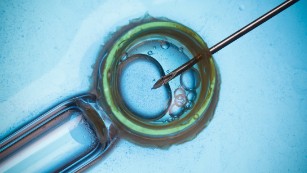
Scientists use a pipette to remove the nucleus from an egg. OHSU Center for Embryonic Cell and Gene Therapy via AP

What are mitochondria?
Mitochondria are small structures found in our cells that generate the cellular energy used to power every part of our bodies.
Mitochondria have their own DNA, which controls only mitochondrial function and energy production.
This is separate from our "nuclear DNA," which makes us who we are and determines appearance and personality.
Source: Wellcome Trust Centre for Mitochondrial Research

Labels: , , ,

 
()() Follow @rheytah Tweet