Ruminations

Blog dedicated primarily to randomly selected news items; comments reflecting personal perceptions

Saturday, July 26, 2025

Securing Justice

"I stand here not just as a mother but as a broken soul whose life changed forever the day my child's life was taken from me by another child."
"I ask myself what has happened to those two boys that has resulted in that terrible act of violence, and I cannot imagine how can they be so angry."
"What they did was horrific and I do not know what has led them to do this, and maybe I will never."
"At least my son is at peace, and those two kids are going to have a really tough time." 
"To the young people who carry knives, I beg you to stop before you raise that blade."
"Don't let a moment of anger steal your future. Don't let the streets raise you in a way your mother never would. There is no power in death, only loss."
Marie Bokassa, mother of murder victim, Kelyan Bokassa
 
"[The teenager looked around and out of the windows before taking his seat] giving every impression that he was concerned for his safety."
"Kelyan Bokassa had no time to reach for his own knife, which remained in his trousers, and instead tried in vain to protect himself with his school bag."
"Since Kelyan Bokassa was seated on the back seat, he was cornered, unable to escape as the defendants repeatedly thrust their knives towards him, smiling as they did so." 
"There were several other passengers on the top deck who fled in panic when they realized what was happening. They describe hearing intense screaming from the back of the bus and the victim shouting, 'Help. Help. I've been stabbed'."
Prosecutor Deanna Heer KC 
https://ichef.bbci.co.uk/news/1024/cpsprodpb/7fd7/live/0f542590-696d-11f0-ba8e-91d56f9acc4a.jpg.webp
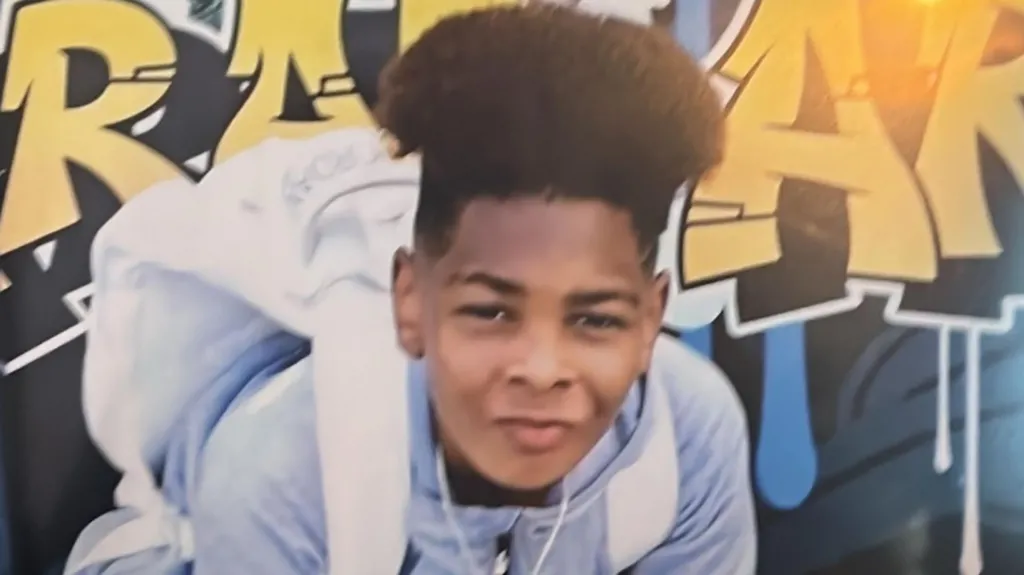
Ms Bokassa told the court her son had loved food, cooking and football, and brought her flowers on her birthday  Photo: Family handout
 
On January7, 2025, a 14-year-old aspiring rapper seated himself on the top deck of a London bus on his way to an appointment. Two minutes after Kelyan Bokassa boarded that bus, another two boys aged 16 and 15, who appeared to know that Kelyan would be on the bus, got on as well. They made their way over to where Kelyan  was seated. Kelyan had stuck a small kitchen knife under his belt for whatever reason. The two boys who confronted him on the top of the double-decker bus had boarded it with machetes concealed under their clothing.
 
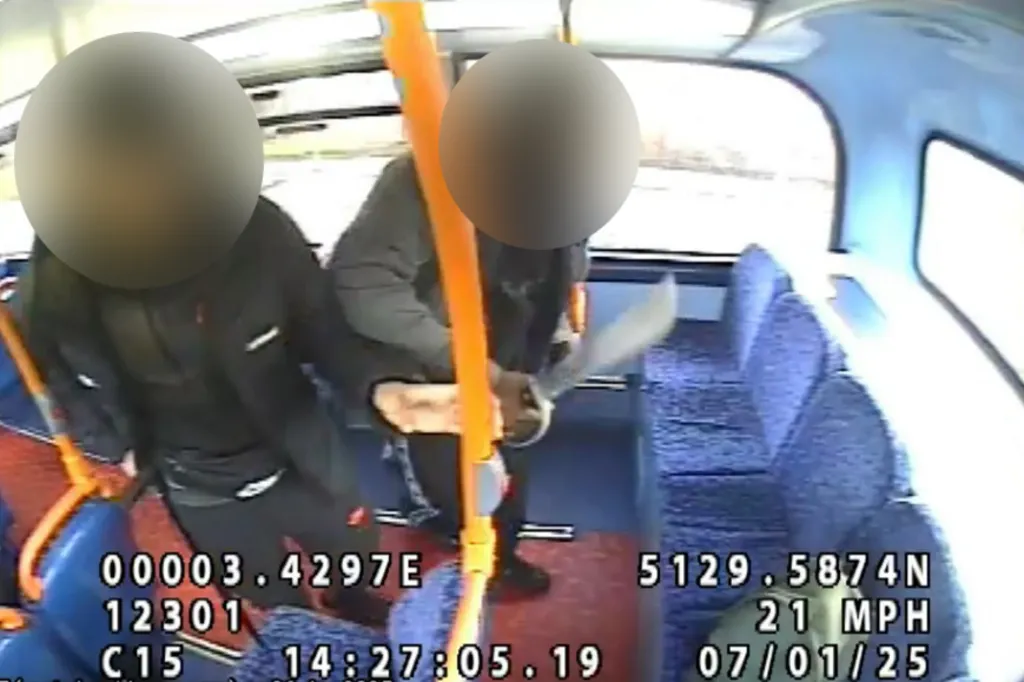
As the prosecution described it: The pair walked towards Kelyan "with purpose" and without speaking a word to their victim, thrust their machetes at him 27 times while smiling. The attack lasted 14 seconds. The briefest of intervals in the lives of three boys, leaving one dead and the surviving two hunted by police. Kelyan was buried, his 15th birthday celebrated by his mother at the cemetery where he was buried. The  two boys were found and charged, to await their day in court.
 
When Kelyan was lethally assaulted, CCTV showed him stumbling through the aisle while other passengers, shocked and transfixed around him watched him bleeding and stumbling along, heading for the stairs. Another passenger moved to assist him. And Kelyan was overheard to have said:  “Take me to my mum’s. I want my mum,” before he collapsed, bleeding heavily from a wound to the leg. When the bus stopped the other two boys fled the bus.

A passing police car was flagged down by members of the public, and officers entering the bus found Kelyan had collapsed, his body limp. Attempts to save him failed and the boy died at the scene. The two boys with their machetes had slashed him no fewer than 27 times. At the time they stood trial, pleading guilty, which would have reduced the penalty they might expect at judgement, they were both 16, their identities shielded from the public under British law, as under-aged defendants. 
https://ichef.bbci.co.uk/news/1024/cpsprodpb/dfca/live/63395570-6974-11f0-915d-d15295b70487.png.webp
Metropolitan Police   The attack was captured on CCTV cameras
 
Judge Mark Lucraft KC told the court at the Old Bailey: "For any parent to lose a child is a tragedy. No sentence of a court can truly reflect the loss of a young life." When he sentenced the two teens to life in prison he explained that one boy was a "victim of child criminal exploitation who had faced "a history of trauma". The second boy, he went on, was also exploited by gangs from the age of 12, experiencing "undiagnosed developmental needs." 
 
"Life in prison" for these two cold-blooded young murderers will be reflected by a minimum term of 15 years. In all likelihood, both will serve considerably less time incarcerated, given the trend to exceptionalism when sentencing those committing serious crimes in society, including murder in the first degree, taking into account their 'deprived' past experiences with the focus on social justice for the malefactors, leaving the public aghast at the consequences of sympathetic justice for malefactors while their victims remain afterthoughts. 
"This case has been deeply troubling for all involved and our thoughts remain with Kelyan’s family and loved ones."
"The harsh reality in London is that violence disproportionately affects young black men and boys. The fact we’re seeing so many teenagers like Kelyan die should be at the forefront of the minds of every politician, every policy maker and everyone who wants better for children growing up in London. Without this collective effort, we won’t be able to tackle knife crime in its entirety."
"Finally, I would like to recognize the members of the public that comforted Kelyan in his final moments and the witnesses who entrusted my investigation team with their testimonies. It was your bravery that helped us secure justice. Thank you." 
Detective Chief Inspector Sarah Lee, Metropolitan London Police 
 
"My child had a name, it was Kelyan, a future, a heartbeat full of hope. That life was not theirs to take."
"That moment of violence may have lasted seconds, but the consequences are eternal. They didn’t just take a life; they shattered an entire world."
"They broke a family, they buried a future, and they left me, a mother dead inside with wounds no justice can ever heal."
Marie Bokassa 
Kelyan and Marie Bokassa, Still from video


Labels: , , ,

Thursday, April 10, 2025

Behavioural Cultural Norms Incompatible with Western Society

"She wanted him to drive her home from a party she'd attended. Rather than take her home, the offender drove her to an empty parking lot."
"He told her they would have fun. He parked the car and got into the back seat. He moved closer to the victim and forcibly kissed her. He put his hand under her dress and touched her vaginal area over her underwear."
"After he tried again to kiss her and she did not respond, he moved away from her."
"She asked if he would still drive her home and he said no. She got out of the car, and he left her in the parking lot."
Justice Scott Pratt, Ontario courthouse
https://img-s-msn-com.akamaized.net/tenant/amp/entityid/AA1CykCS.img?w=768&h=576&m=6
The Ontario Court of Justice in Windsor.

In an attempt to avoid being deemed 'inadmissible' to Canada for 'serious criminality' by the Immigration and Refugee Board, Uber driver Sevan Halabi of Windsor, Ontario, a permanent resident of Canada, hoped to receive a lighter sentence to avoid deportation. Permanent residents of Canada, if sentenced to over six months in prison, according to the Immigration and Refugee Protection Act, can be regarded as inadmissible to Canada. What Mr. Halabi, through his lawyer, sought to persuade the presiding judge was to sentence him to six months less a day plus probation. 

"It would require me to cut the sentence nearly in half, solely to assist him in avoiding future penalties. I cannot do that", responded Justice Pratt. A young woman had engaged Mr. Halabi, an Iraqi Uber driver, to drive her home from an event she had attended on October 9, 2022. Rather than take his passenger on the trip she expected, the Uber driver subjected her to a terrifying ordeal of sexual harassment, the threat of rape and violence by implication, and finally abandonment.
 
The woman's attacker was a married man with two sons, age 14 and 10. Presenting himself as a family man, Sevan Halabi's attempt at sympathy was linked to appealing for a sentence of six months less a day to avert any potential immigration consequences. The Crown had argued that Halabi merited a year in jail, and then three years of probation.
 
Born in Iraq, Halabi emigrated from his home country with his family in 2018 to Canada. Halabi is a permanent resident of Canada as a result of the criminal charge impeding an application for citizenship. His wife and children did achieve Canadian citizenship. As for the charges brought against him, Mr. Halabi maintained his innocence during an interview with the producer of a pre-sentence report.
 
Justice Pratt was informed "he regrets what happened, has learned a lesson, and that this will not happen again", the decision in the pre-sentence report conveyed too the Judge. In response, Justice Pratt said: "The offence has hindered her professional life as a teacher and her personal life as well. She is fearful and angry. She didn't know if she would be raped or killed [in Halabi's car that night], and that fear continues to impact her life", responded the Judge.
 
To further appeal for sympathy from the court, Mr. Halabi who had not been held in custody prior to his appearance at the court before the Judge, lived as he would normally with his family and decided to bring his children along for emotional impact. For the sentencing submissions he arranged for his children to be present in court. "On that point, both children were visibly upset and crying during the proceeding", observed Justice Pratt. "Respectfully, I question why they were here in the first place. It was not a case where their father was in custody and so this would have been a rare opportunity to see him in person."
 
"[Halabi] has been out of custody throughout this case and only appeared virtually from Iraq. I cannot find they were brought into the courtroom to engender sympathy from the court, but given the offender's focus on how my sentence could affect his family, that is certainly an inference available to be drawn", the Judge concluded. 
"It is troubling that sexual offences committed by professional drivers are sufficiently common that they have created their own body of case law. But that is what has happened."
"In my view ... a sentence of six months less a day for this conduct would be unfit. It would prioritize the offender's personal circumstances over the need to denounce and deter his conduct and would not be in line with relevant case law."
"It would be an inappropriate and artificial sentence imposed only to avoid legitimate consequences created by Parliament."
Justice Scott Pratt, Ontario Superior Court
https://smartcdn.gprod.postmedia.digital/nationalpost/wp-content/uploads/2025/04/Mohamed-Al-Ballouz.jpg?quality=90&strip=all&w=564&h=423&type=webp&sig=lxE6k6nGxJVTRv0suzp-uA
Mohamed Al Ballouz, who now goes by the name Levana, is serving a life sentence with no possibility of parole for 25 years for murdering a woman and two children. Photo by Court exhibit
 
This sexual assault case is but one of many where men from cultures where the place of women is subservient to that of men, religiously inspired and historically adapted into a culture of male privilege and female suffering, gravitate to another culture and system of law. Correctional Service of Canada recently completed an assessment of a convicted killer that decided against Mohamed Al Ballouz of Brossard, Quebec being admitted to a women's prison.
 
This man, convicted of murdering his wife Synthia Bussieres and their two sons -- five-year-old Eliam and two-year-old Zac in 2022, was sentenced to life in prison in December, with no possibility of parole for 25 years. While in custody, the man, also convicted of setting fire to the family condo, transitioned to a woman. With his new name of Levana, he asked that he be preferentially incarcerated at the Joliette Institution for Women, northeast of Montreal. Thankfully for the women at Joliette, the decision was that Al Ballouz remain in a men's prison. 

https://i.cbc.ca/1.7416410.1734718968!/fileImage/httpImage/image.png_gen/derivatives/original_1180/synthia-bussieres.png?im=Resize%3D1180
Synthia Bussières with her sons Éliam Al Ballouz, left, and Zac Al Ballouz. (Obituary)

Labels: , , , , ,

Tuesday, March 14, 2023

Public High School Violence in Canada

"Nobody's speaking about this violent assault. I'm in shock."
"He'd been punched and kneed in the face and the head. There's people walking by totally indifferent."
"[It's the silence of the adults that's most upsetting] They're complicit in the attitude that you don't talk about traumatic experiences."
Sarah Murray, mother, Nepean High School student, Ottawa
 
"Soft-on-consequences discipline, a critical factor contributing to unruly] student behaviour [driving fellow teachers to quit the classroom and proving to be] terrible for teachers."
"While most discussion about student behaviour ... focuses on its impact upon students, too often the effects on teachers are simply overlooked."
"They're collateral damage that rarely gets a mention [as articulated by American teacher Daniel Buck, Thomas B. Fordham Institute commentary]."
"[And here in Canada], trauma informed [education philosophy and practice makes it harder to openly address such incidents in class with teens or in meeting with their parents]."
Paul W. Bennett, Ed.D., director, Schoolhouse Institute, Adjunct Professor of Education, Saint Mary's University, National Coordinator for research.ED in Canada
classroom
Nightmares. Frequent tears. Fear of going to school.  London Free Press
 
Sarah Murray, the woman quoted above, became aware of the "culture of silence" practised in schools resulting from violence occurring there. Her son while in a school washroom was beaten, the event posted on social media, despite which local Ottawa school officials managed to hush it up. Increasingly it is not the presence of guns that is troubling in Canadian schools. Rather, in the 4,700 public schools with high school programs, it is fists and knives that dominate as a violent threat. 

During the school closures of the first several years of the pandemic, there was a downturn in school violence. With the resumption of in-person classes, teachers and school principals throughout Canada -- like their counterparts in the United States -- are now reporting higher levels of violence, misbehaviour, assault and drug abuse.

The recent lunchtime episode involving a Grade 10 boy at Weston Collegiate in Toronto shot in the chest and left in critical condition, was an isolated event, making national headlines. Such events in Canada, unlike the United States, remain relatively rare. What has worsened is regular and ongoing violence in and around schools, post-COVID. Ontario high school teachers' union president Karen Littlewood brought attention to this social dilemma by calling for help from provincial and local authorities to ensure schools and classrooms be safe.

The advocacy voice for 55,000 educators in hundreds of high schools, Ms. Littleowod expressed alarm, both for the well-being and security of students, but as well for the safety of teachers, mental health support personnel, child and youth workers. She reported widespread disturbances in the passage of the school disruptions by COVID-19: "These incidents were happening across the province, and it's now reached crisis level".
Taza DeLuna was attacked at school in Collingwood, Ont., in September 2017. His injuries were so severe that he had to be hospitalized. (Caitlin Taylor/CBC)
 
As an astonishing symbol of the prevalence of violence in schools, 622 young people between ages 12 and 29 were victims of stabbings between January of 2021 and November 2022. Alarmed classroom teachers speak up out-of-school. The National Education Association, amid fears of a national teacher shortage in the U.S. claims half of all American teachers report considering or actively planning to leave teaching as a result of deteriorating school climate and safety. Canada has not yet reached that crisis point.

"Biting, kicking and verbal abuse" are reportedly so prevalent in Manitoba schools that the provincial Workplace Safety and Health Department classified schools recently as a "high-risk industry", along with foundries, sawmills and demolition sites. Entitled "Time-loss claims in public school districts", a 2021 Work Safe BC online report documented 16,812 claims by teachers, teaching assistants and administrators between 2011 and 2020. In January 2022 the Halifax Chronicle-Herald revealed that 11,240 violent incidents were reported in the 2020/2021 school year.

The education system is in a parlous state. Violence has become common in classrooms, hallways, fields, and parking lots. There are so many instances of disturbances, low-level disruptions and verbal abuse they are unreported often out of fear of reprisals or in recognition of the near-absence of disciplinary consequences. Privacy protocols are held to a strict code preventing victims from being identified in reports naming perpetrators. No established reporting standards have been established for teacher documentation.

And on the home-and-health front, many Canadian parents, health professionals and child psychologists harbour doubts whether school situations can offer safe, secure and healthy schools. While acknowledging the important role that schools can play in students' access to food and other needs, many parents and child experts objected strongly to the portrayal of schools [as] safe spaces. And they won't until bullying is brought under control.

In senior grades in particular violence, bullying, sexual harassment, racial incidents and negative mental health experiences have become common for students, teachers and education workers.

More school choice would help Ontario families flee unsafe schools
How much academic learning happens when you feel unsafe? If you are like most people, the answer is “not much.   Fraser Institute

Labels: , , , ,

Wednesday, March 23, 2022

Syphilis Resurgent in Canada

"Syphilis can affect any organ, not just the genitals, as is traditionally thought."
"[When public health units pivoted to COVID] which was important, but there is an opportunity cost [programs offering access to STI testing, contact tracing and treatment slowed, or ground to a halt]."
Dr.Zain Chagla, infectious diseases specialist, McMaster University 

"Every case of congenital syphilis reflects a failure of our health-care system to identify and treat a treatable condition."
Dr.Carsten Kruger, infectious diseases fellow, Children's Hospital of Eastern Ontario
 
"Our cases are the highest we've seen since the 1940's, so that's pretty shocking to see those types of numbers."
"There's no question everywhere in the world right now social media apps are being used to arrange sexual contact and casual partnerships. In fact, about a third of our cases (in Alberta) report anonymous partners,"
"A disproportionate number of cases are among Indigenous persons and also persons who are affected by multiple social determinants of health -- so they're affected by homelessness, addictions, mental health issues as well as poverty."
Dr. Ameeta Singh, infectious disease expert, University of Alberta
Syphilis is easily spread through sexual contact and can damage vital organs and lead to death if left untreated. (Getty Images)

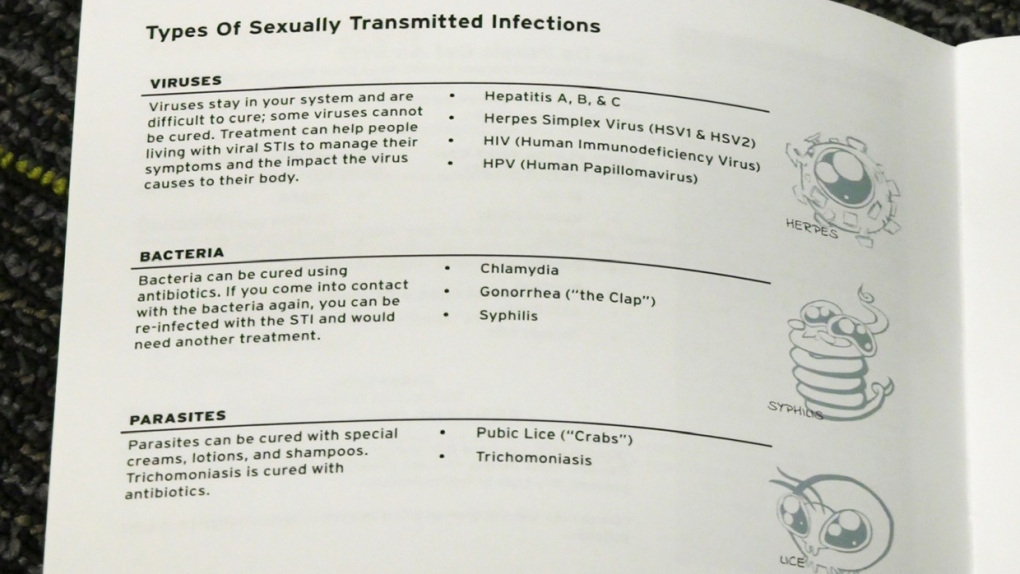
Rates of syphilis infection have increased within Canada, covering every age group. Females aged 15 to 39 have seen an especial rise in cases. A 740 percent increase in infectious syphilis was reported in Canada, infecting women from the years 2016 to 2020; the highest rates being seen among women of child-bearing age. That increase has resulted in a parallel rise in babies with syphilis.

Doctors in Montreal were alerted by public health bulletin in January to test all pregnant women in care for syphilis, reflecting a worrying rise in congenital syphilis. The bacterium, treponema pallidum causing infection, spreads from mother to fetus prior to birth. Left without treatment, syphilis in pregnancy can lead to miscarriage, stillbirth, or infant death following birth.

Born with syphilis, babies can end up with deformed bones, enlargsd liver and spleen, along with nerve and brain damage. Caught expeditiously treatment with penicillin can prevent transmission of syphilis from mother to baby. Commonly in the near past Canada would see no more than ten instances of congenital syphilis yearly. A national congenital syphilis surveillance study last summer asked pediatricians and other doctors treating children to produce monthly reports on confirmed or suspected case.

The official reported number to date came to 101 cases, considered an underestimate. The Prairie Provinces, Alberta, and Saskatchewan have presented as the geographic areas most likely to be reporting congenital syphilis. The rate of which had been ascending in Canada before the onset of the     COVID pandemic. The swift focus and concentration on dealing with the SARS-CoV-2 virus took attention away from the rising number of syphilis cases.

Older people are also falling victim to syphilis. Some 9,382 cases were confirmed in 2020 in Canada, a substantial increase from 2011 when 1,749 cases were reported. Gay, bisexual and other men who engage in sex with men represent the  highest case proportions, but syphilis is shifting toward heterosexual populations, especially targeting women. Every age group has seen a rate increase. 

Symptoms include a sore that is often without pain, or an ulcer marking the point of contact. These can appear on the genitals, the mouth, at any time from three to 90 days following infection. Untreated, the infection advances to the secondary stage where fever develops, swollen lymph glands, a rash. Eyes and ears can become involved as well, causing partial or complete loss of vision, balance and problems with dizziness.

Should no treatment be forthcoming at the secondary stage, a latent stage can be entered where years, even decades forward, people can develop complications of the brain and nervous system "so problems with dementia, problems walking", explained Dr. Ameeta Singh, infectious diseases expert at University of Alberta. Timely penicillin treatment is like magic, she noted: "Often within a month, many abnormalities resolve".

"Our cases are the highest we've seen since the 1940's, so that's pretty shocking to see those types of numbers," said Dr. Ameeta Singh, and infectious disease expert at the University of Alberta

Labels: , , , ,

 
()() Follow @rheytah Tweet