Ruminations

Blog dedicated primarily to randomly selected news items; comments reflecting personal perceptions

Thursday, April 10, 2025

Behavioural Cultural Norms Incompatible with Western Society

"She wanted him to drive her home from a party she'd attended. Rather than take her home, the offender drove her to an empty parking lot."
"He told her they would have fun. He parked the car and got into the back seat. He moved closer to the victim and forcibly kissed her. He put his hand under her dress and touched her vaginal area over her underwear."
"After he tried again to kiss her and she did not respond, he moved away from her."
"She asked if he would still drive her home and he said no. She got out of the car, and he left her in the parking lot."
Justice Scott Pratt, Ontario courthouse

https://img-s-msn-com.akamaized.net/tenant/amp/entityid/AA1CykCS.img?w=768&h=576&m=6
The Ontario Court of Justice in Windsor.

In an attempt to avoid being deemed 'inadmissible' to Canada for 'serious criminality' by the Immigration and Refugee Board, Uber driver Sevan Halabi of Windsor, Ontario, a permanent resident of Canada, hoped to receive a lighter sentence to avoid deportation. Permanent residents of Canada, if sentenced to over six months in prison, according to the Immigration and Refugee Protection Act, can be regarded as inadmissible to Canada. What Mr. Halabi, through his lawyer, sought to persuade the presiding judge was to sentence him to six months less a day plus probation. 

"It would require me to cut the sentence nearly in half, solely to assist him in avoiding future penalties. I cannot do that", responded Justice Pratt. A young woman had engaged Mr. Halabi, an Iraqi Uber driver, to drive her home from an event she had attended on October 9, 2022. Rather than take his passenger on the trip she expected, the Uber driver subjected her to a terrifying ordeal of sexual harassment, the threat of rape and violence by implication, and finally abandonment.
 
The woman's attacker was a married man with two sons, age 14 and 10. Presenting himself as a family man, Sevan Halabi's attempt at sympathy was linked to appealing for a sentence of six months less a day to avert any potential immigration consequences. The Crown had argued that Halabi merited a year in jail, and then three years of probation.
 
Born in Iraq, Halabi emigrated from his home country with his family in 2018 to Canada. Halabi is a permanent resident of Canada as a result of the criminal charge impeding an application for citizenship. His wife and children did achieve Canadian citizenship. As for the charges brought against him, Mr. Halabi maintained his innocence during an interview with the producer of a pre-sentence report.
 
Justice Pratt was informed "he regrets what happened, has learned a lesson, and that this will not happen again", the decision in the pre-sentence report conveyed too the Judge. In response, Justice Pratt said: "The offence has hindered her professional life as a teacher and her personal life as well. She is fearful and angry. She didn't know if she would be raped or killed [in Halabi's car that night], and that fear continues to impact her life", responded the Judge.
 
To further appeal for sympathy from the court, Mr. Halabi who had not been held in custody prior to his appearance at the court before the Judge, lived as he would normally with his family and decided to bring his children along for emotional impact. For the sentencing submissions he arranged for his children to be present in court. "On that point, both children were visibly upset and crying during the proceeding", observed Justice Pratt. "Respectfully, I question why they were here in the first place. It was not a case where their father was in custody and so this would have been a rare opportunity to see him in person."
 
"[Halabi] has been out of custody throughout this case and only appeared virtually from Iraq. I cannot find they were brought into the courtroom to engender sympathy from the court, but given the offender's focus on how my sentence could affect his family, that is certainly an inference available to be drawn", the Judge concluded. 
"It is troubling that sexual offences committed by professional drivers are sufficiently common that they have created their own body of case law. But that is what has happened."
"In my view ... a sentence of six months less a day for this conduct would be unfit. It would prioritize the offender's personal circumstances over the need to denounce and deter his conduct and would not be in line with relevant case law."
"It would be an inappropriate and artificial sentence imposed only to avoid legitimate consequences created by Parliament."
Justice Scott Pratt, Ontario Superior Court

https://smartcdn.gprod.postmedia.digital/nationalpost/wp-content/uploads/2025/04/Mohamed-Al-Ballouz.jpg?quality=90&strip=all&w=564&h=423&type=webp&sig=lxE6k6nGxJVTRv0suzp-uA
Mohamed Al Ballouz, who now goes by the name Levana, is serving a life sentence with no possibility of parole for 25 years for murdering a woman and two children. Photo by Court exhibit
 
This sexual assault case is but one of many where men from cultures where the place of women is subservient to that of men, religiously inspired and historically adapted into a culture of male privilege and female suffering, gravitate to another culture and system of law. Correctional Service of Canada recently completed an assessment of a convicted killer that decided against Mohamed Al Ballouz of Brossard, Quebec being admitted to a women's prison.
 
This man, convicted of murdering his wife Synthia Bussieres and their two sons -- five-year-old Eliam and two-year-old Zac in 2022, was sentenced to life in prison in December, with no possibility of parole for 25 years. While in custody, the man, also convicted of setting fire to the family condo, transitioned to a woman. With his new name of Levana, he asked that he be preferentially incarcerated at the Joliette Institution for Women, northeast of Montreal. Thankfully for the women at Joliette, the decision was that Al Ballouz remain in a men's prison. 

https://i.cbc.ca/1.7416410.1734718968!/fileImage/httpImage/image.png_gen/derivatives/original_1180/synthia-bussieres.png?im=Resize%3D1180
Synthia Bussières with her sons Éliam Al Ballouz, left, and Zac Al Ballouz. (Obituary)

Labels: , , , , ,

Saturday, May 07, 2022

Neighbourly Relations: Finland in Russia's Belligerent Shadow

A sports centre in Helsinki can quickly be turned into a bomb shelter to accommodate more than 6,000 people.
A sports centre in Helsinki can quickly be turned into a bomb shelter to accommodate more than 6,000 people. Photograph: Pjotr Sauer/The Guardian
"I sleep much better at night knowing we have these bomb shelters. Especially now with what is happening in Ukraine." 
"These shelters can protect against practically any bombing or chemical attacks. We have water, clean air and beds that can people going for weeks."
"It was built like this on purpose, [maze-like, with different rooms, including a cafeteria and a children’s playroom]. Studies have shown that people react better to rooms that have walls, where there are boundaries that create a sense of privacy."
"It’s sad to see what is happening in Ukraine. I see the poor people hiding in the metro or in theatres. It shows again how important it is what we do."
Tomi Rask, safety instructor, Civil Defence Centre, Helsinki, Finland 

"Russia is never specifically mentioned, but it has always been understood that the country should be prepared to make the threshold for a Russian attack as high as possible."
"We had no idea at the beginning of the pandemic how bad it was going to get, what it will do to our economy. But then our prime minister came out and said that the deal [to replace its ageing combat jets with 64 F-35 planes and weapons systems in a deal worth £6.97bn.] will go ahead signalling that the country’s security is paramount."
Charly Salonius-Pasternak, security expert, Finnish Institute of International Affairs
A bomb shelter in Helsinki
A bomb shelter in Helsinki. Photograph: Pjotr Sauer/The Guardian

There are countless countries in the world that share long borders, some undefended, as hugely unlikely that one would ever launch any kind of violent aggression against the other, and some moderately defended against the other. For Finland, with its total 5.5 million population, the undercurrent of concern is always there that its neighbour with its population of 144 million, its huge, well-armed military that has just invaded another neighbour, all the signs are there of a potential repeat of the November 1939 Soviet invasion across its border.

On that occasion, as with this current situation with the Russian invasion of Ukraine, the expectation was that the much smaller population and its military would quickly fold. In both instances, Moscow erred, hugely. The Finns made a good accounting of themselves back in 1939; well-trained soldiers, familiar with their own terrain and the additional climatic hardiness, repelled the invasion but still suffered a forced negotiation with a wartime penalty of over 300,000 casualties.

As long ago as that occasion was, the lesson has never faded from memory, with the expectation that what occurred then could recur at any time. Leading Finland to prepare itself for such needed  contingencies by implementing a full policy of "total defence", where every bridge, tunnel and overpass in the country was built complete with charge pits. In them explosives could be placed as required to slow an invader. And in addition, the innovation of turning small roads into runways.

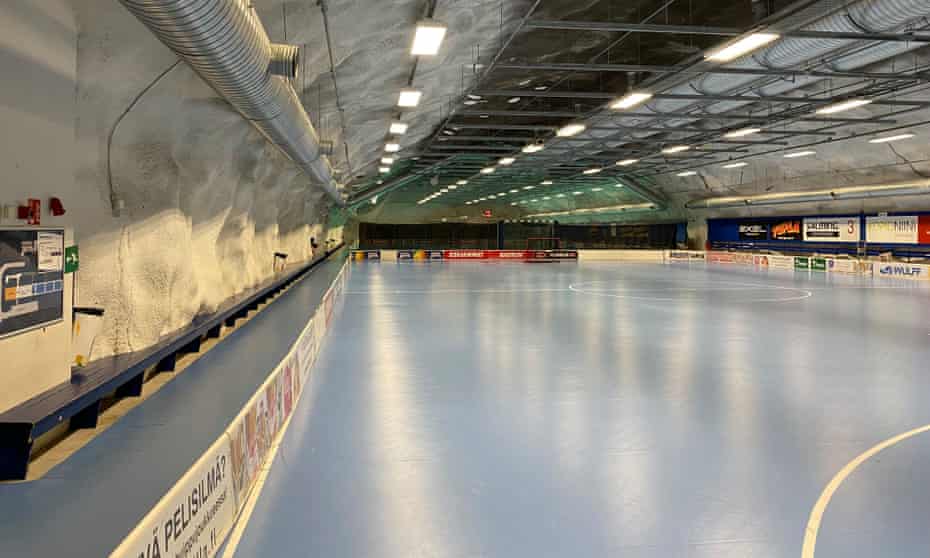
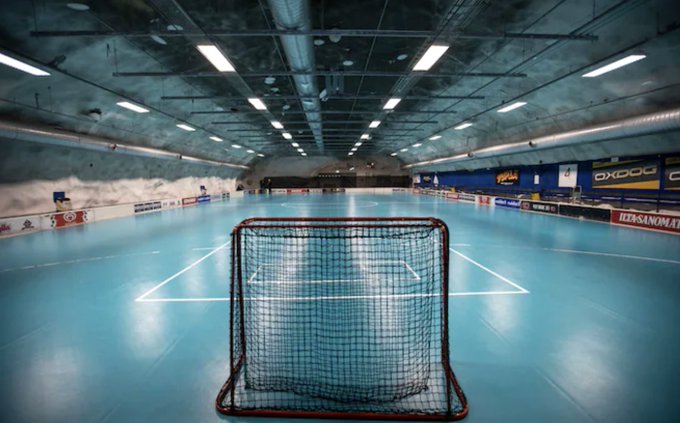
The bunker's sports hall | Credit: Jeff Gilbert
Its bunker system is only one part of a wide-ranging policy of “total defence”, in which the whole country could be mobilised in the event of an attack. Photo via Telegraph

It is the defence of the entire population that exemplifies the full measures that Finland undertook, however. The situation somewhat akin to the tiny Jewish state of Israel committing to installing bomb bunkers for its population in an overall defence that is of more immediate need, when conflict could break out at any time between Israel and the Palestinians; a pincer movement from Hamas in Gaza, Hezbollah in Lebanon and Shiite militias streaming over the border from Syria.
 
Some of those huge underground bunkers built by Finland have been given a double purpose, serving as entertainment venues for the population in a practical use of bunker architecture and facilities not in immediate use as bomb bunkers. Near the centre of Helskini is a play area called the Hakaniemi Arena, with colourful slides, trampolines and tunnels, lying 25 metres below ground, hollowed out of bedrock under the city.

The cavernous space designed to withstand nuclear, biological and chemical attacks. Families with children visit the play area and make full use of its recreational facilities, regarding it as a civic infrastructure offering quality play time for children as a sport centre. A small orange and blue triangle above ground level identifies the complex as a defence shelter. A shelter that has the capacity to house up to 6,000 people.

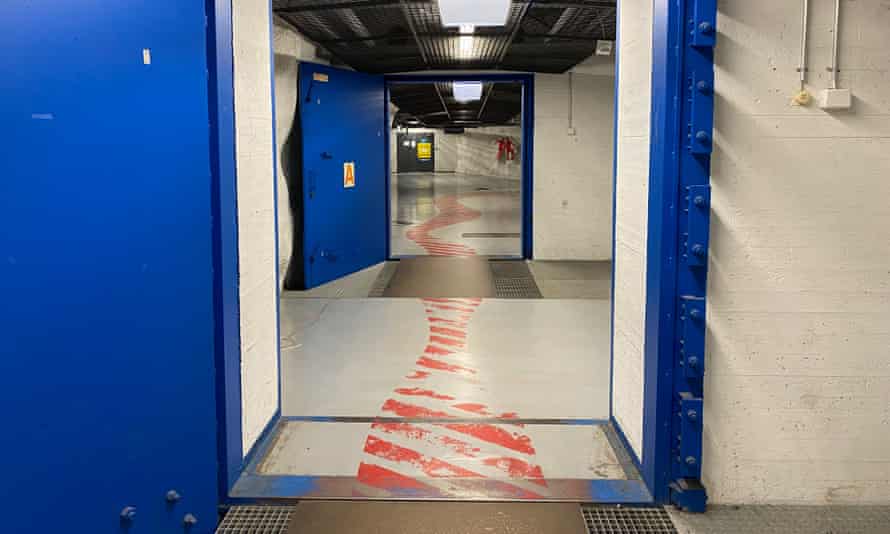
Until it is put into use for its original purpose, rooms off to the side are closed to the public. There is where beds are stored, where air filtration systems await, along with temporary toilet facilities and similar living essentials. There are two layers of blast doors between the indoor space and the outside world; each 35 cm in thickness. One designed to stop a blast, the other to seal the atmosphere.

In the capital city alone, 5,500 bunkers exist, offering a protective place for 900,000 people. In the entire country shelter spaces offer room for 4.4 million in over 54,000 locations.Any building by law over 1,200 square metres must have provision for a shelter. The government itself  has built and maintains over 44 large public shelters in Helsinki. There are storage rooms, sports halls, swimming pools in the shelters' civilian functions which must be amenable to being stripped within 72 hours.

Civil defence instructor Tomi Rask explains that the public would be informed through television, radio, a website and a special app along with outdoor sirens, should an urgent need for the bunkers arise. Preparation for the possibility of chemical accidents and natural disasters are a risk, but while never explicitly stated in official statements, invasion by Russia with which a 1,340 km. border is shared, is the major concern.
 
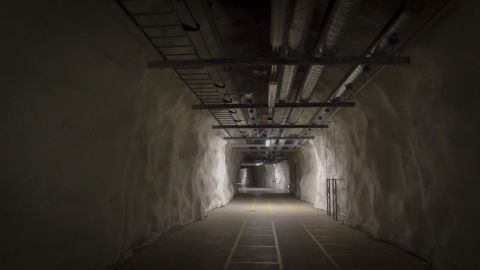
Helsinki's network of tunnels can fit the city's entire population.
Helsinki's network of tunnels can fit the city's entire population.   CNN/Karim Peltone 


Labels: , , , , ,

Monday, July 11, 2016

Assessing the Liability of Breed Tendencies

"It certainly is a problem that is manifesting in many different ways."
"These dogs are from Log Angeles [and are] brought over unassessed, they're put into families that don't know what they're getting themselves into and they're not provided with any support."
Kathy Powelson, Paws for Hope Animal Foundation

"Every freaking day there's another story: 'My child's leg was bitten off, it might have to be amputated'."
"My cat was pulled in half."
"These stories are so horrific and so soul-destroying."
Mia Johnson, National Pit Bull Victim Awareness, Vancouver

"It's life and death for them [rescued pit bulls]."
"It's unfortunate that they have that sort of stigma. You're more likely to get bitten by a chihuahua than a pit bull."
Cindy Smith, Wings of Rescue, Woodland Hills, California
A file photo of a rescued pit bull.
SPCAA file photo of a rescued pit bull.

Needless to say the argument of a chihuahua bite over a pit bull bite is absurd. Consider the relative size, the breeds' temperament, the jaws that lock and those that don't, and the potential danger inherent in a bite from one over the other. Chihuahuas like many small breeds tend to be yappy pests. With the wrong trainer and the wrong exposure, pit bills are formidable fighting machines easily capable of maiming and killing other animals and human beings.

That, apart from each having the capacity to form strong bonds with humans, and some specimens among each -- fewer presumably pit bulls than chihuahua -- responsive to calming methods of training and forging healthy relationships with other animals and with human companions. That said, they are animals not bred specifically to be docile and alert to commands. And like any animal, including man, they are capable of surprise attacks and perpetrating great harm.

International teams of well-meaning animal-welfare volunteers meet at the border between Canada and the United States where dogs that have been abandoned are handed over from a California source to Calgarians eager to give those dogs new homes and a future in Canada. This exchange is no one-time situation of a dog here, a dog there, but a well organized, repeat event with as many as 30 pit bulls at a time taken into Canada from the U.S.

The situation has given pause to many animal rescue groups for its frequency and the reality that what has become common practise is fraught with problems. For one thing, Canada has enough of its own pit bull rescues where new homes are sought for them. If priority is given to dogs rescued from the U.S., then there is less opportunity for Canada-sourced pit bulls to find homes, particularly in provinces or cities that frown at their presence and tend to ban them to begin with.

At the same time reports are growing in volume of pit bull attacks. And there is a growing movement to crack down on entries of pit bulls over the border; disfiguring and even worse-outcome attacks will do that to a concerned population. Needless to say, there is denial on the part of rescue groups who claim the dogs are unfairly maligned and require rescue from certain death in the U.S.

The American group Wings of Rescue flies some 40 dogs from shelters in Los Angeles into Alberta every 90 days, with 75 percent of those dogs being pit bulls or pit bull mixes. The Canadian rescue group, BARC is said to visit California shelters, selecting dogs with "stellar" personalities, according to Cindy Smith. These dogs are also entering British Columbia, New Brunswick and Nova Scotia.

According to Kim Faulkes a former rescue-society administrator, at least 600 pit bulls arrived in Canada last year alone. In the background are hideous events such as the recent death of a 55-year-old woman in Montreal, mauled by a neighbour's pit bull. Before that, an elderly Kamloops, B.C. woman was killed by a pit bull owned by her grandson.

Rife in the news has been reports of "disfiguring injuries" suffered by 13 Canadians this year; whereas there were 54 such attacks between 2004 and 2015.

The breed has its defenders who insist pit bulls are not aggressive but their irresponsible owners have made them so, and the media coverage that accompanies the issue simply heats up public distrust of the breed. At the opposite end, critics of the breed refer to studies in peer-reviewed medical journals concluding that the breed is responsible for serious dog-attack injuries requiring hospitalization.

"You save a dog from the United States, and kill a dog in Canada", added Kim Faulkes with the Canadian Rescue Standards Group out of Ottawa. It's a completely polarizing situation.

Labels: , , , ,

 
()() Follow @rheytah Tweet