Blog dedicated primarily to randomly selected news items; comments reflecting personal perceptions
Tuesday, March 14, 2023
Public High School Violence in Canada
"Nobody's speaking about this violent assault. I'm in shock."
"He'd been punched and kneed in the face and the head. There's people walking by totally indifferent."
"[It's the silence of the adults that's most upsetting] They're complicit in the attitude that you don't talk about traumatic experiences."
Sarah Murray, mother, Nepean High School student, Ottawa
"Soft-on-consequences discipline, a critical factor contributing to unruly] student behaviour [driving fellow teachers to quit the classroom and proving to be] terrible for teachers."
"While most discussion about student behaviour ... focuses on its impact upon students, too often the effects on teachers are simply overlooked."
"They're collateral damage that rarely gets a mention [as articulated by American teacher Daniel Buck, Thomas B. Fordham Institute commentary]."
"[And here in Canada], trauma informed [education philosophy and practice makes it harder to openly address such incidents in class with teens or in meeting with their parents]."
Paul W. Bennett, Ed.D., director, Schoolhouse Institute, Adjunct Professor of Education, Saint Mary's University, National Coordinator for research.ED in Canada
Nightmares. Frequent tears. Fear of going to school. London Free Press
Sarah Murray, the woman quoted above, became aware of the "culture of silence" practised in schools resulting from violence occurring there. Her son while in a school washroom was beaten, the event posted on social media, despite which local Ottawa school officials managed to hush it up. Increasingly it is not the presence of guns that is troubling in Canadian schools. Rather, in the 4,700 public schools with high school programs, it is fists and knives that dominate as a violent threat.
During the school closures of the first several years of the pandemic, there was a downturn in school violence. With the resumption of in-person classes, teachers and school principals throughout Canada -- like their counterparts in the United States -- are now reporting higher levels of violence, misbehaviour, assault and drug abuse.
The recent lunchtime episode involving a Grade 10 boy at Weston Collegiate in Toronto shot in the chest and left in critical condition, was an isolated event, making national headlines. Such events in Canada, unlike the United States, remain relatively rare. What has worsened is regular and ongoing violence in and around schools, post-COVID. Ontario high school teachers' union president Karen Littlewood brought attention to this social dilemma by calling for help from provincial and local authorities to ensure schools and classrooms be safe.
The advocacy voice for 55,000 educators in hundreds of high schools, Ms. Littleowod expressed alarm, both for the well-being and security of students, but as well for the safety of teachers, mental health support personnel, child and youth workers. She reported widespread disturbances in the passage of the school disruptions by COVID-19: "These incidents were happening across the province, and it's now reached crisis level".
Taza DeLuna was attacked at school in Collingwood, Ont., in September
2017. His injuries were so severe that he had to be hospitalized. (Caitlin Taylor/CBC)
As an astonishing symbol of the prevalence of violence in schools, 622 young people between ages 12 and 29 were victims of stabbings between January of 2021 and November 2022. Alarmed classroom teachers speak up out-of-school. The National Education Association, amid fears of a national teacher shortage in the U.S. claims half of all American teachers report considering or actively planning to leave teaching as a result of deteriorating school climate and safety. Canada has not yet reached that crisis point.
"Biting, kicking and verbal abuse" are reportedly so prevalent in Manitoba schools that the provincial Workplace Safety and Health Department classified schools recently as a "high-risk industry", along with foundries, sawmills and demolition sites. Entitled "Time-loss claims in public school districts", a 2021 Work Safe BC online report documented 16,812 claims by teachers, teaching assistants and administrators between 2011 and 2020. In January 2022 the Halifax Chronicle-Herald revealed that 11,240 violent incidents were reported in the 2020/2021 school year.
The education system is in a parlous state. Violence has become common in classrooms, hallways, fields, and parking lots. There are so many instances of disturbances, low-level disruptions and verbal abuse they are unreported often out of fear of reprisals or in recognition of the near-absence of disciplinary consequences. Privacy protocols are held to a strict code preventing victims from being identified in reports naming perpetrators. No established reporting standards have been established for teacher documentation.
And on the home-and-health front, many Canadian parents, health professionals and child psychologists harbour doubts whether school situations can offer safe, secure and healthy schools. While acknowledging the important role that schools can play in students' access to food and other needs, many parents and child experts objected strongly to the portrayal of schools [as] safe spaces. And they won't until bullying is brought under control.
In senior grades in particular violence, bullying, sexual harassment, racial incidents and negative mental health experiences have become common for students, teachers and education workers.
How much academic learning happens when you feel unsafe? If you are like most people, the answer is “not much. Fraser Institute
"The student voice was all that mattered, and basically they silenced the teachers' voices. We were always questioned, we were always undermined, we were always told [the bad behaviour] must be our bias, or our classroom management, or it must be because we're not listening to the students."
"We were telling the kids, 'Go into the class, this is a secure school. And [they said] 'No, we don't have to."
"They had so much control, the kids then wouldn't listen to the vice-principal and principal, that's how bad it was."
"Some of our neediest kids who we were working with and we were keeping them in the class. But then they started being oppositional with us and started hanging out in the hall, too."
"Our students thrive on rules and routines, structure and clear guidelines. And they had none of that."
"The board's stated mission is 'creating a culture of innovation, sharing and social responsibility/. Our school did not uphold any of those pillars. It's outrageous that there was so much chaos, that the school was totally unsafe and that the kids were not learning."
Michael Sterrberg, Grade 5 and 6 teacher, Pinecrest Public School, Ottawa
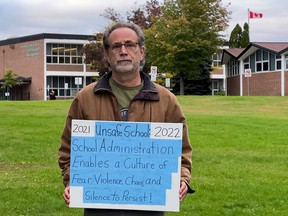
Teacher Michael Sternberg stands outside Pinecrest Public School with a homemade sign in September 2022. Photo by ERROL MCGIHON /POSTMEDIA
"[There] appears to be a poisoned working and learning environment at Pinecrest. [We are examining] interactions and conduct throughout Pinecrest amongst and between staff, students and families."
"[Staff were invited to speak confidentially to investigators and directed to] refrain from yelling or raising voices at students and each other [and to] continue to stop, interrupt and appropriately address the use of slurs and hate-related incidents."
"[There will be] communication with the school community [when the investigation is completed]."
"As that investigation is active, it is not appropriate to comment on specific details."
Ottawa-Carleton District School Board, Office of the Human Rights and Equity Advisor
"[Investigation-solicited comments were] red flags that something is seriously wrong and it's not being dealt with."
"[Some of the older students] would just wander the school all day. We're talking about defiant: 'I'm not going to class, I'm going to sit here on my phone, I'm going to do whatever I want, and I don't have to listen to any adult in this building'."
"[We stopped imposing much discipline for fear of] being accused by administrators of targeting [a child and being sent home to be investigated]. It's self-preservation."
Pinecrest teacher, unauthorized to speak
Disruptions in elementary school classes of a type and duration never before experienced in Canada. A country which historically built its population on a tradition of immigration. Where immigrants stemmed mostly from Europe and those coming into the country made an effort to understand the prevailing culture, the nation's laws and its values, to commit themselves to following them to successfully integrate into the prevailing social system.
On average, Canada's intake of immigrants and refugees are well over 350,000 a year. People coming into the country whose heritage, languages, ethnicities, religions and cultural values do not always mesh with that of native Canadians or Canadians from immigrant backgrounds who have adjusted to Canadian society. And they make no effort to integrate. Along with the fact that many bring cultural baggage inimical to Canadian values of equality and human rights with them. Inclusive of tribal and religious animosities.
This elementary school is a living laboratory of what can gp wrong in a growing atmosphere of cosmopolitan liberal progressivism that has been labelled 'woke'. This 'relaxed' attitude of non-judgemental conditioning views the still, but barely majority 'white' population as guilty of privileged and colonialist attitudes, while people of colour, Blacks and Indigenous and LGBTQ-2 communities now have rights denied to the white-privileged who must expiate the sins of their ancestors committed against the culturally and societally 'underprivileged'.
Teacher Michael Sternberg sent an email to all staff at the school he was teaching in; Pinecrest Public School; the subject line read: "Students reporting they don't feel safe!" In the email he explained that a number of students informed him they felt unsafe at the school. "I am not making this up! Please help! Someone!", he wrote. Other teaching staff, taking care to withhold their names, validated the statements made by Mr. Sternberg.
Some older students at the school had taken to roaming the halls at class time, bullying other students, intimidating staff and ignoring requests to follow basic rules such as not using cellphones. At the same time, teachers found themselves thwarted in efforts to deal with the situation under an administration that insisted on giving students a voice. What was born out of that sentiment, carried too far, was disruptive, disrespectful and dangerous behaviour.
Physical violence broke out among students. There was a "swarming" attack. Several students brought knives to school with them, and some made racial and antisemitic slurs against both other students and teaching staff. A number of teachers at the school were taken out of their classrooms and ordered to remain at home while they were being 'investigated'. A succession of replacement teachers were brought in to take their place. Which led to several staff teachers suddenly leaving, others replacing them.
Students were increasingly unruly, speaking loudly in class, arguing with teachers, throwing around food and paper, and playing with balls in their classrooms. When journalists heard of the problems, they sought answers from the school board which refused to comment on any of the issues claiming it must protect the privacy of staff and students, along with the confidentiality of an internal investigation into the school's problems.
The neighbourhood surrounding Pinecrest School is home to many new immigrants. Students are bused in from two community housing developments. 40 languages are spoken at the homes of these students, many of whom are 'racialized'. "They are beautiful kids and they want to learn", said Mr. Sternberg. Among a handful of students, teachers try to deal with behaviour problems while the majority are anxious to be taught. Yet th edisruptive students were essentially permitted to control the school teaching environment.
Students in grades 5 to 8 are where the problematical behaviour is erupting. The school principal asked teaching staff to submit comments to a digital message board: "Jamboard". Resulting posts made mention of students congregating in hallways using cellphones, bullying, intimidation, attacks and weapons were also issues raised by commenting teachers:
"I am worried about my safety and the safety of students I teach when a student brings in a weapon and there is no consequence [this is a repeat offender]";
"Students are verbally abusive to staff and students daily. These students do whatever they want with no repercussion to their actions. How is this a safe learning and working environment?";
"Students are being physically assaulted and sexually harassed in the bathroom. Students report that they don't feel safe going to the bathroom at school.";
Student safety is at risk, because students are gathering in the bathrooms, recording fights and posting videos of other children online without permission from those children's parents.";
"Students in my class are getting into physical fights and aren't having consequences. How is anyone supposed to feel safe?"
According to one teacher, what was occurring was patently unfair to the majority of the students who wanted to be in school and felt that the teaching staff were concerned about their welfare. The children, like their teachers, were left feeling frustrated, watching this kind of commotion to their school days happen continually, leaving them feeling unhappy and insecure.
Several teachers said they had never experienced situations like this at any other school. "You could send them to the office, nothing was done. Last year, the kids were running the school. When kids don't have a structure and guidelines to follow that's how they're going to behave. I'm not blaming the kids."
And then the teachers stopped trying to impose punishment for misbehaviour, fearing they would be accused and 'investigated' and sent home to stew. The school board issued a statement that Pinecrest has "made changes both big and small". Staff now stand in hallways to "greet students warmly", and teachers engage in connection-building activities, celebrating the diversity of students' backgrounds listening to name histories and pronunciations.
Community 'partners' are now being brought in to the school to speak with students; representatives from the Somali Centre and a Black male mentor group, for example. "We want kids to see excellence in the community they can relate to", said the school principal. After a student brought a knife to school Pinecrest was locked down while police investigated. Some teachers reacting to a directive to act out a "Third Path" by not asserting power and authority in the classroom, responded it was unclear to them how the principles translated to life in the classroom.
Misbehaviour, they pointed out, escalated as students understood there would be no consequences for acting out. Some of the students picked up the educational terminology in The Third Path: "They would actually use the term, 'Are you policing us'?", pointed out Mr. Sternberg. One teacher, referring to the sudden disappearance from class of a teacher sent home remarked: "How do we squash the shock and concern for our colleague, put on a brave smile and do our best with our students coming to us in a few minutes? How do we respond when the students ask where their teacher has gone?"
As for teacher Sternberg, the superintendent responsible for the school, after reading his original emailed message, concluded he had contributed to a poisoned work environment. Sternberg was told to leave and not inform anyone why it was that he was leaving. He was on "home assignment", he was told, but was given no work to do except complete his report cards. 23 years in the classroom as a teacher, his experience at this school led him to retire from teaching.
"We're dealing with human beings who come to school with many experiences, and trauma, that impact how they're going to be showing themselves at school."
"Kids are kids. And I think the way we speak to them, and we respond to them, is very important to de-escalate students and how they're responding back to us. What we do, too, if kids don't feel heard, or seen with their actions, and if they feel triggered, they'll show them with their actions and their words."
"They're telling us something then they're walking out of the room [to roam the school hallways]. Are they engaged? Are they looking for something? Is the work too hard? Is the work too easy? Did they have breakfast this morning? Was there a huge fight in their home this morning or last night? Did their sibling run away?"
"Or were there gunshots in the night before? I hear kids talk about, 'Did you hear the gunshots?' when they're getting on the bus, right? They live in communities where kids carry a lot with them when they come to school. And they show us that with their actions."
"We are in service of children. We are not in this work to police children or to approach situations from a place of distrust and assumptions."
"If students feel that we do not trust them, they will show us that through escalated dysregulated behaviours."
Naya Markanastasakis, principal, Pinecrest School, Ottawa, Canada's Capital City
"At the beginning it was not clear whether he would be able to move his arms, his hands, and play music again."
"It was a shock for me and I realized there is a need for this kind of technology."
"Without doing it digitally this would never be possible to play music in real time."
"It takes away the actual action of strumming a chord."
Zacharias Vamvakousis, creator, "Eyeharp"
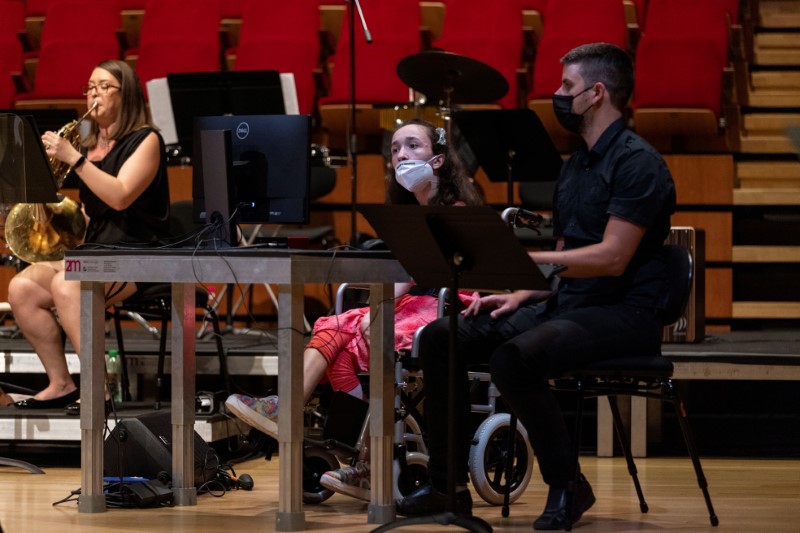
Alexandra Kerlidou, 21, who suffers from cerebral palsy, plays the "Eyeharp", a gaze-controlled digital software Reuters
"I felt strange, I had never imagined such a thing", said Alexandra Kerlidon from her home in Lesbos, Greece, a student whose existence has been compromised by cerebral palsy. "I cried, her mother too" Anastasios Kerlidou said, hearing his daughter first play the Eyeharp. Yes, the Eyeharp. It is part of a program that offers a range of musical instruments whose choice enables those who cannot move their hands or speak, to 'play', through computer-generated software, in obedience to eye movement.
A friend of the Eyeharp's creator -- Zacharias Vamvakousis -- who was a musician, had been involved in a motorcycle accident. They had been scheduled to play a concert together at the time. But his friend was no longer able to do any of the things he had once taken for granted; his limbs unwilling/unable to respond as a result of the accident's severely disabling consequences. So he was inspired by both compassion and his creative genius to come up with an answer to the dilemma.
Himself both a computer scientist and a musician, Vamvakousis created a digital eye-tracking program from a technology already in wide use in gaming, security and medicine; a program geared to monitor eye movement through the performance of commands. As the eye rests on musical notes spaced on a wheel on the screen, the response on average is the playing of three to four notes each second. No fewer than 25 musical instruments can be selected to 'play'.
It takes discipline and concentration to succeed with the program ... since the player must direct eyes from wandering too swiftly over to the following note. Alexandra plays the Eyeharp, gaze-controlled digital software allowing those like her with severe disabilities, to play music. She cannot imagine her life without music.
"After a discussion with your Mother, we have decided that you must leave this house immediately. You have 14 days to vacate. You will not be allowed to return. We will take whatever actions are necessary to enforce this decision."
"Michael Joseph Rotondo, You are hereby evicted from 408 Weatheridge Drive, Camillus, New York effective immediately. You have heretofore been our guest and there is no lease or agreement that gives you any right to stay here without our consent."
"A legal enforcement procedure will be instituted immediately if you do not leave by 15 March 2018."
Michael, here is $1,100 from us to you so you can find a place to stay."
"There are jobs available even for those with a poor work history like you. Get one -- you have to work! If you want help finding a place your Mother has offered to help." Mark Rotondo
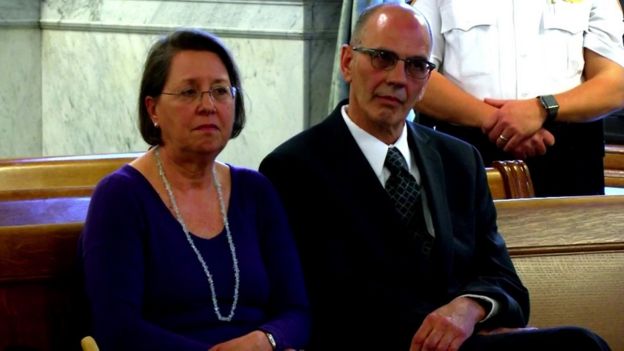
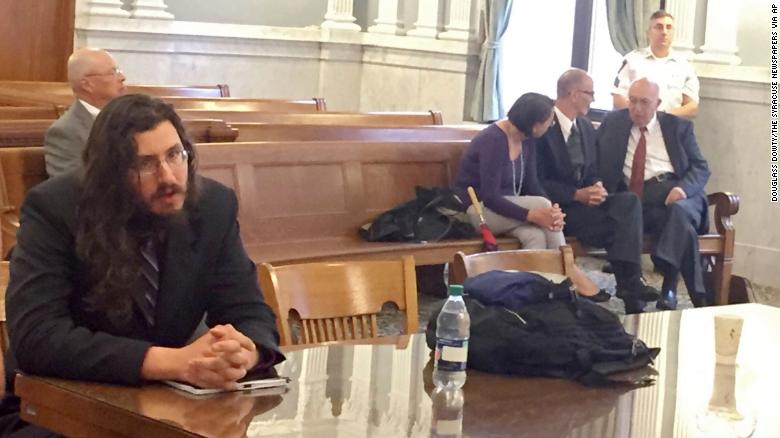
Christina and Mark Rotondo in court Reuters
"I am just so outraged." "[I had] never been expected to contribute to household expenses, or assist with chores and the maintenance of the premises." "I don't see why they can't just, you know, wait a little bit for me
to leave the house. [Six months is] a reasonable amount of time for someone who has been depending on persons for support." Michael Rotondo
Michael Rotondo (left) at his eviction proceeding in Syracuse, New York.
His parents, Mark and Christina, confer with their lawyer in the court
gallery behind. Douglas Dowty, The Syracuse Newspapers via AP
Upstate New York State Supreme Court Justice Donald Greenwood informed Mark and Christina Rotondo that their lawyer would be instructed to draft an eviction order giving their son Michael reasonable time to vacate the home they no longer wished to share with him. They had, in fact, been resentful of their 30-year-old, unemployed son living with them for quite some time.
A situation not made any easier by the fact that he would not speak with them, nor do anything remotely useful around the house; much less that he paid no rent for his accommodation.
The couple's request for an eviction order was granted by the judge who also indicated that adult protective services would be engaged to check on matters in the home that appeared to him to be rather concerning. As for their son, Michael Rotondo informed the judge he was well aware his parents wished him to leave their home, arguing that as a member of the family he felt entitled to six months additional time to make alternative arrangements for himself.
When Michael Rotondo spoke to the media he pointed out that he did his own laundry and provided for his own food. His exasperated parents, feeling it was beyond time their adult son became an adult rather than a recluse who felt no urge to find employment and to be responsible for himself, preferring to live in a bedroom in their split-level ranch home, gave him an initial note requesting he leave in March, repeated it in February, and then again when their son made no move to honour their request.
They felt finally driven to taking legal means when he ignored all their requests, including that he remove his Volkswagen from outside their home, despite offering financial assistance to have it repaired to working order. The eviction order was their last desperate attempt to force their son to take steps toward overdue responsibility for himself. In view of a gaggle of curious reporters, the Rotondo son engaged the judge in a 30-minute verbal sparring, when the judge suggested he address his parents directly, and he refused.
"It really seems kind of outrageous that someone in this day and age could be in someone else's home for six months" before they agree to leave, when requested to do so, remarked the judge. "I want you out of that household." At the hearing's conclusion, the son invited television camera crews to meet him outside the court where he responded to questions and stated baldly that he is not prepared to leave home where he occupies a bedroom, will not speak to his parents and has a business.
Refusing to respond when asked what the business was other than to state tersely "My business is my business".
According to a recent study, an estimated 22.5 percent -- 12 million -- Americans between 24 and 36 years of age live at home with their parents, a notable increase from the 14 percent that did so in 2005.
They all, obviously, believe wholeheartedly in the old adage that "There's no place like home", unwilling to make one of their very own.
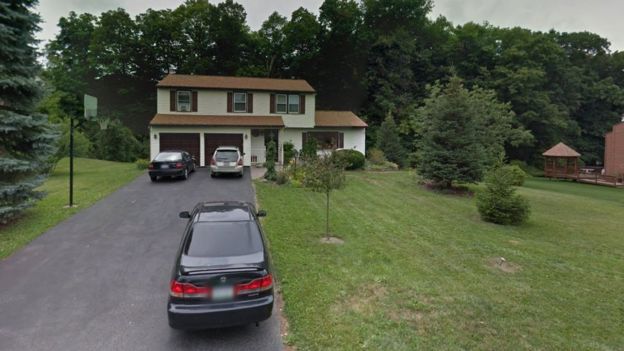
The home near Syracuse, New York that is at the centre of the family dispute Google Maps
"Theoretically what we think is that buying time protects people from the negative effects of time stress in daily life. When feeling pressed for time, that seems to take a bit of a toll on people's day-to-day happiness." "It's not what comes to mind to people as a way to increase their happiness and the rates at which people are engaging in this type of expenditure are surprisingly low." "People who don't feel like they're rolling in dough may feel like that's a frivolous way to spend money but what our research is showing is that even if you don't have tons of money, using money to get rid of your disliked tasks may be a pretty smart decision." "People may feel like I can do this so I should do this, and so I hope our research helps to break through that perhaps misguided cultural assumption." Elizabeth Dunn, psychology professor, University of British Columbia
While most of us don't have digs as fancy as the Royal Yacht Britannia
in Edinburgh, seen in this 2012 file photo, new happiness research finds
that even people of moderate means would be wise to allocate a small
amount of their budget to time-saving services that free them of
disliked chores. (David Moir/Reuters)
A study was undertaken in Vancouver out of the University of British Columbia, headed by psychology professor Elizabeth Dunn. In the experimental study sixty people who formed the nucleus of the study were given $40 and advised that the money should be used to access anything they wanted to spend it on as long as it was a material object that they thought they might like. When the test subjects reported back they indicated they had bought items such as wine, clothing and board games.
That led to the researchers posing the question to their study group to enable them to judge the level of happiness that resulted from those people buying the things they had chosen to spend their study-accessed funds on. For the second weekend, once again the participants were given $40 to spend as they saw fit, only this time they were expected, they were informed, to use the money to achieve time-saving.
As an example, to take a taxi rather than using public transit, or arranging to have someone cut their grass rather than do it themselves, and in another instance use the services of a boy in the neighbourhood to run errands. That done, the researchers compared the group's stated level of happiness that followed both spending activities, week one and week two, with their different emphasis and targets.
The researchers discovered that people appeared to be much happier buying themselves 'time', rather than objects. Reportedly, two percent of the group only, claimed they would use money to buy things that would give them more time for themselves. Professor Dunn reached the conclusion that even those with ample disposable income preferred not to pay others to perform tasks, to save themselves time.
Researchers surveyed 6,000 people in Canada, the U.S. and Europe found
that those who doled out cash to save them time on things such as the
meal delivery service seen in this 2014 file photo, were happier than
those who don't. (Matthew Mead/Associated Press)
Those who were able to afford to have their groceries delivered continued to go out to the supermarket to shop regardless, or continued parking their cars themselves rather than making use of valet parking. That same study made a survey of 850 millionaires in the Netherlands, only to discover that close to half preferred not to spend money outsourcing their most disagreeable tasks.
A survey of 6,000 people in Canada, the United States and Europe indicated that those whose financial situation was healthy and could see benefit accruing from spending discretionary income ridding themselves of dreaded chores still preferred not to. People who do spend money as a time-saving device spend typically $80 to $100 monthly, according to Professor Dunn, adding that even $40 is capable of opening up some spare time.
Professor Dunn's study team's reason that people have an aversion to paying for giving themselves extra time in that they harbour a feeling of guilt for spending funds unnecessarily, since they feel they could do these chores themselves. The team plans a follow-up study hoping to come to a better understanding of why people prefer not to spend money to buy time. Age, gender, ethnicity and other issues could be identified as drivers for that reasoning.
Possibly, it might be an issue of self-respect? That people understand that having certain life skills is a measure of their capability of looking after themselves responsibly? What Professor Dunn and her colleagues are actually engaging in is validation of present-day society's penchant for farming out aspects of their lives that they view as inconvenient, certain responsibilities that hinder their plans, for example.
And, as good an example as any is that children are now commonly farmed out to others for their care and nurturance, depending on non-family members to raise them at critical times in their young lives, rather than their parents, busy with their own lives, absent their children. This study in fact applauds such choices. As it gives a tacit approval rating to failing to acquire the requisite skills and understanding as a parent to fulfill parental obligations to their dependent children.
Another such measure is the extent to which people will not bother learning how to prepare basic, nutritional meals for themselves, vastly preferring to believe that such commonplace tasks central to human existence are too difficult, too much of a nuisance, too interfering in their freedom to disport themselves as they wish, rather than to feel obligated to their own needs, to fulfill them in the most basic of ways, such as meal preparation.
So spending disposable income, or ensuring that whatever money is available is earmarked for fast foods, convenience and pre-prepared foods, or eating out, rather than becoming familiar with simple and wholesome meal preparations. The assumptions that this research team reached simply reflect what they wanted to find to fit their theory.
What they discovered is that some people recognize they should acquire the skills and discipline to be self-sufficient in these measurable ways if for no other reason than mere self-respect. And they find this somewhat wanting in their estimation, expressing the hope that their research leading to their theories will give people the justification to surrender their agency to others rather than be wholly responsible to and for themselves.