Ruminations

Blog dedicated primarily to randomly selected news items; comments reflecting personal perceptions

Tuesday, June 16, 2020

Crisis Management : Great Barrier Reef Corals

"Because COTS [Crown-of-Thorns starfish] juveniles have the ability to stay in an algae feeding form for up to six years, there could be an accumulation of multiple generations of juveniles that are happily feeding on algae until there is a specific cue that catalyzes their transition to feeding on corals."
Paul Barber, professor, Department of Ecology and Evolutionary Biology, University of California at Los Angeles

"The science tells us that elevated fertilizer and other pollutants from primary production run-off is causing an increase in phytoplankton, which is the main food source for COTS larvae."
Anna Maraden, managing director, Great Barrier Reef Foundation

"Given the extreme size of the Great Barrier Reef and many threats to humans, we wanted a 'tool' that could allow the authorities to scale back the manual eradication program."
"In 2006, I developed a robot which proved that vision can be used to allow a robot to estimate its position in the reef and avoid obstacles."
"[We] have been integrating them with robotic boats to further increase their ability to deliver large amounts of coral larvae to damaged reefs."
Matthew Dunbabin, professor of science and engineering, Queensland University of Technology
crown of thorns starfish.jpg
Crown-of-thorns starfish eat coral, and their booming population is causing major problems in Australia’s Great Barrier Reef. (Tarasovs/iStock)

As an irreplaceable wonder of the natural world, the Great Barrier Reef is immense, with its 3,000 reef systems spanning over 214,000 miles, home to over 1,500 species of fish, 400 kinds of hard coral, and one-third of the planet's soft coral. Half of that coral has been lost in the past thirty years, however, both to bleaching events and to outbreaks in the communities of crown-of-thorns starfish which feast on the coral.

As the world's largest coral reef system, the Great Barrier Reef has been attacked by this starfish with its long spikes covering its body, capable of reaching 2-1/2 feet in diameter, looking somewhat like a colourful landmine with 14 to 21 movable arms. The crown-of-thorns matures at four months of age, eating live coral continuously, up to their own body weight in one sitting. One such animal alone is capable of consuming 20 to 32 feet of living coral annually.

The 865 acres the Great Barrier Reef covers off the coast of Australia is host to an estimated 350 billion of the starfish considered to be the most fertile invertebrate in the world. They have stripped 150 reefs of coral and damaged 500 more, in just a few years within the Great Barrier Reef. It was recently discovered that crown-of-thorns are able to delay transition to adulthood for up to six years during which time they can be static, awaiting the healing of a damaged reef, which when healed, and healthy coral regrown, is ripe for the COTS to mature and resume feeding.

Reef RangerBot becomes 'LarvalBot' to spread coral babies
LarvalBot gently squirts the coral larvae onto damaged reef areas. Credit: QUT Media

Yet overfishing and the absence of the starfish's natural predators, the giant triton snail, have also contributed to outbreaks. Where under normal circumstances crown-of-thorns starfish have a useful role in reef vitality and diversity, preferring to consume the faster-growing coral which helps slow-growing coral varieties gain a foothold, when their population is not kept in check they have the capability of becoming a devastating invasive species.

The Great Barrier Reef Foundation recently launched a $37.5 million crown-of-thorns starfish control program, exploring innovative surveillance and control methods. The foundation has also been working with local farmers in reducing the amount of pollutant (fertilizer) run-off into the reef's waters to decrease outbreaks. Since the early 1960s when the escalation in outbreaks was first seen, scientists have been exploring methods of crown-of-throrns outbreak mitigation. Researchers at James Cook University in 2015 discovered a 20-millilitre dose of vinegar would kill a starfish in 48 hours.
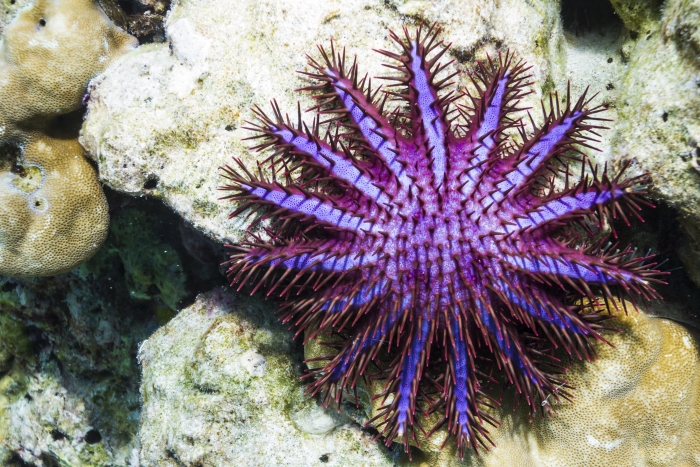
crown of thorns starfish inset
A crown-of-thorns starfish. (tae208/iStock)

A practical, workable culling tool was considered only part of the battle of injectable poison such as bile salts or vinegar where diving crews were tasked with hunting the starfish one by one, making it difficult through such a laborious regimen to much diminish the population. Between four and 12 million crown-of-thorns starfish lived at the Great Barrier Reef in 2015. Two crews working full time were able to eradicate 350,000 of the creatures. To place matters into perspective, a female lays roughly 68 million eggs yearly.

A seemingly hopeless situation, but one with a more practical solution in scooping them up when an autonomous underwater vehicle, a vision-based robot specifically designed to protect coral reef systems was devised. Developed by a team of scientists led by Matthew Dunbabin, with Deep Learning technology, by 2014 Professor Dunbabin's team constructed a robot that could be programmed to detect and inject the starfish with bile salts, through autonomous operation.

The Ranger Bot is programmed to accelerate the development process. Fully operational by late 2018 in the Great Barrier Reef, the team that assembled it was able to increase its capabilities to the point where it can help with coral larvae reseeding along the Great Barrier Reef and reefs in the Philippines.
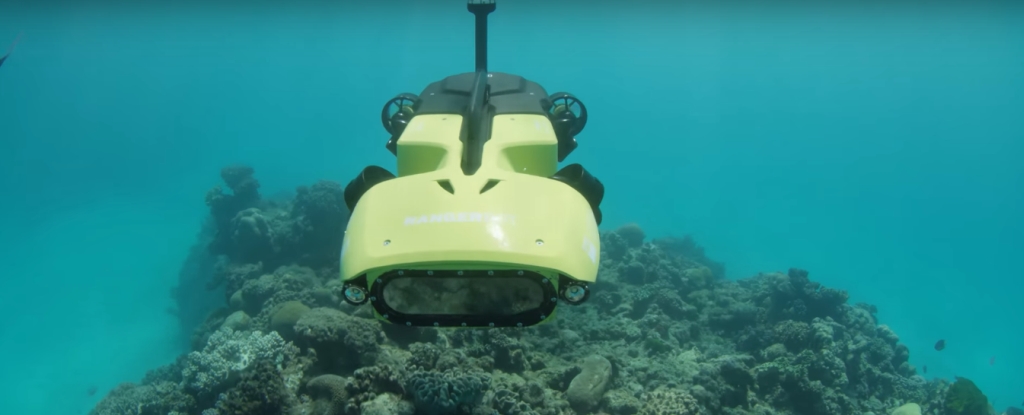
rangerbot august 2018
Ranger Bot   (TheQUTube/YouTube)


Labels: , , , , ,

Sunday, December 15, 2019

Broadcasting an Underwater Invitation to Fish

"Healthy coral reefs are remarkably noisy places -- the crackle of snapping shrimp and the whoops and grunts of fish combine to form a dazzling biological soundscape."
"Juvenile fish home in on these sounds when they're looking for a place to settle."
"Reefs become ghostly quiet when they are degraded, as the shrimps and fish disappear. But by using loudspeakers to restore this lost soundscape we can attract young fish back again."
Steve Simpson, marine biology professor, University of Exeter
Marine biologist Tim Gordon deploys an underwater loudspeaker on a coral reef. (University of Bristol)

"There's no way you could hear those [waves hitting a shoreline] in a healthy reef, because they'd just be drowned out by the diversity and abundance of other sound types going on."
"There's this constant crackle of shrimps clicking their claws, and invertebrates making noise as they scrape along the bottom."
"When we made the patches sound like they were healthy, we discovered … twice as many fish came back and settled onto these habitat patches, than when we didn't do anything to the sound."
"Fish are crucial for coral reefs to function as healthy ecosystems ... Boosting fish populations in this way could help to kick-start natural recovery processes, counteracting the damage we're seeing on many coral reefs around the world."
"[It's important that] we remove the original stressor that caused the damage in the first place — in most instances worldwide, that is climate change and warming seas." 
"Without strong and decisive action on carbon emissions, any reef restoration will ultimately be fruitless."
Tim Gordon, marine biologist  , University of Exeter
Fish and other sea-life settle on coral reefs, leaving them teeming with life. (Isla Keesje Davidson/University of Bristol)

"Acoustic enrichment is a promising technique for management on a local basis. However, we still need to tackle a host of other threats including climate change, overfishing and water pollution, in order to protect these fragile ecosystem."
"We tracked the experimental reefs for 40 days. Whilst we can't necessarily tell if exactly the same individuals remained, it is certainly true that there were increasing numbers of both individuals and of species across that time, so most likely those arriving were staying."
"In that time frame, it was probably a little soon for them to start breeding - future work would ideally monitor reefs for even longer, as ultimately that is one of the key measures that will be important."
Andy Radford, professor in behavioral ecology, University of Bristol 
In a six-week field experiment British and Australian researchers have thought up a strategy they feel might aid in coral reef restoration efforts. This, to add to efforts by marine biologists to help restore failing coral reefs throughout the world, deemed the effect of climate change. In this experiment, the researchers placed underwater loudspeakers within areas of dead coral along Australia's Great Barrier Reef, to play audio recordings of healthy reefs to determine whether diverse communities of fish that normally inhabit such reefs could be lured back, in the process begin to counteract reef degradation.

The study was published in the journal Nature Communications, finding twice as many fish tended to flock to the dead coral patches from which healthy reef sounds were emanating. In comparison, patches where no sound was played attracted fewer fish to return. The study points out the number of species present in the reef patches where healthy sounds were broadcast increased by fifty percent in comparison to other nearby patches, with the new fish populations including species from all areas of the food web.

An underwater loudspeaker on a coral reef.
An underwater loudspeaker on a coral reef
Fish such as scavengers, herbivores and predatory fish were all represented as returnees. And what seemed even more promising is that those fish that arrived at the patches appeared to remain there. Should the technique, replicated to ensure its accuracy and on larger scales, prove to be as positive in its results, it could represent yet another methodology to revive coral reefs globally, alarmingly ravaged by overfishing, pollution and climate change.

Working from October through to December of 2017 in a lagoon located in the northern part of the Great Barrier Reef where a large, shallow reef runs along the coastline, the researchers fixed underwater loudspeakers to the centre of the patches at the start of fish recruitment season when fish spawn and mature. Thirty-three experimental reef patches were built and placed on open sand, some 27 yards from the naturally-occurring reef. The loudspeakers were angled upward to distribute sound evenly in all directions.

Ocean fish and other marine species depend on healthy coral reefs.  jadhav vikram
The researchers sounded the recordings from a healthy reef in some of the patches, while in other patches they used speakers emitting no sounds. A third group of patches was left  untouched. The "acoustic enrichment" process had a "significant positive impact on juvenile fish recruitment throughout the study period" of 40 nights, the researchers wrote in their published study.

It was satisfactorily ascertained that the reefs that were 'acoustically enriched' attracted fish faster, while maintaining them longer than the reefs absent a soundtrack of healthy reefs, according to the study results.


Labels: , , ,

 
()() Follow @rheytah Tweet