Crisis Management : Great Barrier Reef Corals
"Because COTS [Crown-of-Thorns starfish] juveniles have the ability to stay in an algae feeding form for up to six years, there could be an accumulation of multiple generations of juveniles that are happily feeding on algae until there is a specific cue that catalyzes their transition to feeding on corals."
Paul Barber, professor, Department of Ecology and Evolutionary Biology, University of California at Los Angeles
"The science tells us that elevated fertilizer and other pollutants from primary production run-off is causing an increase in phytoplankton, which is the main food source for COTS larvae."
Anna Maraden, managing director, Great Barrier Reef Foundation
"Given the extreme size of the Great Barrier Reef and many threats to humans, we wanted a 'tool' that could allow the authorities to scale back the manual eradication program."
"In 2006, I developed a robot which proved that vision can be used to allow a robot to estimate its position in the reef and avoid obstacles."
"[We] have been integrating them with robotic boats to further increase their ability to deliver large amounts of coral larvae to damaged reefs."
Matthew Dunbabin, professor of science and engineering, Queensland University of Technology
 |
| Crown-of-thorns starfish eat coral, and their booming population is causing major problems in Australia’s Great Barrier Reef. (Tarasovs/iStock) |
As an irreplaceable wonder of the natural world, the Great Barrier Reef is immense, with its 3,000 reef systems spanning over 214,000 miles, home to over 1,500 species of fish, 400 kinds of hard coral, and one-third of the planet's soft coral. Half of that coral has been lost in the past thirty years, however, both to bleaching events and to outbreaks in the communities of crown-of-thorns starfish which feast on the coral.
As the world's largest coral reef system, the Great Barrier Reef has been attacked by this starfish with its long spikes covering its body, capable of reaching 2-1/2 feet in diameter, looking somewhat like a colourful landmine with 14 to 21 movable arms. The crown-of-thorns matures at four months of age, eating live coral continuously, up to their own body weight in one sitting. One such animal alone is capable of consuming 20 to 32 feet of living coral annually.
The 865 acres the Great Barrier Reef covers off the coast of Australia is host to an estimated 350 billion of the starfish considered to be the most fertile invertebrate in the world. They have stripped 150 reefs of coral and damaged 500 more, in just a few years within the Great Barrier Reef. It was recently discovered that crown-of-thorns are able to delay transition to adulthood for up to six years during which time they can be static, awaiting the healing of a damaged reef, which when healed, and healthy coral regrown, is ripe for the COTS to mature and resume feeding.
 |
| LarvalBot gently squirts the coral larvae onto damaged reef areas. Credit: QUT Media |
Yet overfishing and the absence of the starfish's natural predators, the giant triton snail, have also contributed to outbreaks. Where under normal circumstances crown-of-thorns starfish have a useful role in reef vitality and diversity, preferring to consume the faster-growing coral which helps slow-growing coral varieties gain a foothold, when their population is not kept in check they have the capability of becoming a devastating invasive species.
The Great Barrier Reef Foundation recently launched a $37.5 million crown-of-thorns starfish control program, exploring innovative surveillance and control methods. The foundation has also been working with local farmers in reducing the amount of pollutant (fertilizer) run-off into the reef's waters to decrease outbreaks. Since the early 1960s when the escalation in outbreaks was first seen, scientists have been exploring methods of crown-of-throrns outbreak mitigation. Researchers at James Cook University in 2015 discovered a 20-millilitre dose of vinegar would kill a starfish in 48 hours.
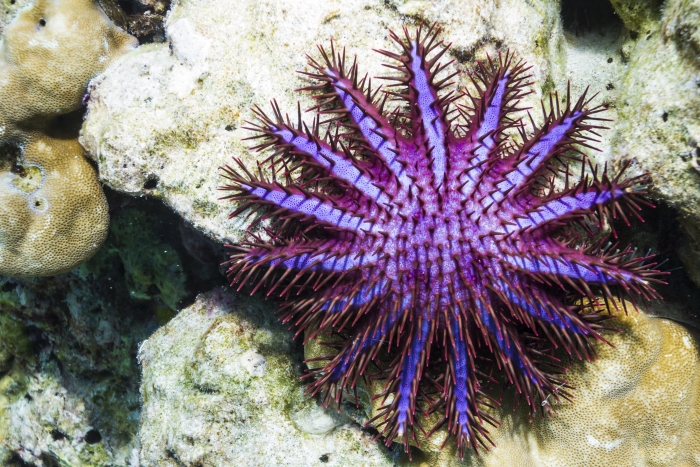 |
| A crown-of-thorns starfish. (tae208/iStock) |
A practical, workable culling tool was considered only part of the battle of injectable poison such as bile salts or vinegar where diving crews were tasked with hunting the starfish one by one, making it difficult through such a laborious regimen to much diminish the population. Between four and 12 million crown-of-thorns starfish lived at the Great Barrier Reef in 2015. Two crews working full time were able to eradicate 350,000 of the creatures. To place matters into perspective, a female lays roughly 68 million eggs yearly.
A seemingly hopeless situation, but one with a more practical solution in scooping them up when an autonomous underwater vehicle, a vision-based robot specifically designed to protect coral reef systems was devised. Developed by a team of scientists led by Matthew Dunbabin, with Deep Learning technology, by 2014 Professor Dunbabin's team constructed a robot that could be programmed to detect and inject the starfish with bile salts, through autonomous operation.
The Ranger Bot is programmed to accelerate the development process. Fully operational by late 2018 in the Great Barrier Reef, the team that assembled it was able to increase its capabilities to the point where it can help with coral larvae reseeding along the Great Barrier Reef and reefs in the Philippines.
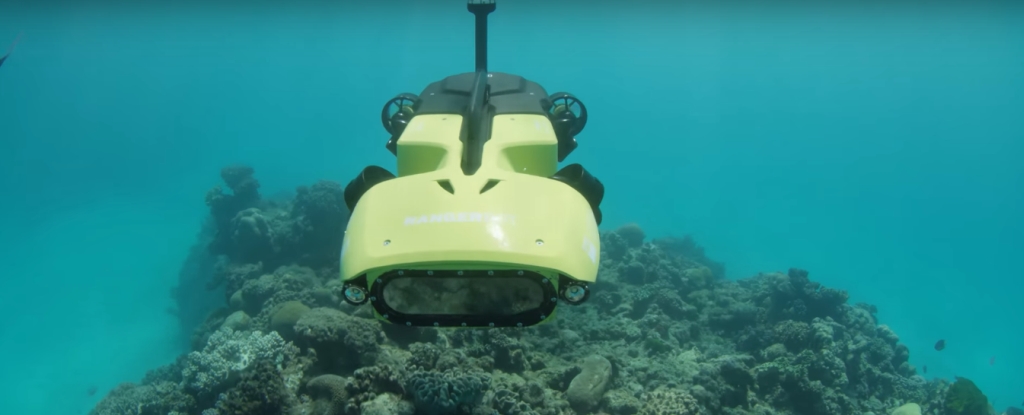 |
| Ranger Bot (TheQUTube/YouTube) |
Labels: Coral Reefs, Ecology, Environment, Great Barrier Reef, Nature, Starfish
posted by Pieface @ 7:02 PM
0 comments


:max_bytes(150000):strip_icc()/coralreefgetty-56cb39055f9b5879cc541a9e.jpg)
