Ruminations

Blog dedicated primarily to randomly selected news items; comments reflecting personal perceptions

Thursday, August 13, 2020

Mixed Experiences, Mixed Reaction

"We are home working alongside our kids, in unsuitable spaces, with no choice and no in-office days. This will create a productivity disaster for firms."               "Everyone assumes I would be gushing over the global rollout of working from home. Unfortunately not."                                                                              "Working from home with your children is a productivity disaster. My 4-year-old regularly bursts into the room hoping to find me in a playful mood shouting 'doodoo!' – her nickname for me – in the middle of conference calls."              "Many people I have been interviewing are now working in their bedrooms or shared common rooms, with noise from their partners, family or roommates."         "I fear this collapse in office face time will lead to a slump in innovation. The new ideas we are losing today could show up as fewer new products in 2021 and beyond, lowering long-run growth."                                                                     "They [study volunteers] reported feeling isolated, lonely and depressed at home. So, I fear an extended period of working from home will not only kill office productivity but is building a mental health crisis."                                             "Phone calls make collaboration harder. You don’t know if anyone is really paying attention. In one conference call I was on, I thought the background noise I was hearing was actually a vacuum cleaner. When I asked ‘is somebody vacuuming', the sound mysteriously stopped. While a video call could seem intrusive, it is essential for ensuring the attendees are paying as much attention as they would in a physical meeting."                                                                                                      Nicholas Bloom, senior fellow, Stanford Institute for Economic Policy Research (SIEPR) 

https://images.theconversation.com/files/253605/original/file-20190114-43535-i3yz5h.jpg?ixlib=rb-1.1.0&q=45&auto=format&w=1356&h=668&fit=crop

An Angus Reid Institute poll tended to conclude that circumstances involved in working from home lead to those questioned falling into the category of plus-or-minus satisfaction. Of people living alone, seven percent felt work productivity has been miserable, working from home. Those people working from home with spouse and children present saw 17 percent stating productivity has been minimized. Close to 30 percent of Canadians, as  result of the pandemic, work from home. 

For many people working from home -- which before the pandemic must have seemed to many the perfect way to balance work and home life -- now that it has become a reality, seems stifling, never ending, with continually incoming business emails and meetings intruding into what was meant to be personal time, once sacred against interference. A huge study of the globe's new, coronavirus-enforced work habits indicates that the average workday for those working from home is an hour longer than it once was, working at a normal work site.

There has been a realized increase of eight percent of emails into inboxes after business hours, leaving the average worker to deal with after-hours email on an increasing basis. On the other hand, even so, polls indicate that Canadian workers remain fairly pleased to be working from home, as discovered by a recent Angus Reid Institute poll which found 87 percent of workers in Canada described working from home as "really great" or "OK". Of those polled, a mere 13 percent felt the experience was dreadful.

By those in the know, it is assumed that the greater satisfaction is due in large part to less time spent in meetings than what was occasioned at a workplace, balancing out the longer working hours. Even as the average worker is now participating in about one additional meeting daily than previously and meetings tend to include on average two more people than before, the length of time these meetings consume has decreased.

 Getty Images

Meetings tend now to be around 12 minutes shorter in duration than they had been prior to the lockdown so that the average length of time spent in those meetings daily has been reduced by ten minutes. There appears to be no particular reason to account for the shorter duration of meetings, but researchers referred to a previous study finding workers struggle to stay engaged in virtual meetings compared to in-person meetings.

Data from digital communications software used globally was analyzed in a working paper released by the National Bureau of Economic Research in the United States. Because the aggregated data is anonymized the question of whether people are working longer days or just taking advantage of flexible hours while working from home went unanswered. "It is unclear if this increase in average workday span represents a benefit or a drawback to employee well-being."

A New Study Reveals Why Working From Home Makes Employees More Productive
Getty Images

Researchers found that in the first week of the lockdown, a flurry of emails internally and externally were unleashed by workers. Emails continued to be sent in high numbers through the first four weeks of the lockdown, then tended to descend to pre-lockdown levels, though the number of recipients for each email has continued to be higher than normal, even when volume returned to normal levels.


Labels: , ,

Friday, May 22, 2020

COVID-Confused? Here, Let Me Help!

What is obvious is what is known. The world is in a global pandemic. Of such a virulent nature that it has closed down society as it has developed over the years, presenting us with a faint resemblance of the familiar, where people are ordered to remain separate from others lest the opportunistic virus be given a clearer mandate through oblivious carelessness to infect ever greater numbers of the people than the five million already infected worldwide by its insidious, insistent, triumphant presence.

What is known is that this is a zoonotic, a virus that leaped the species chasm from wild animals to human animals, and that it first emerged in a city of northern China, Wuhan, in a province that became the first to be inundated with the virus, and consequently locked down, where so many presentations at hospitals swamped their capacity to react, and health workers began to succumb to its evil influence.

Known? That China sought at first when the virus initially presented and its own physicians began warning of an unusually dangerous presence of viral pneumonia and puzzling deaths, to deny that any unusual public health threat had arisen. It failed to give vital information to the World Health Organization to prepare to recognize a looming global threat, influencing a too-late declaration issued to the world at large of a global pandemic.

It is also known that in Europe, Italy, Spain, France and the United Kingdom suffered vast numbers of infections; that Russia has been smothered with cases, that in North America the United States has succumbed to the virus with a fury, hospitalizing and killing thousands of health-vulnerable people. In the Middle East, Iran, though claiming otherwise, has seen COVID-19 strangle its population, while India and Africa are striving to control a pestilent disease that thrives within poverty-stricken crowded conditions.

It is well and truly known that the world economy is in tatters, that countries that took steps to attempt to protect their populations from the worst deadly effects of the SARS=CoV-2 virus causing COVID-19 by shutting borders, businesses, social spaces, warning people to remain secluded indoors, venturing out only for emergencies, infrastructure and finances -- are in free-fall.

A Mexican flag stands on display next to a closed beach in the town of Bucerias, Nayarit state, Mexico, on Thursday, April 23, 2020. Cesar Rodriguez/Bloomberg
And there's more, much more:
  • The elderly; those over 65 and well beyond are at higher risk of infection and ultimately losing their lives to COVID since risks tend to rise in lock-step with advanced age. But this is a very strange disease; some individuals aged 100 and even beyond who were infected, have recovered and somehow escaped the Grim Reaper. 
  • Irrespective of age, those with such chronic conditions such as diabetes, obesity, cancer, heart disease and other serious health conditions are also at grave risk. The combination of age and any of these conditions accelerates the risk of lost mortality.
  • Self-isolation; quarantining oneself is immensely useful, given that density is dangerous, representing a situation beloved of the virus which loves to send out emissaries from a host to those located conveniently nearby to represent yet another depository of viral danger. 
  • Observe the differences in countries, where heavily-populated Germany went into lockdown and Sweden, heavily populated as well, deliberately failed to; so a low death rate occurred in Germany and a high rate in Sweden. This.is.not.rocket.science.
  • In Florida notorious as a haven for the elderly, a low death-rate has been seen which studies explain is due to the majority of its vulnerably elderly chose to voluntarily remain within their homes, even in the absence of government-mandated lockdown.
  • No evidence, only rumours, that heat or warmer weather may slow the disease spread or possibly deters its spread. Just as there is no evidence that when cold weather returns in the fall, a "second wave" of new outbreaks will occur.
    • The world awaits a life-saving vaccine against COVID, though no one has any idea what it might be, how it could work, and when it will be discovered. On the other hand some scientist believe COVID will of its own volition fade away after 70 days of terror.
There, wasn't that useful? Don't you feel better already? Prepared to launch yourself off on a vacation to some exotic spot. If they aren't under quarantine. If they will permit entry. If you aren't too fearful to venture out. If there are flights to that destination. If you're prepared to distance yourself and to wear a mask to soothe the resentment of the locals that  you've come from abroad to threaten them with the possibility you might be carrying the virus while unsymptomatic....

How about Italy, China or Mongolia. Even Egypt or Portugal? All have high hopes to rescue their tourism season...

A visitor wearing a face mask following the coronavirus disease (COVID-19) outbreak poses for pictures at the Badaling section of the Great Wall in Beijing, China, April 24, 2020.Carlos Garcia Rawlins / Reuters

Labels: , , , , ,

Monday, April 13, 2020

Home Deliveries during COVID-19

"[Just because the virus is] detectable [doesn't mean it necessarily poses a threat]."
"If you take basic precautions the danger from accepting a package from a delivery driver or takeout from a local restaurant or from buying groceries is de minimis."
Joseph G.Allan, assistant professor, exposure and assessment science, Harvard University
Amazon delivery driver
An Amazon delivery driver (not pictured) has tested positive for COVID-19. AP
"[Despite the company's ] expressions of support for its workforce [many Amazon employees insist the official messaging] doesn't always match what they have seen inside the company's warehouses."
"[They are concerned] about crowded hiring events and training sessions, limited access to disinfectant wipes, and the company's overall ability to follow through on its commitments."
CNN
Most retail establishments have now been identified as 'non-essential', and have been ordered by governments to close down for the time being, until the urgency over the novel coronavirus hurtling its threat against civil society everywhere has been brought under control. So while grocery stores, pharmacies and (unaccountably puzzling) liquor store outlets (in Ontario) are considered essential services, other retail dealers and outlets may only offer curbside pickup with online ordering.

Greater numbers of people are trying to switch over to ordering what they need in groceries and from pharmacies online to be delivered or for pickup at designated areas. The trouble is, as more people living lockdown conditions turn to eordering, supermarkets and other groups such as pet food stores (also considered non-essential) are experiencing difficulties catching up to the demand. If you're placing a food order and want to pick it up the same day, you find that pick-up spaces are blocked for the next month.

And then the public, already deeply concerned over their vulnerability to the epidemic where the highly contagious COVID-19 has been spreading, and hoping to evade capture by the little-understood zoonotic, continues to turn to deliveries from Amazon. In the current situation where small businesses are shuttering for good and large businesses appeal to government for financial assistance, the supply lines are being stretched to the limit.

Grocery chains are challenged to meet the needs of the public, a public which has reacted to the lockdown by fears of food shortages and shortages of disinfectant and toilet tissues, by emptying shelves. The supply model of 'just-in-time' warehousing and delivery was not designed for the current situation of panic buying and hoarding. Clearly, there is a dire need recognized to retool the model that has failed in this time of a coronavirus epidemic haunting the world.

While large corporations tremble in anticipation of being unable to weather this viral storm, there is one service that has the potential to grow faster than it might ever have dreamed of doing, even at a time when it was already a service-delivery success story, and that's Amazon. How well they've risen to the challenge, in face of the fact that drivers are themselves vulnerable to infection by the virus and then transmitting the virus to the public they serve, is a question not yet answered.

But for those customers who order through Amazon, yet quail at the thought of taking possession of a delivery package that just might be contaminated by the virus when they're concerned with reducing the potential of infection and worrying that Amazon delivery might pose as a direct danger, they would likely do best to relax about it because experts in the field claim such contamination to be highly unlikely. So, not the package, but the driver.

It is, in very fact, the drivers, exposed to a wide variety of people at doorstops delivering those packages who are at risk. The global pandemic has managed handily to upset entire universal applecarts. While Amazon has seen a huge  uptick in sales, their employees are less than gratified at the attention paid to their own state of health. In one area, employees were outraged that they were informed a week after one of the employees had been confirmed with COVID-19.

In this new world order where packaging and delivery play a vital new role, as people venture out of their homes with trepidation and care against infection, the new lifestyle imposed upon communities of social distancing and closed businesses require reliability of deliveries. Which places the public at an advantage, able to sequester at home, but employees of Amazon and other like conformations at higher risk of contracting COVID.
Amazon suggestions:
The first suggestion is to wipe down packages with disinfectant. Most deliveries coming from Amazon have two pieces of packaging--the product packaging, and the shipping container. Realistically, you should probably just remove your product from the shipping package, and dispose of that box immediately. 
Once you've done that, the surface of the inside package can be wiped down with a disinfectant wipe. Most products shipped by Amazon have likely been in a package for some time, meaning that the inside product probably isn't a super likely source of infection. Still, if you want to be extra careful, you can wipe that surface as well.
After you've disposed of the packaging, and wiped everything else down, wash your hands. This, by the way, is one of the most effective ways to prevent the spread of the virus anyway--meaning, you should be doing it anyway.
If that's not enough, another option is to leave the entire package outside, or, as Carney said, put it "in a remote location for a period of time." While it's not known exactly how long this particular virus can survive on cardboard packaging, in the long term it needs a host organism to survive and multiply. If it can survive on cardboard for only 24 hours, leaving it outside may kill it, allowing you to safely bring your package inside. 
If you have a garage, you can simply place the entire box outside, and leave it a few days. Then, to be safe, you can wipe down the inside package as described above.
Jason Aten, Inc.
Getty Images

Labels: , , , ,

Tuesday, March 31, 2020

Working From Home ...

"Repetitive strain injuries are chronic and they creep up over time. So anybody who has underlying conditions like tendinitis, a herniated disc, sciatica, neck problems ... depending on how many weeks or months this goes on [coronavirus lockdown; working from home], these people are going to be going back to their employers with aches and pains. It's going to have a snowball effect."
"Don't forget, a lot of people were going to chiropractors and physiotherapists and that's all come to a grinding half. You can't get a virtual massage."
"The most important part of the work station is the chair. How many of us are going to have a  height- adjustable chair like we have at the office? Probably not many."
"The overwhelming message is we have to get the person up higher. What you don't want to do is what we call 'turtling'. That's when you hunch over the computer, say to look at the numbers in a spreadsheet, then you forget to lean back again."
"Every twenty minutes look at something 20 feet away and hold it for 20 seconds. That's a good thing for visual fatigue, migraines and headaches."
Sue Hanel, founder, Ergo-Safety, Ottawa


We've all been thrust into a strange, new world. One mitigating against going out daily, crowding onto public transit, entering a busy building full of other people going to their offices, and once there, taking your place among the others who happen to work nearby. Government workers and workers in high-tech and other white collar jobs have all been released from daily workplace attendance. But not from their daily work schedules, necessarily. It's semi-permanent work-from-home time. At least until the lockdown hoping to protect populations from the transmission of the novel coronavirus comes to an end.

So, it's a boon to be ordered to work from home. Still working, still earning a pay cheque. Many have that option, many more in the service industries or operating their own retail businesses do not. Those who can, do, and focus on working from all manner of temporary 'work stations'; anything from the living room sofa to the dining room table, hunched over a laptap. Since these workplace scenarios fail to focus on optimum or even sub-optimum working conditions, they may lead to health complications due to musculoskeletal injury.


With the closure of businesses, work can still proceed but government offices are closed for business. When people left their place of employment they left behind all the functioning tools enabling them to do their jobs with personal safety. Those ergonomic keyboards, mouses, extra monitors and office chairs geared toward proper workplace conformation. "We've even had people send us photographs of their work spaces and asked us for advice on what to do", Ms.Hamel whose company has been tasked by private industry and government departments to perform work station assessments for close to 30 years, noted.

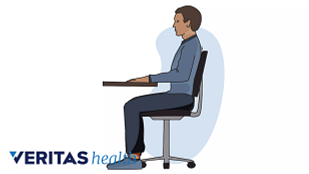
proper sitting posture


The worker should ideally be seated with back straight; ears over shoulders, elbows under shoulders; forearms and thighs parallel to the floor. Lumbar support is critical, even if you resort to placing a cushion on the seat to raise yourself to the proper working level, and another at your back, if using a wooden chair. A footrest may be required. Eyes should be at the level of the top third of the monitor. So if a laptop is being used, think of placing it atop a stack of books to bring it to eye level. Use a separate keyboard and mouse.

Light sources from a window should be shining in from the side, neither from the front nor behind. The use of blinds or curtains to control light is recommended, as the sun moves. Display settings to be adjusted with contrast close to 100 percent, and brightness in the 40 to 60 percent range. Do it.

Labels: , , ,

 
()() Follow @rheytah Tweet