Ruminations

Blog dedicated primarily to randomly selected news items; comments reflecting personal perceptions

Friday, June 26, 2026

Border-Crossing Drugs -- Transnational Criminal Operations

"There's a lot of frustration and it, in and of itself, lends itself to facile responses that look good, but in the end don't really do anything."
"Blowing up drug boats ... is a perfect example of a facile response that does absolutely nothing."
"We often think of [fentanyl] as just a border issue, and it's not just a border issue. These are transnational criminal operations."
Regina LaBelle, professor of addiction policy Georgetown University 
 
"The biggest concern we see is what's happening on our southern border being pushed up to our northern border."
"Over the last year, we've apprehended enough fentanyl that would kill 17 million Americans on our northern border." 
U.S. Homeland Security Secretary Markwayne Mullin
https://i.cbc.ca/ais/b860d07f-42a6-4870-85d2-346a964f35b9,1781881120949/full/max/0/default.jpg?im=Crop%2Crect%3D%280%2C0%2C5751%2C3834%29%3BResize%3D796
U.S. Homeland Security Secretary Markwayne Mullin said this week that more fentanyl is coming into the U.S. from Canada, which is not reflected in the latest data from U.S. border officials (Manuel Balce Ceneta/The Associated Press)
 
"I mean, it just really isn't happening."
"It's way too much trouble to ship [fentanyl] around and put it through Canada and then take it into the United States."
Mark Tyndall, public health scientist, professor of medicine University of British Columbia
 
"The flows that we know of across the U.S.-Canada border are token and trivial compared to the flows into the U.S., primarily across the southwest border or the flows into Canada of the precursors, not through the U.S."
"The fentanyl killing Canadians is mostly made in Canada with precursors that came from China."
"The U.S. supply chain is independent of the Canadian supply chain once the precursors leave China, but the manufacturing for U.S. markets mostly happens in Mexico." 
Jonathan Caulkins, drug policy researcher, Carnegie Mellon University
https://www.ctvnews.ca/resizer/v2/CEKXSUYIWANW2MWGKXF6XPXEVU.jpg?smart=true&auth=e17a063aff6d5ba209dd64d9b0e19ce2b080edb6273c9371f6aeb7dc0f35d6c5&width=1600&height=899
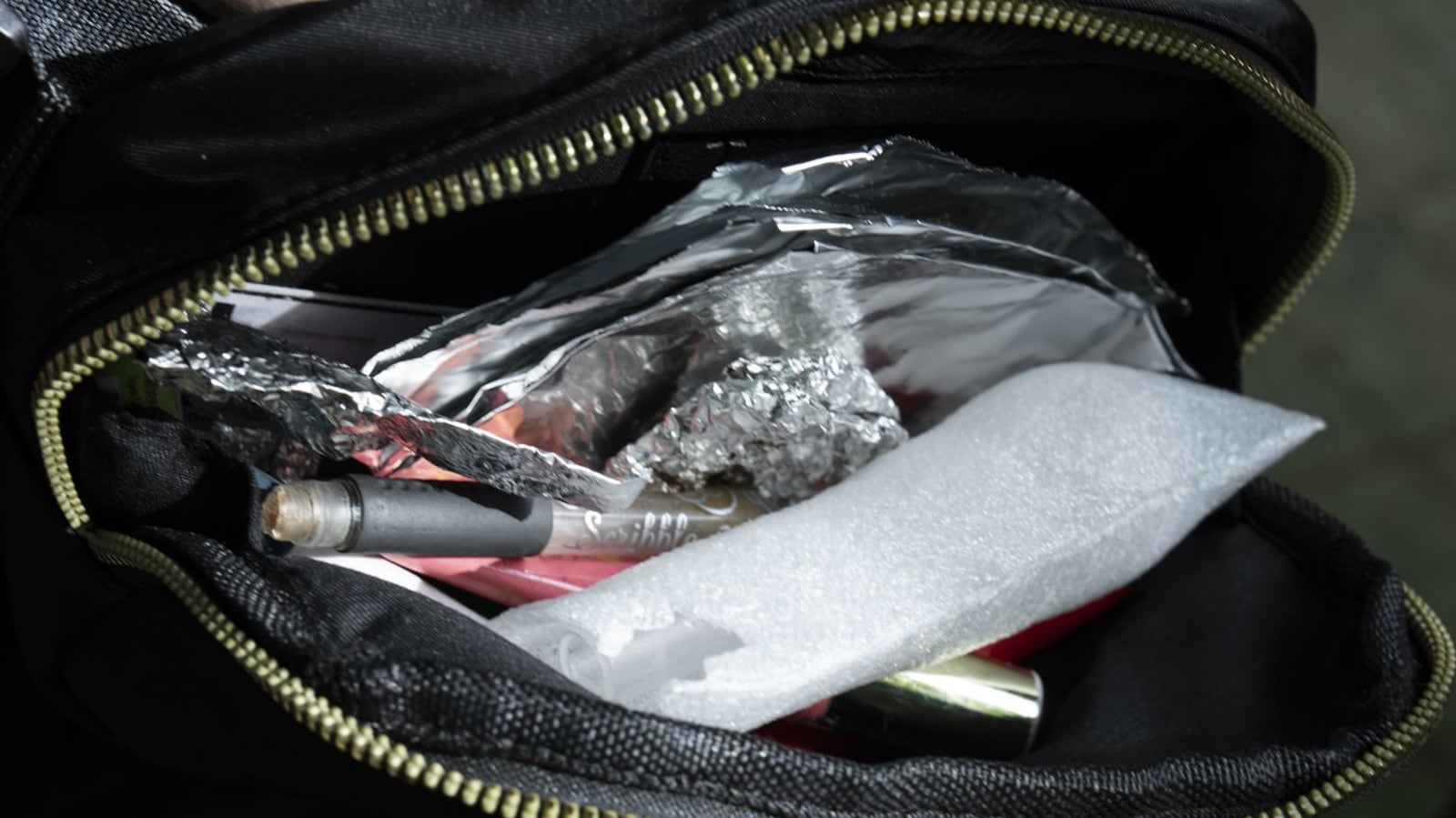
A bag filled with drug paraphernalia  (AP Photo/Jenny Kane)
 
There has been a realization of a drop in overdose deaths in both Canada and the United States. Drug policy experts can only theorize what the cause might be. The recently identified decline may be attributable to supply shifts alongside public health measures, eliminating tariffs or border crackdowns as part of the cause. The fearful public menace of overdose deaths has strike across all measures of society in both countries; everyone knows someone who knows someone who died of a drug overdose caused by synthetic opioids like fentanyl.
 
While Canada has developed no system of gathering statistics, the worst-hit province of British Columbia can boast that one in five residents knew someone who died from an overdose, in 2023. In 2024, close to half of Americans knew of someone who died from an overdose. Those who study the societal impacts of the drug trade tend to differ in their understanding of the situation, its impact and its victims and the possible causes, from politicians who view the subject from the perspective of ... politics.
 
And while Homeland Security Secretary Mullin claims pressure on the southern border drives cartel actions northward, including toward Canada, citing a surge in fentanyl moving across the northern border, he is contradicted by his Canadian counterpart who states data "really haven't borne that [Mullin's contention] out". 
https://i.cbc.ca/ais/63a79de7-88cf-4007-bc58-70c021f4a018,1781881050227/full/max/0/default.jpg?im=Crop%2Crect%3D%280%2C164%2C7925%2C4457%29%3BResize%3D860
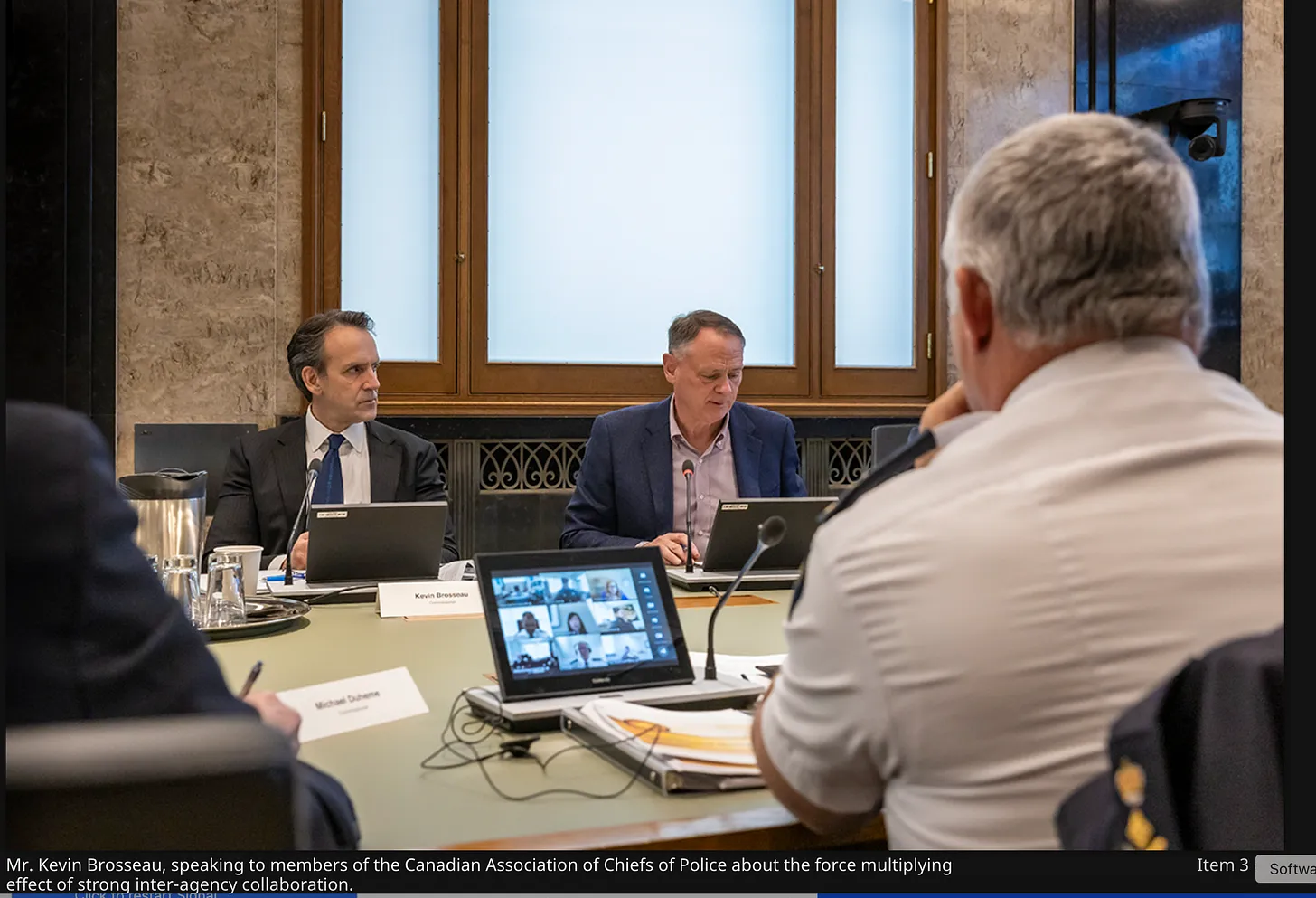
Kevin Brosseau, Canada's fentanyl czar, says his goal is to eliminate all fentanyl in the country. 'It's killing kids every day and destroying families,' he said. (Adrian Wyld/The Canadian Press)
 
Canadian fentanyl czar Kevin Brousseau cited U.S. Customs and Border Protection figures indicating some three kilograms of fentanyl seized at the northern order since October 2025. Which makes quite a comparison with over 3,000 kilograms seized at the southern, Mexican border. Nor are epidemiologists other than skeptical of charges that fentanyl trafficking has been shifting north.  
"We're talking about an illicit supply market that is entirely in the hands of illicit production traffickers, criminal organizations, and there's no regulation."
"[Supply conditions] can change very quickly again."
"A little change or an added highly toxic component to the drugs distributed could drive that toward an uptick."
Regina LaBelle
 
"From all I can gather, it's a mix of things, but the most likely driver of the drop in overdose deaths, at least on the Canadian side, has been changes in the fentanyl or in the synthetic opioid supply."
"[That could be construed as lower purity or products mixed with less lethal substances]."
Benedikt Fischer, professor, Faculty of Health Sciences, Simon Fraser University  
Precursor chemicals, usually shipped in from China, are generally available widely, enabling local production of fentanyl. The potency of the opioid calculates to a tiny amount able to supply the U.S. market. According to Professor Caulkins, trafficking capacity  and the criminal organizations that are involved are logically the most effective target by law agencies. 
 
Sharp declines in overdose deaths seen in both Canada and the U.S., since late 2023 where in the U.S. deaths involving synthetic opioids fell from 74,702 in 2023 to 48,422 in 2024, according to the Centers for Disease Control and Prevention, while positive in outlook, remain a puzzle in understanding why. The Canadian Public Health Agency data reflect 7,146 opioid-related drug toxicity deaths in 2024, 17 percent fewer than 2023, followed by another 2025 decline to 5,630.
The factors that may be assigned to these drops in fatal overdose occurrences range widely; expanded naloxone access, supervised consumption sites, drug supply prevention efforts, and increased public awareness among them. A 2026 study in Science magazine revealing a shock to the fentanyl supply having occurred in 2023 attributed to Chinese regulatory changes affecting access to precursor chemicals, another possible reason. 
 
In late 2023, deaths suddenly decreased in both countries, making it unlikely to point to one of the countries' policy changes, as a causative. Making it more likely that it is the supply that likely had an effect on the death rate. If so, this is a condition that may not continue. Academics now appear to favour the opinion that the fentanyl crisis is not vulnerable to border crackdowns, but more likely reacting to illicit market shifts and the capacity of public health systems to react accordingly. 
"If vigilance at any border drops, traffickers could use it as a transshipment route."
"Things that disturb the ability of the two countries on either side of the border to partner effectively are counterproductive."
"[Canada and the U.S. should refrain from allowing trade tensions to impair working in tandem at the border]." 
Jonathan Caulkins, Carnegie Mellon University 

https://www.ctvnews.ca/resizer/v2/I5REYHEHH5HGNA7UPRPCN74JPQ.jpg?smart=true&auth=7e0ff706ec68ee43779d3c561253bf255c5579a13323529a14e588cc74b08931&width=1600&height=899
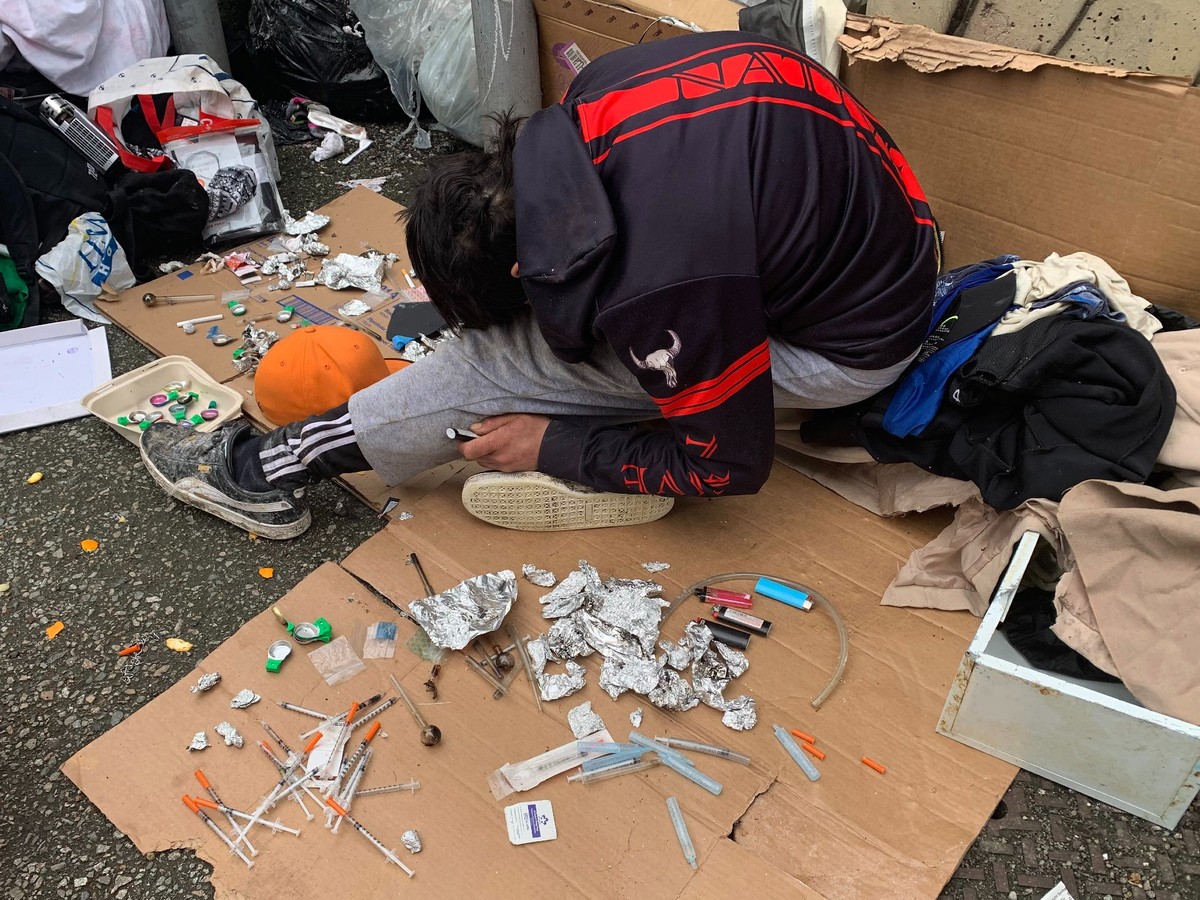
A man sits on a sidewalk along East Hastings Street in Vancouver's Downtown Eastside. THE CANADIAN PRESS/Jonathan Hayward
 

Labels: , , , , , ,

Wednesday, December 17, 2025

Cornering the World Market on Fentanyl : Beijing's Industrial Complex

"We're looking to collaborate with China, because it's not an indictment against the Chinese government, per se."
"It's companies, chemical companies in China, that are engaged in this kind of conduct -- and the Chinese government has taken a lot of action in terms of regulating and prohibiting various [fentanyl] precursors."
"There's very little north-south movement of produced fentanyl across the borders [U.S./Canada/Mexico]."
"Even if [there's 0.01 of a pound or percent going across, my uber-focus -- while I suppose to a degree aspirational -- has been to lower that to zero, and to eliminate fentanyl the best as I can from a supply perspective, but also reduce demand in this country."
"[U.S. officials expressed] strong acknowledgment of the efforts being made and encouragement to continue on this path [tackling fentanyl, if not necessarily] satisfaction." 
Kevin Brosseau, Liberal government 'fentanyl czar'
https://substackcdn.com/image/fetch/$s_!ImwC!,w_1456,c_limit,f_webp,q_auto:good,fl_progressive:steep/https%3A%2F%2Fsubstack-post-media.s3.amazonaws.com%2Fpublic%2Fimages%2F47dbc55f-4600-414f-89d8-53886fbb499d_2434x1660.png 
 
In line with Canadian Prime Minister Mark Carney's plan to visit China next year to confer with President Xi Jinping over trade issues primarily linked to poisoned diplomatic relations over the past several years when Beijing's hostage-diplomacy went a long way to alienating its regard in Canada, along with China's penchant for industrial piracy and cyber espionage as well as blatant interference in Canadian politics, a move is underway to collaborate with China for the purpose of putting a halt to the chemicals pouring into Canada used in the production of the synthetic opioid that has caused an overdose epidemic in Canada. 
 
Under successive Liberal governments, business and trade with China has always been seen as a high priority. This, despite China's investing in Canadian universities to launch China-friendly studies, and its record of criminally taking possession of industry and government blueprints to enhance and speed China's own industries at a cost to those whose successful systems, mechanisms and techniques made them world leaders in the world of  high tech. The end result has been China perfecting its rival industries and those from whom production expertise was surreptitiously taken saw their own collapse.
 
Canada's liberal governments were always able to overlook these inconveniences in favour of smoothing over differences and getting on with what they considered to be the more important work of benefiting from trade and cooperation with the world's industrial colossus. Years ago the United States managed an agreement with Beijing to help ensure that opioid-type drugs and their chemical precursors would be monitored in an effort to stop the carnage in human lives they cause as they flood into the West. The situation has persisted and continues to take its toll.


To believe that the Chinese Communist Party is incapable of fully controlling the flow of fentanyl and its precursors produced by chemical producers in China, is to disregard the total control it has over its industries, many of which have direct ties to the government or to the Peoples' Liberation Army. China monitors its population carefully and closely, thanks to face recognition technology and the ubiquitous presence of closed circuit cameras and apps Chinese must download to their iphones. To assume it has little knowledge of fentanyl production and trade is naive. It is just another industrial production that Beijing nurtures in control of a lucrative market.
 
The punitive tariffs that the Trump administration has slapped on trading partners throughout the world has made strange bedfellows in any event. U.S. President Donald Trump, in his insistence that the United States would no longer be taken advantage of through what he claims is uneven trade, has upended the world economy as a struggle ensued to plead for a more moderate tariff toll on those who consider themselves allies of the U.S. who have been  hit just as hard as those the United States considers adversarial countries.
 
https://www.lowyinstitute.org/sites/default/files/2025-11/54890669668_9f11288970_k.jpg
Donald Trump in talks with Xi Jinping (Daniel Torok/White House Photo)
 
Citing illegal migration crossing the border from Canada into the U.S. as well as large fentanyl shipments entering across the border, the tariffs imposed on Canada as punishment for presumed laxity in those areas has been a stinging blow. Seizures of fentanyl at or close to the border with the U.S. are minuscule from Canada, averaging 3.5 pounds monthly over the past three years. In comparison those drug seizures with Mexico averaged slightly over 1,500 pounds per month. But even 3.5 pounds of a deadly opioid has catastrophic consequences. 
 
Citing China as "the primary source country for illicit fentanyl precursor chemicals" as well as pill-pressing equipment, U.S. intelligence agencies named India as second in line; the drug itself, acknowledges Brosseau, is produced now "largely" within North America. Adding that the US. produces its own fentanyl as well as what comes across its border from Mexico. Canada, on the other hand, is responsible for its own fentanyl production. In the background, President Trump signed one of his famous 'executive orders' classifying fentanyl as a "weapon of mass destruction".
 
https://www.lowyinstitute.org/sites/default/files/styles/interpreter_article_image/public/2025-11/GettyImages-2234387567.jpg?itok=uYe1yPYW
Barrels of fentanyl production precursor materials displayed to the media in Pasadena, Ca, September 2025 / Getty Images 
 

Labels: , , , , , ,

Thursday, May 15, 2025

Unhoused, Mentally Unstable, Drug-Addicted -- Don't Worry, Government is There to Help ...

https://smartcdn.gprod.postmedia.digital/nationalpost/wp-content/uploads/2023/05/Overdose-vancouver.jpg?location=full_width&quality=90&strip=all&w=1200&type=webp&sig=Qf8uZJWhtvsTHt7wo81b4Q
A drug user slumped in a lane in Vancouver. Photo by NICK PROCAYLO/Postmedia

"[The Sandy Hill injection site's impact on the community has been] catastrophic."
"[The consequences of the social disorder and crime around the site] have surpassed what we could even imagine when [our] 2016 letter [of conditional support before the site opened] was written."
Action Sandy Hill 
 
"Anecdotally, with that centre being closed, we're hearing from the community that there has been an increased amount of issues that they're seeing."  
"They're noticing ... quite a dramatic increase in problematic behaviours [fighting, open drug use and open sex trafficking] in that area, and they're certainly asking for more of a police presence, which we are absolutely dedicated to providing."
"Those people who have normally been using that service are now using in the community. So that's often on private property, in their backyards and on porches and alleyways."
 "What I'm hearing from the community is that the problems that were already prevalent in that area in the north end of Sandy Hill have just become more and more common. More public drug use, public drug trafficking and just social disorder."
Sgt. Paul Stam, Ottawa Police Service community outreach and engagement, downtown core
https://i.cbc.ca/1.7104522.1707060519!/fileImage/httpImage/image.jpeg_gen/derivatives/original_1180/derrick-st-john-sandy-hill-community-health-centre-february-2-2024.jpeg?im=Resize%3D1180
Derrick St John is acting director of consumption and treatment services at the Sandy Hill Community Health Centre. (Guy Quenneville/CBC)
 
A large detailed package representing an exhaustive analysis for the study of community-located safe injection sites has recently been assembled, to aid government in decision-making over the usefulness of those sites as opposed to the community backlash their presence has engendered. In Toronto's Kensington neighbourhood a legal challenge was launched with the claim that legislation passed in Ontario prohibiting injection sites from operating within 200 metres of schools and daycare facilities violates the charter rights of drug users. 

The overarching argument in support of the safe injection sites placed within communities in central city areas is that people confident in the use of Naloxone can administer the drug when an overdose occurs. Site staff are trained, and they are often drug users themselves, knowledgeable in the use of drugs and their potential aftermath. At the sites a small percentage of drug users across the nation may inject dangerous street fentanyl leading to overdoses. That scenario changes after 'office hours' when users still overdose with no one nearby to give aid, a common enough occurrence.
 
https://i.cbc.ca/1.7257377.1720461525!/fileImage/httpImage/image.JPG_gen/derivatives/original_1180/sandy-hill-cts.JPG?im=Resize%3D1180
A view of the new hoods hanging over the booths where clients prepare and use drugs under supervision at Sandy Hill Community Health Centre's OASIS program. (Nick Persaud/CBC)

The provincially appointed supervisor of Toronto's South Riverdale injection site wrote a report noting that endless waves of client (and staff) overdose deaths were such frequent occurrences that staff morale plummeted. In the charter challenge litigation, lawyers representing Ontario presented expert witnesses who established the science around injection sites is not settled. The 2022 Stanford-Lancet Commission on the North American Opioid Crisis notes "there is no evidence that accessing a site lowers an individual's risk of fatal overdose over time." 

The author of the 2012 feasibility study leading to injection sites opening in Toronto and Ottawa, Dr. Ahmed Bayoumi, reported that "many" drug users disclosed in interviews they would not use an injection site if they had to walk more than a few minutes once obtaining their drugs. Logically translating to drug dealers required to be operating within a few blocks of sites for them to be effective. In other words, encouraging drug dealers to potentially sell outside a site within 150 metres of elementary schools and daycare facilities.
 
According to Dr. Jerry Ratcliffe, an expert witness in the spatial dynamics of crime for the province, injection sites cause "microlevel" concentrations of crime and disorder. A recent study of Toronto injection sites shows assaults increasing by 61 percent, robberies by 62 percent, and break-and-enters by 47 percent within 100 metres following the implementation of sites. Dr. Ratcliffe, acknowledging that the rate of crime tends to level out over five years, notes the study "does not explore the wealth of other possibilities" to explain why the initial crime spike gradually subsided; police are discouraged from having a presence around injection sites, as an example.
 
https://smartcdn.gprod.postmedia.digital/nationalpost/wp-content/uploads/2023/05/safer-supply-3.jpg?location=full_width&quality=90&strip=all&w=1200&type=webp&sig=sxe3BPVF-WXPQvltdW8_Xg
With little incentive to switch to hydromorphone, fentanyl addicts sell their safer supply at bargain prices to buy their substance of choice. Photo by Darryl Dyck/The Canadian Press
 
The issue is one of a number of initiatives impacting on health care for the Canadian public that filtered down from the federal government over the last ten years of Liberal rule under Justin Trudeau, who gifted Canada with: 1) legalization of Cannabis, 2) Medical Assistance in Dying (government-approved-legal-suicide), and safer drug injection sites. And not to be overlooked the distribution of opioids meant to wean users away from unsafe, often lethal street drugs like fentanyl and carfentanil. 
 
The distributed opioids make their way to the black market with users trading them for the more powerful fentanyl. The more readily-available opioids on the street, for example, has led to greater introduction and use by young people. And opening government-approved Cannabis shops for legal purchase of the drugs has not led, after all, to closing the market for illegal drugs on the black market, which continues to thrive.
 
https://smartcdn.gprod.postmedia.digital/nationalpost/wp-content/uploads/2023/05/safer-supply-6-new.jpg?location=full_width&quality=90&strip=all&w=1200&type=webp&sig=f3sj4C1BgnllPf47mZ6EUQ
People stand outside a Downtown East Side safe injection site in Vancouver. Photo by Nick Procaylo/Postmedia/File
 

Labels: , , , ,

Sunday, October 01, 2023

And The Solution to the Scourge of Drug Addiction Is .... ?

"We are regularly seeing and hearing in our practices that diverted hydromorphone is causing harm to both adults and children."
"We call on the government to ensure that all hydromorphone prescribed to people with opioid addiction is provided in a supervised fashion or that funding be ceased for the current harmful practice."
"[The] Unsupervised Free Government Funded Hydromorphone [is] causing further harm to our communities by increasing the total amount of opioids on the streets and providing essentially unlimited amounts of opioids to vulnerable people with addiction."
"As a result of this practice, we are witnessing new patients suffering from opioid addiction, and additional unnecessary overdoses and death."
Open letter to government of Canada from 17 addiction specialists
https://www.reuters.com/investigates/special-report/assets/baby-opioids-pennsylvania/overview-video.jpg?v=322416211117
A Reuters investigation found 110 examples of children whose mothers used opioids during pregnancy and who later died preventable deaths after they were sent home from the hospital. A federal law meant to protect those children has largely been ignored by states across America.
 
"What is killing people is an increasingly toxic and unpredictable drug supply... The idea in giving people an alternative to that, that is predictable."
"It's not as if our field is in disarray, in disagreement around sort of the more conventional treatment of addictions."
"This is a very specific item which has a lot of controversy associated with it."
Dr. Paxton Bach, co-medical director, B.C. Centre on Substance Use, addiction medicine physician, St.Paul's Hospital, Vancouver
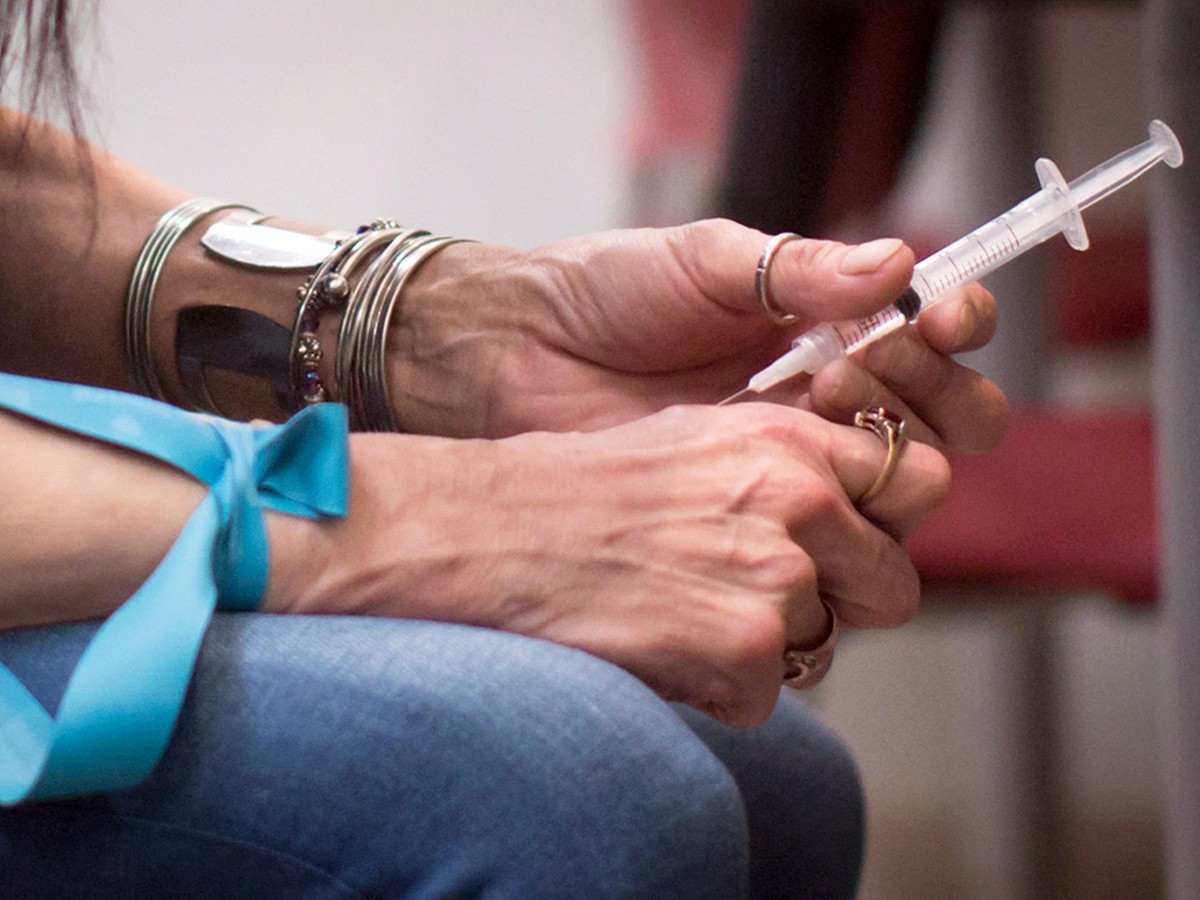
A person injects an opioid at a Vancouver clinic.
A group of addiction physicians called on the Liberal government to ensure that safe-supply drugs are either not provided entirely, or if they continue to be provided for drug-addicted people, it be in a supervised manner. This, given accounts of people addicted to drugs visiting safe-supply outlets that provide them with free hydromorphone to ensure they have an alternative to the vastly more preferred street-acquired illegal fentanyl which has been implicated in an epidemic of drug overdoses.

The problem has become that those receiving the hydromorphone use it as leverage on street markets by selling it to others and using the profit they gain by so doing, to acquire the more desired fentanyl, thus entirely negating the purpose of the safe supply function, and in the process making more drugs available on the street. Hydromorphone availability has been cited as the cause of inciting more youth to become addicted to drugs, among other untoward consequences.

The pharmaceutical-grade hydromorphone made easily available through the street clinics as a method of reducing drug overdoses from heroin or fentanyl has backfired, the government-funded program of ten pilot projects in British Columbia, Ontario and New Brunswick has simply created a wider and more complicated system of drug use. Despite that a report in the Harm Reduction Journal in June of 2023 concluded enrolment in safer-supply programs leads to "fewer overdoses and overdose-related deaths, reduced drug-related harms, and improved health and social outcomes".

Angelica Richardson McKenney feeds her daughter Lynndaya in December 2012. The snapshot was taken the day before McKenney, high on a trio of drugs, fell asleep on top of Lynndaya and suffocated her. REUTERS/Handout
 
Not, however, in the opinion of critics claiming the programs have led to a number of other problems being created. The letter's authors argue that research of safer supply is "methodologically weak" and the program should be reformed or altogether cancelled. Author of the letter, Dr. Rob Cooper, spoke of a patient receiving safe supply treatment: "She's now dead. She was selling the hydromorphone she was getting and she was buying fentanyl. The problem here is there's no safety measures protecting that person or the public."

Founder of he ACT Addictions Clinic chain in Ontario, Dr. Clement Sun, a signatory to the letter, explains the situation is "almost like we're getting back to the days ... that the source of the drug is not from the illegal dealer [but] is from these safe clinics", resembling how over-prescribed OxyContin fuelled the opioid crisis.

"I'm not against them trying to help addicts, because that's what my job is. But this way, it is reckless", added Dr. Sun. Drug users receive their safer supply drugs, then turn around on the streets and sell them. The "diversion" money is "commonly used to purchase more potent opioids such as fentanyl. There is widespread evidence that this is occurring", the letter adds. In addition to which they argue that the diverted hydromorphine is "creating more children with addiction in our Junior High and High Schools".

Data out of British Columbia indicates hydromorphone to be present in five percent of the opioid deaths that took place in the province. In comparison to fentanyl, which was seen to be present in 88 percent. Dr. Sun believes these deaths might not yet be showing up in statistics. "They're not seeing it, because they're selling it to the kids and they haven't overdosed yet", he stated. "We're not talking about people dying. We're talking about the fact that you're spreading a medication that's addictive and being the supplier to the dealers, to the people who are selling it."

Drs. Cooper and Sun suggest that people who want the pharmaceutical grade opioids could be instructed they must be taken under supervision at a 24-hour pharmacy, while Dr. Bach agreed there are ways that such prescribing could be improved, yet a countrywide reform that addresses all concerns is unlikely to be developed. "I don't think there is going to be any one solution that is universally appropriate. But there is lots of opportunity to be thoughtful about this", he concluded.

https://static01.nyt.com/images/2022/07/26/science/00opioids-vancouver1/00opioids-vancouver1-superJumbo.jpg?quality=75&auto=webp
Credit...Jackie Dives for The New York Times

Labels: , , , , , ,

Saturday, June 01, 2019

Diminishing Life Expectancy

"In particular, the drug overdose crisis occurring in Canada was a major contributing factor in the change seen in life expectancy from 2016 to 2017, especially for men."
"Although older men are living longer, the increase in deaths among young men almost completely offset these gains [in increased life expectancy in the near past]. A similar pattern occurred among women, although to a lesser extent."
Statistics Canada report

"I don't understand, truthfully, how governments are making decisions that pertain to this issue because we're hemorrhaging money with bad drug policy and poor health care spending."
"It's absolutely mind-blowing."
"We're doing a very bad job nationally with drug policy, combined with the fact that we're not looking after people from the lower socioeconomic groups."
"There's a traumatic fallout for people who are losing children and siblings and friends and parents. There is health-care-provider burnout at a level I've never seen before. My colleagues are absolutely burned out."
Dr. Keith Ahamad, St.Paul's Hospital, Vancouver
Image result for stats canada, life expectancy dips, opioid deaths

Vancouver has seen some of the most troubling numbers of drug overdoses leading to death, in all of Canada. Street drugs tainted with inexpensive, deadly fentanyl and the even more powerful carfentanil, both opioid-alikes produced in laboratories and imported into Canada mostly from China, have taken their toll. Although the toll can be seen across Canada, in both urban and rural settings, it is in Vancouver and in British Columbia that the shock of increasing drug overdoses is the most egregious.

Death rates as a result of drug overdose were 2.1 times higher for men and 1.6 times higher for women in 2017 in comparison to 2015, according to Statistics Canada. Yet even these dreadful figures of wasted lives are considered to be underestimates since cause of death in some cases have strained resources in investigations leading to long wait times to determine validation of suspected drug overdose.

The situation has led to the realization that for the first time in four decades life expectancy rates in Canada have been stopped in their tendency to increase, reversing the trend. From 2016 to 2017 the reverse of the upward trend dating from the mid-1990s to 2012 was halted. The gains stalled and began to reverse, and Statistics Canada points to the increasing emergency of drug overdoses as causation.

For the second year in a row in British Columbia, 2017 life expectancy, particularly for young men between the ages of 20 and 44, was seen to have fallen. Addiction specialist, Dr. Ahamad, responding to notice of the high rate of deaths, insisted that the public in its concern over young adults dying from overdoses should call for immediate changes in drug policy by "holding politicians' feet to the fire".

Life expectancy, he said, between young men in Vancouver's poor Downtown Eastside and the west side differs by 17 years. Men are dying 11 years earlier than women. Indigenous people are affected disproportionately by the overdose crisis, leading the government of British Columbia to declare a public health emergency in 2016. According to Dr. Ahamad, this is an issue that should be highlighted during the federal election this fall.

Vancouver's opioid epidemic has prompted community groups to patrol Downtown Eastside alleys on the lookout for people who might be at risk of a drug overdose.

Of the 4,108 overdose deaths recorded in 2017 in Canada, close to 1,100 involved people between the ages of 30 and 39, according to Statistics Canada. The issue seems to correlate in time with the legalization of recreational marijuana in Canada. Where casual drug use may be a crowd pleaser for the Liberal government that promised to enact drug legalization during the 2015 election; did so, but perhaps failed to take into account fallout from 'entry level' to harder drug use and dependency.
"Every province in Canada has experienced the impacts of the opioid crisis, so I think we would expect that dip in life expectancy gains that we see in B.C., maybe not in the same level of magnitude,"
"I think we do need different approaches to address the gender-based uniqueness of the impact."
"[Restricting access and denormalizing its use needs to be applied to cannabis to ensure it isn’t further normalized] We need to monitor that."
"Tackling every drug issue at the time of a crisis is not where I want to go and we need to go upstream and get to prevention."
Dr. Theresa Tam, Canada’s chief public health officer

Labels: , , ,

 
()() Follow @rheytah Tweet