Ruminations

Blog dedicated primarily to randomly selected news items; comments reflecting personal perceptions

Monday, May 13, 2024

Flotation Therapy For a Multitude of Body and Mental Health Benefits

"It calms the mind, sharpens our sense of the body and helps us live in the moment -- all of which can break the cycle of negative thoughts."
"Floating might shift attention away from how the body looks to how it feels, promoting a healthier body image."
Sahib Khalsa, principal investigator, clinical director, Laureate Institute for Brain Research, Tulsa
 
"Is there something special about flotation, or not?
"Maybe you're just in a very relaxing environment, so  how unique is it compared to other relaxation techniques we have?"
Wen Chen, National Institutes of Health, branch chief, basic and mechanistic research, complementary and integrative health 

"Floating has been referred to as 'sensory deprivation', which I think is a misnomer."
"[On the contrary, patients have reported] enhancement [of internal sensations during flotation, such as noticing their breath and heartbeat]."
Justin Feinstein, director, president, Float Research Collective
https://www.health.com/thmb/AkY3YCRDb5TZ77m2CNT4oQlpHt8=/750x0/filters:no_upscale():max_bytes(150000):strip_icc():format(webp)/Float-Therapy-dc428b3988124ef38a14c442b685630d.jpg
Group4 Studio / Getty Images

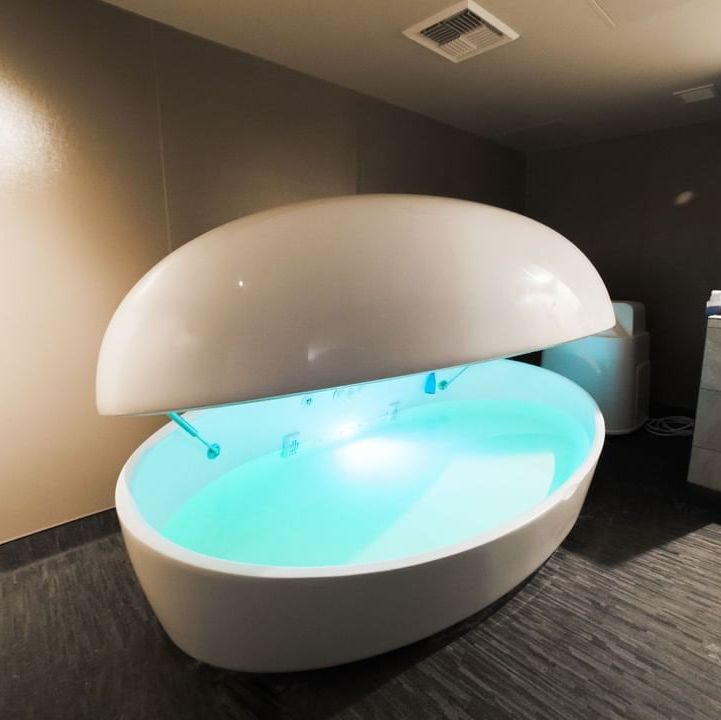
Basically, flotation therapy, recently popularized as a relaxation technique that can lead to improved mental health, involves floating in a tank of warm-salt-saturated water. A growing body of research appears to validate the belief the therapy may reduce symptoms of mental health conditions. Float tank sessions take about an hour with a typical experience seeing people enter the pod that looks like an oversized hot tub that is filled with shallow body-temperature water saturated with Epsom salts to buoy the body.

The pod can be left open, alternatively the lid closed to give the impression of being cocooned where light and sound is shut out. According to experts in the field, float therapy appears to operate on several levels to heighten the senses, help in relaxation, leading to the body and mind feeling soothed. "It's become like a ritual. You unwind, and you begin to see life differently, from a more distanced perspective", explained 27-year-old Abby Michel, for whom floating on a regular basis has become "an important tool in the tool box", in the management of her anxiety.

There are studies indicating that float therapy may reduce symptoms of a number of conditions, including generalized anxiety disorder, depression and anxiety. Lowering blood pressure is another benefit of the therapy along with a decrease in muscular soreness following high-intensity exercise. As well, according to preliminary research, the therapy may serve to minimize cravings of addiction-related illnesses.

Brain and time perception researcher Marc Wittmann, based in Freiberg, Germany, views the experience as being akin to meditation. "During meditation, you feel that you lose your body boundaries and you are more one with the environment", he explained of his experience with the use of float tanks for his research. The dissolving sense of one's body is correlated, he states, with lower anxiety,  according to his own research.Evidently the therapy has properties that are able to enhance a biological process called "interoception", defined as the process by which the nervous system "senses, interprets and integrates" signals from the body.

Some researchers study whether flotation therapy can be of assistance to people with eating disorders; an NIH-funded study, recruiting patients at present, is set to investigate how augmenting float therapy with interoception-focused psychotherapy can improve anxiety and body image in patients suffering from anorexia nervosa. A randomized controlled trial of 68 women and girls hospitalized for anorexia led researchers to report twice-weekly float sessions improved patients' levels of body dissatisfaction.

According to one estimate, growing consumer demand has led to the opening of nearly 400 float centres in the United States, an increase from 50 in 2010, with costs from $50 to $100 each 60- or 90-minute session. With the newer float centres, people can look forward to accompanying calming music and soft lighting as well as less claustrophobic pools, more related to open-style hot tubs. The therapy offers profound relief for some individuals.
https://hips.hearstapps.com/hmg-prod/images/65006497-151866189202936-453710884192311314-n-1580937103.jpg?crop=0.668xw:1.00xh;0.100xw,0&resize=1200:*
Float Seattle
"The float tank helped me to take a break from the real world, a break from my body for a little bit."
"Before, I'd hear the eating disorder voice, the diet commercial voice, the influencer who lost weight voice, the dad trauma voice."
"In the float tank, I could hear my own voice."
Emily Noran, 28, San Diego

Labels: , , , ,

Wednesday, June 12, 2019

The Enigma of Dissatisfied Human Physical Ideals

"Many assessment tools that are currently standard practice to diagnose eating disorders are geared toward females and are based on weight loss behaviours with the goal to become thin."
"Exercise is an under-recognized component of eating disorders. Teenagers who excessively exercise can have energy deficits and become malnourished if they do not increase their food intake to match their energy needs."
"Disordered eating may develop when a boy becomes preoccupied with his appearance, body size, weight, food, or exercise in a way that worsens his quality of life. He may withdraw from his usual activities or friends because of concerns with body size and appearance."
Dr. Jason Nagata, University of California San Francisco

"We are basically not asking the right questions for boys."
"Consequently, boys do not get access to treatment and they do not themselves see their problems as an eating disorder."
Dr. Trine Tetlie Eik-Nes, researcher, Norwegian University of Science and Technology, Trondheim
eating-disorders-men-anorexia-bulimia-binge-eating-disorder

Eating disorders in boys and men are not readily recognized as such, mostly because diagnosis is canted toward symptoms related to and common with eating disorders in girls and women. The popularly-recognized symptoms of eating disorders making diagnosis simple for a troubling pathology are all associated with the way that girls and women react to their eating disorders; the symptoms are not transferable to boys and men. Males focus on building muscle, as opposed to reaching a goal of appearing unhealthily thin.

Adolescent eating disorders exemplified by calorie restriction and purging represent the classic hallmarks of girls' illness, not that of boys. A recently published commentary in the Lancet Child & Adolescent Health, makes that quite clear, reflecting the work and conclusion of Dr. Nagata and colleagues. Pediatricians and parents may simply overlook eating disorders among teen-age boys; unlike the characteristic symptoms for girls, boys' disorders are linked with the over-consumption of proteins.

Boys will take to a rigid regimen of restricting intake of carbohydrates and fats, and indulging in periods of over-consumption and calorie cutting, convinced this will aid in building muscle, according to the doctors' commentary in the Lancet Child & Adolescent Health journal. The use of steroids or supplements to bulk up, or to compulsively exercise, is the type of focus that boys' eating disorders typically lead toward.
Body Positivity
Positive body image

Medical community guidelines steering treatment for eating disorders in boys fail to offer recommendations for how best to proceed with patients who exercise excessively. Biohacking is yet another method that increasingly appeals to teen-aged boys with eating disorders as they attempt to optimize physiology for muscle building through episodes of intermittent fasting, elimination diets, supplements and multiple cycles of steroid use.

The issue of the use of unregulated supplements used by teen-age boys to bulk up, which can include a variety of ingredients not clearly labelled or approved for human consumption is yet another problem the doctors identify in their commentary. The most pressing issue to be considered at this juncture, given the increasing numbers of boys and teens presenting with eating disorders is that most research has been undertaken focusing on disordered eating patterns in girls and women; non-applicable to boys and men.

What is applicable however, to both genders, is the idealization of the human figure whereby the 'perfect' muscled male becomes an object of admiration and that of the thin but curvaceous female whom girls and women are anxious to emulate to fit the concept that anyone can aspire to -- the perfect male or female shape through dedicated sacrifices downplaying the need for healthy, balanced food intake and moderate-level exercising.

As the younger generation becomes more addicted to social media sites where the ideal figures for each sex is constantly flaunted, the onlooker's sense of perspective dims and anxiety mounts. What steps into the picture at that juncture is the implacable 'need' to achieve perfection. Accompanied by a willingness to force one's body into an unrealistic and ultimately harmful conception of the perfect male or female shape.

Boys who exercise too much can become malnourished even when they aren't restricting their calorie intake, the doctors write. Photo: Getty


Labels: , , , , , ,

 
()() Follow @rheytah Tweet