Ruminations

Blog dedicated primarily to randomly selected news items; comments reflecting personal perceptions

Sunday, July 24, 2022

Global Monkeypox: MPXV

Public Health Agency of Canada
"Many ... well-intentioned officials appear fearful of saying something homophobic."
"LGBTQ organizers have ample practice with informing their communities about a possible health threat and championing safe-sex practices."
"Public-health officials should activate these resources rather than tiptoeing around the issue."
Jim Downs, professor, historical study of infectious diseases, Gettysburg College
 
Back around 1985, when a terrifyingly mysterious new disease was appearing in gay-centric areas of New York and elsewhere around the United States, it wasn't uncommon to read or hear of dismissive comments that gays brought this dreadful malady on themselves. The immune systems of homosexual men completely broke down with acquired immunity-deficient syndrome. No one knew what to do, how it could be avoided, much less treated, The disease took its dread course and people died horrible deaths, but the straight majority felt fairly complacent, and from pulpits sermons thundered that the supreme one above was punishing gays.
 
Fast forward to 2022 and no one but the most die-hard homophobic-committed will break a sneer over just desserts at the sudden appearance globally of yet another disease linked to sex acts shared between men with other men. The saving grace, is that this new disease is relatively mild in comparison to HIV-AIDS. With monkeypox suddenly taking centre-stage, nudging SARS-CoV-2 out of the way temporarily, the development of another gay-sex punishment is being  handled by public health somewhat differently.

No one wants to overtly call attention to the fact that the vast majority of those contracting monkeypox are males. And they are males of a specific group. Society at present is well and truly chastened, a far cry from when 'gay' was just another epithet to be tossed off in contempt against a swath of society that kept a low profile in avoidance of the backlash that was usually forthcoming at mention of gay sex, a bull's red flag for straight men who thought mocking and demeaning their gay brothers was fun.

The New England Journal of Medicine recently published the results of their study of the surprise outbreak of monkeypox outside of Africa, where the disease, while endemic, is still relatively unusual. It can have devastating effects on pregnant women and young children if infected. Yet another 'invasive species' from one corner of the world to another. The large study used a sample of 528 cases on four continents. Of the total, 13 percent saw hospitalization, the majority suffering "no serious complications", and no deaths.

For starters, HIV/AIDS was initially occurring exclusively within the gay population. Before eventually spreading to women and straight men, albeit not in overwhelming numbers. As with AIDS, monkeypox has been seen to afflict 98 percent men of the 528 cases studied. Furthermore 95 percent of the cases, according to the study, were transmitted sexually. In the first news coming out of clinics worldwide, those statistics were verified by diagnosis and observation.

Leaving government agencies and health authorities with a dilemma; how to transmit the information to the public clearly and honestly without risking a backlash against the gay community? The fear was that frank admissions of the disease's spread through same-sex physical intimacy would engender and "fuel hate" and risk spurring "unintended consequences".

The disease continues to spread, and to be treated. Its symptoms are not particularly worrisome. And it now has a global presence. The World Health Organization identifies monkeypox as a specific problem for gay men, advising that audience "for gay, bisexual and other men who have sex with men", mincing no words in addressing the concerned audience. 

A letter was issued a month ago, co-signed by 29 medical experts recommending to the WHO that the word 'monkeypox' brings undue attention to Africa where it has a historical presence. First identified in monkeys, the disease crossed the species barrier in Africa. Which explains why photographs used by Western media so often depict African men whose skin shows monkeypox's effects.

New, replacement names for monkeypox to reduce the possibility of identifying the disease with a specific world region now that it has become a global health phenomenon are being considered. Such as MPXV-1, MPXV-2 or MPXV-a, as descriptives of the type. "MPXV", an acronym for monkeypox, too clever by half.
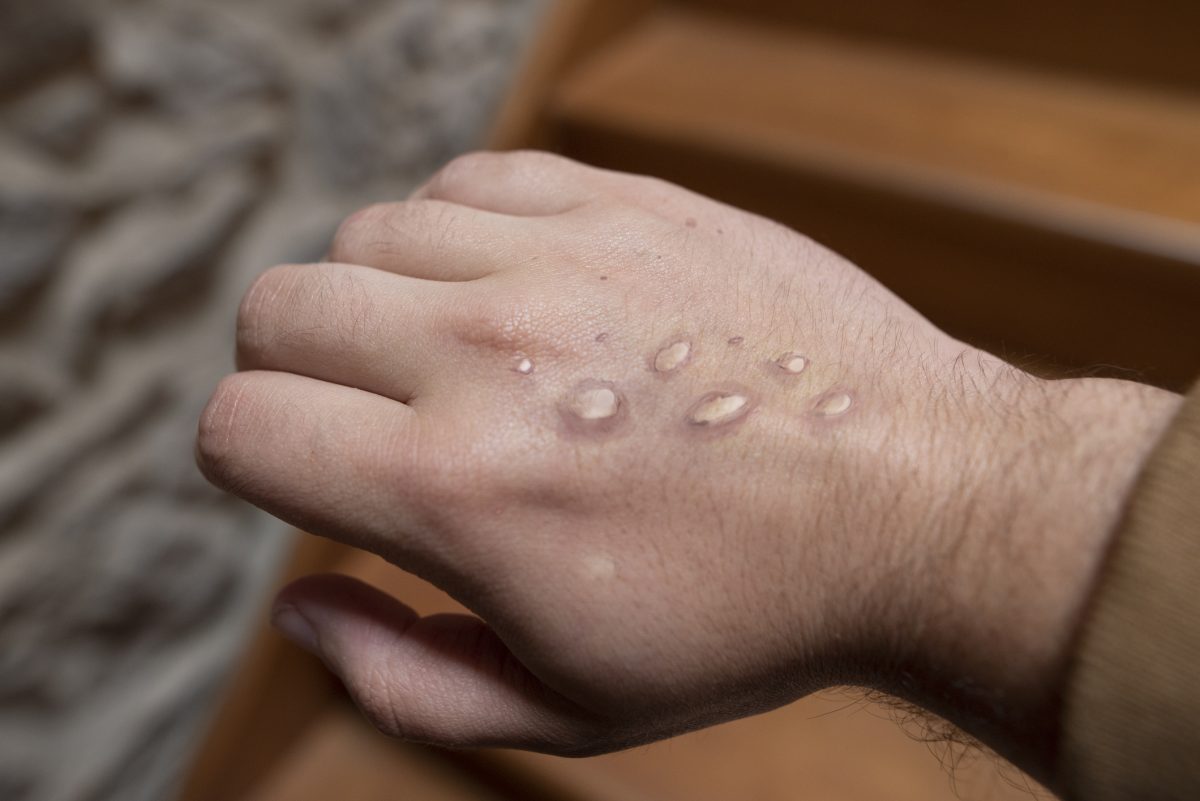
 
Rash on human hand depicting a Monkeypox infection
"The symptoms of monkeypox virus are milder than, but similar to those of smallpox. One key difference is that monkeypox causes swollen lymph nodes (lymphadenopathy) while smallpox does not. The swelling can occur in many different locations on the body, or be localized, including lymph nodes of the neck and armpit. The incubation period (time from infection to onset of symptoms) for monkeypox is usually 7−14 days but can range from 5−21 days. In addition to swollen lymph nodes, early signs and symptoms may include fever, headache, muscle aches, exhaustion, backache, and chills. A rash develops on the body within 1 to 3 days (sometimes longer) after the appearance of fever, usually first on the face, then spreading to other parts of the body. The lesions progresses through the stages of macules, papules, vesicles, pustules, and finally scabs before falling off."
National Collaborating Centre for Infectious Diseases, Public Health Agency of Canada

Labels: , , , ,

Friday, June 25, 2021

Sobering Runaway COVID: Variants of Variants

"WHO is tracking this variant as part of the Delta variant, as we are doing for other Variants of Concern with additional mutations."
"For the moment, this variant does not seem to be common, currently accounting for only a small fraction of the Delta sequences ..."
"Delta and other circulating Variants of Concern remain a higher public health risk as they have demonstrated increases in transmission."
World Health Organization  
 
"All lineages of the Delta variant are variants of concern [so there is nothing unusual in labelling Delta Plus as such]." 
"We do not have any indicators as of now to show that Delta Plus should be causing any public health worry or panic. We are not seeing anything worrisome yet."
"We are tracking it carefully, and strengthening all public health measures."
Dr Anurag Agarwal, director,  Delhi-based CSIR-Institute of Genomics and Integrative Biology
India second wave
The Delta strain was said to be responsible for the deadly second wave of infections   Reuters

"There is no data yet to support the variant of concern claim," 
"You need biological and clinical information in order to consider whether it is truly a variant of concern."
"You need to study a few hundred patients who are sick with this condition and variant and find out whether they are at greater risk of greater disease than the ancestral variant." 
Dr, Gagandeep Kang, virologist, Fellow of the Royal Society of London
 
"We don't have much reason to believe this is any more dangerous than the original Delta."  
"Delta Plus might have a slight advantage at infecting and spreading between people who were previously infected earlier during the pandemic or who have weak or incomplete vaccine immunity." 
"I would keep calm. I don't think India or anyone else in the world has released or accumulated enough data to distinguish the risk from the so-called Delta Plus as being more dangerous or concerning than the original Delta variant."
Dr Jeremy Kamil, virologist, Louisiana State University Health Sciences Center, Shreveport
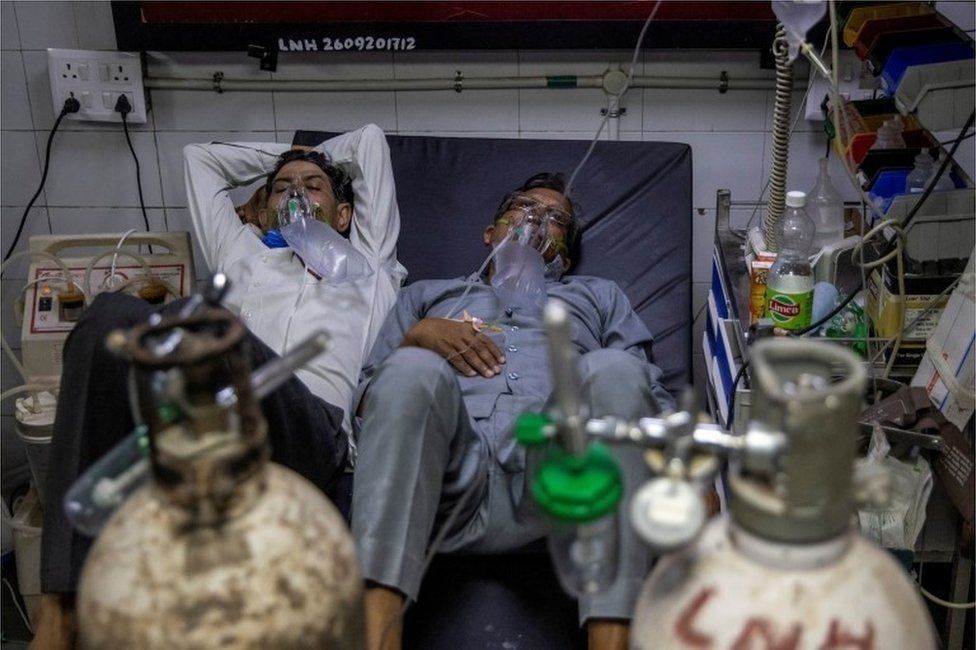
The ongoing complexities and mysteries of SARS-CoV-2. India announced several days ago that it has identified roughly 40 cases of the Delta coronavirus variant that first emerged in India and this variant now carries a mutation appearing to make it even more readily transmissible than the already-more-transmissible Delta strain. It is the Delta strain that has caused a good deal of anxiety in Britain, identified as causing a new wave, and prompting the U.K. to hold off its promised re-opening. In Canada the Delta strain resulted in health authorities speeding up vaccinations in an attempt to head off the eruption of another COVID wave.

There is always the danger of mutations occurring with viruses, pushing health authorities to accelerate inoculation programs before the emergence of a mutation that turns out to be not only more transmissible but even significantly deadlier than the original. In the case of COVID 19, anything more deadly than the original is a nightmare to be avoided at all costs. In India the appearance of the new Delta variant has seen states in the country being cautioned of the urgent requirement to increase their testing.

Delta Plus was reported for the first time in a Public Health England bulletin issued on 11 June. Identified as a sub-lineage of the Delta variant which first emerged in India, Delta Plus has inherited the spike protein mutation called K417N, found as well in the Beta variant first identified in South Africa. The concern among some scientists is that the mutation along with other features of the Delta variant could ensure it is considerably more transmissible than the parent mutant.

"The mutation K417N has been of interest as it is present in the Beta variant (B.1.351 lineage) which was reported to have immune invasion property", stated India's health ministry. The K417N was known -- according to top Indian virologist Shahid Jameel -- to reduce the effectiveness of a number of therapeutic monoclonal antibodies. Resistance to vaccines, in other words, a potential horror story that might leave the world without the hope of vanquishing the pandemic through the miracle medium of anti-COVID vaccines.

To date, the Delta variant has been identified as having appeared in eleven countries altogether; Britain (36), Canada (1), India (40), Japan (15), Nepal (3), Poland (9), Portugal (22), Russia (1), Switzerland (18), Turkey (1), and the United States (83). Around 40 cases of the variant, according to India, have been observed in the states of Maharashtra, Kerala and Madhya Pradesh, with "no significant increase in prevalence". A sample taken on April 5 represents the earliest case identified in India.

On April 26, Britain sequenced its first five cases; contacts of individuals who had travelled from or transited through Nepal and Turkey. Among the U.K and Indian cases no deaths have as yet been reported. In India and throughout the globe, studies are being initiated to test vaccine effectiveness against the mutation. Regions where the Delta variant has been found "may need to enhance their public health response by focusing on surveillance, enhanced testing, quick contact-tracing and priority vaccination".

In India, the concern is obviously that Delta Plus may inflict yet another infection wave, at a time when it has so recently emerged from the world's worst surge in cases. At the present time, some 5.5 percent of Indians have been fully vaccinated, with 18 percent having received at least one dose. Vaccinations have been accelerated to the point where up to six million people are being vaccinated daily. One of the issues of concern is vaccine availability.
 
"It is most likely capable of dodging immunities", was the opinion of Shahid Jameel, virologist and director of the Trivedi School of Biosciences at Ashoka University in Sonipat, India. "That is because it carries all symptoms of the original Delta variant and also from its partner Beta variant."
 
Checking on a Covid-19 patient at a hospital in Mumbai, India, this month.
  Credit...Rajanish Kakade/Associated Press


Labels: , , , , ,

 
()() Follow @rheytah Tweet