Ruminations

Blog dedicated primarily to randomly selected news items; comments reflecting personal perceptions

Sunday, April 28, 2024

Waiting For The Next One...

"Public Health Agency of Canada maintains agreements to secure timely access to pandemic influenza vaccines for the entire Canadian population should an influenza pandemic occur."
"[Those agreements are meant to protect against risk of vaccine embargoes, border closures and transportation and shipping delays] as recently witnessed during the COVID-19 pandemic."
"As influenza viruses constantly change and cases in livestock increase opportunity for changes leading to mammalian adaptation, continued surveillance and preparedness are critical."
Nicholas Janveau, spokesperson, PHAC

"We are all taught about this [risk of mutations that could potentially allow the virus to successfully jump to humans] in epidemiology school."
"For twenty years now, flu watchers like myself have been warning about avian flu making the leap [to humans]."
"[H5N1 has pandemic potential] but many things have pandemic potential. [Canada should begin producing vaccines now]."
"Better to have it and not need it than to need it and not have it."
Raywat Deonandan, epidemiologist, professor, University of Ottawa
https://smartcdn.gprod.postmedia.digital/ottawacitizen/wp-content/uploads/2024/04/cp169946742.jpg?quality=90&strip=all&w=1128&h=846&type=webp&sig=ZTq-rw5th9VL1VGBfknW3A
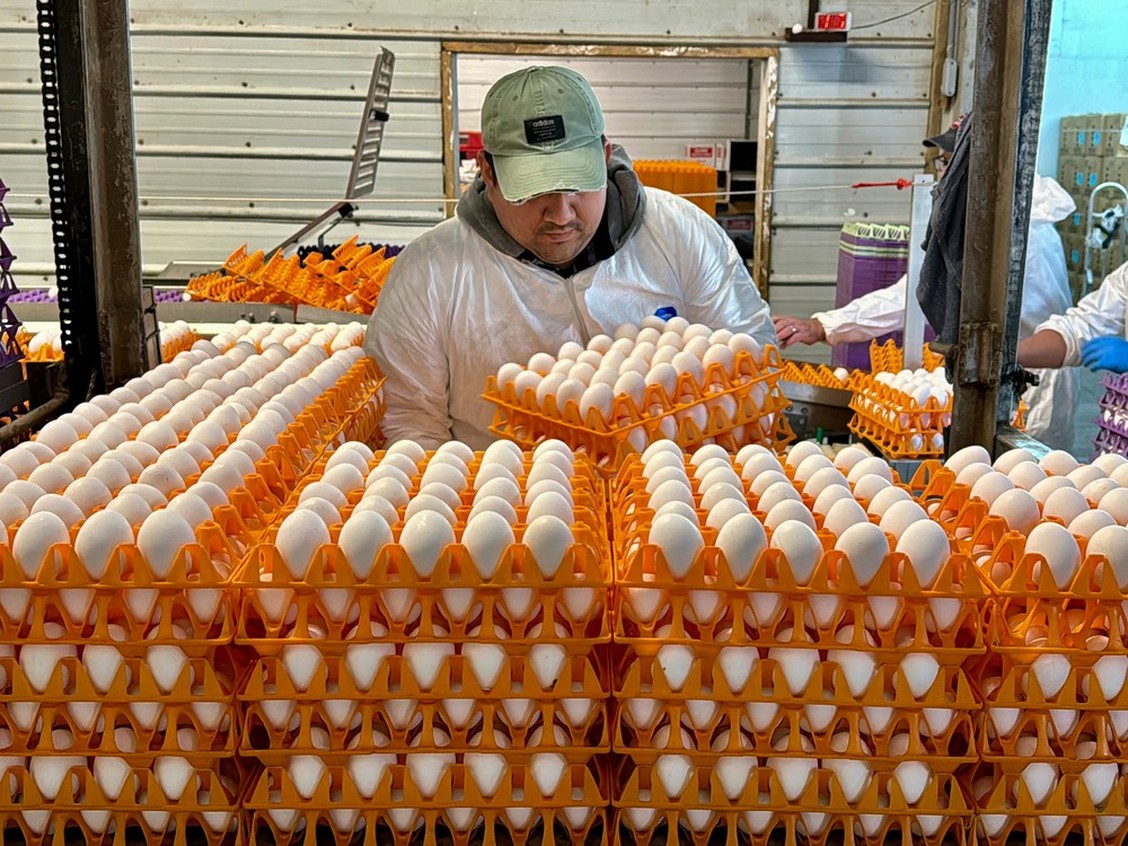
People are being urged by health experts to refrain from drinking raw, unpasteurized milk, and to make certain that meat is cooked thoroughly. The real potential risk from bird flu they say with some assurance is not from food intake, but the possibility that alterations to the H5N1 highly pathogenic avian influenza virus stems from the possibility it might make the leap from animals to humans, creating a potential influenza pandemic, since human immunity to the virus is expected to be minimal.

In the event of a pandemic declaration, the Public Health Agency of Canada may begin to assess options to produce pr-pandemic vaccines against H5N1 that could be in place should a pandemic declaration become reality. The risks of H5N1, however, is being actively assessed so that PHAC can switch annual influenza vaccine production from seasonal influenza vaccine to pandemic influenza vaccine. Stockpiles of anti-viral medications are maintained as well, by federal and provincial and territorial governments.

American Health officials have latterly reported outbreaks of H5N1 avian influenza in some 33 dairy herds, along with poultry and wild birds. Wide-spread reports have emerged of barn cats falling ill and dying. Remnants of the H5N1 bird flu virus in 20 percent of retail milk samples tested in the US. has been discovered, the cause of growing concern that livestock outbreaks are more widespread than thought. Although the virus fragments were not live, posing no risk, their presence suggests that more cows are infected than have been reported. 
 
A situation that increases the risk of mutations with the potential of allowing the virus to leap to humans.

Dr. Deonandan points out that though avian bird flu has been decades in circulation, the leap to humans that might allow widespread human-to-human transmission has not occurred. There have been 26  human cases globally, associated with the strain of H5N1 in circulation, yet human cases primarily resulted from close contact with infected birds or animals. "There is a lot of good news here", he remarked.

Unlike with COVID-19, vaccines, explained Dr. Deonandan, will be available, although they would be in high demand, and antivirals would also be readily available. Even so, the situation would likely be hard on the elderly and children. In the meanwhile, he urged people to take precautions such as rejecting raw milk and cooking food well, along with avoiding dead birds and other wild animals.

https://i.cbc.ca/1.7178851.1713541907!/fileImage/httpImage/image.jpg_gen/derivatives/16x9_780/raquel-and-cows-1.jpg
Raquel Kolof is a beef cattle farmer who owns Hough Heritage Farms in Gibsons, B.C. No cases of highly pathogenic avian influenza have shown up in Canadian cattle yet, but she's concerned watching outbreaks in the U.S. (Submitted by Raquel Kolof)

"[Human-to-human transmission is unlikely right now without further genetic changes in the virus, but since the viruses constantly evolve, the WHO called on countries to increase their surveillance]."
"As these viruses are constantly evolving and spreading in animal populations, and with an increased risk of exposure for humans, there is a continuous need to reassess the risks as the situation evolves and when more information becomes available."
World Health Organization assessment

Labels: , , , ,

Sunday, July 24, 2022

Global Monkeypox: MPXV

Public Health Agency of Canada
"Many ... well-intentioned officials appear fearful of saying something homophobic."
"LGBTQ organizers have ample practice with informing their communities about a possible health threat and championing safe-sex practices."
"Public-health officials should activate these resources rather than tiptoeing around the issue."
Jim Downs, professor, historical study of infectious diseases, Gettysburg College
 
Back around 1985, when a terrifyingly mysterious new disease was appearing in gay-centric areas of New York and elsewhere around the United States, it wasn't uncommon to read or hear of dismissive comments that gays brought this dreadful malady on themselves. The immune systems of homosexual men completely broke down with acquired immunity-deficient syndrome. No one knew what to do, how it could be avoided, much less treated, The disease took its dread course and people died horrible deaths, but the straight majority felt fairly complacent, and from pulpits sermons thundered that the supreme one above was punishing gays.
 
Fast forward to 2022 and no one but the most die-hard homophobic-committed will break a sneer over just desserts at the sudden appearance globally of yet another disease linked to sex acts shared between men with other men. The saving grace, is that this new disease is relatively mild in comparison to HIV-AIDS. With monkeypox suddenly taking centre-stage, nudging SARS-CoV-2 out of the way temporarily, the development of another gay-sex punishment is being  handled by public health somewhat differently.

No one wants to overtly call attention to the fact that the vast majority of those contracting monkeypox are males. And they are males of a specific group. Society at present is well and truly chastened, a far cry from when 'gay' was just another epithet to be tossed off in contempt against a swath of society that kept a low profile in avoidance of the backlash that was usually forthcoming at mention of gay sex, a bull's red flag for straight men who thought mocking and demeaning their gay brothers was fun.

The New England Journal of Medicine recently published the results of their study of the surprise outbreak of monkeypox outside of Africa, where the disease, while endemic, is still relatively unusual. It can have devastating effects on pregnant women and young children if infected. Yet another 'invasive species' from one corner of the world to another. The large study used a sample of 528 cases on four continents. Of the total, 13 percent saw hospitalization, the majority suffering "no serious complications", and no deaths.

For starters, HIV/AIDS was initially occurring exclusively within the gay population. Before eventually spreading to women and straight men, albeit not in overwhelming numbers. As with AIDS, monkeypox has been seen to afflict 98 percent men of the 528 cases studied. Furthermore 95 percent of the cases, according to the study, were transmitted sexually. In the first news coming out of clinics worldwide, those statistics were verified by diagnosis and observation.

Leaving government agencies and health authorities with a dilemma; how to transmit the information to the public clearly and honestly without risking a backlash against the gay community? The fear was that frank admissions of the disease's spread through same-sex physical intimacy would engender and "fuel hate" and risk spurring "unintended consequences".

The disease continues to spread, and to be treated. Its symptoms are not particularly worrisome. And it now has a global presence. The World Health Organization identifies monkeypox as a specific problem for gay men, advising that audience "for gay, bisexual and other men who have sex with men", mincing no words in addressing the concerned audience. 

A letter was issued a month ago, co-signed by 29 medical experts recommending to the WHO that the word 'monkeypox' brings undue attention to Africa where it has a historical presence. First identified in monkeys, the disease crossed the species barrier in Africa. Which explains why photographs used by Western media so often depict African men whose skin shows monkeypox's effects.

New, replacement names for monkeypox to reduce the possibility of identifying the disease with a specific world region now that it has become a global health phenomenon are being considered. Such as MPXV-1, MPXV-2 or MPXV-a, as descriptives of the type. "MPXV", an acronym for monkeypox, too clever by half.
 
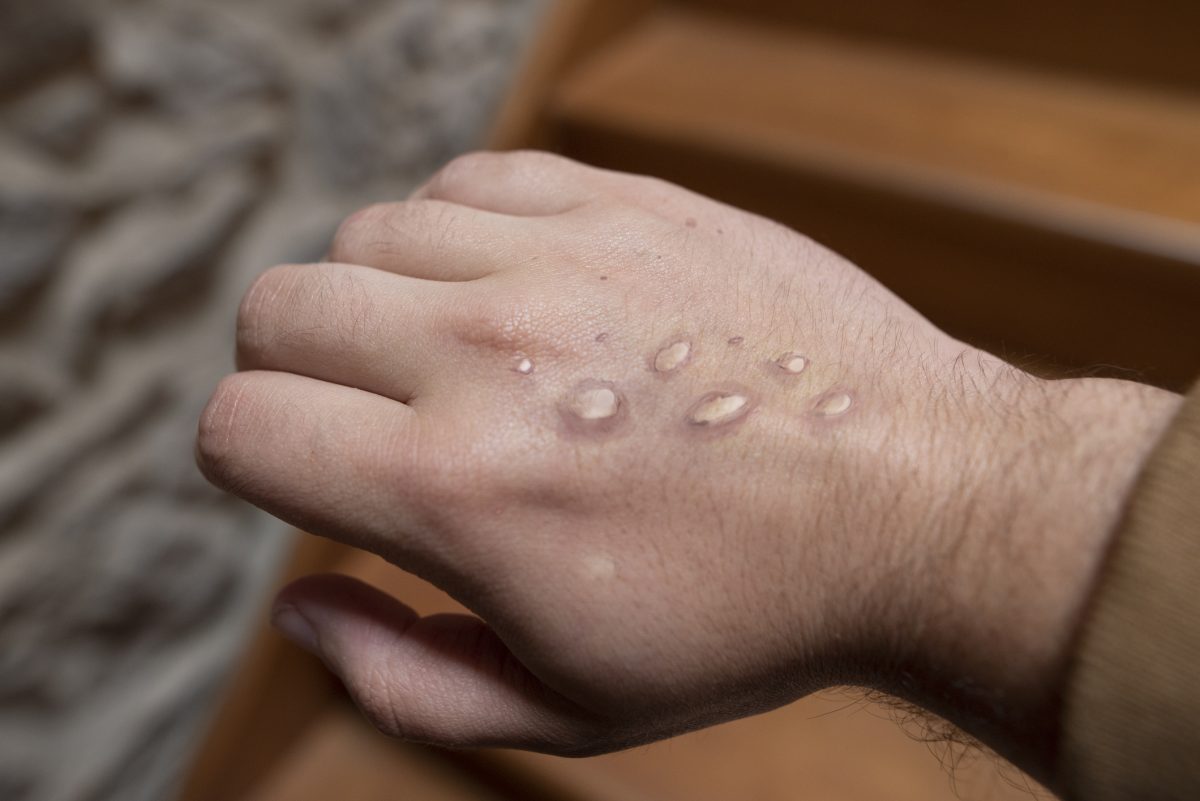
Rash on human hand depicting a Monkeypox infection
"The symptoms of monkeypox virus are milder than, but similar to those of smallpox. One key difference is that monkeypox causes swollen lymph nodes (lymphadenopathy) while smallpox does not. The swelling can occur in many different locations on the body, or be localized, including lymph nodes of the neck and armpit. The incubation period (time from infection to onset of symptoms) for monkeypox is usually 7−14 days but can range from 5−21 days. In addition to swollen lymph nodes, early signs and symptoms may include fever, headache, muscle aches, exhaustion, backache, and chills. A rash develops on the body within 1 to 3 days (sometimes longer) after the appearance of fever, usually first on the face, then spreading to other parts of the body. The lesions progresses through the stages of macules, papules, vesicles, pustules, and finally scabs before falling off."
National Collaborating Centre for Infectious Diseases, Public Health Agency of Canada

Labels: , , , ,

Sunday, December 10, 2017

Viewing The Sun -- With Appropriate Caution

"What we found is that the sun's rays had damaged the photoreceptor layer in a very specific pattern, like a crescent."
"It really aligned with what she drew for us when we first saw her."
"There is no treatment on the horizon, but the horizon is only seen when you're able to see it, and I think that's what this imaging helps us to do."
Avnish Deobhaktya, assistant professor of ophthalmology, Mount Sinai Hospital

"So far, it's a nightmare, and sometimes it makes me very sad when I close my eyes and see it."
"It's embarrassing. People will assume I was just one of those people who stared blankly at the sun or didn't check the person with the glasses."
"It's something I have to live with for the rest of my life."
Nia Payne, 26, New Yorker
partial-solar-eclipse-2012
Extreme Tech

The unfortunate experience that Ms. Payne underwent that has left her with permanent obstruction to her once-perfect vision presented as a new phenomenon for eye specialists at Mount Sinai Hospital in New York when they were confronted with the evidence that their theories about the potential for serious eye damage occurring when exposing unprotected eyes to the full glare of the sun, not only served to confirm for her that she was a victim of circumstances, but also may lead eventually to a cure for her malady.

A new study was recently published by researchers with the New York Eye and Ear Infirmary at Mount Sinai, outlining findings published in JAMA Ophthalmology, rendered by the realization that no other previous research had resulted in knowledge the Mount Sinai doctors gained when they performed a detailed scan of this woman's retinas. Solar retinopathy has been known to doctors for a long time as a "rare form of retinal injury that results from direct sungazing".

This disastrous outcome can occur when the eyes are burned by the sun's energy, a phenomenon that can occur despite the sun being obscured by the moon, say for example during a solar eclipse, since the sun's rays still reach the Earth. And this, precisely, is what Ms. Payne set out to do; view the historic solar eclipse that occurred in August. Because she was not in possession of protective glasses she took care not to focus with her naked eyes on the sun.

She did, as she walked about on Staten Island, glance at the sun, which was 70 percent covered by the moon, for an estimated six seconds. And then she went looking for sun protection and borrowed a pair of what appeared to be eclipse glasses from someone. With them, she looked directly at the sun for 15 to 20 seconds in the faith that these were eclipse eyewear, which they were, in fact, not. And then she realized in the days that followed that there was a black crescent-shaped spot in the centre of her vision.

When she took herself to the emergency room of the hospital, she was referred to the infirmary. Doctors there confirmed that the black spot in her vision and the damage on her retina were mirror images of the eclipse, proving that scientific "intuitions were correct" in the hypothesis of how it is that the sun damages the eye. Her left eye was more affected than the other, and the doctors felt a closer examination was called for.

With the use of a very precise imagining machine using adaptive optics capable of examining the retina's individual cells they peered closely at the photoreceptor layer of the retina, the portion that "takes in the sun's light and converts it to electrical energy so our brains can make sense of light", explained Dr. Deobhakta. Their finding's significance may well be recognized as the initial step in discovering a treatment for this very type of injury, uncommon and extremely injurious.

Ms. Payne is attempting to train herself to focus mostly with her right eye. She must sit in close proximity to a television to view it, and understandably, reading has become a challenge.

Global News

Labels: , ,

Friday, July 22, 2016

Sun Driving Skin Cancer

"For years, dermatologists have observed that patients in the U.S. often have more sun damage [which can lead to wrinkles, leathering, sagging, brown 'age' spots and even skin cancers] on the left side of their faces than on the right."
"Why? Research increasingly points to ultraviolet A [UVA] radiation penetrating through car windows."
"The UV exposure we receive driving a car especially adds up. In a U.S. study by Singer et al the researchers found asymmetric photodamage [sun-induced skin damage] on the face, with more brown pigment [colour] and deeper wrinkles on the left. The more time subjects spent driving a vehicle, the more severe their photodamage on the left side."
Dr. Susan Butler, dermatologist, co-author, Journal of the American Academy of Dermatology study
Karl-Josef Hildenbrand  / AFP / Getty Images
Karl-Josef Hildenbrand / AFP / Getty Images   The sun's rays can penetrate car windows, dermatologists say.

Vehicle windshield glass is laminated for safety reasons, giving the glass additional strength, a safety measure that ensures there are two sheets of glass with a sandwiched layer of thin plastic between them. Governments looking to enhance safety in the event of accidents with a view of reducing harm from flying glass shards in the event of vehicle collisions mandated this special windshield precaution. Not so however, with other glass windows in a vehicle.

The glass on the side and back windows was left as is, without tempered-glass [-hardened] since there was no need foreseen to have them treated in the same way as the windshield. Now, it seems that observation and research have led to the understanding that ultraviolent light beamed to the surface of the Earth which arrives in UVA and UVB form [UVB the more damaging; its short waves filtered out by car windows], sees the UVA rays penetrate those side windows.

The more complex glass with the light plastic sheeting in the centre is efficient at filtering out both UVA and UVB light; an unanticipated byproduct of serendipity in providing safety in crashes from flying glass, and at the same time offering a shield from the harmful sun rays that penetrate the side window glass. Which went a long way to explaining the puzzle that dermatologists struggled with; the presentation of patients with damaged skin, including skin cancer on people's left side of their faces and necks.

In Britain, Australia and Japan, it would be the right side of the face that is affected, for obvious reasons, reflecting the side of the road driven on. In a study that took place in 2010 of American subjects, it was noted that skin cancer on face and neck appeared on the left side in 52.6 percent of cases and on the right side in 47.4 percent of instances. A total of 890 patients were studied; these were people who had arrived for skin cancer surgery at a single medical clinic.

In Australia, the effect of right-side skin cancer has been named "cabbie cancer", to reflect drivers spending their working day in cars and their resulting susceptibility. It is unknown why it should be so, but studies reveal that the occurrence is more commonly seen in male than in female drivers. A California ophthalmologist who happens to also be a medical editor on the website WebMD, published an analysis of how much UV light penetrates side car windows.
Sun coming in through a car's side window can be a skin cancer risk, dermatologists have said.
Sun shining through a car's side window can be a skin cancer risk, dermatologists have said. Digital Vision, Getty Images

Dr. Brian Boxer Wachler studied the phenomenon in 29 vehicles manufactured by fifteen different companies, produced between 1990 and 2014 from the perspective of how eyes are affected by the influx of UV light penetration in vehicles. He found that the average side window succeeded in blocking out 71 percent of UV light, but also found that four of the cars studied blocked over 90 percent. His results saw publication recently in JAMA Opththalmology.

Until all car windows feature the same kind of three-ply protection, with two pieces of glass sandwiching a thin plastic sheet for the windshield, the recommendation is that alert people take to applying sunblock for UV protection, even while driving.

Zoran Bozecevic / Postmedia
Zoran Bozecevic / Postmedia  Research has shown that ultraviolet A rays can penetrate through car windows.

Labels: , , , ,

 
()() Follow @rheytah Tweet