Ruminations

Blog dedicated primarily to randomly selected news items; comments reflecting personal perceptions

Monday, November 08, 2021

The Staggering Worldwide Infection Rate of COVID

"We think between now and the end of 2022, this is the point where we get control over this virus ... where we can significantly reduce severe disease and death." 
Maria Van Kerkhove, epidemiologist, World Health Organization COVID technical lead
 
"The loss of sense of taste and smell during acute illness is an indication of the penetration of the virus into the nervous system and increases the risk of long-term damage to memory and concentration."
"Long COVID is a multi-system syndrome attributed to the period beginning 12 weeks after the acute illness. The information in the literature is preliminary only, and from it, we find around 10% of those who recovered will suffer from at least one symptom in this period."
"The rate of the symptoms' appearance varies, and there is a lack of information on symptoms that continue beyond half a year and on the populations that are at increased risk for long-term consequences."
Dr. Ilan Green, Study research director
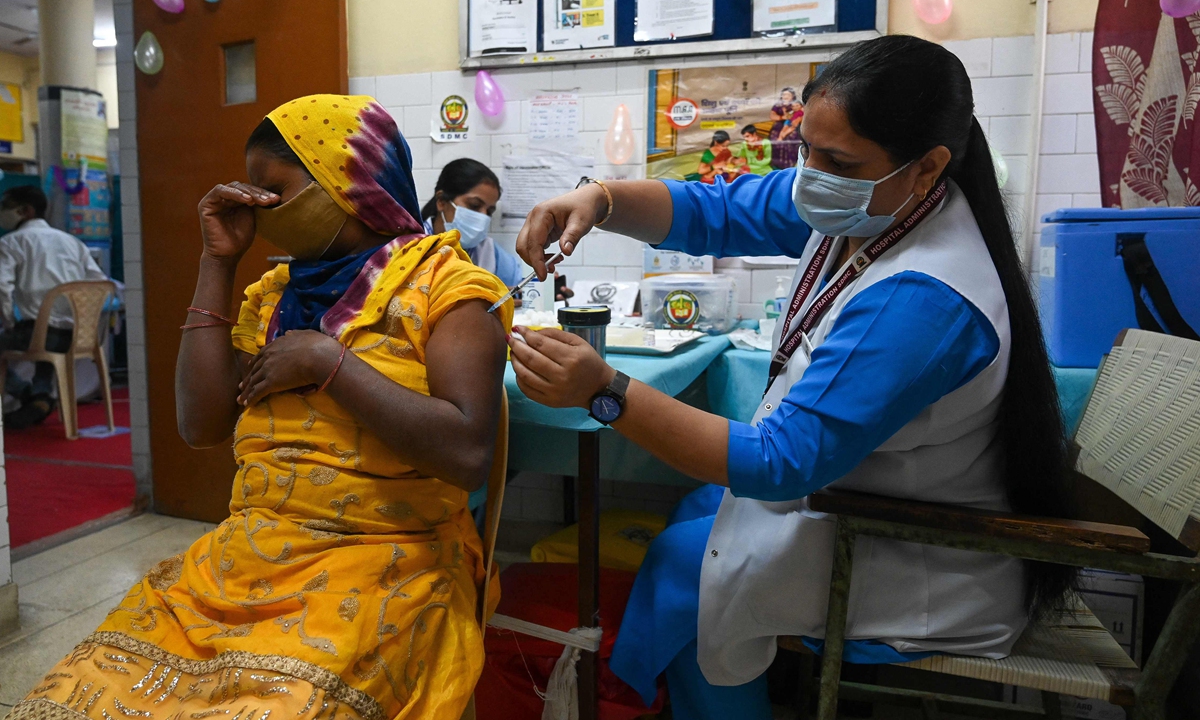
A health worker inoculates a woman with a dose of the Covaxin vaccine against the COVID-19 at a health center in New Delhi, India on Thursday. Photo: VCG

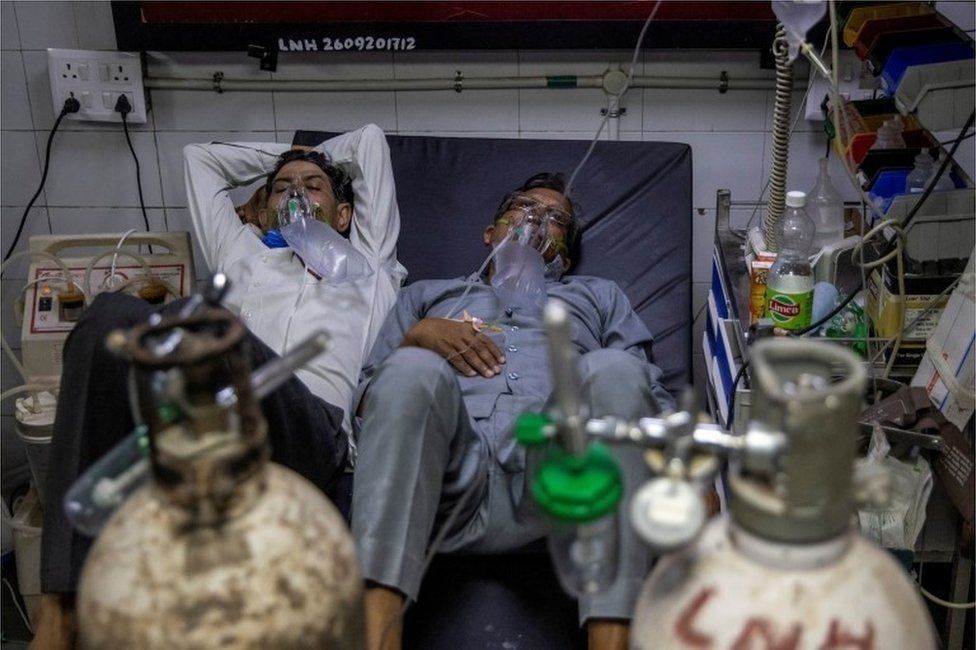
Over half of the world's population has not yet received a single dose of a COVID vaccine, according to Our World in Data. In low-income countries, fewer than five percent of the population have been given at minimum one dose. Leading the World Health Organization and other aid groups to appeal to the governments of the 20 largest economies for funding of a $23.4 billion program to close the gap in bringing COVID-19 vaccines, tests and drugs to emerging economies within the next year.

COVID cases worldwide are nearing the 250 million milestone. The surge experienced from the Delta variant, along with efforts to normalize trade and tourism is seeing some easing of the situation, even while some countries in eastern Europe are undergoing record outbreaks. Coincidentally, they are the same countries where vaccine uptake has been low, particularly in more rural farming and isolated communities..

Overall, in the large scale of things, the last three months has seen the daily average of cases falling by 36 percent, according to a Reuters analysis. However, while the virus spread appears to have relentedm 50 million people are still being infected every 90 days, resulting from the highly transmissible Delta variant's effect. Before its emergence, the original virus before mutation took place saw 50 million people infected worldwide over the space of a year. 

There is growing confidence among experts in health care and epidemiology that in many countries the most serious effects of the pandemic are now behind them as a result of the availability of vaccines and from natural exposure. There is still, however, an expectation that the onset of colder weather along with seasonal holiday gatherings, an increase in cases could be realized.

Within the medical community globally, there has arisen through intensive study and observation, a better understanding of the SARS-CoV-2 virus causing COVID-19, though much has yet to be discovered about its volume of sometimes mysterious effects, including long COVID. As well, more intensive understanding has led to better treatments. 
 
Britain is set to be the first country to approve a potentially successful COVID-19 antiviral pill which studies indicate could reduce the chances of dying or being hospitalized by half, for people most at risk of development severe COVID-19.

With good news there is often sobering news to balance the situation, and the reality is that infections are still on the rise in 55 of 240 countries. Russia, Ukraine and Greece are experiencing near record levels of reported cases since the start of the global pandemic two years earlier. Eastern Europe's vaccination rate is among the lowest in Europe. Over half of all new infections reported globally are from countries in Europe. 
 
A million new infections are reported about every four days.

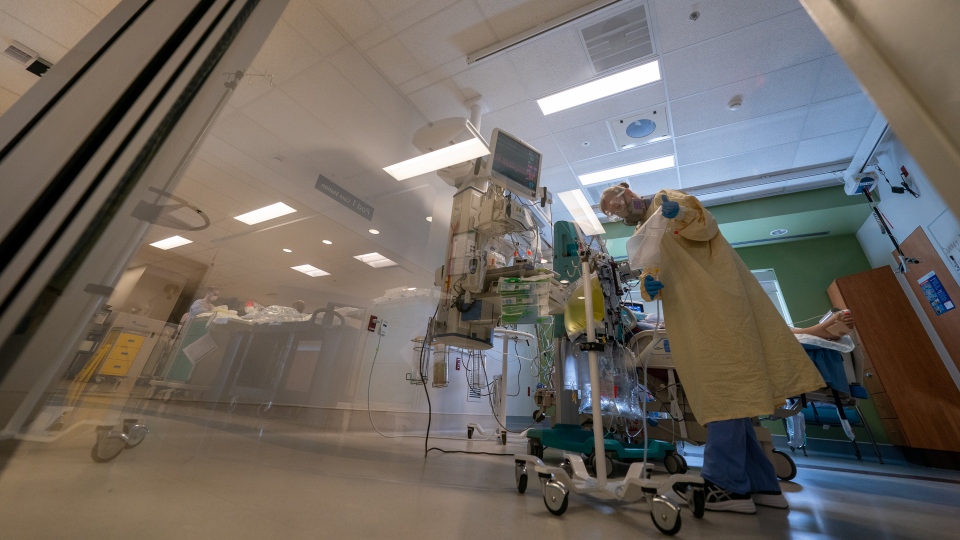
Medical personnel provides medical assistance to a COVID-19 patient inside the intensive care unit in an hospital which treats patients with COVID-19 coronavirus in Kiev on Nov 2, 2021. (SERGEI SUPINSKY / AFP
 

Labels: , , , , ,

Monday, August 30, 2021

The COVID State of the Union

"There are continued increases, but not to the level that we've seen in previous surges here in the North-east."
"I'm seeing some modelling to suggest that peak won't occur until late September, early October -- but of course we don't know for sure."
"Multiple factors challenge our ability to predict what's going to happen next."
"Certainly opening school without having vaccinations available for kids under 12 also potentially will influence the course."
Dr.Roy Gulick, chief of infectious diseases, Weill Cornell Medicine and New York-Presbyterian hospital
 
"I believe that mandating vaccines for children to appear in school is a good idea."
"We've done this for decades and decades, requiring polio, measles, mumps, rubella, hepatitis [vaccinations]."
"I think there's a reasonable chance that the Pfizer-BioNTech or Moderna vaccines could get FDA clearance for kids under 12 before the upcoming holiday season."
Dr.Anthony Fauci, U.S. infectious disease expert
An empty ICU bed SSM Health St. Joseph Hospital in Lake Saint Louis. (photo by Armond Feffer).

Amidst key areas of concern in the United States over the bedeviling Delta wave, parts of the American Northeast, according to experts, may be closing in on the peak of the latest COVID wave. It is anticipated that in weeks to come hospitalizations and deaths will continue to mount. In Connecticut and Massachusetts cases appear to have topped out, reflecting a consensus of forecsts published by the U.S. Centers for Disease Control and Prevention.

In New York and New Jersey however, infection rates are expected to increase. The Northeast has been ground down since mid-July by the effects of the COVID-19 wave that was first seen in Arkansas and Missouri and which went on to fuel record hospitalizations in Florida. In every state in the Northeast, daily hospital admissions are rising, according to the Department of Health and Human Services data. 

Leading indicators -- given that the rates of infection remain distinctly lower than those seen in early Delta-variant hot spots -- appear to suggest the region may crest before attaining Florida-like levels of viral prevalence. Nationwide however, cases remain projected to continue rising for several weeks. The original epicentre of the U.S. pandemic, New York city, has its effective reproduction number (Rt -- an estimate of how many new infections arise out of a single COVID carrier) indicating sustainable declines in case numbers may be approachable soon.

The Rt in Manhattan is estimated to have decreased to 1.0; and at such time that it falls below that level the expectation is that cases will decrease in the near future. The Bronx, Queens and Brooklyn have somewhat steeper Rt rates, revealed by covidestim, a project including representatives from Yale School of Public Health, Harvard's T.H.Chan School of Public Health and Stanford Medicine.

A record 5,048 new infections was reported two days earlier in Mississippi, signalling that the worst per capita outbreak in the country shows no signs of abating in a state with the nation's lowest vaccination rate. Mississip0i reported a record for deaths earlier in the week, with health officials reporting 20,000 students quarantined with the virus, or for exposure.
 
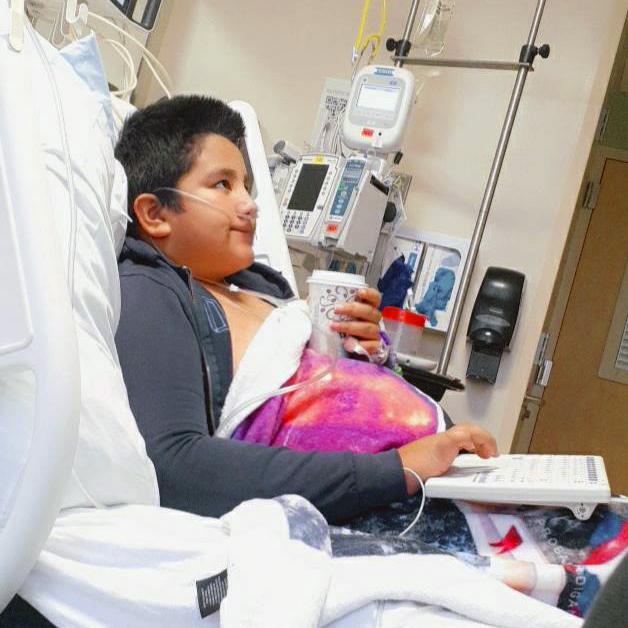
This 2021 photo provided by Yessica Gonzalez shows her son, Francisco Rosales, 9, in the intensive care unit at Children’s Medical Center in Dallas, Texas. The day before he was supposed to start fourth grade, Francisco was admitted to the hospital due to severe COVID-19, struggling to breathe, with dangerously low oxygen levels and an uncertain outcome. (Yessica Gonzalez via AP)
Francisco Rosales, 9, in the intensive care unit at Children’s Medical Center in Dallas, Texas. The day before he was supposed to start fourth grade, Francisco was admitted to the hospital due to severe COVID  AP
 
Florida is preparing to withhold funding from two school districts that have mandated mask-wearing for students, in defiance of an executive order signed by Florida Governor DeSantis barring facial coverings to be required.
"It is important to remember that this issue is about ensuring local school board members, elected politicians, follow the law."
"We cannot have government officials pick and choose what laws they want to follow."
Richard Corcoran, Commissioner of Education, Florida Department of Education


Labels: , , , , ,

Wednesday, August 11, 2021

Canada's Fourth Wave Driven by COVID's Delta Variant

"We've got to get to 85, 90 percent of the population immunized before we can have the conversation about herd immunity. We're nowhere near that."
"Epidemics are all about susceptible populations, and who's susceptible? The unvaccinated."
"I think this is particularly true of conservative leaders [fear of accusations of limiting freedoms] whose identity is built upon reducing government control, and not increasing it."
"Some people have returned to life as normal, and I understand why; you feel you've been doubly vaccinated why not go back to normal?"
"But they're interacting with unvaccinated people to an extent that is unhealthy and in the context of Delta hyper-transmissibility, this is what you get."
"What I'm hoping happens is that people get a lid on this -- in Ontario cases go up to maybe 500, then vaccination uptake increases considerably and we drive it down to nothing and let public health handle the rest."  
"Previously we could have said the kids aren't really vulnerable, they do get [COVID-19] but not really as much, and if they get it they're asymptomatic, they're much less likely to be hospitalized."
"That does not seem to be the case any longer, at least not to the same extent."
Raywat Deonandan, epidemiologist, University of Ottawa 
Rising vaccination rates, alongside public health measures like mask-wearing, may ward off the worst outcomes of a fourth wave, even as delta spreads. But medical experts warn pressure on Canada's hospital system remains a possibility if cases continue to spike. (Graham Hughes/The Canadian Press)
"We're reopening. We didn't just rip the Band-Aid off and go straight from stage zero, to step three. We took our time."
"We're in a highly uncertain period right now in the sense that this is entirely up to us. I don't think it's inevitable that we have a bad fourth wave."
"If we were to let the virus spread unmitigated we would expect really high attack rates in kids. And what I think we are seeing in the Southern U.S. states is exactly that; you have high rates of infection and you are seeing those rare outcomes more frequently; just because there are so many infections happening." 
Ashleigh Tuite, epidemiologist, Dalla Lana School of Public Health, University of Toronto
With phased-in re-opening in Ontario and the introduction of more relaxed attitudes about attending gyms and indoor dining, it was generally acknowledged that even with all appropriate-level cautions still in order, there would be a gradual rise once more in COVID case numbers. Which is exactly what has and is occurring; confirmation that infection numbers are on the increase, even with a measured response in re-opening. 

It is the situation yet to come looming on the near horizon that fixates the minds of health professionals. Now that the rise is unfolding, what does the near future hold? Ontario is a highly vaccinated province, but even so, there are inoculation gaps where the numbers are insufficiently high to rate as capable of fully halting further transmission. 

The Delta variant was identified  as one of the most infectious viruses in history, according to epidemiologist Larry Brilliant whose assistance in eradicating smallpox led to fame. Even though 61 percent of over 12-years-of-age Canadians covering those in their teens, and on upward from 18 to the elderly bracket who have a vaccination rate against COVID of 73 percent, that rate must continue growing substantially for full-population protection against the virus.

There has been a recent rise in case numbers across Ontario, British Columbia Alberta and Quebec even though case numbers come nothing near the explosive rate seen across the border in the United States driven by the Delta strain of COVID. The seven-day moving average in Canada as a whole stands at 945 reported daily, between July 30 and August 4; a 48 percent increase week over recent week.

In British Columbia, modelling predicts the province could see 1,000 new confirmed infectious daily by September. Central Okanagan has seen a case surge that brought in new restrictions on bars, nightclubs and personal gatherings indoors and out. British Columbia hospitals have seen a slight increase in hospitalizations, mostly representing unvaccinated people in their 40s and 50s.
 
A pedestrian walks past an electronic information board displaying a COVID-19 information relating to a "variant of concern in the area" in Blackburn, northwest England, on June 16, 2021.
Data from the Public Health Agency of Canada and from Ontario indicate unvaccinated people now account for the majority of reported cases, for hospitalizations and for deaths. Recently a Public Health Ontario summary of infections following vaccination drives found unvaccinated people to be about eight times likelier to become infected in comparison to the doubly-vaccinated. The unvaccinated age 60 and up are 15 times likelier to be hospitalized than are the fully vaccinated.

In Canada as a whole -- between mid-December and 17 July -- 5,896 deaths attributable to COVID were reported in the unvaccinated in comparison to 89 deaths in the fully vaccinated, and 561 in those people who were partially vaccinated (single dose). Concern focuses on September when without masking, small cohorts, improved ventilation, testing, and a strong outbreak "you would expect a large number of children to be infected", said Dr.Tuite. 

Florida, pointed out Dr. Deonandan, saw a steep rise in children's hospitalization, along with a number of other southern American states, and it is quite possible that such a scenario could play out in Canada as well. He has general, simple, workable advice for best-practise in avoidance of infection: Vaccinate ... wear masks indoors until a significant drop in case numbers, (all the more so in situations where exposure to people whose vaccine status is unclear).

Canada is in fourth wave, doctors say
Registered nurse Linda Wright attends to a patient in the COVID-19 Intensive Care Unit at Surrey Memorial Hospital in Surrey, B.C., Friday, June 4, 2021. THE CANADIAN PRESS/Jonathan Hayward

Labels: , , , ,

Sunday, July 11, 2021

When Success Turns to Desperate Need

"We cannot live with this variant. No place on Earth has unless they have their vaccination rates much, much higher than what we  have."
"Otherwise, it subjects the population to thousands and thousands of deaths."
Gladys Berejiklian, premier, New South Wales
A lone woman wearing a protective face mask pulls a suitcase through the city centre during a lockdown to curb the spread of a coronavirus disease (COVID-19) outbreak in Sydney, Australia, July 6, 2021.  REUTERS/Loren Elliott
A lone woman wearing a protective face mask pulls a suitcase through the city centre during a lockdown to curb the spread of a coronavirus disease (COVID-19) outbreak in Sydney, Australia, July 6, 2021. REUTERS/Loren Elliott
 
Celebrated internationally for their swift reactions that worked to suppress the global pandemic last year, the death toll in Australia and South Korea was comparatively low in comparison to the United Kingdom and the United States. One critical oversight: their vaccination rollouts have now placed them in a position of public vulnerability to COVID-19 outbreaks. And this, at a time when the Delta variant has been wreaking havoc world-wide.

On Friday, South Korea brought out its highest level of restrictions across Seoul and the surrounding area of virus-related restrictions, leaving half of the country's 52 million population affected. "We are facing the biggest crisis with our containment efforts with the daily new cases hitting a record every day", Prime Minister Kim Bookyun explained as he announced the new lockdown measures, including gatherings of over two people after 6 p.m. banned, and shutting school operations down.

The worst was yet to come for South Korea, warned head of the Korea Disease Control and Prevention Agency, even as the vaccine drive was strengthening. Gen.Paul LaCamera, leading 28,500 American troops stationed in South Korea, reintroduced tougher controls on military personnel movements. "While we have achieved a more than 80 percent vaccination rate, we are witnessing small clusters of the virus spread within select locations", he said.

In Japan, Prime Minister Yoshihide Suga was forced to declare a state of emergency in Tokyo with the additional statement that the Olympics will now be held for the most part in the absence of spectators. Across the Asia-Pacific governments have been forced to swiftly impose tougher lockdowns in the face of the highly contagious COVID-19 Delta variant's sudden resurgence, one that is straining health systems and creating anxiety among their public, with vaccination drives interrupted by delays and shortages.

Among the worst hit of the countries in the region, Indonesia's 270 million people are in the throes of its deadliest outbreak since the introduction of the pandemic; its medical system struggling to cope with record numbers of cases, and with a daily death toll that has doubled in the past week to over 2,000. Authorities warn the number of new infections may surge up to 70,00 after surpassing 34,000 in mid-week.
 
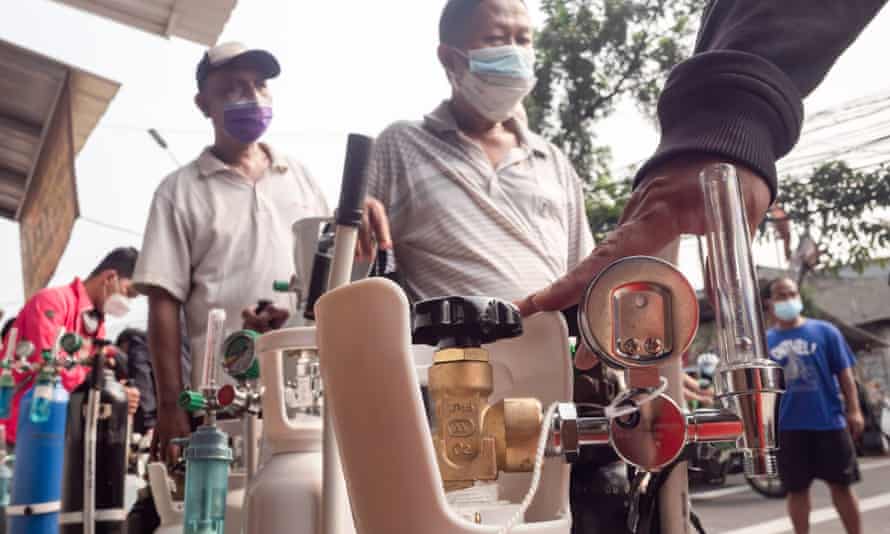
People wait in line to refill their oxygen tanks at a filling station in Jakarta
People wait in line to refill their oxygen tanks at a filling station in Jakarta. Indonesia is facing an oxygen crisis amid a surge in Covid-19 cases. Photograph: Wisnu Agung Prasetyo/SOPA Imag/Rex/Shutterstock
 
Hospitals are reaching capacity and turning patients away, with the government attempting to import oxygen tanks from neighbouring countries, their own supplies exhausted. Indonesia has been reliant on the Chinese Sinovac vaccines, but its rate of vaccination has been tardy, in the midst of supply shortages, apart  from its less-than-optimal efficacy rate, made all the more severe by the Delta strain.
 
Authorities in Australia warn thousands of people could die, taking into consideration the Sydney outbreak with its Delta variant link, should it not be brought under control. The city of 5 million has failed to quell active case clusters despite a two-week lockdown, requiring a tightened activation of restrictions in a desperate bid to block any further spread and to control the level of infection.

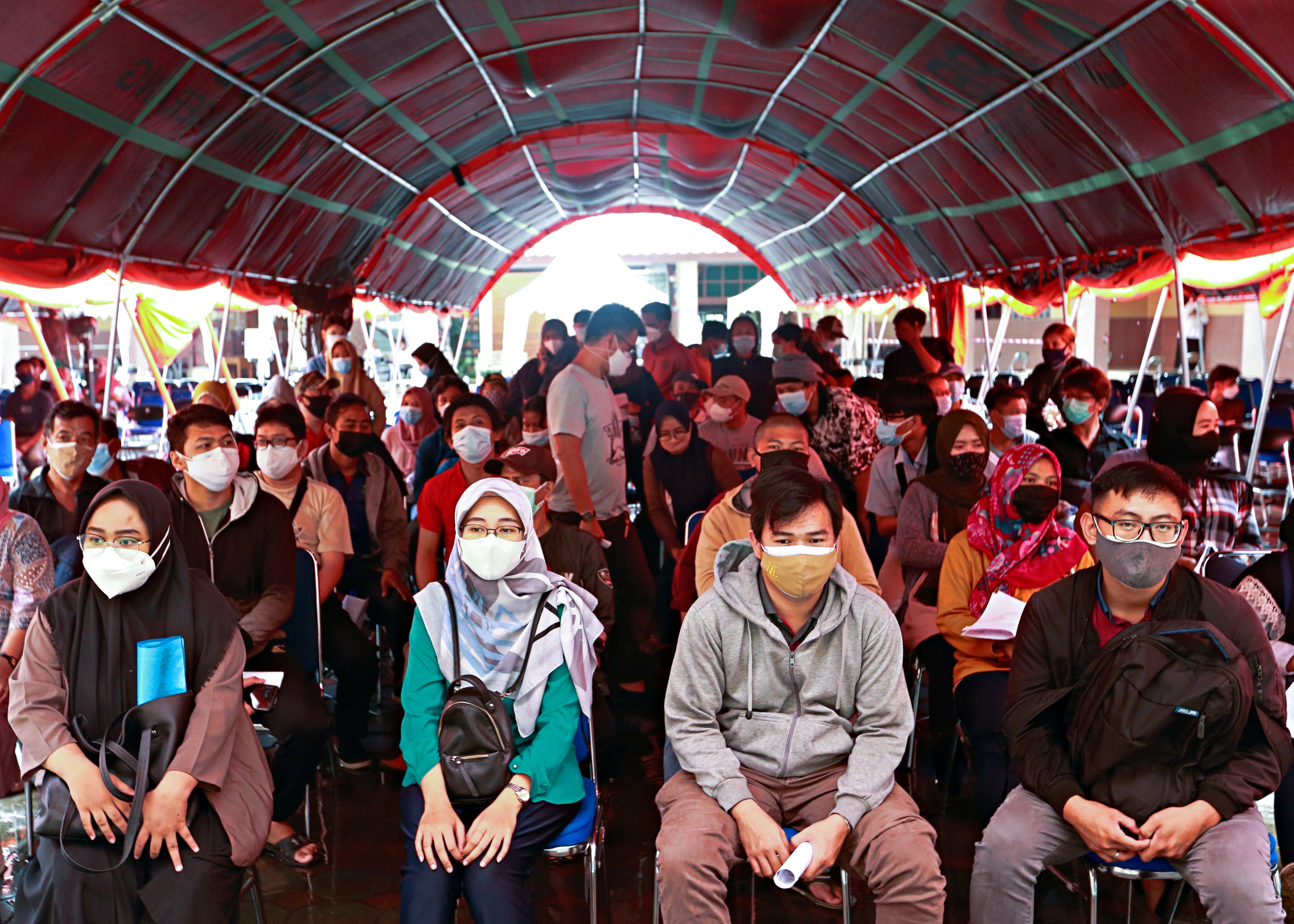
People wearing protective face masks sit before receiving a dose of the coronavirus disease (COVID-19) vaccine during the mass vaccination program at the Tangerang City Government Center, in Tangerang on the outskirts of Jakarta, Indonesia, June 30, 2021. REUTERS/Ajeng Dinar Ulfiana/File Photo
Mass Vaccination clinic, Seoul, South Korea -- Reuters

Labels: , , , , ,

Friday, June 25, 2021

Sobering Runaway COVID: Variants of Variants

"WHO is tracking this variant as part of the Delta variant, as we are doing for other Variants of Concern with additional mutations."
"For the moment, this variant does not seem to be common, currently accounting for only a small fraction of the Delta sequences ..."
"Delta and other circulating Variants of Concern remain a higher public health risk as they have demonstrated increases in transmission."
World Health Organization  
 
"All lineages of the Delta variant are variants of concern [so there is nothing unusual in labelling Delta Plus as such]." 
"We do not have any indicators as of now to show that Delta Plus should be causing any public health worry or panic. We are not seeing anything worrisome yet."
"We are tracking it carefully, and strengthening all public health measures."
Dr Anurag Agarwal, director,  Delhi-based CSIR-Institute of Genomics and Integrative Biology
India second wave
The Delta strain was said to be responsible for the deadly second wave of infections   Reuters

"There is no data yet to support the variant of concern claim," 
"You need biological and clinical information in order to consider whether it is truly a variant of concern."
"You need to study a few hundred patients who are sick with this condition and variant and find out whether they are at greater risk of greater disease than the ancestral variant." 
Dr, Gagandeep Kang, virologist, Fellow of the Royal Society of London
 
"We don't have much reason to believe this is any more dangerous than the original Delta."  
"Delta Plus might have a slight advantage at infecting and spreading between people who were previously infected earlier during the pandemic or who have weak or incomplete vaccine immunity." 
"I would keep calm. I don't think India or anyone else in the world has released or accumulated enough data to distinguish the risk from the so-called Delta Plus as being more dangerous or concerning than the original Delta variant."
Dr Jeremy Kamil, virologist, Louisiana State University Health Sciences Center, Shreveport
The ongoing complexities and mysteries of SARS-CoV-2. India announced several days ago that it has identified roughly 40 cases of the Delta coronavirus variant that first emerged in India and this variant now carries a mutation appearing to make it even more readily transmissible than the already-more-transmissible Delta strain. It is the Delta strain that has caused a good deal of anxiety in Britain, identified as causing a new wave, and prompting the U.K. to hold off its promised re-opening. In Canada the Delta strain resulted in health authorities speeding up vaccinations in an attempt to head off the eruption of another COVID wave.

There is always the danger of mutations occurring with viruses, pushing health authorities to accelerate inoculation programs before the emergence of a mutation that turns out to be not only more transmissible but even significantly deadlier than the original. In the case of COVID 19, anything more deadly than the original is a nightmare to be avoided at all costs. In India the appearance of the new Delta variant has seen states in the country being cautioned of the urgent requirement to increase their testing.

Delta Plus was reported for the first time in a Public Health England bulletin issued on 11 June. Identified as a sub-lineage of the Delta variant which first emerged in India, Delta Plus has inherited the spike protein mutation called K417N, found as well in the Beta variant first identified in South Africa. The concern among some scientists is that the mutation along with other features of the Delta variant could ensure it is considerably more transmissible than the parent mutant.

"The mutation K417N has been of interest as it is present in the Beta variant (B.1.351 lineage) which was reported to have immune invasion property", stated India's health ministry. The K417N was known -- according to top Indian virologist Shahid Jameel -- to reduce the effectiveness of a number of therapeutic monoclonal antibodies. Resistance to vaccines, in other words, a potential horror story that might leave the world without the hope of vanquishing the pandemic through the miracle medium of anti-COVID vaccines.

To date, the Delta variant has been identified as having appeared in eleven countries altogether; Britain (36), Canada (1), India (40), Japan (15), Nepal (3), Poland (9), Portugal (22), Russia (1), Switzerland (18), Turkey (1), and the United States (83). Around 40 cases of the variant, according to India, have been observed in the states of Maharashtra, Kerala and Madhya Pradesh, with "no significant increase in prevalence". A sample taken on April 5 represents the earliest case identified in India.

On April 26, Britain sequenced its first five cases; contacts of individuals who had travelled from or transited through Nepal and Turkey. Among the U.K and Indian cases no deaths have as yet been reported. In India and throughout the globe, studies are being initiated to test vaccine effectiveness against the mutation. Regions where the Delta variant has been found "may need to enhance their public health response by focusing on surveillance, enhanced testing, quick contact-tracing and priority vaccination".

In India, the concern is obviously that Delta Plus may inflict yet another infection wave, at a time when it has so recently emerged from the world's worst surge in cases. At the present time, some 5.5 percent of Indians have been fully vaccinated, with 18 percent having received at least one dose. Vaccinations have been accelerated to the point where up to six million people are being vaccinated daily. One of the issues of concern is vaccine availability.
 
"It is most likely capable of dodging immunities", was the opinion of Shahid Jameel, virologist and director of the Trivedi School of Biosciences at Ashoka University in Sonipat, India. "That is because it carries all symptoms of the original Delta variant and also from its partner Beta variant."
 
Checking on a Covid-19 patient at a hospital in Mumbai, India, this month.
  Credit...Rajanish Kakade/Associated Press


Labels: , , , , ,

Friday, June 11, 2021

Post-COVID Normalcy Spectacularly Uncertain

"Right now, most Delta cases are caught at border entry points and there has been relatively few cases within the country."
"[It's almost certain Delta will overtake Alpha in Canada], once lockdown and sanitary measures are eased."
"[Moreover another pandemic wave is possible, one that] will affect severely those not vaccinated, and mildly those vaccinated once."
"This is why there is a race against the clock for national double-vaccine coverage."
Dr.Marc Andrew Langlois, lead, Coronavirus Variants Rapid Response Network, University of Ottawa virologist

"I think having 90 percent of our population with two doses would put us in a really strong position."
"We don't know how transmissible any of these variants are really going to look in a fully reopened population, because none of them have ever seen a fully reopened population, really."
"So, we don't know. Do we need 95 percent protection, or 95 percent immunized? Do we need 85 percent? What do we really need?"
"We're going to need 80 plus percent of our population immune, which means more than that immunized. [The authorized vaccines are] awesome and wonderful and great and innovative [but they're not perfect]."
"Our best guess would be that if we just went for it, and reopened with only 75 percent of eligible people vaccinated, that's not enough. We would see so many infections in the rest."
"Now it's getting a little less predictable because we don't really know in a Canadian reopened population how transmissible these variants are. But we think it's going to be not great."
"I think it's probably a great starting point for starting to reopen. But I don't think it's going to get us there in terms of a completely fully back-to-normal life."
Dr.Caroline Colijn, COVID modeller, epidemiologist, Simon Fraser University
David Burga and his wife Jeanne Chai enjoy a breakfast made by someone else for a change. Cafe Diplomatico was open for breakfast as of 8 a.m. Friday morning.
The Star
 
Into the unknown. This is where the world is headed as it hopes to resume normalcy once it reckons the SARS-CoV-2 virus causing COVID-19 has been tamed. If it is ever tamed. Although expectations are there alongside the uncertainties. Insecurity of opinion exists because no one considered to be an expert in viruses and their behaviour based on past experiences, now faced with a virus that outdistances all others in unexpected effects and a whole host of confusing complications, vexes understanding even while the experts are forecasting events to come and hoping for the best.

On the surface it is beginning to look as though the COVID adventure that turned Canada upside down and inside out may be lingering, but is on its way to softening its presence before finally succumbing to medical science and the science of the herd effect. And then there is the wild card represented by a virus whose mutations have resulted in more devious, infectious, and effects-negative variants. Each of the recognized new variants appearing to be more threatening than the last. And with the literally thousands of mutations, the concern that a new variant may surface whose threat level may outdistance all others.

The hope that once enough numbers in any population are finally vaccinated with the recommended two first doses, their immunity level will serve to protect not only the individuals but the larger community, leaving COVID-19 to slink away, no longer posing the dire threat it represents today. Canada is preparing to reopen, socially, and structurally, in the hope that businesses will reopen, people return to work, the economy will pick up, and normalcy will resume.

And then there's the reminder from the country's chief public health officer, that there is a wild card over the horizon, the Delta variant causing greater infections in India and whose presence is now guaranteed to be "essentially across Canada". Not precisely widespread and dominant yet, but on the cusp of being so. Just awaiting the opportunity that reopening will present it with, so to speak. There is always the experience of the United Kingdom to use as an assessment tool of the opportunistic virus.

There, in the United Kingdom, Delta has succeeded in surpassing Alpha (formerly identified as the U.K. variant). Britain is a week away from its full reopening. An event that could quite possibly be cancelled or put on hold as the case may be, in the wake of runaway infections, thanks to Delta;s prevalence. Judging from Britain's experience, there is every expectation that Delta will succeed in overtaking Alpha as the primary virus in Canada. "Once lockdowns and sanitary measures are eased".
 
Cumulative UK Covid-19 vaccinations
 
The simple fact of the matter is that double-vaccinations offer up to 90 percent protection against Delta, whereas a single shot, which is where most Canadians are at this juncture, offers far less protection. Which is why provinces should be planning to achieve 90 percent vaccine coverage and not just the 75 percent threshold initially set, to ensure there will be a safe reopening situation. Another issue is that children under 12 are ineligible for inoculations, along with the fact that some people cannot be vaccinated for reasons medical. Leaving a potential third of the population still vulnerable.

All it takes is for every person infected with Delta to spread the infection to four or five others: "That's when we would start talking about waves, and fourth waves", said Dr.Colijn. People may have spoken about waves: "really the waves have just been, we've turned on and off our control measures, and then the cases have risen and fallen, and we've gone, 'Oh, look, a wave'. But it's not." It's been completely predictable, cautioned Dr.Colijn, holder of a Canada 150 Research Chair in Mathematics for evolution, infection and public health.

Early evidence suggests that three weeks following the first dose of either Pfizer-BioNTech or AstraZeneca, either provides 33 percent protection against symptomatic infections with the Delta variant with the second dose of Pfizer boosting that to 88 percent, and a double dose of AstraZeneca provides 60 percent protection against Delta. The variant of concern may also cause more severe disease, given early evidence from England and Scotland suggesting an increased risk of hospitaliztion compared to Alpha cases.
"[Higher infectivity means Delta could conceivably] rip through unvaccinated populations if life returns to normal in a fortnight."
Peter Openshaw, professor of experimental medicine, Imperial College, London

"If we have unvaccinated, or partially vaccinated pockets, if there are dense networks out there of people who are vaccine hesitant, the risk that they will eventually get infected between October and April 2022 is very high."
"That's the challenge here."
Dr.Peter Juni, scientific director, COVID-19 science advisory table, Ontario
Peel Region Medical Health Officer Dr. Lawrence Loh prepares to give an injection of the Pfizer-BioNTech COVID-19 vaccine in an overnight clinic at the International Centre in Mississauga, Ont., on May 16 and 17, 2021. (Evan Mitsui/CBC)

Labels: , , ,

 
()() Follow @rheytah Tweet