Ruminations

Blog dedicated primarily to randomly selected news items; comments reflecting personal perceptions

Thursday, May 06, 2021

Prehistoric Grief of Loss

"This is at the root of the symbolic mind that characterizes Homo sapiens."
"The child was buried in a residential site, close to where this community lived, evincing how intimately life and death are related."
"Only humans treat the dead with the same respect, consideration and even tenderness they treat the living [with]. Even when we die, we continue to be someone for our group."
"[Ancient Homo sapiens and Neanderthals practised funerary behaviour], a type of behaviour that allows us to maintain links with those who died and offer a farewell."
Maria Martinon-Torres, director, National Research Center on Human Evolution (CENIEH), Spain
 
"This would likely have been a group act, perhaps by members of the child's family."
"All of these behaviours are, of course, very similar to those observed in our own species today, so we can relate to this act even though the burial dates to 78,000 years ago."
Nicole Boivin, archaeologist, director, Max Planck Institute for the Science of Human History, Germany
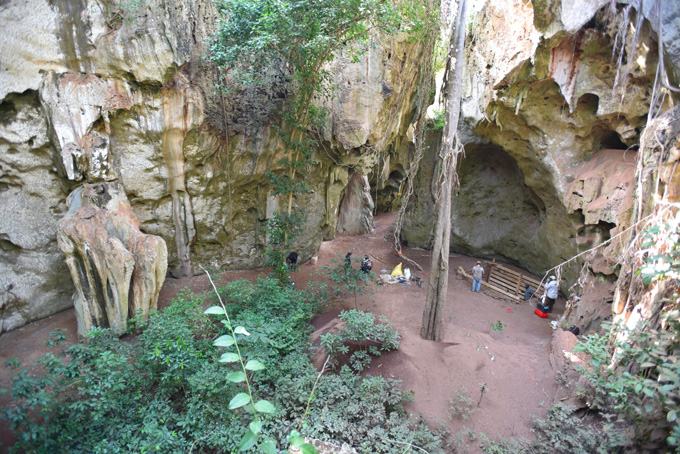
Panga ya Saidi cave site
Excavations at this African cave site called Panga ya Saidi revealed the continent’s oldest known example of an intentional human burial.   Mohammad Javad Shoaee
Scientists revealed this week their finding of the oldest-known human burial in Africa. Not surprising in the sense that Africa is the continent where the human species arose. The burial site of a young child -- [estimated to be between 2-1/2 years of age and three when it died, its gender remains indeterminate] -- in a cave called Panga ya Saidi, near the coast of Kenya. The child's remains were given the name "Mtoto", translated from Swahili to English: "child". 
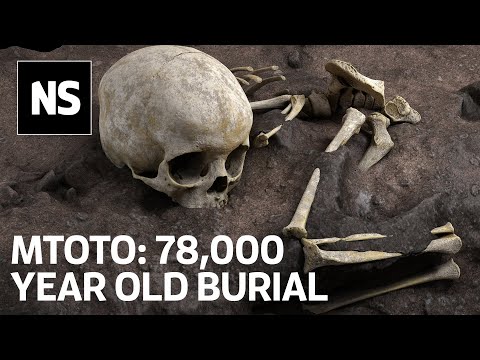
 

This virtual reconstruction shows the original position of a child’s bones in a Kenyan grave dug around 78,300 years ago, making it Africa’s oldest known human interment. Jorge González, Elena Santos

The fragile skeleton was found buried in a shallow grave beneath the overhang of the cave. Its head rested on a 'pillow' with the upper torso carefully wrapped in a shroud, both pillow and shroud hypothesized to having been composed of dried, decayed vegetation. It is a discovery which the researchers claim sheds light on the development of early complex social behaviours in Homo sapiens.

Africa gave birth to the first Homo sapiens species over 300,000 years ago. A species which gradually, through migration, spread throughout the world. The archaeologist/researchers encased the decomposed bones in plaster after lifting them from the circular pit where they had lain over the vast space of millenna on end, to be taken to CENIEH for eventual study. 

The skeletal remains were found in the grave placed in a flexed position, body on its right side, knees drawn toward the chest. A void left by the decay of a pillow composed of perishable vegetation that had collapsed caused the cranium and three neck bones to fall into the depression. 
 
The researchers hypothesized from the position of a shoulder bone and two ribs that the upper body had been wrapped in similar perishable material -- after which the body was covered with earth dug up from the floor of the cave.
"The next oldest grave in Africa is about 74,000 years old. Interestingly, that was also a young child, but it was poorly excavated about 50 years ago, so we don't know much about it."  
"Here, there is definitely a sense of personal loss. It's evidence of people who had a more symbolic representation of the world around them."  
Dr Louise Humphrey, Natural History Museum, London    
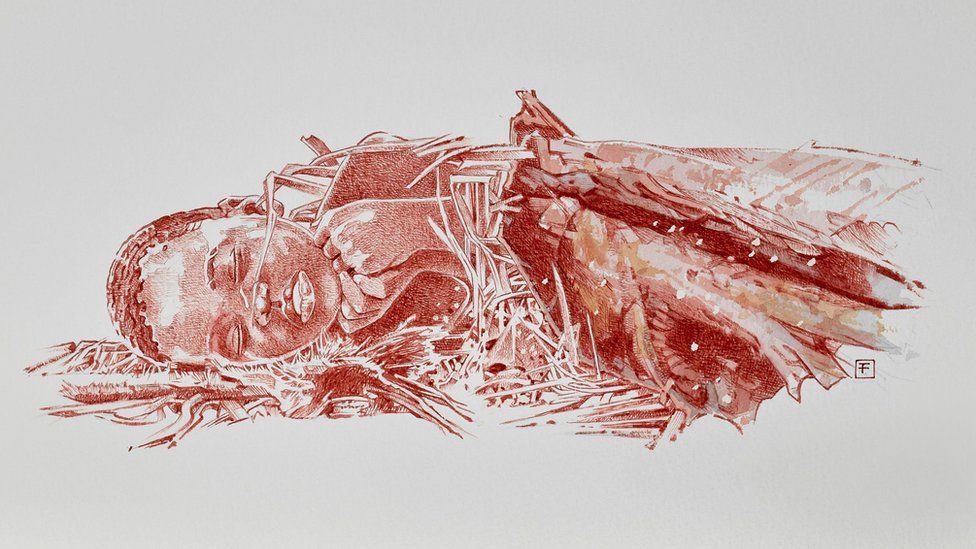
An artist’s interpretation of Mtoto’s burial (c) Fernando Fueyo
The scientists have named the child Mtoto, which means 'the kid' in Swahili   Fernando Fueyo

Labels: , , , , ,

Thursday, November 02, 2017

Wither Neanderthal?

"It's like everyone is searching for 'just so' stories about why one species led the other to extinction."
"It's the simplest model that we can build without assuming any hard-to-prove claims, like selection or environmental change."
"What do I expect would have happened by default?"
"...Even if there were no selection and no climate change, the end result would have been the same."
Oren Kolodny, evolutionary biologist, Stanford University
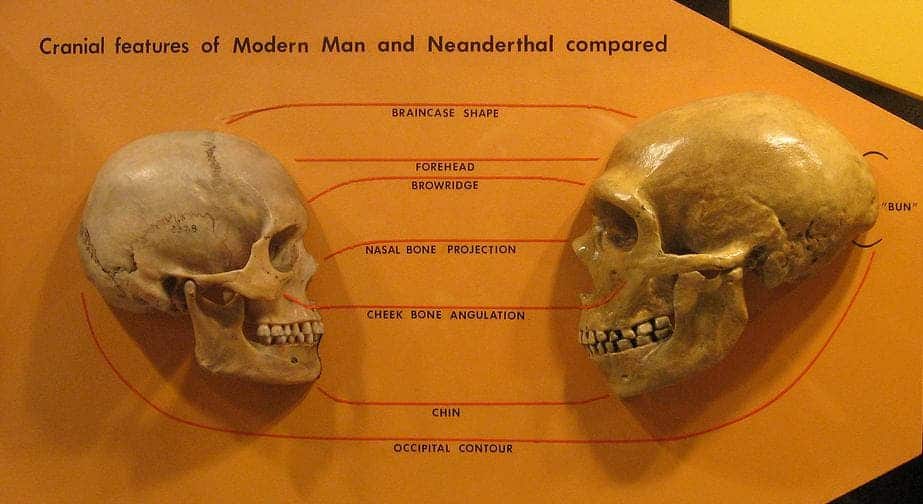
Not that different, right? Comparison of Neanderthal and Modern human skulls from the Cleveland Museum of Natural History -- ZMEScience

No, they don't look all that different, really. The skull of Neanderthal is bulkier than that of Homo Sapiens. Evolutionary biologists a long time ago postulated that Neanderthal women could carry a Homo Sapiens to birth, but a Homo Sapiens woman could not carry a Neanderthal fetus to live birth; her birth canal simply would be unable to accommodate the larger skull. But that the current human community has traces of Neanderthal DNA appears to have been well established, so Neanderthal as a species has left its mark for posterity on humanity.
"People of Caucasian descent have, within their genomes, small amounts of Neanderthal DNA. Previous studies have shown this ancient DNA may influence a person’s health, but a new study in the American Journal of Human Genetics today (October 5) reveals that the effects of one’s inner Neanderthal are even more wide-reaching."
"'[This study] is looking at a huge cohort and at a different set of traits than have been directly analyzed before, many of which are nonmedical,' says evolutionary and computational geneticist Tony Capra of Vanderbilt University who was not involved in the current study but performed a similar analysis of Neanderthal-influenced medical traits last year 'And what’s really exciting is that even though there was this broader scope of traits that was considered, they point to effects of Neanderthal DNA on similar systems to what’s been seen previously'."
"After the 2013 discovery that Neanderthals interbred with the ancestors of modern Europeans, says Janet Kelso of the Max Planck Institute for Evolutionary Anthropology, “one of the questions that came up was what effect does that have on the genomes of people today, what effect does it have on their phenotypes'?"
Ruth Williams,  October 5, 2017, The Scientist
Visitors take pictures of models ...
In this file photo, visitors take pictures of models representing Flores, human and Neanderthal women in the “Musee des Confluences”, a new science and anthropology museum in Lyon, central France. Neanderthals had a long run in Europe and Asia, but they disappeared about 40,000 years ago after modern humans showed up from Africa.

Neanderthals have been proven by paleolithic research to have been far more industrious and intelligent than they were believed to have been with the revelations that Homo neanderthalensis who migrated across Europe and Asia for over 300,000 years were capable of producing tools and even art and jewellery. They predated modern humans and as precursors of what we like to think of as 'man the wise' (Homo Sapiens Sapiens), accomplished, it would seem, just as much as their successors did in manipulating their environment.

That mystery appeared to be solved; the understanding that Neanderthals were not the dumb brutes they were commonly held to be, but the mystery surrounding their eventual disappearance has not. Scientists still grapple with what it might have been that led to their extinction. Were they perhaps genetically predisposed to being more lethally vulnerable to disease? During one of nature's episodes of extreme climate change were they incapable of adapting? Was there a challenge with the appearance of modern humans that Neanderthals were unable to match, leading to their downfall?

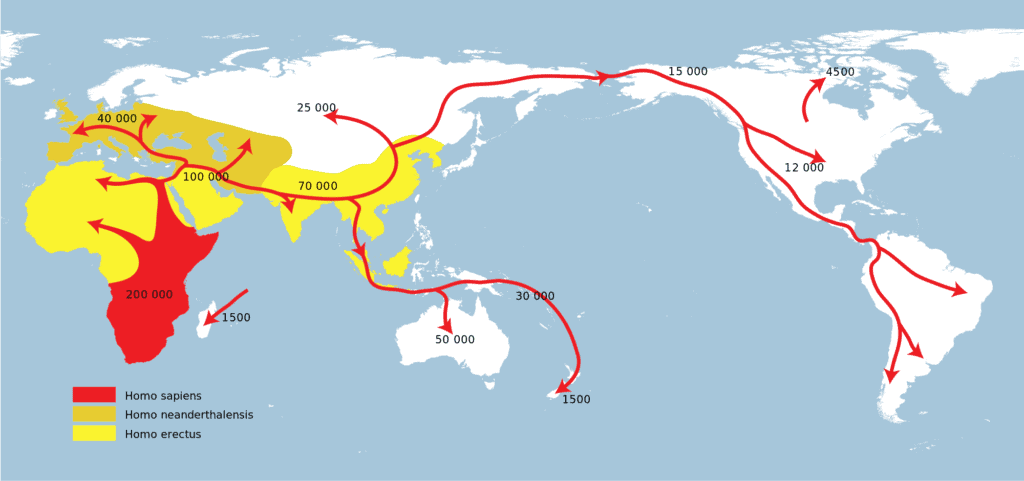
A new paper out of Stanford University published in the journal Nature Communications, authored by Oren Kolodny and his colleague Marc Feldman posit a fairly basic hypothesis, that the Neanderthal extinction was caused through an happenstance intersection between bad timing and population dynamics. They expired, modern humans thrived. They emerged in Europe some 400,000 years ago and were eventually joined by anatomically modern humans. H. neanderthalensis and H. sapiens appeared to share the landscape of Europe for a period estimated between 51,000 and 39,000 years ago.

There was interbreeding between the species and likely survivalist challenges for territory. Over the millennia and having shared geography, the end result was the continuation of the Homo Sapiens line and the extinction of the Neanderthals. A design of nature, not inconsequential, but the result of various circumstances that have seen countless extinctions of various creatures on Earth throughout the ages. The researchers designed their model using known issues of ancient hominin population groups, migration patterns and ecological patterns.

Drs. Kolodny and Feldman constructed a computer model to simulate interactions in Paleolithic Europe. Europe, in the hypothetical simulation inhabited by bands of Neanderthals randomly shifting about and eventually dying. Occasionally a band of modern humans join the picture, themselves moving about with bands from each species sharing equal opportunities of displacing the other. The simulations were run a myriad of times with changing values to reflect variables matching uncertainties with this period in human history.

Despite a wide range of parameters the simulation models consistently demonstrated the die-out of Neanderthals within a 12,000-year period. The assumption being that Neanderthals were unable to match the slow and steady entry of human bands continually flowing north from Africa into Europe. The researchers hasten to caution that the result of their study does not really disprove humans had a selective advantage or that an episode of aggravating climate change influenced the situation. But they are confident that irrespective of both issues being present or absent, Neanderthal extinction would have occurred.

Migration of species, via Wikipedia.


Labels: , , , ,

 
()() Follow @rheytah Tweet