Ruminations

Blog dedicated primarily to randomly selected news items; comments reflecting personal perceptions

Wednesday, June 30, 2021

The Neanderthal In Us

"It all started in Israel. We suggest that a local group was the source population."
"During interglacial periods, waves of humans, the Nesher Ramla people, migrated from the Middle East to Europe."
"The European Neanderthal actually began here in the Levant and migrated to Europe, while interbreeding with other groups of humans."
Dr Hila May, Tel Aviv University, Israel
 
"This is the first time we could connect the dots between different specimens found in the Levant."
"There are several human fossils from the caves of Qesem, Zuttiyeh and Tabun that date back to that time that we could not attribute to any specific known group of humans. But comparing their shapes to those of the newly uncovered specimen from Nesher Ramla justify their inclusion within the [new human] group."
Dr Rachel Sarig, Tel Aviv University  
"It was a surprise that archaic humans were using tools normally associated with Homo sapiens. This suggests that there were interactions between the two groups."   
"We think that it is only possible to learn how to make the tools through visual or oral learning. Our findings suggest that human evolution is far from simple and involved many dispersals, contacts and interactions between different species of human."
Dr Yossi Zaidner, Hebrew University of Jerusalem
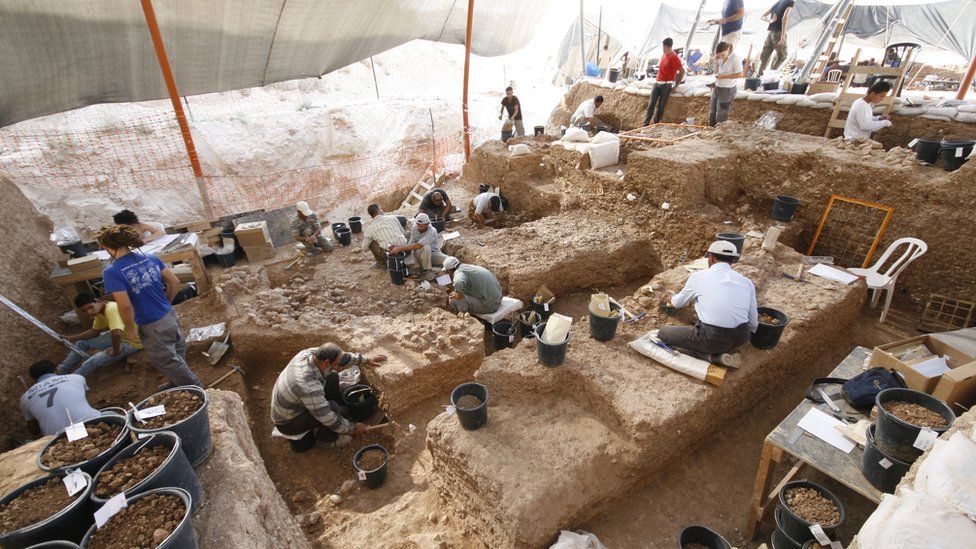
Site of Discovery
The human finds were uncovered during the excavation of a sinkhole. Thousands of stone tools and animal remains were also found  Photo: Yossi Zaidner

"The discovery of a new type of Homo is of great scientific importance."
"It enables us to make new sense of previously found human fossils, add another piece to the puzzle of human evolution, and understand the migrations of humans in the old world."
"Some fossils found in East Asia manifest Neanderthal-like features as the Nesher Ramla do."
Israel Hershkovitz, Tel Aviv University
Scientists in Israel feel they have succeeded in unearthing a discovery of a hitherto-unknown early human. Pieces of fossilized bone discovered at a site in central Israel used by a cement plant were studied carefully and led to this conclusion. Fragments were those of a skull and a lower jaw with teeth, estimated to be roughly 130,000 years old. Should their conclusions prove to be correct, the potential of reimagining parts of the human family tree is on the horizon. 

The archaeological project was a joint venture between researchers from Tel Aviv University and the Hebrew University of Jerusalem. The new proto-human was named Nesher Ramla Homo, after the area  southeast of TelAviv where the remains were discovered. The species, it is speculated, may have lived alongside our own species, Homo sapiens for over 100,000 years and it is posible that interbreeding took place, according to the team's studies.
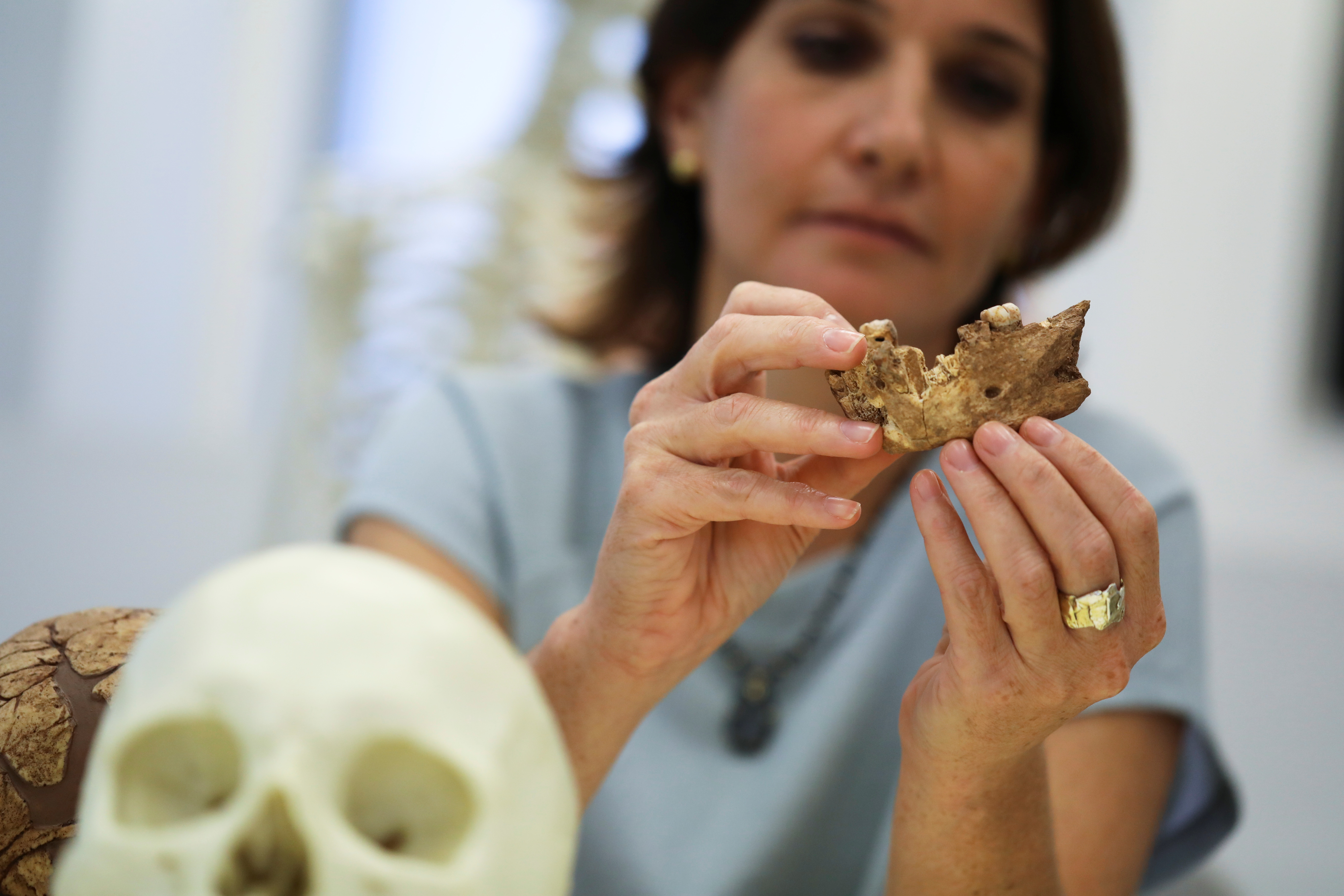
 
Hila May, a physical anthropologist at the Dan David Center and the Shmunis Institute of Tel Aviv University holds what scientists say is a piece of fossilised bone of a previously unknown kind of early human discovered at the Nesher Ramla site in central Israel, during an interview with Reuters at The Steinhardt Museum of Natural History in Tel Aviv, Israel June 23, 2021. Picture taken June 23, 2021. REUTERS/Ammar Awad
Hila May, a physical anthropologist at the Dan David Center and the Shmunis Institute of Tel Aviv University holds what scientists say is a piece of fossilized bone of a previously unknown kind of early human   Reuters
 
Distinguished with large teeth and chinless, these early humans may have been ancestors to Neanderthals. In making that suggestion the archaeological team is challenging the scientific given that distant evolutionary humans originated in Europe. While exploring the mining area of the Nesher cement plant not far from the city of Ramla, Dr.Yossi Zaidner of Hebrew University had discovered the fossils.

Follow-up excavation revealed the bones located roughly eight metres underground and with them were discovered stone tools, along with the skeletal remains of horses and deer. The Nesher Ramla type resembled pre-Neanderthal groups in Europe, according to the study authors whose work was published in the journal Science.

"This is what makes us suggest that this Nesher Ramla group is actually a large group that started very early in time and are the sources of the European Neanderthal", explained Hila May, physical anthropologist at the Dan David Center and the Shmunis Institute of Tel Aviv University.

Dr.May is convinced the Nesher Ramla might represent the mystery group responsible for Homo sapiens genes being present in earlier Neanderthal populations in Europe, long a puzzle to experts in the field. The skull of the species discovered is flat, the jaw bone is chinless and 3D shape analysis has ruled out any other known group related to it.

There was a match, however, with a small number of human fossils discovered elsewhere in Israel, dating back even earlier (400,000 years back in dim antiquity), and which anthropologists had been unable to place.
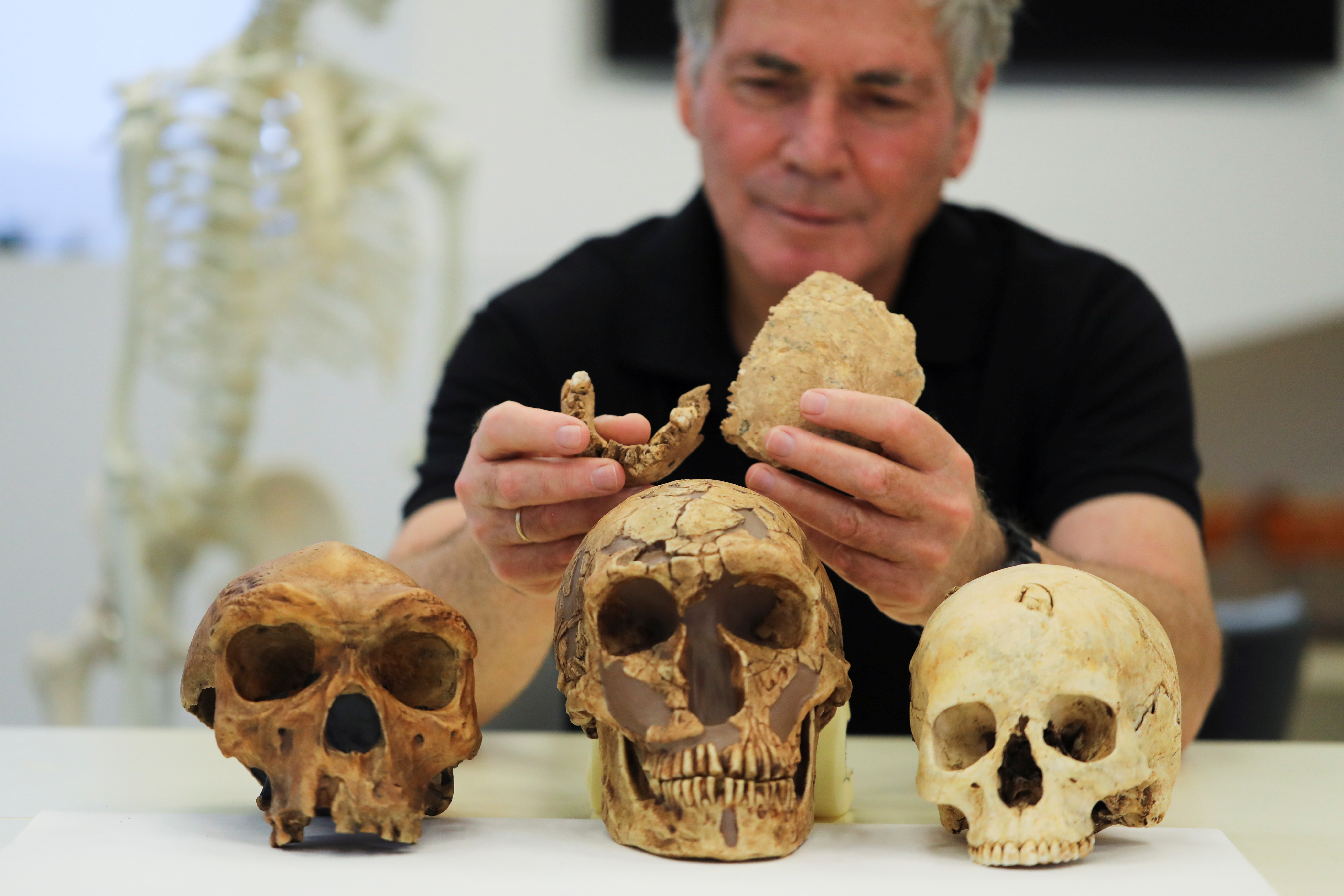
Tel Aviv University Professor Israel Hershkovitz, holds what scientists say are two pieces of fossilised bone of a previously unknown kind of early human discovered at the Nesher Ramla site in central Israel, during an interview with Reuters at The Steinhardt Museum of Natural History in Tel Aviv, Israel June 23, 2021. Picture taken June 23, 2021. REUTERS/Ammar Awad
Tel Aviv University Professor Israel Hershkovitz, holds what scientists say are two pieces of fossilised bone of a previously unknown kind of early human discovered at the Nesher Ramla site in central Israel  Reuters

Labels: , , , , , ,

Monday, November 27, 2017

Out of Africa

"The conventional timeline of human evolution and migration continues to crumble in the face of new research."
Gemma Tarlach, science writer, Discover Magazine

"That's just because of the way that the differences can accrue over time between the genetic lineage and the species, right? You're always going to have individuals and populations within a species that go extinct and leave no living descendants."
"So they represent basically lost lineages of people leaving Africa, and their descendants slowly expanding into parts of Europe and Asia, but then for whatever reason, those populations went extinct. And subsequently, somewhere around 40,000 to 70,000 years ago, we have groups of modern humans beginning to leave Africa again, and they're essentially the ancestors of all of us that are of non-African descent."
"The context of that find really challenged people's thinking, but now, 15 years later, it's not as challenging, because we really see this process of dispersal happening again and again for the past two million years."
"So likely Homo Florsiensis represents descendants of some of those earliest dispersals of humans out of Africa, long before even the common ancestors of humans and Neanderthals evolved and left Africa."
"[The signal of Neanderthal in modern non-African human DNA is] rather small, and there have been clear selective sweeps against Neanderthal DNA in our DNA. So what that means is essentially it wasn't really as compatible as any other two populations of modern humans breeding together." 
"The fact that [the Jebel Irhoud bones] date to that [early] time pretty much excludes them as a potential ancestor of anyone living today."
Matthew Tocheri, anthropologist, Canada Research Chair in Human Origins, Lakehead University

"The common myth that we drove them [Neanderthals] to extinction is just that, it's a myth."
"There's no evidence at all in the archaeological or fossil record of modern humans interacting with Neanderthals."
"There is no way to know from what part of that population [in Europe and Asia] the first modern humans did so [left Africa]."
David Begun, paleoanthropologist, University of Toronto
Two views of a composite reconstruction of the earliest known Homo sapiens fossils from Jebel Irhoud (Morocco) based on micro computed tomographic scans of multiple original fossils.
Philipp Gunz, MPI EVA Leipzig

At one time the scientific hypothesis called the multi-regional theory held that modern humanity resulted from an evolutionary process over the space of two million years taking place simultaneously in archaic human populations existing in Africa, Europe and Asia. That theory eventually surrendered to the more probable one that human origin could be traced to its beginnings in East Africa. More recent studies indicate that human and Neanderthal evolution diverged 500,000 years ago, scant Neanderthal DNA remaining in the human genetic code, of less than five percent.

The view that humans of today all share their origins from a small group of East African ancestors resulting in all of humanity essentially stemming from the same family tree and sharing an attractively theorized grandmother named Mitochondrial Eve, was seen as a great anthropological leveller; that we evolved as a single race. That the Caucasus did not produce Caucasians and nor did Asians originate in Asia; we all evolved from the original East African strain of humanity.

And the human record, thanks to new  strides in genetics and fossils along with biomechanics has led paleoanthropologists to believe humans as a species are older than believed to have been the case.

That the human species 'left' Africa on many occasions over the anthropological time record, evolving in different regions at variant rates, not in one fell swoop of an immense migration in a finite period of time. The Neanderthals and the littler-known Denisovans appeared, according to this new agreement between scientists, to have died out on their own, similarly to every other hominin population that once lived, with the exception of Homo sapiens.

The previously-subscribed-to timeline went back to 200,000 years earlier in East Africa when a small population of Homo sapiens, anatomically modern, having descended from an ape became behaviourally 'modern' in the last 100,000 years, colonizing the entirety of Africa, moving to the Middle East, Europe, Asia and in time, North and South America. An increasingly consistent fossil record of manufactured tools and a progression of artwork helped to tell the story of emerging conceptual thought.

The romance of the Great Rift Valley as the cradle of evolutionary humankind was the locus encouraging the shaping of the human mind and body and where the four "Fs" of evolution emerged: fighting, fleeing, feeding and mating. That is, in the popular imagination of paleontologists of the time. What has remained constant, however, while research advances a more accurate understanding of evolution is that origins in Africa remain certain, even though the scope has been recognized as somewhat more complicated.
The Moroccan hillside where anthropologists found the remains.
Shannon McPherron, MPI EVA Leipzig

In June, a discovery reported in Nature initiated a wholesale re-think when bones from a site called Jebel Irhoud in Morocco, thought to represent Neanderthals, were later identified as human when additional bones were unearthed, augmented by an improvement in scientific dating techniques of the sedimentary layer in which they were discovered, shown to be up to 350,000 years in primitive antiquity. The traditional story of evolution underwent a transformation reflecting the presence of anatomically modern Homo sapiens in Morocco dating that far back.

The lead taken from that discovery was that the emergence of humanity was not confined to a certain East African savanna, more in all likelihood the entire continent of Africa, representing a full fifth of the planet's land mass. Most of those human populations, it seems, simply failed to survive. Similar discoveries have been unearthed in Europe with genetic combinations no longer existing in modern humans, indicating a pattern of ancient humans migrating out of Africa and in so doing becoming isolated and in time, extinct, leaving behind a fossil record.

Fossils discovered in Indonesia in 2003 known as Homo Floresiensis represent one example; those discovered in Indonesia overlapping with the fossils of modern humans as little as a few thousand years ago created a conundrum for anthropologists. That they simply failed to survive as a species lends a new air of discovery relating to Neanderthals as well, dispelling the long-held theory that the superior Homo sapiens involved in conquest of a challenger for resources, exterminated Neanderthals.


This is a schematic representation of the evolutionary scenario for mitochondrial and nuclear DNA in archaic and modern humans. Neanderthal mitochondrial DNA recovered in this study suggests an intermediate migration out of Africa before 220,000 years ago.
Credit: Annette Günzel, © Max Planck Institute for the Science of Human History

Labels: , , , , ,

Thursday, November 02, 2017

Wither Neanderthal?

"It's like everyone is searching for 'just so' stories about why one species led the other to extinction."
"It's the simplest model that we can build without assuming any hard-to-prove claims, like selection or environmental change."
"What do I expect would have happened by default?"
"...Even if there were no selection and no climate change, the end result would have been the same."
Oren Kolodny, evolutionary biologist, Stanford University
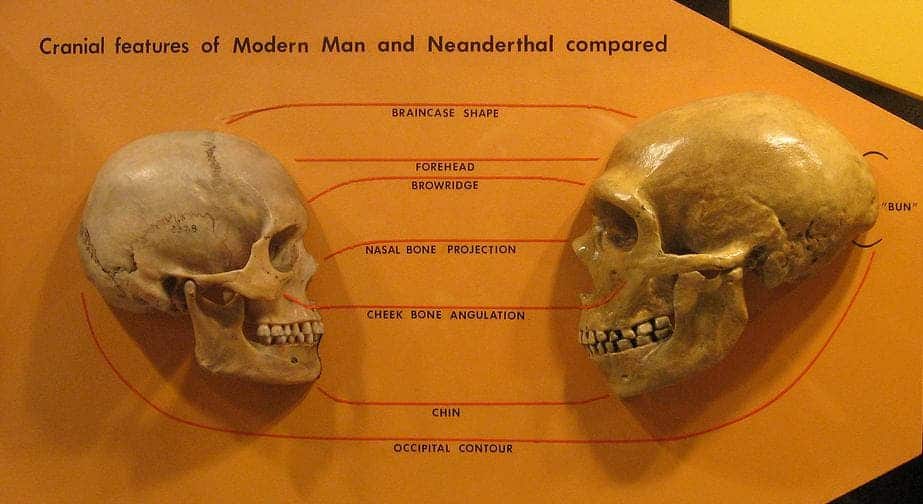
Not that different, right? Comparison of Neanderthal and Modern human skulls from the Cleveland Museum of Natural History -- ZMEScience

No, they don't look all that different, really. The skull of Neanderthal is bulkier than that of Homo Sapiens. Evolutionary biologists a long time ago postulated that Neanderthal women could carry a Homo Sapiens to birth, but a Homo Sapiens woman could not carry a Neanderthal fetus to live birth; her birth canal simply would be unable to accommodate the larger skull. But that the current human community has traces of Neanderthal DNA appears to have been well established, so Neanderthal as a species has left its mark for posterity on humanity.
"People of Caucasian descent have, within their genomes, small amounts of Neanderthal DNA. Previous studies have shown this ancient DNA may influence a person’s health, but a new study in the American Journal of Human Genetics today (October 5) reveals that the effects of one’s inner Neanderthal are even more wide-reaching."
"'[This study] is looking at a huge cohort and at a different set of traits than have been directly analyzed before, many of which are nonmedical,' says evolutionary and computational geneticist Tony Capra of Vanderbilt University who was not involved in the current study but performed a similar analysis of Neanderthal-influenced medical traits last year 'And what’s really exciting is that even though there was this broader scope of traits that was considered, they point to effects of Neanderthal DNA on similar systems to what’s been seen previously'."
"After the 2013 discovery that Neanderthals interbred with the ancestors of modern Europeans, says Janet Kelso of the Max Planck Institute for Evolutionary Anthropology, “one of the questions that came up was what effect does that have on the genomes of people today, what effect does it have on their phenotypes'?"
Ruth Williams,  October 5, 2017, The Scientist
Visitors take pictures of models ...
In this file photo, visitors take pictures of models representing Flores, human and Neanderthal women in the “Musee des Confluences”, a new science and anthropology museum in Lyon, central France. Neanderthals had a long run in Europe and Asia, but they disappeared about 40,000 years ago after modern humans showed up from Africa.

Neanderthals have been proven by paleolithic research to have been far more industrious and intelligent than they were believed to have been with the revelations that Homo neanderthalensis who migrated across Europe and Asia for over 300,000 years were capable of producing tools and even art and jewellery. They predated modern humans and as precursors of what we like to think of as 'man the wise' (Homo Sapiens Sapiens), accomplished, it would seem, just as much as their successors did in manipulating their environment.

That mystery appeared to be solved; the understanding that Neanderthals were not the dumb brutes they were commonly held to be, but the mystery surrounding their eventual disappearance has not. Scientists still grapple with what it might have been that led to their extinction. Were they perhaps genetically predisposed to being more lethally vulnerable to disease? During one of nature's episodes of extreme climate change were they incapable of adapting? Was there a challenge with the appearance of modern humans that Neanderthals were unable to match, leading to their downfall?

A new paper out of Stanford University published in the journal Nature Communications, authored by Oren Kolodny and his colleague Marc Feldman posit a fairly basic hypothesis, that the Neanderthal extinction was caused through an happenstance intersection between bad timing and population dynamics. They expired, modern humans thrived. They emerged in Europe some 400,000 years ago and were eventually joined by anatomically modern humans. H. neanderthalensis and H. sapiens appeared to share the landscape of Europe for a period estimated between 51,000 and 39,000 years ago.

There was interbreeding between the species and likely survivalist challenges for territory. Over the millennia and having shared geography, the end result was the continuation of the Homo Sapiens line and the extinction of the Neanderthals. A design of nature, not inconsequential, but the result of various circumstances that have seen countless extinctions of various creatures on Earth throughout the ages. The researchers designed their model using known issues of ancient hominin population groups, migration patterns and ecological patterns.

Drs. Kolodny and Feldman constructed a computer model to simulate interactions in Paleolithic Europe. Europe, in the hypothetical simulation inhabited by bands of Neanderthals randomly shifting about and eventually dying. Occasionally a band of modern humans join the picture, themselves moving about with bands from each species sharing equal opportunities of displacing the other. The simulations were run a myriad of times with changing values to reflect variables matching uncertainties with this period in human history.

Despite a wide range of parameters the simulation models consistently demonstrated the die-out of Neanderthals within a 12,000-year period. The assumption being that Neanderthals were unable to match the slow and steady entry of human bands continually flowing north from Africa into Europe. The researchers hasten to caution that the result of their study does not really disprove humans had a selective advantage or that an episode of aggravating climate change influenced the situation. But they are confident that irrespective of both issues being present or absent, Neanderthal extinction would have occurred.

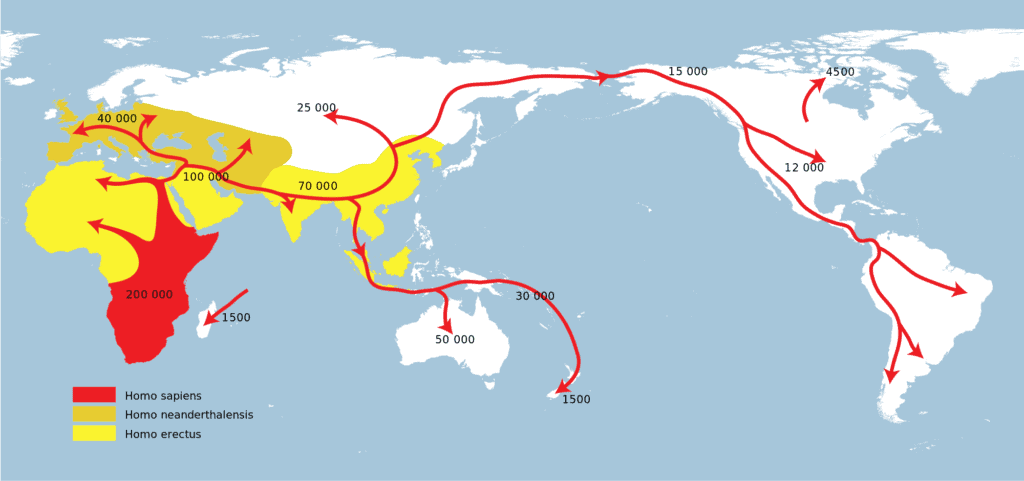
Migration of species, via Wikipedia.


Labels: , , , ,

 
()() Follow @rheytah Tweet