In Truth, There Are Consequences
"Michelle's stated desire to become transgender was never challenged and it was treated to the exclusion of her other serious mental health issues, closing the door to alternative treatment options.""[The defendants] permitted Michelle to self-diagnose as transgender and prescribe her own treatment without providing a differential diagnosis or proposing alternative treatments.""Michelle came to believe that her biological sex of female did not match her true gender identity of male.""She further came to believe that this mismatch between her biological sex and gender identity was causing her feelings of depression, self-harming behaviour and unease in her body, a mental-health condition commonly known as gender dysphoria.""However, as a result of what she read on the internet, she became convinced that she was a transgender man, and that once she embraced this new identity, her depression would subside.""Michelle has struggled to come to terms with the permanent changes from her hormone treatments and hysterectomy surgery have caused; a low voice, male-pattern balding, facial hair, an enlarged clitoris, a flat chest, and the inability to ever become pregnant.""All of this has caused her to suffer from a worsening of her depression."Statement of claim; legal suit,Ontario Provincial Court
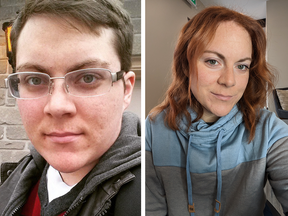 |
Orillia, Ontario resident 34-year-old Michelle Zacchigna has launched a malpractise suit against no fewer than eight health professions. Included among them are doctors, psychologists, a psychotherapist, and a counsellor. The defendants operate out of a number of clinics and institutions in southern Ontario. Four of the defendants filed notices of intent to defend against the suit in Ontario Superior Court; statements of defence have yet to be filed.
"I've been under the impression that all medical malpractice suits are challenging. Doctors win the majority of cases in Canada", observed the women in conversation with news media. "It's very much a David and Goliath undertaking."
Ms. Zacchigus narrates her early years of social difficulties forming relationships with fellow students in elementary school. She was often the subject of bullying at school. Which led her by age eleven to begin behaviours known as self-harming; cutting her arm with a knife as example, behaviours that carried forward into adulthood. At age 20 she attempted suicide and was referred for psychotherapy by her family doctor. She was treated for social anxiety and clinical depression.
None of which helped her out of her unhappy and depressed state. She dropped out of university as a result of her mental health decline. While she was in therapy she came across an online community focused on gender noncomformity. What she gleaned from the site was an insight into her dysphoria; the first indication she felt of having been born in the wrong body. Before this she had not identified as male.
"Michelle received these formal diagnoses for the first time nine years after she was formally referred to the [therapist] following her suicide attempt in 2008, and eight years after she first 'came out' as transgender in 2009.""[The psychologist] did not analyze or consider whether Michelle met the diagnosis for gender dysphoria in her assessment reports."Statement of claim for lawsuit
At this point she began attending a support group in Toronto for people thinking of gender transition. There a counsellor informed her of opportunities she could access to proceed through a medical transition and she was invited to apply for medical intervention in 2010. A recommendation letter written by the counsellor outlined a medical history failing to match fully her past medical history, according to the claim. Nor were alternatives recommended or encouragement to seek confirmation of her own diagnosis of gender dysphoria.
All this in a background where professional medical governing bodies, institutions such as school boards and dysphoria-counselling clinics have cautioned teachers, doctors, academic administrators, as well as friends, family members and even parents not to question people -- including underage children -- convinced they are occupying incorrect genders and plan to transition to complete their journey through life in psychological comfort.
Her regular therapist recommended her for transition treatment, indicating that she was an 'ideal candidate for hormone therapy'. The supervising psychologist of the therapist supported the recommendations and at a Toronto health centre Ms. Zacchigna was prescribed testosterone hormone therapy following three appointments. The MD working out of the health centre then became her family physician.
"On or about November 20, 2020, Michelle began to question whether she had ever been transgender, or if she had ever met the criteria for gender dysphoria.""Since that time, she has commenced a process of detransition toward living life as a woman again.""The Defendants failed to investigate or failed to adequately investigate and/or confirm that Michelle's stated desire to transition to the male sex was rooted in a diagnosis of gender dysphoria resulting from other factors in Michelle's mental health including her history of clinical depression, anxiety, developmental disabilities, and social difficulties."Statement of claim, lawsuit
According to the lawsuit claim neither her mental health nor counselling records were consulted; no screening "for any other mental health diagnoses or development disabilities" were considered. She underwent testosterone therapy for three or four years. Then, in 2012 her breasts were removed by a surgeon in Florida on the recommendation of her doctor; a procedure she paid for. She became 'disenchanted' with testosterone four years later. "She no longer cared about the ongoing masculinization of her body".
A psychologist diagnosed her in 2017 with several conditions, including attention defiicency, hyperactivity disorder, borderline personality, clinical depression, autism spectrum disorder, and traits of post-traumatic stress disorder, according to the statement of claim. Her family doctor referred Ms. Zacchigna in 2017 to another doctor for possible hysterectomy surgery. A year later she underwent a partial hysterectomy.
She now seeks $350,000 in general damages to compensate for pain, suffering and loss of enjoyment of life, as well as an undetermined amount for past and future loss of income, past and future medical treatment, along with other expenses and costs. It might seem to the casual onlooker that she could experience some difficulty persuading a judge and jury of the implication that she experienced 'loss of enjoyment' through a life fraught with psychic insecurity and unhappiness, much less loss of income.
Under current medical practise, patient insistence that they know best what they feel and how they feel and why they feel should be honoured. Doctors are pretty well forbidden from questioning the wisdom of choice of patients, suspected mental instability aside. In fact, mental instability might be viewed as par for the course for anyone seeking gender transition. Health professions committed to the concept of 'the patient knows best' have become enablers out of conviction.

“I will live the rest of my life without breasts, with a deepened voice and male-pattern balding, and without the ability to get pregnant. Removing my completely healthy uterus is my greatest regret,”
Labels: Gender Dysphoria, Hormonal therapy, Regre.s, Surgical Intervention, Transitioning
posted by Pieface @ 8:14 PM
0 comments