Ruminations

Blog dedicated primarily to randomly selected news items; comments reflecting personal perceptions

Sunday, March 29, 2020

Optimistic Good-Humour Survivor

"I shouldn't have been here past last summer. Nobody knows why I am still here, but here I am, and I am doing fine."
"It's black humour, you know. Really, I have to laugh, because if you can't laugh at it what else can you do?"
"I said to the doctor, who was dressed like a Martian in a protective suit, are you kidding me?"
"I can probably renovate any house now [after having watched innumerable home renovation shows while in isolation]. So, if you are looking for someone, let me know."
"I remember thinking, when the doctor told me I had COVID-19, 'Screw this, I'm not letting a stupid virus get me, not after making it this long with my brain tumour'."
"I know that sounds crazy, but that's what I thought: Forget it. I'm not dying now -- and I came through it."
Rene Galipeau, 75, Toronto
The retired mining executive has indeed experienced quite a few health challenges in his lifetime. Enviably, he managed somehow, to retain both his sense of humour and his hold on life. This man has had a long history with cancer -- all kinds of cancer. Not in itself surprising, perhaps, since there is a family history of cancer, and deaths resulting from that genetic inheritance. The first time he waltzed with cancer was 28 years ago when he was diagnosed with a late stage lymphoma.

That was a time when it was very handy to have close relatives. His identical-twin brother volunteered with a bone marrow transplant, and that meant his survival. Over the years that followed Rene Galipeau was diagnosed with skin cancer, bladder cancer and prostate cancer. And he managed to survive them all. And then, a year-and-a-half ago, came news of another cancer. The specialists advised him this time it was a brain tumour, and in their experienced wisdom he had eight months to live.
René Galipeau on a walk with two of his six grandchildren. Courtesy René Galipeau
What he did within that eight months was to focus on his family. With six grandchildren that meant a lot of time spent giving all of them special attention. Of the two grandchildren who love hockey he planned a trip to Boston to watch the Toronto Maple Leafs play the Boston Bruins. Two of the grandchildren focus on baseball, so he went with them to Cooperstown, New York, home of the Baseball Hall of Fame. With the final two grandchildren, their grandfather planned a trip to Quebec City for a live history lesson.

"Everybody said I was crazy, but I got all the trips done in the first six weeks. But now I am still here", he mused. Then, more latterly, he experienced several seizures and was hospitalized on March 17. There, doctors confirmed that it wasn't his brain tumour that was involved, but another illness altogether; COVID-19. And then, the following day his wife of 32 years was confirmed with the novel coronavirus as well. The hospital sent them home to "ride things out", together.

Their 19th floor condominium has a picturesque view of Lake Ontario and no doubt they spent many hours gazing out at the winter lake. Mary Galipeau was bedridden with a high fever and was much more ill than her husband whose symptoms galvanized around a cough and heavy fatigue. Neither has any idea how they might have become infected with the virus. They hadn't travelled, and there was nothing out of the ordinary in their usual routine.

But that's the thing about this mysterious new respiratory disease; it is readily transmissible, and its active phase on hard surfaces is prolonged and easily picked up by the unaware, left to infect others by people who in all likelihood themselves had no symptoms and had no idea that they were infected and acting in society as vectors.

Mr. Galipeau attributes his body's ability to withstand the truly deadly illnesses he has been exposed to, to the influence of his wife. Her sunny, optimistic outlook on life reflects his own. His identical twin brother had contracted the same brain cancer that now afflicts Rene, but his brother died of it. An older brother had lung cancer at age 48 and died from that. 

Now, both Mary and Rene are looking forward to summer, where they plan on spending quality time on Lake Erie, at the family cottage.
Details from article by Joe O'Connor, National Post
Bruce Trail
Lake Erie, Cottage Life

Labels: , , ,

Sunday, October 06, 2019

Location! View! Security! Elegance! Prestige ....

"[Doomsday investors sell a] hypermasculine fantasy [that danger is approaching, and they will provide to those who can afford the comfort, the capability of saving their families from disaster -- should they care enough to make the choice]."
"Fear sells even better than sex."
John W. Hoopes, professor of anthropology, University of Kansas

"Our clients are sold on the unique advantage of having a luxury second home that also happens to be a nuclear hardened bunker."
"This aspect allows our clients to invest in an appreciating asset as opposed to an expense."
"Some people are worried about solar flares taking out the power grid. Some are worried about a dirty bomb or a pandemic, but it doesn’t matter what your threat scenario or ranking is, what matters is that this is a one-size-fits-all solution. ... Having a survival facility is certainly in vogue."

Read more here: https://www.kansas.com/news/local/article134892379.html#storylink=cpy
"If you’re designed to withstand a nuclear explosion, you already get a lot of the other threats you can keep out. You get protection from things like meteors, comets, tornadoes, hurricanes, solar flares, civil unrest, global climate change, earthquakes, tsunamis."
"You can see the activity, you can see the wind turbines in the background on the hill [through CCTV. Psychologically, you don’t feel isolated. For all practical purposes, you couldn’t feel if you were on the surface or if you were 100 feet underground."

Read more here: https://www.kansas.com/news/local/article134892379.html#storylink=cpy
d more here: https://www.kansas.com/news/local/article134892379.html#storylink=cpy
Larry Hall, condominium developer, Survivor Condo, Kansas
Survival Condo Project Garage 2.JPG
Courtesy of Survival Condo Project

Prepared to live 61 meters underground? Has Larry Hall got the luxury condominium unit for you! He's got the goods if you've got the lucre. These are condominiums with high ceilings and spacious living rooms. Amenities? a swimming pool, saunas, movie theatre. No worries, really, should the apocalypse ring in the new year -- or for that matter any year. He's got it all covered in his converted nuclear missile vault that is now a luxury condominium, 15 stories in height. Hard to see that height in the landscape, though. It's all underground.

He's a doomsday capitalist, like other new real estate developers who have realized that the thrill of knowing something very, very bad is in the future for humankind and short of establishing a colony on Mars which would take some time and some doing, the alternative would be to burrow underground, like a mole. The concept is not particularly new. Generations of Americans have built fallout shelters. Remember the Cold War? And the fears surrounding Y2K and basement supply caches?

A living room in the Survival Condo complex, a converted missile silo, includes a live video feed of the world outside.
Living room includes a live video feed of the world outside. The Wichita Eagle

Read more here: https://www.kansas.com/news/local/article134892379.html#storylink=cpy


Well, now we have these wonderful new Doomsday Paradise sites. Want to be ahead of the game in this multimillion-dollar business? Feel like escaping from the inevitable-seeming potential of climate change, terrorism and other threats to human health and longevity? The choice is yours -- grab for it!

The military in its wisdom spent billions of dollars in the construction of nuclear warheads, hiding them in underground lairs in one site after another during the Cold War. Kansas, Nebraska, Oklahoma and New Mexico were favoured sites. They've since been decommissioned. The Cold War fizzled. Of course it's returned and so have many other unfavourable-to-peace-and-life situations. Which is the point, after all; evading them entirely, as a  practical and attractive alternative to becoming a victim of 'circumstances'.

In the Survival Condo where apartments begin at $1.3 million, there is a dozen apartments to choose from. Oh, and a monthly fee of roughly $2,600. In this place where visitors enter the complex through a concrete dome. The apartments sit below, stacked, fifteen stories of them. Add to that the additional lifestyle conveniences such as digital screens in place of windows, to emulate the 'outside'. There's a dog park, where dogs can be dogs.

Full floor units at the Survival Condo cost $3 million, while half floor units cost $1.5 million.
Full floor units cost $3 million, half floor units $1.5 million. The Wichita Eagle

Read more here: https://www.kansas.com/news/local/article134892379.html#storylink=cpy


There are storerooms for food storage. A swimming pool, did we mention the swimming pool? The building has been outfitted with five air filters, a well has been drilled to the nearby aquifer. Diesel generators are in play, alongside a wind turbine and a battery bank for backup power. No worries, none whatever.

Originally the site was outfitted to house an Atlas-F missile. Its warhead infinitely more powerful than the bomb that was dropped on Nagasaki. Oh, not to worry, it's no longer there. Apartments are, condominium apartments. Nifty, huh? The U.S. military spend millions to build this vault, and when it was sold in 1967 the new owners paid just over $3,000 for it. And then there was a succession of handovers to other owners, with the price steadily rising, until Mr. Hall bought it. And spent $20 million remodelling it.


If the facility ever went on lockdown, children would have to attend classes four hours each day in this classroom in the Survival Condo facility.
If the facility ever went on lockdown, children would have to attend classes four hours each day in this classroom in the Survival Condo facility. The Wichita Eagle

Read more here: https://www.kansas.com/news/local/article134892379.html#storylink=cpy

Larry Hall is an entrepreneur's entrepreneur, a man excited by possibilities, and willing to take risks because he so enjoys the opportunity to enhance and enrich peoples' lives. What could be more enhancing and attractive than selling not only a home, a lifestyle, but an assurance of avoiding disaster where others cannot? All it takes is some forethought and lots of money. The money is a piffling consideration, since after all, what's a life worth?

So excited is he over future prospects that he is busy building another, larger condominium project. A second Kansas vault, three times larger as the first experimental one keeps him busy, very busy.
The 'end' could arrive at any time, and there is so, so much to get done, to be able to offer assurances and luxury and leisure -- peace of mind! -- to people deserving of it. Evidently every time North Korea explodes another missile, enquiries about new condos come pouring in....
An armed security guard stands by an armored Pit-Bull VX outside the Survival Condo complex.
An armed security guard stands by an armored Pit-Bull VX outside the Survival Condo complex. The Wichita Eagle

Read more here: https://www.kansas.com/news/local/article134892379.html#storylink=cpy


Labels: , , , ,

Saturday, October 05, 2019

Egregious Waste Habits in Toilet/Sink Flushing

"We were all rather surprised to find that this Sidmouth fatberg was simply a lump of fat aggregated with wet wipes, sanitary towels and other household products that really should be put in the [garbage] bin and not down the toilet."
"Sidmouth is a small coastal community [in southwestern England] that is largely populated by retired people, so in a sense that explains it."
"This is not a hotbed of crime and drug-taking or anything like that. The microfibres we did find probably came from toilet tissue and laundry, and the bacteria were those we would normally associate with a sewer."
"It was my first time analyzing a fatberg, and when you smell it you think this is going to be the last time because the smell was honking. It was awful to do, it smelled gross."
Dr.John Love, professor of synthetic biology, University of Exeter
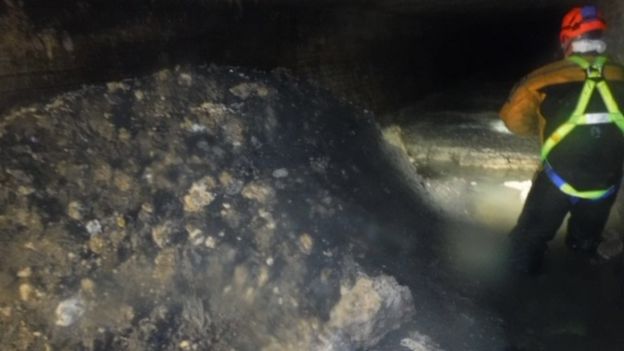
A sewer worker stands next to the "monster" fatberg
Sewer worker next to the fatberg    South West Water


In 2017, the world was introduced to the notoriety of urban fatbergs, greatly immense aggregations of household waste, along with cooking grease, whose size typically blocks sanitary sewage systems and cause an ungodly odour of fermenting rot. A 140-tonne fatberg was discovered in London's East End that year, and an 'autopsy' later conducted to determine what, exactly such a gigantic slug of discarded material might possibly consist of, aside from the suspected main ingredient; fat.

What was found was that the residents of London, similar to what residents of New York City were doing, were flushing condoms down the toilet, along with syringes and narcotics -- with the inclusion of cocaine and ketamine -- and all these forbidden objects which even the village idiot should be aware, have no place in a toilet being flushed through the sewer system, were lodged within that time-accumulated fat globule of monumental size.

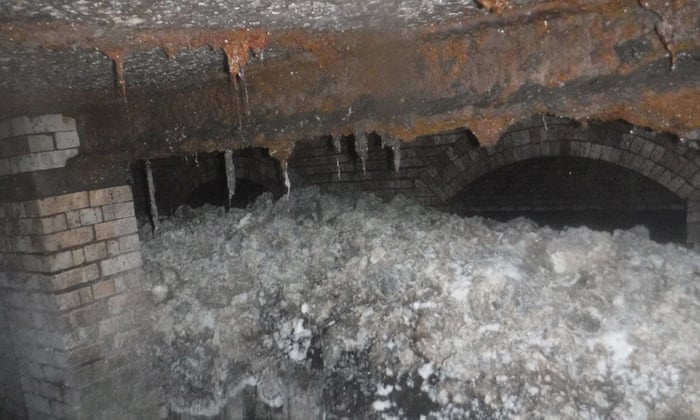
More recently, a routine check by South West Water, an industrial sewage maintenance company managing the Sidmouth sewers (as well as 11,000 square kilometres of sewage lines throughout England), had a routine check done on the condition of its sewers last year. This is when it was revealed that a 64-metre-long fatberg was comfortably resting under the seaside town's seafront road, the Esplanade.

Its discovery set a removal operation into motion to dismantle the lump. Workers laboured for eight weeks to excavate the resulting 36 tanker loads of debris that comprised the fatberg, at a cost of $123,000. Sidmouth, it should be noted, has a population of merely 13,000 people who live there year-round. Its modest population size would never have registered as a potential site where such a fatberg could go undetected for so long.

"We wanted to learn as much as we could about it, how it was created and what it was made of", Andrew Roantree, South West Water's director of waste water, commented. Which led to four ten-kilogram lumps being extracted from the blockage and sent over to the nearby University of Exeter for scientists there to examine, by agreement. A ten-scientist team responded to the challenge, under the leadership of Dr. Love.

They melted down parts of the mass they had been put in charge of, carrying out a dissection, extracting and identifying the waste materials, and even extending the process to perform DNA sequencing. For obvious safety reasons, the researchers equipped themselves with stab-proof gloves and steel-capped boots for protection. Weeks of analysis led them to the conclusion that no dangerous bacteria or chemicals were present in the lumps.

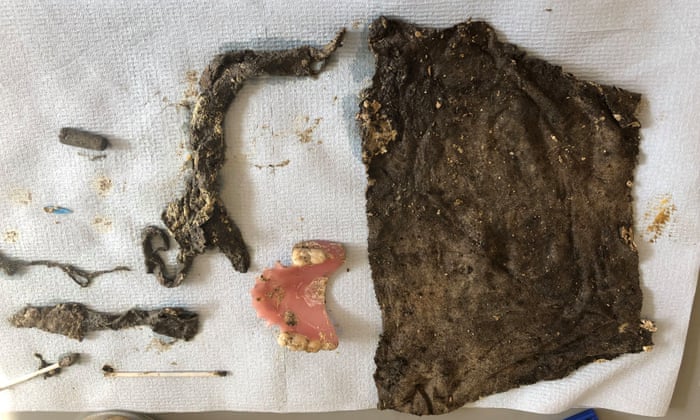
What was present was a composition of domestic waste all glued together by home-cooking fats, dumped down the sink drain or the toilet. The contents of the fatberg reflected the makeup of the town's population; elderly retired people. Not that age fails to confer appropriate intelligence, or being retired should equate with both cognitive and physical decline or laziness, but in this instance it appears that both perceptions might be correct.

False teeth among the things found in the fatberg. Photograph: University of Exeter/PA

Within the massive, disgusting mess were wet wipes, oils, sanitary products, and surprise! a set of false teeth. Municipal authorities could be forgiven in assuming that most people are intelligent enough not to flush wet wipes, sanitary napkins and towels and elders' diapers or condoms of anything other than normal biological waste and toilet paper down the toilet, yet even so public education campaigns reminding people are often launched by necessity.

Sidmouth's disgustingly stomach-churning mess of a fatberg was longer than the Tower of Pisa. But great relief, right? It was found, and removed, and the event memorialized through publicity. Are the residents of Sidmouth any the wiser now? Actually, according to South West Water's director of waste water, Mr. Roantree, the sewer re-visited in the last few weeks was discovered to be hatching yet another fatberg.

Which the company plans to speedily address and remove before it takes any greater size. While they're at it, they should melt a portion of the fatberg to extract some of the odoriferous liquid to spray it over the homes whose toilets produce these messes, as a reminder to residents that this is their disgusting habit, to create these noxious substances, through indifference and neglect and outright stupidity. And through DNA analysis, identify to which of the households the dental set should be returned.
"Although we deal with around 8,500 blocked sewers every year, the Sidmouth fatberg was by far the largest discovered in our service history."
We wanted to learn as much as we could about it, how it was created and what it was made of to help us avoid further fatbergs in future."
"The results confirm our suspicions, that fat and non-flushable products such as wipes are the main culprits, and that fatbergs are a consequence of the individual and collective impact that our behaviour has on our environment."
"We will be using these results to help us educate, inform and change the behaviours of people in terms of what they are putting down the toilet and sink. That’s not just applicable to Sidmouth, but across our region."
Andrew Roantree, director of waste water, South West Water
It took eight weeks for a team to remove the fatberg from the sewer after it was discovered a year ago. Photograph: South West Water/PA

Labels: , ,

Wednesday, March 06, 2019

The Passing Years

"It showed [Getty Images search for online images of older people] that we are just not visualizing older people with the same richness and diversity that we use to visualize younger people."
"Instead of representing aging in a genuine way we are reinforcing stereotypes."
Rebecca Swift, director of creative insight, Getty

"If we can get people to think about aging in a much more positive way and not as this inevitable cascade of decline then we could start to see really impressive feats of function in older people that wouldn't be just exceptions to the rule but would just be, 'Well, that's what older people do now'."
Joe Baker, kinesiologist, York University, Toronto
Jack Lemmon and Walter Matthau star in Grumpy Old Men
Jack Lemmon and Walter Matthau star in Grumpy Old Men    Credit: Rex

In bygone societies the elderly were celebrated for assumed and legendary levels of wisdom, related to their years of life giving them opportunities for experiences, each of which is considered a learning opportunity to accumulate knowledge and confidence about the world around them. Placing them in a trusted position to teach the younger generation through capitalizing on the knowledge they acquired through living and exposure to life's vicissitudes.

The elderly were respected and honoured, as long as they weren't living in subsistence societies where resources to sustain life were limited and everyone in society was expected to expend time and energy to be productive. In some such societies, once the elderly became infirm and could no longer contribute to the general weal while remaining respected, they acceded to a custom of removing themselves, recognizing they had become a burden.

In today's societies of relative plenty while the elderly have equal status in importance to all others their status as elders is accepted as a natural order of life progressing from infancy to adulthood to the senior years and death. An aura of expendability has arisen in a culture that celebrates youth, freshness, action, beauty and good health. Everyone wants to be included in the category of 'young', including the elderly, attempting to fashion themselves as pre-elderly.

And those whose health is impaired by age to the point where such a pretense is no longer viable, regard themselves gloomily as old, decrepit, awaiting the inevitable. That frame of mind can wreak deadly damage on a psyche fixated on the benefits of youth they feel they never fully sufficiently appreciated when they were young and yearn to recapture now that they are not, but with ill health dominating their lives they surrender to mere existence with scant pleasure in life.

Rebecca Swift was alluding to a 2016 search by Getty Images relating to their stock photo inventory and their web-crawling technology, discovering in their search for typical photographs of the elderly that what they found were pictures of unhappy, sedentary people, people shown in stereotypical activities; sitting around with grandchildren, having tea with other elderly; typical inaction associated with 'being old'.

Film and advertising, television shows and online images all portray the typical older person whom society generally glances past, ignores or views as caricatures, because of course aging is a natural phenomenon beloved of no one.   If, on the other hand, as a member of that demographic one is routinely exposed to these popular cultural tropes it has a depressing effect; a generation viewed in unappealing stereotypes, gearing the onlooker to anticipate their own impending fate.

It is well known that exposure to racist and sexist assumptions can cause minorities and women to test and think less positively about themselves. There are studies that demonstrate that older people will tend to walk, talk and think more tentatively if they have been exposed to ongoing, unflattering images of the elderly frail, incapable of adequately caring for themselves, withdrawing from general society.
Vivienne Flesher

At York University's School of Kinesiology and Health Sciences, Rachael Stone, a researcher, had older test subjects climb a flight of stairs. She then had them repeat the exercise after giving them a false article to read on aging eroding stair climbing ability. From speed, to accuracy, to balance, their performance deteriorated.

Memory too is susceptible to a similar decline when doubts assail one's capacity because of exposure to stereotypical renditions of the elderly mind fraught with memory lapses. Those risible but telling "senior moments". Many elderly make the assumption that their memories are failing them and because they feel that way, they make no effort to use that function; to recall a long-familiar recipe, to rely on a GPS system driving a familiar route. Cognitive decline follows when the brain is underused.

There are ample studies that illustrate that people with a more positive view of growing older will be better at looking after themselves, performing better on memory and motor control tests where they are able to walk faster, standing a better chance of recovering from disability and living an average of seven and a half years longer than others of their age group who make no effort to use all their functions, physical and mental.

Researchers at Yale University studied people with a gene variant linked to dementia, finding that those with a favourable view of aging were fifty percent less likely to go on to develop the disease than those with a gloomy outlook. Professor of epidemiology and psychology Becca Levy, the lead author in the study regards the results as an action call: "This helps make the case of implementing a public health campaign against ageism".

Image

Labels: , , , ,

Sunday, August 12, 2018

Reaching For The Sky

"It's [a] blast, man! [To air traffic controller] I played video games before so, you know, I know what I'm doing a little bit."
"Man, I'm sorry about this. I hope this doesn't ruin your day. I'm glad you're not, you know, screwing up everyone else's day [by re-directing air traffic to steer planes away from the flight of the plane absconded with] on account of me."
"I got a lot of people that care about me and it's going to disappoint them to hear that I did this. I would like to apologize to each and every one of them. Just a broken guy, got a few screws loose, I guess. Never really knew it until now."
"[I'm a ground service agent] That means I lift a lot of bags. Like, a lot of bags. So many bags."
"[But] it [his job] allows me to do some pretty cool things, too. I get to visit those [geographic places like Alaska, France, Ireland, Mexico] I love the most."
Richard B. Russell, Horizon Air ground service agent
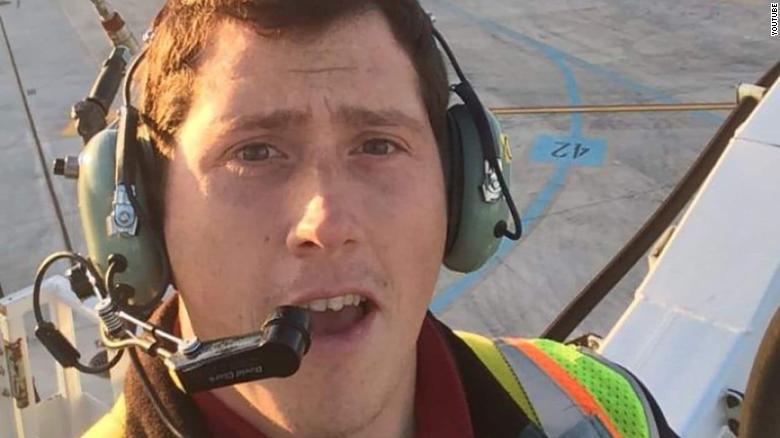
Richard B. Russell, 29, Horizon Air Industries ground service agent : still from video

"They don't necessarily use a key, so there's switches that they use to start the aircraft."
"So if the person has basic understanding -- from what I understand he was support personnel, ground personnel -- they probably do have at least a basic understanding on how to start the aircraft."
Debra Eckrote, chief, north-west regional office, National Transportation Safety Board

"Commercial aircraft are complex machines."
"I don't know how he [Richard Russell] achieved the experience he did."
Gary Beck, chief executive, Horizon Air Industries

"I want to share how incredibly sad all of us at Alaska [Airlines] are about this incident."
"Our heart is heavy for the family and friends of the person involved."
Brad Tilden, chief executive, Alaska Air Group/Horizon Air

"We are going to be thorough, which means taking the time needed to scour the area, delve into other background of the individual believed responsible, and review every aspect of this incident with all appropriate public and private partners."
Seattle FBI field office statement
'This is probably jail time for life,' airline worker says before crashing empty Alaska Airlines plane near Seattle
Planes sit on the tarmac at Sea-Tac International Airport on Friday as service was halted after an Alaska Airlines plane was stolen. (Bettina Hansen / Associated Press)

How well do we know ourselves? Here is a man who on impulse or inner compulsion acted on a wish he may have long harboured to fly a commercial plane. He had no formal training. He used video instructions and simulations to acquaint himself with some basic flying methodology. A huge leap to take from thinking about something of that nature to actively setting out to make it reality. It ended, in the words of Pierce County Sheriff Paul Pastor of the Seattle region as a "joy ride gone terribly wrong".

Richard Russell had the requisite security clearance for his job. He had worked for the airlines for three and a half years, and was paid an hourly wage pittance for his labour. He knew he was underpaid and resented that, but he liked his job and enjoyed the perquisites that came with it; travel opportunities that he valued despite being paid under the minimum wage limit of $15 an hour.  He worked "on the secure side" of the airport, and he was on shift duty Friday.

"Just a broken guy, got a few screws loose, I guess. Never really knew it until now", he remarked casually to the air traffic controller he had been in conversation with and who was guiding him and other planes to avoid his flight path. Are most of us susceptible to sudden, inexplicable impulses to commit to doing things we know will end up badly? He was aware that what he had begun was illegal, a criminal act, a dangerous one and that he could be imprisoned for endangering himself and the public.

He was paid and trusted to handle luggage and cargo and to tow aircraft. But he decided to take a chance, perhaps confident he would survive flying a plane for the first time. He'd had no flying lessons, wasn't obviously capable of applying for a pilot license. But there he was, soaring above the Olympic Mountains after takeoff from Seattle-Tacoma International Airport. Passengers were stranded in the terminal, alternatively seated in planes parked on the tarmac, their flight delayed while the drama in the sky played out.

Richard Russell enjoyed an hour in the air, admiring the views below at sunset after his 7:30 p.m. takeoff. And he was, as he said, having a "blast". Onlookers from the ground took videos and they watched as he took the plane into deep dives, broad loops and a heart-stopping upside-down roll. This was nothing like working on the ground, loading, fueling, cleaning airplanes. A work colleague who had known him for decades as school chums described him as a regular church goer "so he doesn't really fit the bill of someone who would steal an airplane. Funniest person in the room. Nicest person in the room".

"I do remember him as a nice quiet young man", remarked Rick Christenson, an operational supervisor with Horizon, suggesting that the young married man might have learned to fly from "flight simulator games". About 48 kilometres from the airport the plane descended and crashed on Ketron Island, killing the nice young man.

The plane was a Bombardier Q400, like this Horizon Air plane shown in May 2017. Horizon Air is a sister carrier to Alaska Airlines.
The plane was a Bombardier Q400, like this Horizon Air plane shown in May 2017. Horizon Air is a sister carrier to Alaska Airlines

Labels: , , ,

 
()() Follow @rheytah Tweet