Ruminations

Blog dedicated primarily to randomly selected news items; comments reflecting personal perceptions

Tuesday, December 06, 2022

From Medicine To Space Flight

"[Going into space is like going into a hospital emergency room]. You have to prepare yourself for anything and everything."
"[Pilots prepare themselves of course but] for space missions to be successful, you've got to have that health-care component."
Dr. Farhan Asrar, assistant professor of medicine, University of Toronto

"[There are] Striking parallels between the challenges and constraints of rural medical practice and medical care for on-orbit astronauts; isolation, self-reliance, limited equipment, and impractical or impossible medical evacuation."
"Similar problems often have similar solutions; that's why medical technology developed for space crews is usually relevant to medicine on Earth. And vice versa."
Dafydd (Dave) Williams, emergency physician, Canadian astronaut 

"[Astronauts and physicians both use distinctive language] Acronyms and jargon pepper our conversations with colleagues. I smile to myself whenever I encounter a new space acronym that shares a meaning from my medical past."
"[Space agencies are called upon] to recruit physicians for our unique training experiences and for the operational capabilities that we hone on hospital wards."
Bob Thirsk, family physician, Canadian astronaut
https://www.nasa.gov/sites/default/files/thumbnails/image/jsc2021e064218_alt.jpg
NASA
 
Among individuals chosen to wear the Canadian flag into orbit, military pilots and flight instructors leap to mind as the seemingly most appropriate personnel to have aboard a space flight. Chris Hadfield commanded the International Space Station and distinguished himself by his photographs and communications back to Earth through his awe of space and his manner of conveying to an interested general public just how inspiring and vast space is, along with the views back down to Earth.

But there is also the seeming anomaly of people from the general population chosen more latterly to venture where few have gone before. And in Canada's selection of astronauts, medical personnel tend to feature as prominently as pilots. In fact there has been an even selection between physicians and pilots in Canada's opportunities to choose 14 people over the past years with the potential to become astronauts; among them four pilots and four medical doctors.

Community physician Dr. Farhan Asrar, who works out of Toronto area hospitals speaks of the synergies between the mindset of concerns of a community doctor and a space flight crew member. According to Dr. Asrar, astronaut choices transitioned from the early American space programs that focused on the military and pilots, to eventually begin selecting private citizens with specialized non-military careers.

A new paper published in the journal Canadian Family Physician, co-written by Saint-Jacques and Williams states: "Outer space assets offer benefits to health care". Each of the authors contributing reflections on the comparison and lessons drawn from their own parallel careers in both medicine and space flight. Their paper underlines benefits that space technology offered to health care. 

"The Canadian Space Agency's Bio-Monitor, which provides continuous health monitoring, and its Bio-Analyzer, which tests blood and other bodily fluids and provides results within minutes", among them. Sketching out as well complex conceptual similarities in medical education and training for astronauts. The strategy of trapping errors, to "contain and fix" them "before they have mission consequences."
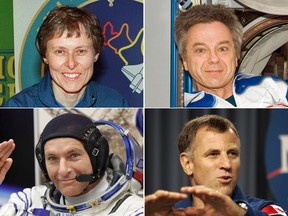
 
Out of the nine Canadian astronaut candidates who have actually made it to space, four have been physicians. They are, clockwise from top left: Roberta Bondar, Bob Thirsk, Dave Williams and David Saint-Jacques.

Labels: , , , , ,

Monday, April 15, 2019

In the Name of Biological Science : Exploring Space

"I believe it's the most comprehensive assessment of human beings to date."
"I don't know that there's been anything close to this."
"The main conclusion I got from this paper, based on all the objective data, is why would anybody want to go to Mars or be in space?"
Dr. Eric Topol, director, Scripps Research Translational Institute

"The fact that they're twins really narrows down the alternatives."
"We can say that, as best as we can tell, these changes [biological changes to the human body] are due to space flight."
"People have asked me, 'Well, is going to space the Fountain of Youth?' I don't think so If it is, you're going to have to stay up there forever."
Susan Bailey, cancer biologist, Colorado State University
Twins Scott Kelly and Mark Kelly
Over the past few years, twins Mark and Scott Kelly have participated in what’s now called the NASA Twin Study: A first-of-its kind longitudinal study in which one brother (Scott) spent a year onboard the International Space Station (ISS) and the other (Mark, who had already retired from spaceflight) spent those same 12 months on Earth.
NASA/Robert Markowitz

Two brothers, actually twin brothers, and both American astronauts. What an opportunity for science to study the effects on the human body that is hurtled into space and remains there for a period of time. What might the change of atmosphere, gravity, living in an scientifically technologically-manipulated environment for an extended period of time result in with respect to the human body's ability to adjust to these radical new conditions imposed upon it?

Scott Kelly, aboard the International Space Station, spent 340 days using his own body as the experiment from which he drew data to be examined at a later date upon his return to Earth from his stay on the orbiting space station. While he played computer games to test his memory and reaction speed, and drew blood for tests, saved his urine for the same purpose, measured the shape of his eyes, his twin brother Mark, conducted identical tests on himself 385 kilometers away, on Earth.

The idea was to compare test results between the twins and to determine the differences at the molecular level. It has taken three years to study the results drawn from the 55-year-old astronaut-twins for NASA researchers to report on the changes that Scott's body underwent while he was in orbit. In some of his cells DNA mutated; his immune system responded with a number of new signals, and his microbiome hosted new bacterial species.

Of the biological changes, many faded away after his return while others, including genetic mutations and declines in cognition test scores failed to return to their former, pre-orbit state. The former was reassuring, while the latter was found concerning, at the very least to the scientists if not to Scott himself. Among the scientists there were some who thought of managing the risks -- leaving others to wonder whether long journeys to Mars or beyond would ever be 'safe' biologically for astronauts.

It's been six decades that astronauts have shot out of Earth's atmosphere into the inner ring of space surrounding our planet. Despite that sixty years and the experiences that have been documented, scientists face a large question mark about life in space. The NASA Twins Study published in the journal Science, led the agency to hope to be able to more fully appreciate changes that Scott Kelly experienced.

Researchers were led to believe by studying the comparison tests between the twins that the pace of biological alterations became more measured, hinting that the human body in space reaches a new equilibrium in adjustment. Dr. Bailey, a co-author of the study, looked at sections of Kelly's DNA called telomeres which protect chromosomes where they are seated, from deterioration. Telomeres become shorter as people age. Radiation or pollution may hasten aging, fraying telomeres more than is usual.

Kelly's telomeres increased while in space, rather than decreasing; it was as though his cells were more youthful, a reversal of expectations -- and it was speculated that the space environment might have aroused a quiet population of stem cells in his body. His body may have produced a fresh supply of young cells with longer telomeres, it was suggested. Thousands of genes, once inactive, increased their activity in Scott's body, while Mark's body on Earth saw his genes remaining stable.

Scott on ISS
Scott Kelly on board the International Space Station during his year in space. (NASA)

Radiation levels in the International Space Station, higher than those on Earth may have been responsible for some of the awakened genes known to encode proteins to aid in restoring damaged DNA. On his return to Earth in March of 2016, his body indicated signs of intense stress, his immune system in high gear, reflecting a shock to the body, which restored to normal pre-flight condition quite expeditiously. The bacteria that thrived in his gut while in space that were alien, disappeared, back on Earth.

Yet some biological aspects of Kelly's body failed to return to their pre-flight norm, and six months following his return to Earth, 8.7 percent of his genes still behaved in an untypical manner -- and research indicated he failed to respond as well on cognitive exams, while even more worrying was a collection of genetic mutations gained in space, enduring. Radiation can trigger a kind of mutation that incites cells to gain even greater mutations as they divide; cells may begin growing exponentially "taking steps on the road to cancer", explained Dr. Bailey.

"I think all of these problems are solvable", stated Jerry Shay, a cell biologist at the University of Texas Southwestern Medical Center, who holds out hope for countermeasures that might protect astronauts. To that end, he and his colleagues are testing drugs meant to trigger cells to mend DNA which has been damaged by radiation exposure.

Research Threads
Graphic illustration of the path the individual Twins Study research takes from research to integration to one summary paper to several companion papers. (NASA)

Labels: , , , ,

 
()() Follow @rheytah Tweet