Ruminations

Blog dedicated primarily to randomly selected news items; comments reflecting personal perceptions

Thursday, June 08, 2023

Crewing a Mars Voyager Spacecraft with Female Astronauts

"On average, women tend to be smaller than men, and so this metabolic advantage may be greater in women, as suggested by our calculations."  
"This is why we concluded that there may be specific metabolic or life support resource operational advantages to all-female crews during future human space exploration missions."
"At this point in time, I don't think our study will have any influence [on the gender of the crew for a Mars mission], and I don't think it should."
"The two studies we performed, one on theoretical male and one on theoretical female astronauts, are just that — theoretical."
Jonathan Scott, researcher, French Institute for Space Medicine and Physiology
https://cdn.mos.cms.futurecdn.net/HQN4xAtnNMhVqf3G6EuWGb-1200-80.jpg
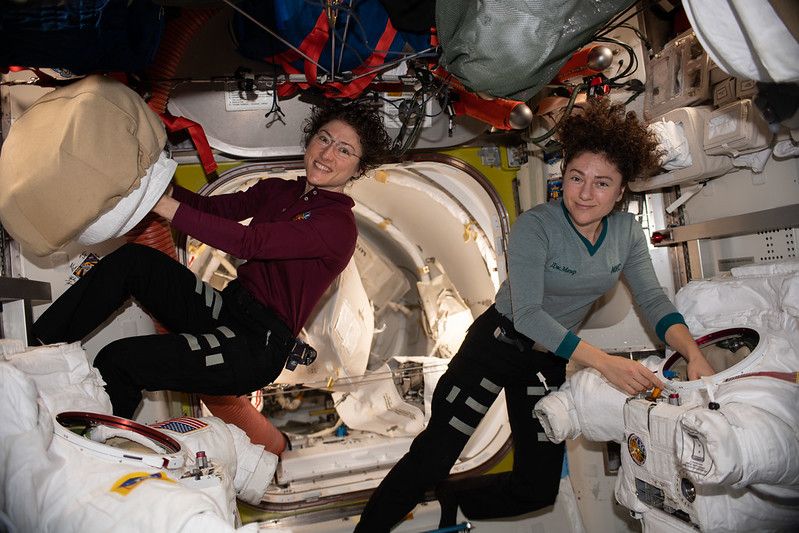
NASA astronauts Christina Koch (left) and Jessica Meir prepare their spacesuits for a series of spacewalks in January 2020. (Image credit: NASA)
Lead author of a new study published in April in the journal Scientific Reports -- Jonathan Scott and his colleagues -- found that female astronauts' requirements for food, water and oxygen are significantly less than needed by their male astronaut-counterparts. Their study looked at requirements for a four-person crew on a hypothetical three-year trip to Mars and back.

This study is one of a growing body of research that suggests female astronauts use far fewer resources of necessity than males. Any reduction in the amount of food, water and oxygen required to sustain life on a years-long journey to Mars and back would generate considerable savings, even to the degree that a mission might become a success, evading failure.

The Scientific Reports study calculated an all-female crew would have a total energy expenditure of between 5 and 29 percent less than would an all-male crew of similar stature, a differential accountable by female astronauts being lighter than males of a similar height, and requiring lower oxygen resources. The study team drew on astronaut data for both sexes back to the 1950s

Early NASA planners had considered female astronauts for the same reason of resource consumption, accompanied by the  belief that females might cope with more tolerance to the tight spaces and isolation linked to such an epic journey. Since that early period of space exploration dating back 70 years, the idea of all-female flights was periodically considered.

In the year 2000, NASA had seriously considered deploying an all-female space shuttle flight. In that same year a paper was published, entitled "An all-woman crew to Mars: a radical proposal", but one that has remained a proposal with dim expectations it would be carried out from its status as a potential to a commitment.
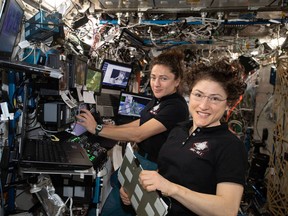
From left, astronauts Jessica Meir and Christina Koch aboard the International Space Station in 2019.
"[International Space Station modules have a diameter of about 4.2 metres; three metres in diameter. might represent the dimensions of a Mars ship.] As such, crews composed of individuals with smaller statures may also have potential habitability benefits (i.e., perceived volume and sensation of ‘crowdedness’) when co-working in the same module."
"In addition, there may also be reduced crew ‘traffic interactions’ where crew members need to move to allow another to pass and/or share equipment or workstations."
Scientific Reports-published study

Labels: , , ,

Tuesday, December 06, 2022

From Medicine To Space Flight

"[Going into space is like going into a hospital emergency room]. You have to prepare yourself for anything and everything."
"[Pilots prepare themselves of course but] for space missions to be successful, you've got to have that health-care component."
Dr. Farhan Asrar, assistant professor of medicine, University of Toronto

"[There are] Striking parallels between the challenges and constraints of rural medical practice and medical care for on-orbit astronauts; isolation, self-reliance, limited equipment, and impractical or impossible medical evacuation."
"Similar problems often have similar solutions; that's why medical technology developed for space crews is usually relevant to medicine on Earth. And vice versa."
Dafydd (Dave) Williams, emergency physician, Canadian astronaut 

"[Astronauts and physicians both use distinctive language] Acronyms and jargon pepper our conversations with colleagues. I smile to myself whenever I encounter a new space acronym that shares a meaning from my medical past."
"[Space agencies are called upon] to recruit physicians for our unique training experiences and for the operational capabilities that we hone on hospital wards."
Bob Thirsk, family physician, Canadian astronaut
https://www.nasa.gov/sites/default/files/thumbnails/image/jsc2021e064218_alt.jpg
NASA
 
Among individuals chosen to wear the Canadian flag into orbit, military pilots and flight instructors leap to mind as the seemingly most appropriate personnel to have aboard a space flight. Chris Hadfield commanded the International Space Station and distinguished himself by his photographs and communications back to Earth through his awe of space and his manner of conveying to an interested general public just how inspiring and vast space is, along with the views back down to Earth.

But there is also the seeming anomaly of people from the general population chosen more latterly to venture where few have gone before. And in Canada's selection of astronauts, medical personnel tend to feature as prominently as pilots. In fact there has been an even selection between physicians and pilots in Canada's opportunities to choose 14 people over the past years with the potential to become astronauts; among them four pilots and four medical doctors.

Community physician Dr. Farhan Asrar, who works out of Toronto area hospitals speaks of the synergies between the mindset of concerns of a community doctor and a space flight crew member. According to Dr. Asrar, astronaut choices transitioned from the early American space programs that focused on the military and pilots, to eventually begin selecting private citizens with specialized non-military careers.

A new paper published in the journal Canadian Family Physician, co-written by Saint-Jacques and Williams states: "Outer space assets offer benefits to health care". Each of the authors contributing reflections on the comparison and lessons drawn from their own parallel careers in both medicine and space flight. Their paper underlines benefits that space technology offered to health care. 

"The Canadian Space Agency's Bio-Monitor, which provides continuous health monitoring, and its Bio-Analyzer, which tests blood and other bodily fluids and provides results within minutes", among them. Sketching out as well complex conceptual similarities in medical education and training for astronauts. The strategy of trapping errors, to "contain and fix" them "before they have mission consequences."
 
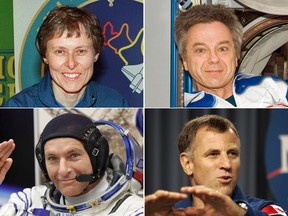
Out of the nine Canadian astronaut candidates who have actually made it to space, four have been physicians. They are, clockwise from top left: Roberta Bondar, Bob Thirsk, Dave Williams and David Saint-Jacques.

Labels: , , , , ,

Sunday, February 20, 2022

Analyzing Deep Space

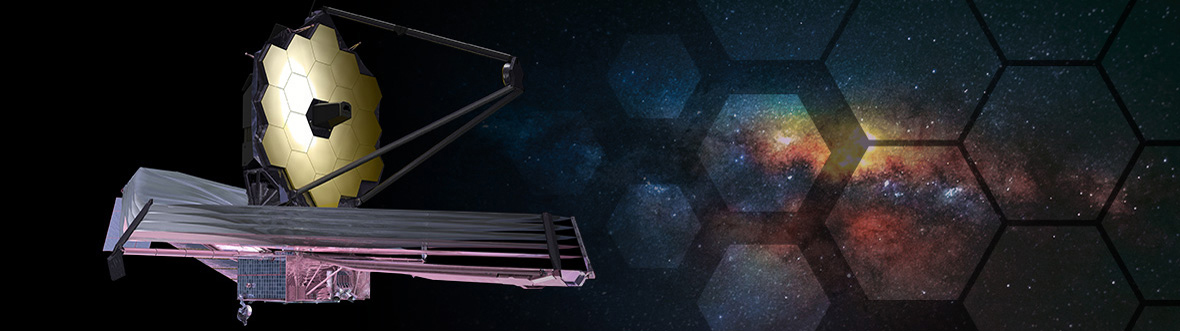
James Webb Space Telescope   NASA
"It's extremely satisfactory seeing everything coming into place. It's a sense of amazement and happiness."
"[The sensor ... Fine Guidance Sensor ...] is mission critical. There was a lot of pressure on us. Everybody was very happy."
"You would be able to point at a human hair [with the sensor] from a couple kilometres away. It's pretty much pushing the limit of what can be done."
"I can't wait to see the data we'll get."
 Jean Dupuis, senior mission scientist, Canadian Space Agency
Canada's Fine Guidance Sensor (FGS) and the Near-Infrared Imager and Slitless Spectrograph (NIRISS) at NASA's Goddard Space Flight Center. (Credit: NASA)

Canada is an integral part of the massive James Webb Space telescope functioning, joining with NASA with the ambitious to make this space exploration project operational, from the beginning. Up to half of the 600 scientists in the Canadian Astronomical Society are or have been involved with the project. Dozens of Canadian scientists and engineers are involved in the design team that produced vital Canadian technology used in the functioning of the telescope. 
 
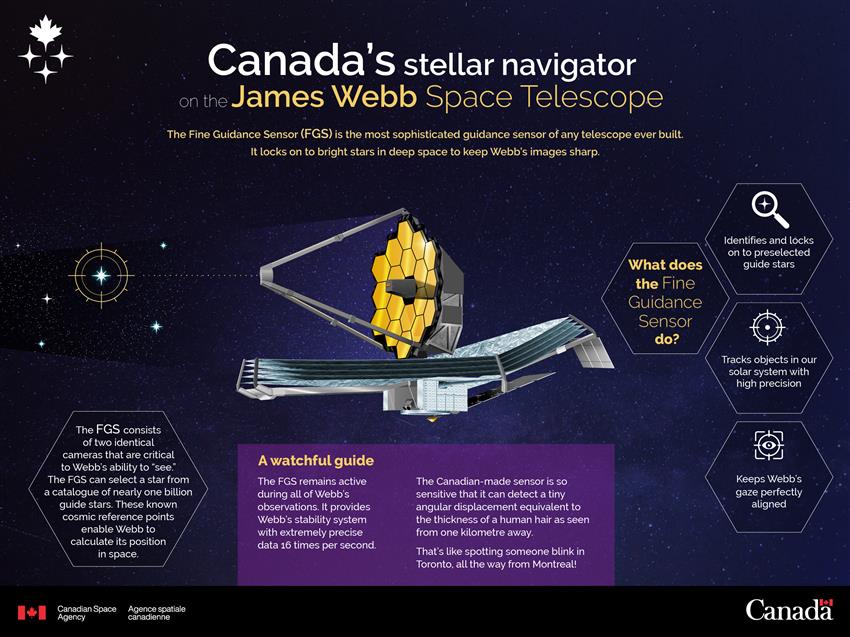
The systems meant to give direction to the telescope have been designed and built through the Canadian Space Agency.

The cost of the James Webb, launched in late December, designed to study the nature of planets beyond our solar system, and to enable study of what the oldest galaxies reveal about the birth of the universe, was $13 billion, and represents over two decades of work. Designed and builtt as the successor to the Hubble Space Telescope, the Webb is meant to orbit deeper into space -- about 15 million kilometres out -- with a sensitivity more than a hundred to a million times greater than its predecessor.

It is deemed to be sensitive enough through the newer technology with which it is outfitted to analyze exoplanetary atmospheres and to gather data from "First Light" galaxies, whose formation extends back 13.6 billion years. Without the installed Fine Guidance Sensor none of these ambitious prospects would be possible. Up and running, the sensor is used to align the telescope's 18 mirrors. It will probably take until summer for the sensor to cool down to below -200C to be fully operative.

Once that happens the sensor will function to aim the James Webb with a precision scarcely believable; down to a few milli-arcseconds. Operational and functional success appears to be the hallmark of the telescope and its launch. In December, NASA announced that the telescope had succeeded in slipping into its orbit so wonderfully well, the fuel savings could operate the telescope for significantly longer a period than the original ten-year lifespan foreseen. 

As well as the sensor, another Canadian contribution is its Near-Infrared Imager and Slitless Spectograph, meant to assist in analyzing light observed by the telescope. As a result of Canadian involvement to the extent and degree that it has been, Canadian astronomers have a special entitlement to five percent of the observation time the telescope offers.

Canadian researchers plan to use the Webb telescope to study asteroids and comets close to Earth as well as the effect that stars have on the space around them in distant regions of the galaxy where new stars are born.
 
Infographic on the Fine Guidance Sensor sophisticated guidance sensor

Labels: , , , ,

Monday, May 31, 2021

Oh, Those Inconvenient Details

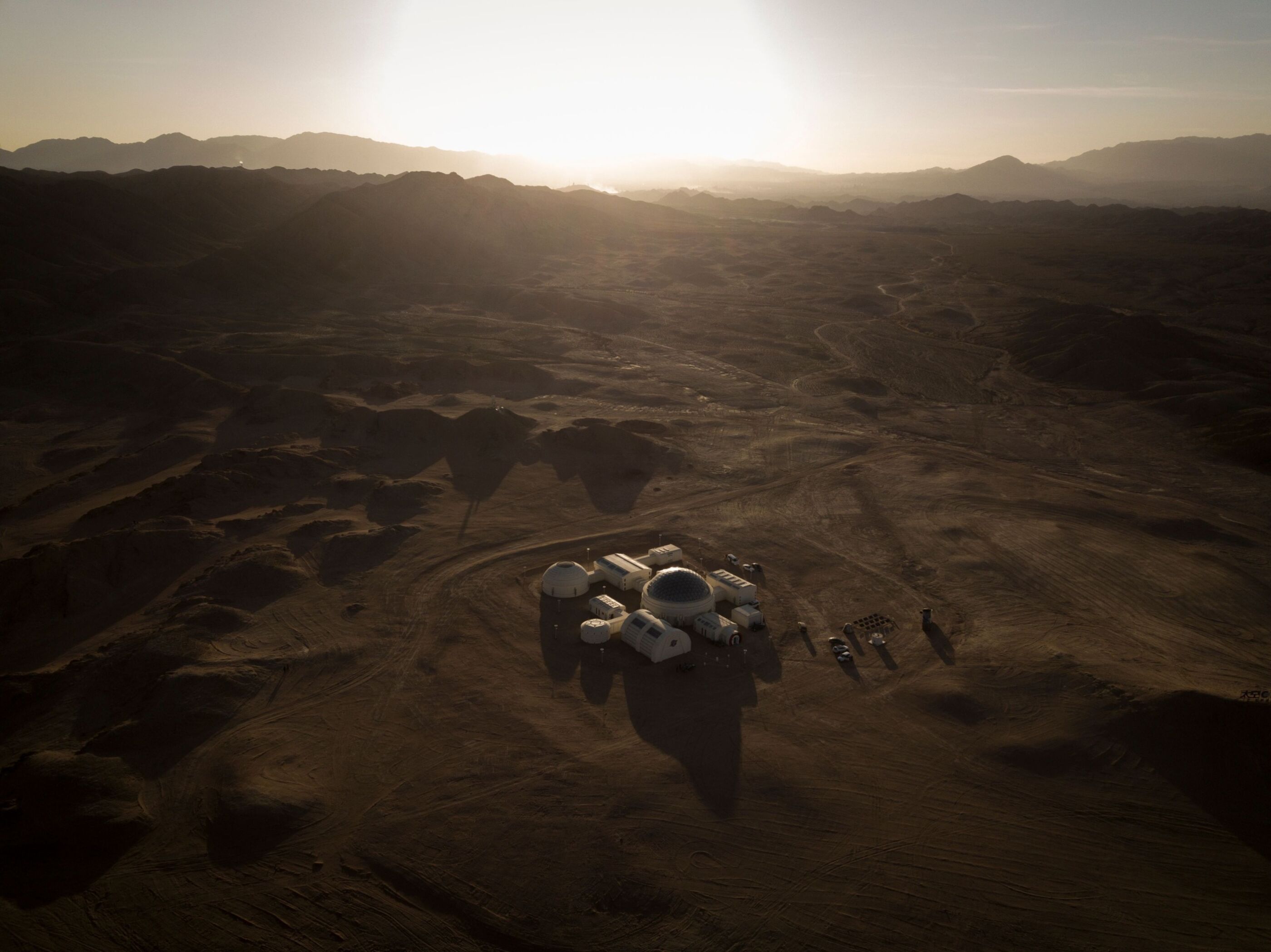
Aerial image of a Mars base simulation surrounded by the empty Gobi desert valleys and mountains
“Mars Base 1” is a Mars simulation center in the Gobi desert. Photographer: Wang Zhao/AFP via Getty Images
"[With lunar exploration], there's always the prospect of rescue or provisioning or supply from Earth or from a midway space station."
"That's not going to be the case for Mars."
Alice Gorman, associate professor, Flinders University, Adelaide, member advisory council Space Industry Association of Australia

"It's a very gruesome way to die [hit by radiation from unpredictable solar flares]."
"We don't have established capacity to observe the Sun from different angles for tracking solar storms."
Lewis Dartnell, professor, astrobiology specialist, Department of Life Sciences, University of Westminster, London

"'During a massive dust storm], it's almost like midnight on the surface of Mars for two months."
"If you are there with solar panels for power, you very likely don't survive."
"You don't have enough energy to keep things warm enough."
Nilton Renno, professor, astrobiology research, University of Michigan

"Today it's definitely a place where we can't live."
"But as we develop science and technologies, the answer might be different in fifty to a  hundred years from now."
Adnan AlRais, Mars 2117 program manager, Mohammed Bin Rashid Space Center, United Arab Emirates
caption
 
There are future plans, ambitious and determined from various sources, to have humans visit Mars and perform preparatory work to form a colony on the Red Planet. NASA plans to send astronauts at some point in the 2030s to Mars. China stated that sending humans to Mars is a long-term goal it holds. The United Arab Emirates promotes a 100-year plan for the creation of a colony; for a starter it has a spacecraft orbiting Mars. For anyone interested in the here-and-now in experiencing what it might feel like to land on the planet, there is a site in the Gobi Desert simulating being there.

And then there's Elon Musk, that forward-looking billionaire, founder of Space Exploration Technologies whose plan is to send humans to Mars within the decade, confident that a crewed mission could occur in 2026. There are risks, he acknowledges, having responded in the face of warning by many scientists that too many unanswered questions confront deep-space travel. "Honestly", remarked the tycoon, "a bunch of people probably will die at the beginning."

It took but a few days for the Apollo astronauts to fly to the moon. Mars, on the other hand, would require between six to nine months for arrival from Earth, the distance between Mars and our planet varying between 35 million miles and 249 million miles taking into account their elliptical orbits, with a small window potentiating when the two would be ideally aligned for space travel; tricky logistics.
 
International Space Station astronauts have been helping to pave the wave for future manned Mars missions. Image via NASA.
 
Exposure during a long flight to one of space travel's terrors, solar flares would await any humans who opted for the experience. Solar flares represent immensely violent hydrogen explosions capable of obliterating everything in their near vicinity, they represent the most powerful explosives in the solar system. A single flare representing the equivalent of 100 million hydrogen bombs. While the Earth's magnetic field can shield orbiting astronauts, a deep-space traveller hit by fierce radiation couldn't survive beyond a few days.

On a multi-month trip to Mars, conceivably shields could be made of water tanks onboard the spacecraft were they to be properly positioned, so in the event of a flare, the spacecraft's version of a panic room surrounded by water tanks could offer a safe retreat to travellers. A bit of a stickler is detecting activity on the Sun, particularly on the side facing away from Earth. So there's the problem of radiation where Mars's thinner atmosphere without a global magnetic shield sees humans risk exposure to solar and cosmic radiation.
 
NASA is developing the capabilities needed to send humans to an asteroid by 2025 and Mars in the 2030s – goals outlined in the bipartisan NASA Authorization Act of 2010 and in the U.S. National Space Policy   vis NASA
 
Then, there's the problem of massive storms that can produce dust clouds to block out the sun, since the Mars surface is itself largely comprised of dust. Humans could conceivably use the dust for protection by lining shelters with sandbags filled with Martian soil to block out radiation, offers associate professor Joseph Michalski, who studies the habitability of Mars at the University of Hong Kong. Cave-dwelling could also be a mode of shelter by exploiting some of Mars's lava tubes, large caverns left over from space antiquity when Mars experienced volcanic activity.

There are experiments taking place in growing algae in low-nutrient environments, in greenhouses as a source of food and the production of oxygen. Survival must include a water source. Mars does contain some sub-surface ice that could be transformed to water. For that purpose the use of radar to map the distribution of sub-surface ice would be invaluable to a future Mars mission. "Once you know where the ice is, those are locations where you might send humans", noted Victoria Hamilton, planetary geologist at the Southwest Research Institute, Boulder, Colorado.
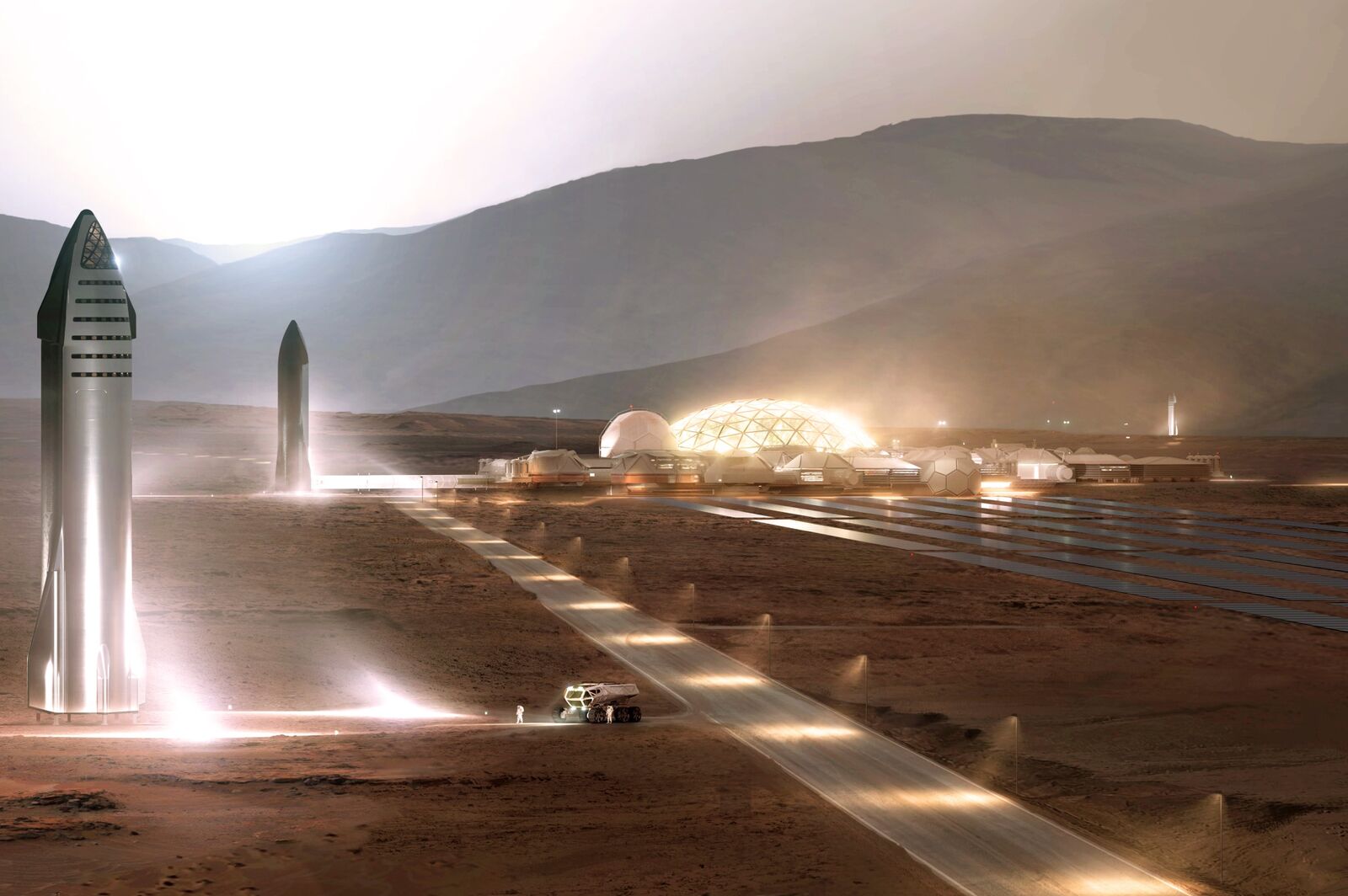
How many people, at a guess, would opt for a one-way trip to Mars, disinterested in returning to Earth? Once on Mars it would take a rocket to return to Earth, and where the fuel would come from to power the spacecraft for a return journey through space remains a huge technological puzzle. "It's not the case that we would bring the rocket fuel with us. It's just too heavy", pointed out Michalski. He offers a potential solution of producing fuel by electrically separating water from sub-surface ice and hydrated rocks, combining the hydrogen and oxygen for rocket fuel. 

TK
An artist’s rendering of SpaceX’s Starship. Source: SpaceX

Labels: , , , , ,

 
()() Follow @rheytah Tweet