Ruminations

Blog dedicated primarily to randomly selected news items; comments reflecting personal perceptions

Saturday, August 19, 2023

Life is a Learning Exercise to Lubricate the Brain

"I'm actually doing a little bit of work now on how we can get more people [children] in the United Kingdom to play chess, because it's so good for you."
"It's a great skill, and it's really good for helping you think."
U.K. Prime Minister Rishi Sunak
 
"Chess games are good for the brain as they require concentration, working memory, planning and problem solving."
"Therefore, they activate the brain regions involved in those cognitive processes."
"This is like a brain workout but also means you get better in those forms of cognition."
Barbara Sahakian, neuroscience professor, University of Cambridge
Learning-Games-Decreases-Alzheimer-GettyImages-1454277759
MirageC/Getty Images
"For the most part, the numbers of brain cells or neurons stay pretty stable across your lifespan, but these activities affect synapses, which are the connections between neurons."
"As we grow older, we tend to lose synapses in parts of the brain, and if you do things that are very stimulating toy our brain, you can make more connections, and you're just more resilient to the damage that's going on in the early phases of diseases like dementia."
Tara Spires-Jones, professor of neurodegeneration, University of Edinburgh
In the summer, a study that tracked over ten thousand older Australians over the course of a decade was published in the Journal of the American Medical Association (JAMA). The study concluded that chess as well as other cognitively stimulating leisure activities may help to reduce the future risk of dementia. A view shared by neuroscience professor Barbara Sahakian, who says chess players -- those in particular who play competitively in leagues and tournaments -- become fast thinkers.
 
Yet it is not chess specifically and chess alone that is highlighted as a skill found by researchers to be beneficial in later life. Included are card games like bridge or poker, games that involve many of the same calculating skills as does chess, have been found to hold benefits to maintain or improve cognition as people approach their elder decades.
 
Active mental activities including card games, crosswords, puzzles or taking adult education classes were all identified as examples of activities geared to potential helpfulness in reducing the risk of acquiring dementia in years to come. American and Canadian psychologists in 2020 published a study where they described learning a second language as being effective in delaying Alzheimer's disease. 
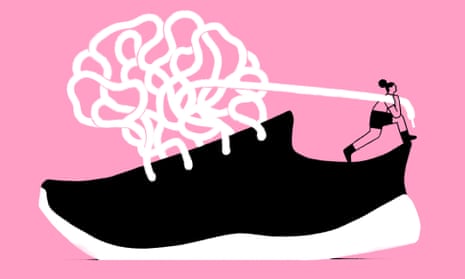
illustration of a trainer with strings knotted to resemble a brain
Illustration: Fran Pulido/The Guardian
According to Professor Tara Spires-Jones, the idea that supports all these activities as measures that people can take to ensure their brain remains in prime working order to help prevent its deterioration in years to come, can be summed up as building a strong brain network through the stimulating of various parts of the brain, simultaneously. It is generally acknowledged that physi9cal activity is associated with lowering the risk of dementia.

This is because physical activity keeps tiny blood vessels in the brain healthy. Greater rates of atrophy or brain shrinkage, which naturally occur with age, result from issues relating to the blood supply to the brain. Increasing that supply maintains the brain's integrity.
"There's the calorie burning from dancing that has an impact alone. But because it's a form of aerobic exercise, getting oxygen to the muscles, you have this increased supply of nutrients to the brain."
"This causes the brain to increase the production of a chemical called brain-derived neurotropic factor or BDNF."
"When you do aerobic exercise, your brain cells create more BDNF, which makes them healthier, and it also makes the neighbouring brain cells healthier."
"All exercise stimulates a process called neurogenesis, which is the birth of new brain cells. But if you stop running today, the benefits of that exercise decrease within just a few days."
"Yet when you build strength in your muscles, you not only give birth to new brain cells that day, but you have more and more neurogenesis even days later."
Joyce Shaffer, Psychologist, behavioural scientist, University of Washington
And there are other, alternate forms of exercising movement that occur in social settings. Dancing classes can act as one of the most beneficial forms of physical activity, according to behavioural scientist Joyce Shaffer. The BDNF increase has an essential role to play in maintaining healthy neurons, keeping the brain agile and capable of readily forming new connections; the essence of memory.

 
senior-learning
Back to school; learning a new skill (language) can benefit the brain. Harvard Health

And there are even more aids that have the potential in exercising the brain; another is through music performance, mastering the ability to play a musical instrument. The International Journal of Alzheimer's Disease nine years ago examined twins; one had learned to play a musical instrument, the other had not. They were followed throughout the course of their lives; the musician found to be 64 percent less likely to develop mild cognitive impairment of dementia.

Leading researchers to conclude that beginning to learn to play any kind of musical instrument in mid- or later-life was one of the most powerful tools in the maintenance of brain health. The reason: music stimulates our brain through a myriad of pathways.
"People think that sound is just relevant to your ears, but it's connected to emotions, memories, what we pay attention to, movement and even how we interact with our other senses."
"Music teaches you to make these connections between sound and meaning, and once you tune your brain that way, you carry this through the rest of your life."
Nina Kraus, professor, neuroscientist, amateur musician Northwestern University, U.S.
Finally, Dr. Shaffer discovered gym strength training to be one of the most powerful methods of preserving cognitive faculties ... more so even than other forms of exercise, such as swimming or running.

Labels: , , , , , ,

Tuesday, March 26, 2019

Repeat: Velvet Fluff

"[The focus on language studies is often on culture] but our work shows that language is also a biological phenomenon -- you can't fully separate culture and biology."
"If you are raised on softer foods, you don't have the same kind of wear and tear on your bite that your ancestors had, so you keep an overbite." 
“The landscape of sounds that we have is fundamentally affected by the biology of our speech apparatus. It's not just cultural evolution."
"Certain sounds like these ‘f’ sounds are recent, and we can say with fairly good confidence that 20,000 or 100,000 years ago, these sounds just simply didn’t exist."
Balthasar Bickel, linguist, University of Zurich

"I hope our study will trigger a wider discussion on the fact that at least some aspects of language and speech—and I insist, some—need to be treated as we treat other complex human behaviors: laying between biology and culture."
"The probabilities [for making labiodentals accidentally] are relatively low, but given sufficient numbers of trials—and by this, we mean that every utterance you make is a single trial—over generations, that leads to the statistical signal we see. But it's not a deterministic process, right?"
Damián Blasi, researcher, Comparative Linguistics Department, University of Zürich (Switzerland) and research affiliate, Department of Linguistic and Cultural Evolution, Max Planck Institute for the Science of Human History
Inside Science's key science stories from February
Still from video: Inside Science
A new study out of the University of Zurich in Switzerland on language and sounds humans make in communication, recently published in the journal Science adds another vital element to the science and history of linguistics and speech, pointing out that the human jaw and how the teeth are arranged in the jaw is as much and perhaps more a determinant of speech as is culture and popular practise over the aeons. The study points out the critical influence of the food eaten by humans on the placement of the jaw and the set of our teeth, enabling certain forms of speech.

By analyzing Stone Age against modern skulls the researchers created simulations demonstrating the manner in which variant jaw placements permit our mouths and vocal chords to produce different sounds. A database of about 2,000 languages representing over a quarter of the languages in use to the present day, was utilized in identifying which sounds were given more and which less frequent use, and where that would happen to be geographically. 

Hunter-gatherer society groups in the recent past are recognized as being far less likely to have used consonants, more familiarly used by early-era farming societies, the study discovered. "Our anatomy actually changed the types of sounds being incorporated into languages", pointed out Noreen von Cramon-Taubadel, evolutionary anthropologist at the University of Buffalo, though not herself involved in this study. 

Early human societies chewed meat; tough because it was raw, which wore on jaws and teeth. Much later societies cultivated crops and eventually cooked foods became a common part of the human diet, requiring far less chewing, on soft food stuffs. Consequently, adult skulls dating from the Stone Age look different than more modern skulls, the older skulls' upper and lower teeth closing shut atop each other. Modern skulls reflect the fact that most people have a degree of overbite; front teeth extending slightly over bottom teeth, with closed mouth. 

Over time, humans' diet of softer food reflected on an evolutionary-resulting jaw with a different configuration and that in turn became enabling for different sounds to be produced since pronunciation was simplified. The "f" and "v" sounds are what linguists describe as "labiodental" sounds, and the modern skull with its modified jaw and upper teeth slightly overlapping bottom teeth made their pronunciation possible.

In their research, the linguists studied 52 languages from the Indo-European language group which included dialects spoken from Iceland to India, charting how the "f" and "v" sounds appeared in various languages over time. The sounds became increasingly more commonly used as societies became agricultural and softer food became accessible, with less emphasis on meat consumption, even in its cooked state. 

"New sounds get introduced into languages, and then are more widely adopted", explained Steven Moran, another linguist at the University of Zurich and co-author of the paper.
The difference between a Paleolithic edge-to-edge bite (left) and a modern overbite/overjet bite (right).
The difference between a Paleolithic edge-to-edge bite (left) and a modern overbite/overjet bite (right). (Tímea Bodogán)

Labels: , ,

Tuesday, November 21, 2017

LGBTQ2 The Inquisition Lives!

Pronoun guidance

"It is hard to imagine that a court would make such a finding [of discrimination]."
"The point of showing the video was to discuss the content of the ideas, and a court would have to balance the rights to non-discrimination with the values of academic freedom and freedom of expression."
Law Professor Brenda Cossman, University of Toronto

"I'm familiar with U.of T professor Dr. Jordan B. Peterson]. I follow him. But can you shield people from those ideas? Am I supposed to comfort them and make sure that they are insulated away from this [controversy over policy guidelines that refusal to refer to an individual by their self-identified personal pronoun]? Like, is that what the point of this [interview] is? Because to me, that is so against what a university is about. So against it. I was not taking sides, I was presenting both arguments."
"...When they [students] leave the university they're going to be exposed to these ideas, so I don't see how I'm doing a disservice to the class by exposing them to ideas that are really out there. And I'm sorry I'm crying. I'm stressed out because this to me is so wrong, so wrong."
"I don't get why I'm being seen as transphobic by virtue, by proxy, of me saying saying, just stating, just exposing people to an idea."
Lindsay Shepherd, teaching assistant, Wilfred Laurier University, Waterloo, Ontario
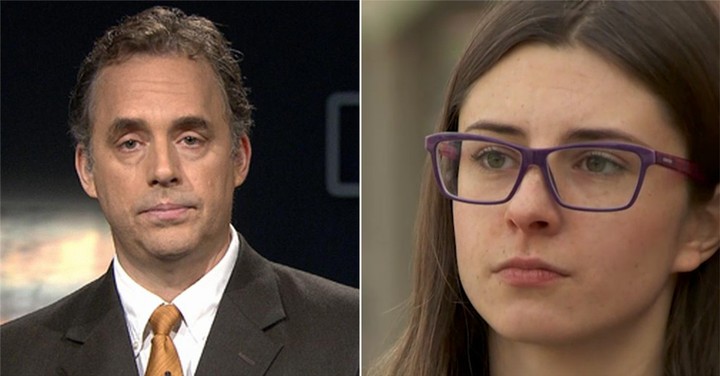
Dr. Jordan Peterson (left), Lindsay Shepherd (right)  Vice  The head of Wilfrid Laurier University officially apologized to a teaching assistant for a meeting in which she was berated for playing a video clip of controversial professor Jordan Peterson in a classroom.

"So the thing about this is, if you're presenting something like this, you have to think about the kind of teaching climate that you're creating. And this is actually, these arguments are counter to the Canadian Human Rights Code. Even since ... C-16, ever since this passed, it is discriminatory to be targeting someone due to their gender identity or gender expression."
"I understand the position that you're coming from and your positionality, but the reality is that it has created a toxic climate for some of the students, you know...."
"It's more about the effect than the intention. Obviously that wasn't your intention. But, nevertheless, it disturbed students enough...."
Nathan Rambukkana, supervising professor, Wilfred Laurier University

"Um, so gender-based violence, transphobia, in that policy. Causing harm, um, to trans students by, uh, bringing their identity as invalid."
"Their pronouns as invalid - potentially invalid."
Adria Joel, manager of Gendered Violence Prevention and Support, Wilfred Laurier University
Wilfrid Laurier University professors Nathan Rambukkana, left, and Herbert Pimlott, right, reprimanded teaching assistant Lindsay Shepherd for showing a video featuring controversial U of T professor Jordan Peterson without denouncing his views. Wilfrid Laurier University

Well then, is it understood now that society must gird itself punctiliously and take steps to extend their pronoun vocabulary to include ... let's see: "zim", "xe", "thon", "herm", and a galaxy of others, because the simple fact of politically correct life is that these and other pronouns are now required of those among us of patience and goodwill to surrender our conventional use of civil language to denote the presence among us of the aggrieved, the dreadfully wronged victims of yore, demanding their just due.

As respected members of our society, of course. Not so much respected any longer are those who hold out in respect of conventional civility and language to match, language that reflects heritage and culture, not so much dependent on the whims of the entitled who from the depths of their juvenile-arrested minds insist that society turn itself inside-out on their behalf. Which is to say, to mollify their outraged sensibilities that there any any among us so warped and cruel that we would deny them this yet-another victory foisted upon an appeasing public.
University of Toronto psychology professor Jordan Peterson. Tyler Anderson / National Post

And if there is any one single individual who has stepped into the foetid, roiling swamp of blame for upsetting the trans applecart, it can be none other than clinical psychologist and tenured professor of psychology at University of Toronto. Who, in a fit of displeasure at the pressures in the university environment to conform to popular demand that whining gender-confused students be 'respected' by acknowledging that they are not to be insulted through being addressed as 'her', 'him', 'ms' or 'mr', while 'they', bending the plural toward a singular gender-neutral designation is preferred.

By defying the appeasement of these childish demands, Professor Peterson has been identified as a Nazi, no less. He has become notorious, his name and his refusal to bow to the demands of irate transgenders and their myriad of supporters, inclusive of the very-careful-to-accede-to-left-society's championing of LGBTQ2 'rights' against the transgressors who revel in denying them, he has become anathema to right-thinkers, and a champion of the troglodytes who revel in denying trans' "human rights" entitlements.

Clearly, Lindsay Shepherd, a teaching assistant at Wilfrid Laurier University in Waterloo, Ontario, is one of those backward types having brought in a video of an interview taken from a well-known and -watched television show, The Agenda, interviewing Dr. Peterson on the politics of grammar, so virulently controversial. For her students, felt Ms. Shepherd, this was as good a lesson as any on communications, language and the intersection of politics. She presented this lesson neutrally, content to have the students reach their own conclusions. For which sin she was brought  to an interview with university heavies to 'explain herself'.
The Globe and Mail
Several hundred students attend a rally protesting the views of U of T professor Jordan Peterson, who refuses to use non binary pronouns.    Fred Lum/The Globe and Mail
In June the federal Liberal government passed Bill C-16 prohibiting discrimination based on gender identity or expression, an initiative typical of this government that celebrates free speech rights, yet enacted this legislation that restricts free speech. It is a measure undertaken to stifle controversy over addressing trans people in the manner to which they prefer to be addressed, by insisting under the law that this is not a matter of free choice, but mandatory. On the other hand because the bill criminalizes extreme speech, it's hard to see how insulting a trans person by referring to that person as he or she would fall under that category.

Canada's hate-crime laws include inciting to genocide or deliberately inciting to hatred toward an identifiable group in categories inclusive of colour, race, religion, national or ethnic origin, age, sex, sexual orientation and mental or physical disability; fairly exhaustive. Charges can be laid only with the approval of a provincial attorney general. The Ontario Human Rights Commission's policy guideline claims that "refusing to refer to a person by their self-identified name and proper personal pronoun" could be considered gender-based harassment.

But a witch-hunt, an inquisition has been launched and in fact, hatred and blame attached squarely to the reputation of Dr. Peterson, as an enemy of alt-gendered victims of societal discrimination. The lines have been drawn; all those who believe that Dr. Peterson's reaction to an unreasonable demand that societal attitudes and an entire language undergo a change to pacify the demands of a tiny segment of society is reasoned and reasonable, are themselves now charged with unforgivably, criminal phobic behaviour.

Cassandra Williams, a U of T student union member, at a Peterson protest in October. Peterson sparked a storm by declaring he would not use pronouns, such as "they," to recognize non-binary genders.
Cassandra Williams, a U of T student union member, at a Peterson protest in October. Peterson sparked a storm by declaring he would not use pronouns, such as "they," to recognize non-binary genders.  (Vince Talotta)

Labels: , , , , , ,

 
()() Follow @rheytah Tweet