Ruminations

Blog dedicated primarily to randomly selected news items; comments reflecting personal perceptions

Saturday, April 30, 2022

Sea Floor Fossils Revealed Atop Swiss Alps

"The tooth is particularly interesting because it could possibly -- but unlikely -- represent the largest animal to ever inhabit Earth."
"The Alps have a very complicated structure, with giant slabs of rock consisting of former sea floor, called nappes, piled on top of each other by the African plate pushing into the European plate."
"The nappe that the ichthyosaurs come from is the highest in the pile. This piling up happened in the last 35 million years or so." 
"Maybe there are more rests of the giant sea creatures hidden beneath the glaciers."
Martin Sander, paleontologist, University of Bonn 
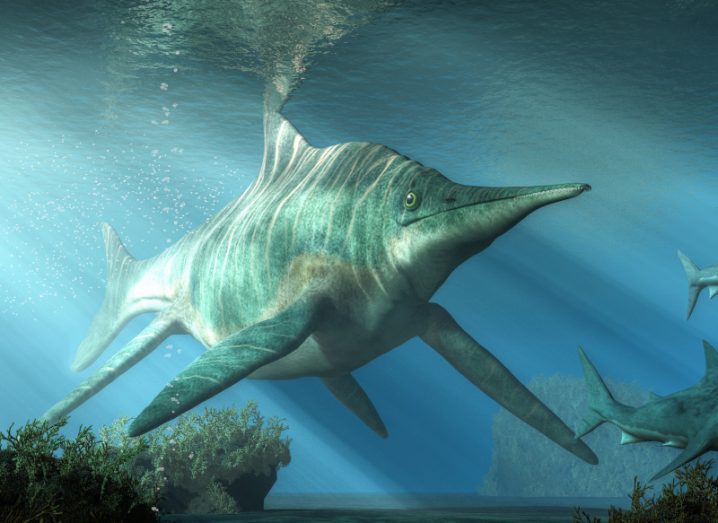
Illustration of the massive marine reptile called the ichthyosaur, swimming next to other sea creatures to the side.
Illustration of an ichthyosaur. Image: © Daniel Eskridge/Stock.adobe.com
 
The blue whale, an aquatic mammal that grows up to around 30 meters in length is considered to represent the largest-ever creature that Earth has ever seen. New discoveries on long-extinct Triassic ichthyosaurs may now crown these marine reptiles as having been even greater in size than the whales. The giant ichthyosaurs' bodies were shaped elongated with relatively small skulls. That early in the evolutionary cycle they may have borne small brains.

Specimen fossils were discovered back in the 1970s and '80s in the eastern Alps at three sites, in Switzerland. It is only now that after a deep study of the fossils that they are being scientifically described. A study has now been published in the Journal of Vertebrate Paleontology. Found atop the Chrachenhorn mountain near Davos, one of the fossils was a tooth.
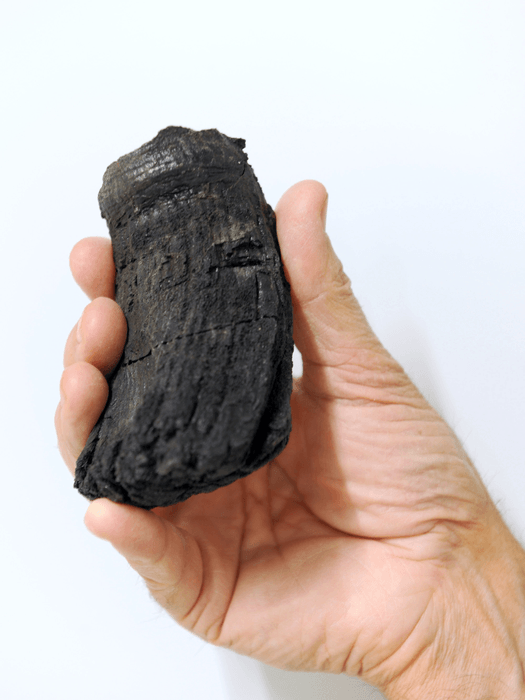
An ichthyosaur tooth fossil in a person's hand.
The root of the ichthyosaur tooth fossil, with a diameter of 60mm. Image: Rosi Roth/University of Zurich
 
More complete fossil remains were described as a rib and vertebrae from two ichthyosaur species, one judged to be 21 meters in length, the other about 15 meters; considerable size in any natural lexicon of Earth's creatures, large and small. Dating to around 205 million years back, close to the conclusion of the Triassic Period, the three individual creatures represented by the fossil remains are considered to be the largest of the giant ichthyosaurs to inhabit the oceans, when dinosaurs were starting to dominate land.

They were all found on three mountains in the Swiss Alps at an elevation of 2,740 meters above sea level. The third of the specimens, representing a tooth, was the largest from any ichthyosaur ever found. Its base is 6cm wide with an estimated length of 15cm, testing the imagination to envision a fearsome predator of the day. Last year, a 18-mters-long ichthyosaur was described as having had a tooth with a base 2cm wide.

"Then a tooth 6 centimetres wide could possibly have come from an animal 54 meters in length", suggested Dr.Sander; a formidable, absolutely unimaginable size. Other giant ichthyosaurs evidently ate small fish and squid, sucking them up, engulfing them in their toothless mouths. Fossils formed in an ancient seabed were found on top of mountains resulting from the inexorable, crushing movement of immense plates making up Earth's crust; a process called plate tectonics.
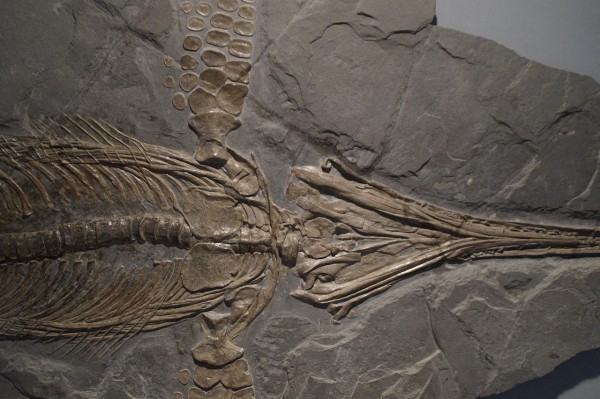
 Fossils of Giant Sea Monster From 205 Million Years Ago Found 9,000 feet Above Sea Level in the Swiss Alps
(Photo : Pixabay/Efraimstochter)
Fossils of Giant Sea Monster From 205 Million Years Ago Found 9,000 feet Above Sea Level in the Swiss Alps

Labels: , , , ,

Thursday, October 31, 2019

The Ancients' Taste for Bone Marrow

"It was believed that early hominins were consuming everything they could put their hands on immediately, without storing or preserving or keeping things for later."
"This [study] is a game changer for our modern conceptions about our ancestors because it is believed that early hominids were not capable of or not accustomed to delayed consumption."
"This gives us a view of them as very similar to us [with the cognitive capacity to plan ahead] and not as some primitive human creatures."
"Until now, evidence has pointed to immediate consumption of marrow following the procurement and removal of soft tissues. In our paper, we present evidence of storage and delayed consumption of bone marrow at Qesem Cave."
"We show for the first time in our study that 420,000 to 200,000 years ago, prehistoric humans at Qesem Cave were sophisticated enough, intelligent enough and talented enough to know that it was possible to preserve particular bones of animals under specific conditions, and, when necessary, remove the skin, crack the bone and eat the bone marrow."
Ran Barkai, archaeologist, Tel Aviv University, Israel
New Scientist Default Image
Qesem cave in Israel
JACK GUEZ/AFP/Getty Images


"Prehistoric humans brought to the cave selected body parts of the hunted animal carcasses."
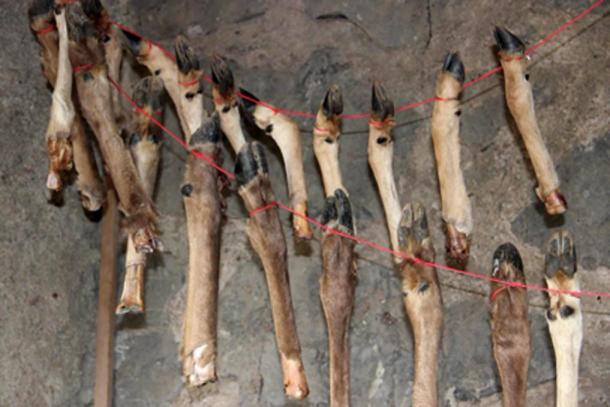
"The most common prey was fallow deer, and limbs and skulls were brought to the cave while the rest of the carcass was stripped of meat and fat at the hunting scene and left there. We found that the deer leg bones, specifically the metapodials, exhibited unique chopping marks on the shafts, which are not characteristic of the marks left from stripping fresh skin to fracture the bone and extract the marrow."
Prof. Jordi Rosell of Universitat Rovira i Virgili (URV) and Institut Català de Paleoecologia Humana i Evolució Social (IPHES)

Qesem Cave, its discovery locating it in central Israel not far from Tel Aviv, is valued as a time capsule of limestone revealing details of the lives and the diets of Paleolithic people dating from 420,000 to 200,000 years ago. A mind-boggling concept of ancient early human life to begin with, and one most people automatically ascribe to the most primitive of evolving humanity eking out a basic life of existence. Clues from the most recent forays into the cave by a team of archaeologists led by Ran Barkai, showed convincingly that ancient humans used stone-fashioned blades to butcher animals they hunted and then barbecued the resulting meat on their campfires.

"It was a surprise. The Qesem hominids have demonstrated very modern behaviour in their livelihood strategies", pointed out Ruth Blasco, zooarchaeologist at the National Research Center on Human Evolution in Spain, lead author on the study. The careful interpretation of the vast multitude of bones discovered in the cave and the marks that led to the hypothesis that further study revealed and confirmed, convinced the scientists that these ancient beings were adept at thinking outside their primitive box which would have had them immediately consuming all that fell into their hands after a hunt.

The cave's earliest inhabitants, according to Dr. Barkai and his colleagues, may also have decided to store marrow-filled animal bones for later consumption. The scientific guesswork based on their findings, appeared to suggest storage of these bones for a period of up to nine weeks, before total rancidity might set in. As such, this represents the earliest example of primitive humans taking well thought-out steps to preserve food for later consumption. A startling indication of an intelligence of these ancients leading them to plan for the future.

"[If the removal of dry skin did leave a unique butchery mark] it's now up to us zooarchaeologists to look for these traces in older fossil assemblages to see if we can document a greater antiquity of this food storage behaviour", commented Briana Pobiner, a paleoanthropologist at the Smithsonian National Museum of Natural History in Washington, who praised the study as a heads-up to other archaeologists who might never have noticed similar markings on bone fragments they may have found elsewhere in much the same manner as the Qesem Cave excavation, and in the light of this new revelation, take closer scrutiny to determine whether the same attention to future need was practised elsewhere.

The Qesem Cave team collected freshly killed deer leg bones for an experiment. The bones were stored for several weeks in conditions identical to what pertained within the cave, and after each week that passed, a researcher would remove dried skin from the bones, hammer a bone open to analyze the marrow and determine how nutritious it would be at each of those stages. The chop marks which were created by this experiment and visible on the bones, were found to be similar to those seen in the Qesem Cave. In the wake of nine weeks' storage the bone marrow fat was seen to have degraded only slightly, remaining nutritious.

Archaeological testing the longevity of marrow in deer leg bones. Credit: Ruth Blasco

Of course scientific researchers are extremely curious; a trait that is common to the profession that seeks answers to riddles about humankind's beginnings. If anyone would be interesed enough to wonder how the stored marrow might taste, there is someone on the team who could respond with authority on the matter. "It is like a bland sausage, without salt, and a little stale I can say that its taste was not bad, perhaps a little more rancid in the last weeks, but not bad", assured Jordi Rosell, an archaeologist at Rovirai Virgili University in Spain.

Labels: , , , , ,

Tuesday, March 26, 2019

Repeat: Velvet Fluff

"[The focus on language studies is often on culture] but our work shows that language is also a biological phenomenon -- you can't fully separate culture and biology."
"If you are raised on softer foods, you don't have the same kind of wear and tear on your bite that your ancestors had, so you keep an overbite." 
“The landscape of sounds that we have is fundamentally affected by the biology of our speech apparatus. It's not just cultural evolution."
"Certain sounds like these ‘f’ sounds are recent, and we can say with fairly good confidence that 20,000 or 100,000 years ago, these sounds just simply didn’t exist."
Balthasar Bickel, linguist, University of Zurich

"I hope our study will trigger a wider discussion on the fact that at least some aspects of language and speech—and I insist, some—need to be treated as we treat other complex human behaviors: laying between biology and culture."
"The probabilities [for making labiodentals accidentally] are relatively low, but given sufficient numbers of trials—and by this, we mean that every utterance you make is a single trial—over generations, that leads to the statistical signal we see. But it's not a deterministic process, right?"
Damián Blasi, researcher, Comparative Linguistics Department, University of Zürich (Switzerland) and research affiliate, Department of Linguistic and Cultural Evolution, Max Planck Institute for the Science of Human History
Inside Science's key science stories from February
Still from video: Inside Science
A new study out of the University of Zurich in Switzerland on language and sounds humans make in communication, recently published in the journal Science adds another vital element to the science and history of linguistics and speech, pointing out that the human jaw and how the teeth are arranged in the jaw is as much and perhaps more a determinant of speech as is culture and popular practise over the aeons. The study points out the critical influence of the food eaten by humans on the placement of the jaw and the set of our teeth, enabling certain forms of speech.

By analyzing Stone Age against modern skulls the researchers created simulations demonstrating the manner in which variant jaw placements permit our mouths and vocal chords to produce different sounds. A database of about 2,000 languages representing over a quarter of the languages in use to the present day, was utilized in identifying which sounds were given more and which less frequent use, and where that would happen to be geographically. 

Hunter-gatherer society groups in the recent past are recognized as being far less likely to have used consonants, more familiarly used by early-era farming societies, the study discovered. "Our anatomy actually changed the types of sounds being incorporated into languages", pointed out Noreen von Cramon-Taubadel, evolutionary anthropologist at the University of Buffalo, though not herself involved in this study. 

Early human societies chewed meat; tough because it was raw, which wore on jaws and teeth. Much later societies cultivated crops and eventually cooked foods became a common part of the human diet, requiring far less chewing, on soft food stuffs. Consequently, adult skulls dating from the Stone Age look different than more modern skulls, the older skulls' upper and lower teeth closing shut atop each other. Modern skulls reflect the fact that most people have a degree of overbite; front teeth extending slightly over bottom teeth, with closed mouth. 

Over time, humans' diet of softer food reflected on an evolutionary-resulting jaw with a different configuration and that in turn became enabling for different sounds to be produced since pronunciation was simplified. The "f" and "v" sounds are what linguists describe as "labiodental" sounds, and the modern skull with its modified jaw and upper teeth slightly overlapping bottom teeth made their pronunciation possible.

In their research, the linguists studied 52 languages from the Indo-European language group which included dialects spoken from Iceland to India, charting how the "f" and "v" sounds appeared in various languages over time. The sounds became increasingly more commonly used as societies became agricultural and softer food became accessible, with less emphasis on meat consumption, even in its cooked state. 

"New sounds get introduced into languages, and then are more widely adopted", explained Steven Moran, another linguist at the University of Zurich and co-author of the paper.
The difference between a Paleolithic edge-to-edge bite (left) and a modern overbite/overjet bite (right).
The difference between a Paleolithic edge-to-edge bite (left) and a modern overbite/overjet bite (right). (Tímea Bodogán)

Labels: , ,

Sunday, March 10, 2019

Bioarchaelogy Sleuthing

"When it comes to our understanding of cancer in the past, we're really just at the beginning."
"[This new find has importance to enable scientists to learn more relating to cancer in vertebrates]."
"On the subject of our understanding of most cancers up to now, we’re actually [just at the starting gate]." 
"It’s not like individuals say, ‘Oh, I need to go research most cancers in historic turtles or in fossil mammoths,’ as a result of [which] we've got so little proof."
Michaela Binder, bioarchaeologist, Austrian Archaeological Institute
 Cancer was found on examination of a femur of an excavated Pappochelya    Brian Engh


"What makes this really cool is that now we understand that cancer is basically a deeply rooted switch that can be turned on or off. It's not something that happened recently in our evolution."
"It's not something that happened early in human history, or even in mammal history."
Yara Haridy, paleontologist, National History Museum, Berlin
The fossil record hasn't exactly been a cornucopia of discovery in traces of cancer in early animals during evolutionary stages of existence. Researchers, however, writing in JAMA Oncology on February 7 revealed the discovery of cancer on an ancient femur of a 240-million-year-old precursor to modern turtles, an amniote, a group including reptiles, birds and mammals.

triassic turtle cancer
The 240 million-year-old fossilized leg bone of an ancient stem turtle that revealed signs of bone cancer.

It was described as representing the oldest known instance of cancer in an ancient creature. Cancers that surface in the present day are diagnosed through soft-tissue examination (biopsies), but such diagnosis is difficult working with hard fossils. The femur was identified when it was collected for the Stuttgart State Museum of National History in Germany as belonging to a wide-bodied, long-tailed animal called a Pappochelys, a relative of modern turtles but lacking a shell.

The jagged growth on the femur aroused the interest of Yara Haridy, with Berlin's Natural History Museum. She identified the marks as indications that illness and injury had been involved, those marks drawing the attention of bioarchaeologists in the study of paleopathology, combining aspects of modern forensic and medical practices. When the femur was examined through micro-CT scans Ms. Haridy and her colleagues identified the swelling as an osteosarcoma, a type of bone cancer.

Up to the present, prehistoric cancer knowledge suffered from a lack of evidence, leading researchers to conjecture that the disease represents a purely modern phenomenon, the result of unhealthy living; pollution, or individuals becoming 'older' in biological terms. On the other hand, other specialists suggest the presence possibly of a tumour-suppressive gene present in vertebrates, the failure of which permits tumours of a benign nature to metastasize.

With no fossil evidence there was no available proof that either theory could be hitting the mark. Furthermore, some animal lineages appear to be less susceptible to cancer than others. On the other hand, tumours in invertebrates tend not to resemble those appearing in vertebrates.

IN 2001, Russian paleontologists identified a possible cranial osteosarcoma in an Early Triassic amphibian, as an example of other finds of recent vintage. Yet again, a jaw tumour from a 255-million-year-old mammal forerunner had been reported in 2016.

5c5d7ce383274.jpg
A mass on the femur of a Pappochelys rosinae specimen. (JAMA Oncology (2019))


Labels: , ,

Tuesday, July 31, 2018

Out Of Africa

"Suddenly you had a primate that could obtain meat from a carcass, and it opened up a new world for them."
"That simple technology was enough to get them out of Africa and right across Asia."
"Our discovery means it is necessary now to reconsider the timing of when early humans left Africa."
"Very importantly here, there are no geological processes that could have flaked these stones. The Loess Plateau is a stone free landscape—it is basically an enormous deposit of wind-blown dust, deposited year upon year by the winter monsoonal winds for the last 2.5 million years."
"Hominin remains are incredibly scarce. Their skeletons are very fragile, preservation is very rare, and they were not very common. In contrast, a single hominin can generate thousands of stone tools in a lifetime. Additionally, fossils will never indicate the first actual appearance of an animal—the first recorded appearance is always later than the first actual appearance, no matter whether it’s a hominin or a hippopotamus."
"As an archaeologist, I have always found it strange that some refuse to accept artifacts unless found with hominin remains when the antiquity of humankind was first established in the early 19th century from stone artifacts in France and Britain, and not from skeletal evidence."
Robin Dennell, paleoanthropologist, University of Exeter, Britain
One of the tools from the discovery site in Shangchen, China
One of the tools from the discovery site in Shangchen, China ( Zhaoyu Zhu )

"The roughly 14,000-kilometre trek from eastern Africa to eastern Asia represents a range expansion of dramatic proportions."
"The dispersal of hominins was probably facilitated by population increases as they moved into new territories."
"Yet even with a dispersal rate of only 5-15km per year, a value well inside the daily foraging range of modern hunter-gatherers, the distance between Africa and Asia could have been covered in just 1,000–3,000 years."
"What this paper suggests is: Boom! You get this dispersal, all the way across what was then the known Earth. The pieces were being filled in there very early on. It’s the kind of thing where, if we saw this for some other species, it would be remarkable."
"They [ancient horses] originated in North America, then migrated into the Old World about 11 million years ago. And then, boom, it’s like gangbusters. They’re everywhere."
Professor John Kappelman, anthropologist, University of Texas
Paleoanthropologists are discovering a long and unexpected fossil record of hominins in Africa, the oldest dating over six million years back in time. The earliest of these proto humans was bipedal, yet had chimpanzee-sized brains in a very short body. Homo erectus by 1.9 million years ago was in stride across East Africa leading many paleoanthropologists to make the assumption that Homo erectus represented the first of the migrants to leave Africa.

In the 1990s older hominin bones were discovered in Asia, while in Georgia scientists came across ancient fossils as old as 1.75 million years; even older, at 1.82 million years of age were the stone tools found in Dmanisi, Georgia. A Homo erectus skull was unearthed for the first time in China, in 1964, named Lantian. It was thought to be 1.14 million years old, but in 2001 Zhaoyu Zhu, a Chinese Academy of Sciences geologist in Guangzhou and colleagues determined the skull to be 1.63 million years old.

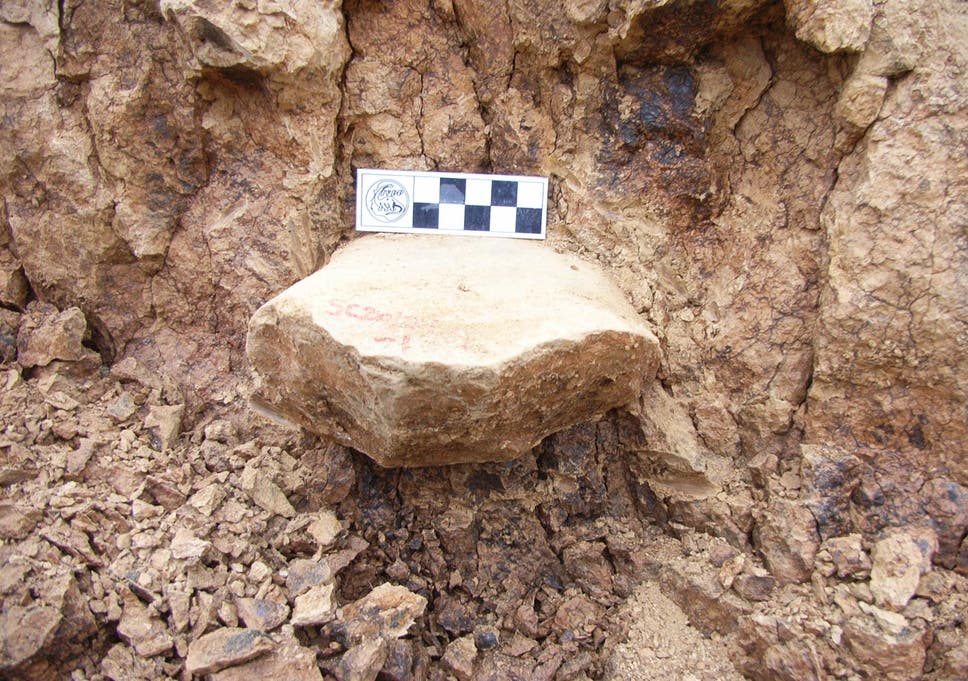
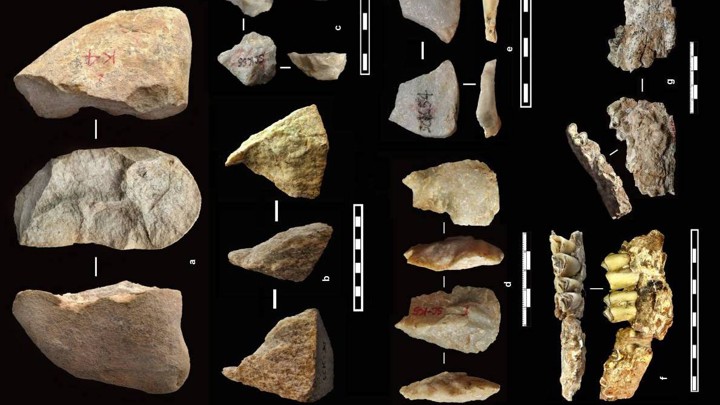
Dr. Zhu and his colleagues found over a hundred ancient stone tools embedded 650 meters in depth in the side of a gully in the region around where the fossil was discovered. From that discovery came a new study published in the journal Nature, arguing that the stones whose indentations and scrapes they interpreted as tool-making efforts by primitive manlike creatures could not possibly have been so marked by natural means since the rock surrounding them had formed from what was originally grassland soil absent stones the size and shapes of the tools.

The assumption researchers reached was that the hominins at Lantian were spurred to make their way to mountain streams to enable them to select the stones to be made into tools, carrying the tools for use in food gathering, the sharp-edged portions used presumably to carve meat away from animal carcasses.  Dating the discovered material in the layers of rock, the team estimated the tools to be 2.12 million years in age.

Scientists who publish studies leading to various conclusions will invariably find that not all their fellow scientists in related fields of study will agree with them, and John J. Shea, a Stony Brook University in New York anthropologist is one of these. He is suspicious of the reliance on tools alone to provide irrefutable evidence that hominins appeared over two million years ago in Asia: "Bottom line -- no hominin fossils, no hominins", he argues.

Homo erectus (the predecessor to Homo sapiens) was named by Paleoanthropologists as a species discovered to have travelled across Asia, some specimens found to be as old as 1.6 million years, roughly as tall as humans today, and with fairly large brains. Homo erectus's brain was about two-thirds as large as modern humans in contrast to chimpanzees with brains roughly one-third human size.

Dr. Zhu and his colleagues believe their discovery of those stone tools in China indicate they were made by ancient members of the human lineage. The expectation is that their find may represent a new addition to the advent of hominin evolution in that some species had travelled out of Africa at a much earlier date than was once believed; the hoiminin species small, bipedal apes with chimpanzee-size brains.

It was in Africa that human lineage arose and developed, where the primal ancestors of humanity diverged from those of chimpanzees seven million years ago.

Selected artifacts, including non-hominin mammal bones, found at the new site       Zhaoyu Zhu et al / Nature

Labels: , , ,

Friday, July 20, 2018

A Post-Mortem For The Ages

"It [minute examination of 'Iceman's' stomach contents] was very impressive. We could see chunks and pieces of food with [the] naked eye."
"The stomach content is yellowish to brownish colored and mushy, with some bigger pieces of meat and grain."
"It wasn't the most hygienic of meals [given that fly remnants and long strands of goat hair were present]." 
"It's a harsh environment [landscape of the frozen Alps]. They [ancient Europeans] had to be prepared. They had to have food that gave them the necessary energy [to survive a hostile environment and a long trek through a demanding geology]."
Frank Maixner, microbiologist, Institute for Mummy Studies, Bolzano, Italy

"They're [investigative scientists] trying to use all the methods in the toolbox to answer this really important question of what people [five thousand years ago in Europe] were eating [to sustain themselves in frozen atmospheres at  high mountainous altitudes]."
Albina Hulda Palsdottir, archeozoologist, University of Oslo
Here's What Ötzi the Iceman Ate before He Was Murdered
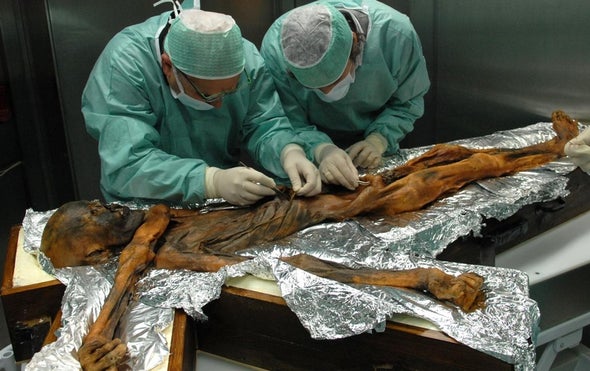
This photograph was taken during the stomach content sampling campaign in November 2010 in Bolzano, Italy. Credit: South Tyrol Archaeology Museum, Eurac and M.Samadelli
It created an international news sensation when the frozen, mummified body of an ancient human who lived 5,300 years ago, was discovered almost thirty years ago -- 1991 -- in the Alps between Italy and Austria. With him was discovered his weapons. a copper-headed axe and a number of tools. His clothing was meant to insulate him from the cold, and was fairly sophisticated, some woven, some animal skins.

Initial examination revealed wounds thought to be have been inflicted in a violent confrontation with an adversary. He was judged to be about forty-five years of age when he died, likely from loss of blood linked to the mortal wounds he had sustained. From evidence discovered on his own weapons Oetzi did his utmost to defend himself; the blood of others also found.

He was named Oetzi, for the region where his body, encased in ice, was discovered by tourists. Italy succeeded in claiming him and he is kept in Bolzano, Italy. In 2009 the puzzle of his 'missing stomach' was solved when researchers discovered to their amazement, that after his death his stomach had shifted upward to remain undetected behind his rib cage.

Giving scientific enquiry the opportunity to examine that organ's contents answering the query, what was his, and others of his period, diet comprised of? A lot of fat, for energy, it would seem.

After the scientists had concluded their examination of Oetzi's stomach contents they published a paper describing their findings in the journal Current Biology to list the meat of a wild goat, its fat, meat of a red deer and whole wheat seeds, indicating that this was the last meal this human ate before his death.

Fern leaves and spores were discovered as well, items that the examining scientists feel may have been eaten without intention, or alternately as a medicinal for the parasites found on previous examination in his intestines.
The 5,000-year-old mummy known as the Iceman was found in the Italian Alps in 1991.
Photograph from Vienna Report Agency/Sygma/Corbis


Labels: , , ,

Thursday, May 17, 2018

Revelations in the Primal Fossil Record

"New actinopterygian fossils from the Tournaisian provide an opportunity to improve our understanding of earliest Carboniferous faunas and test whether other osteichthyan lineages follow the tetrapod pattern. Here, we describe a new genus of actinopterygian from a three-dimensionally preserved partial skull from Blue Beach, Nova Scotia, a locality in the Tournaisian Horton Group. This locality has previously yielded a diverse tetrapod fauna, as well as undescribed actinopterygian and sarcopterygian material [8,15,17]. Mirroring trends in the tetrapod fauna of this locality, this specimen demonstrates close affinity to taxa more typical of the Devonian, with clear implications for end-Devonian extinction survivorship among vertebrates."
A primitive actinopterygian braincase from the Tournaisian of Nova Scotia
Conrad D. Wilson, Jason D. Pardo, Jason S. Anderson
Figure 1.
Avonichthys manskyi gen. et sp. nov. Photograph and interpretive drawing of specimen in dorsal view. Scale bar = 10 mm. br.psp, broken dorsal surface of parasphenoid; dsph, dermosphenotic; ?esc, indeterminate extrascapular; f, frontal; hm, hyomandibular; ifc, infraorbital canal; it, intertemporal; mx, maxilla; nIII, foramen for oculomotor nerve; p, parietal; por, post-orbital process; st, supratemporal.

Labels: , , , ,

Friday, April 20, 2018

Neanderthals ... Human Cousins

"When you have symbols, then you have language."
"For all practical purposes, [Neanderthal] they were modern humans, too."
"Neanderthals have disappeared. So have Fuegian Indians. So have Greenland Vikings."
"Population extinction has been a part of human history forever."
"The Aviones finds [Cueva de los Aviones, a cave in southeastern Spain] are the oldest such objects of personal ornamentation known to this day anywhere in the world. They predate by 20 to 40 thousand years anything remotely similar known from the African continent. And they were made by Neanderthals. Do I need to say more?"
Joao Zilhao, archaeologist, University of Barcelona, Spain
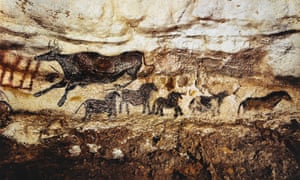
Cave art breakthrough … a painting of a cow and horses at Lascaux, France.
Cave art breakthrough … a painting of a cow and horses at Lascaux, France. Photograph: Alamy

Researchers have combined forces (University of Barcelona, University of Southampton, Max Planck Institute for Evolutionary Anthropology) have produced a study establishing the existence of evidence that primeval Neanderthals could boast one of the principal hallmarks of cognitive sophistication, for they were capable of producing painted cave art, a realization that they could think in symbols and for all we know they may also have succeeded in achieving other human milestones of which no trace has been preserved.

In the mid-1800s, when fossils linked to Neanderthals and examination revealed their low, thick brow ridge on their skulls, it seemed to indicate that they may have been proto-humans of low intelligence, incapable of cognition. Since then, however, discoveries to follow have indicated that in fact Neanderthals were possessed of brains as large as that of homo sapiens, but within shorter, stockier bodies.

Still, during the early 1900s it was commonplace for Neanderthals to be described as gorilla-like beasts, a mere extinct branch of near-humanity, but nothing like the well-formed, intelligent creatures that humankind was to become. Current evidence construed from fossils and DNA indicates, however, that both living humans of today and Neanderthals had descended from a common ancestor dating back roughly 600,000 years ago.

For several hundred thousand years, ancestors of living humans left evidence of stone axe tools and spear blades. Humans in Africa were showing signs of abstract thinking 70,000 years ago, colouring and piercing seashells for ornamental purposes. Modern humans began arriving in Europe from Africa some 45,000 years ago and they left ivory carvings and cave wall paintings, while Neanderthals became extinct 40,000 years ago, a fossil record from Spain to Siberia attesting to their presence.

It has only been in recent years that researchers have discovered evidence linking Neanderthals to symbolic thought processes with archaeologists discovering Neanderthals used feathers and bird claws with which to make ornaments. Some scientific skeptics opt to transcribe those discoveries as mere copies of original thought, preferring to believe that Neanderthals had taken inspiration from modern humans they lived beside.

Within caves in Spain ancient paintings were discovered over the past century and there researchers discovered the presence of flowstones, milky crusts of minerals on cave walls, which covered parts of artworks. Researchers scraped away samples for dating purposes from three caves, to discover some of the art to be over 64,000 years old, about 20,000 years earlier than the first evidence of modern humans in Europe.

It was deduced that the artwork was produced by Neanderthals. In a cave on the Spanish coast Dr. Zilhao discovered shells, drilled and painted with ochre. He and colleagues found a layer of flowstone atop the rock where the shell jewellery had been discovered. In testing the flowstone it turned out to be about 115,000 years in origin; the pierced and coloured shells held to be slightly older. Strong evidence the shells were produced by Neanderthals.

At one time in the historical record, researchers had concluded that Neanderthals had died out because they were incapable of manipulating their environment to aid in survival. Now it is understood that Neanderthals developed in parallel with modern humans in Africa. It appears that the illusion of inferiority leading to their extinction is unjustified and what led to their disappearance is now attributed to evolutionary mechanics.
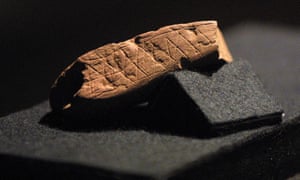
Even older still … a piece of red ochre with a deliberate zigzag engraving from Blombos cave, South Africa.
Even older still … a piece of red ochre with a deliberate zigzag engraving from Blombos cave, South Africa. Photograph: Anna Zieminski/AFP/Getty

Labels: , , ,

 
()() Follow @rheytah Tweet