The Migration Route to Europe
"Deepest condolences [to the those who lost their lives; Italy will step up efforts to tackle migrant traffickers].""When a tragedy like today's occurs, with the deaths of dozens of people in the waters of the Mediterranean, a strong sense of dismay and compassion arises in all of us.""And we find ourselves contemplating the inhumane cynicism with which human traffickers organize these sinister journeys.""[Stepping up rescue efforts is insufficient to tackle the scourge of trafficking; this could be done only by] preventing irregular departures and managing migration flows."Italian Prime Minister Giorgia Meloni
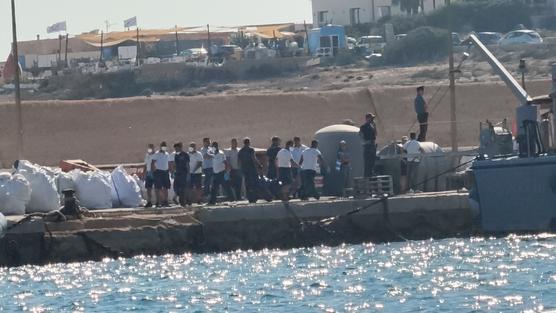 |
| Italian Coast Guards officers carry a body bag on the dock of Lampedusa harbor on Wednesday, August 13, 2025, after a boat carrying nearly 100 migrants capsized off the Italian island. |
In its geographic situation between the North African coasts of Libya and Tunisia and Italy, Lampedusa has become the chosen route for illegal/irregular migration routes to Europe for well over a decade. Even back in early 2010s, the passage of boats, people and bodies of those that perished on the way through by this most dangerous of sea routes, created pressure linked to growing numbers of arrivals on the island, striving to accommodate their needs.
Lampedusa is a small, rocky island in the middle of the Mediterranean. It became one of the busiest yet deadliest entry points to Europe through a crisis of migration from countries in the Middle East and North Africa. The year 2015 marked the most frantic challenges of Europe's efforts to deal with huge waves of incoming migrants, with the European Union convincing its member-states that a fair apportionment of migrants between all would relieve the unbearable burden of stress that Italy found itself in.
A handful of Eastern European countries shunned the prospect of absorbing migrants whose culture, heritage, religion and values were often in opposition to their own. Western Europe answered the call, with Austria and Germany declaring their borders would be open to welcoming migrants. The result was not quite as salutary to the social order of those countries welcoming and making an effort to settle the migrants as their humanitarian gesture might assume.
 |
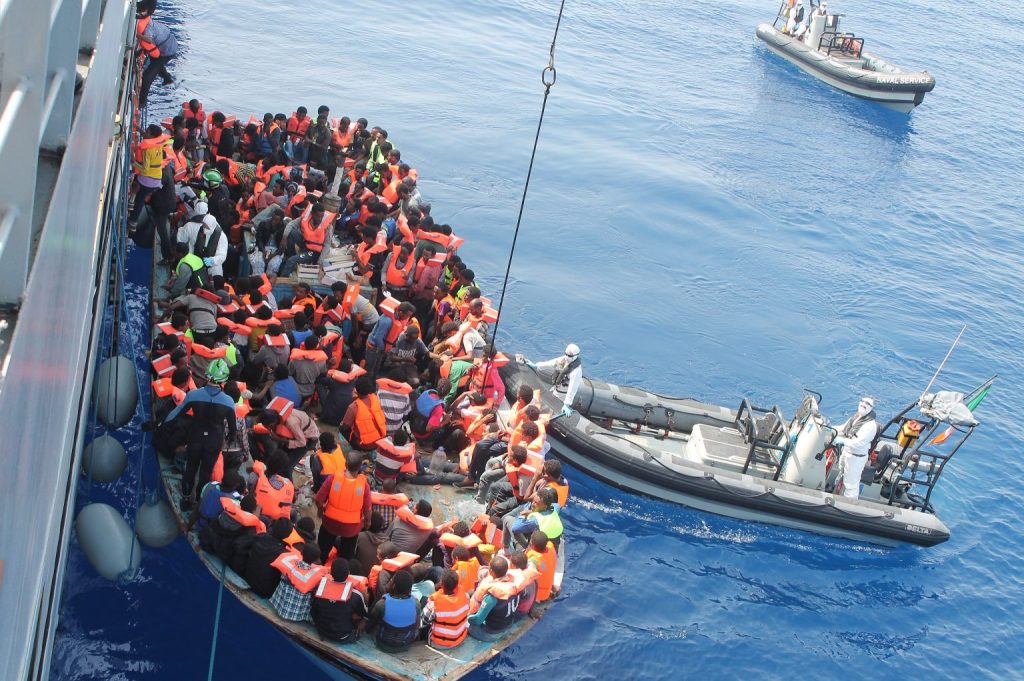
Migrants wait in a boat during a search and rescue (SAR) operation in central Mediterranean Sea on August, 17, 2022 REUTERS/Juan Medina |
Typically, when migrants landed in Lampedusa as their first step in achieving their goal to enter Europe, most migrants were transferred to Sicily or the Italian mainland then dispersed across centers for asylum seekers and migrants across Italy. When the Italian coast guard failed to succeed in locating and aiding a sea-unworthy vessel crammed tight with migrants and drownings occurred, the bodies were brought to cemeteries in Sicily to be interred in unmarked graves.
The Italian and European authorities, along with the Italian Red Cross, worked in tandem to produce an efficient system of dealing with the hundreds of thousands of migrants entering Italy through Lampedusa. Arrivals by land and sea have been greatly reduced from their 2015 high point of over a million, now averaging about 180,000 annually; each year producing 3,000 deaths in the perilous voyages. The Central Mediterranean route remains a primary passage used by migrants attempting to reach Europe, and one of the deadliest.
On that route alone in 2025 over 1,300 people were recorded as dead or missing; a number widely considered to represent a significant underestimate. Deadly illegal sea crossings on small unstable boats packed with people have become 'normalized', bringing in people leaving Bangladesh and Pakistan, Eritrea and Guinea among countless others. The passengers for the most part are young, working-age people who continue to aspire to reach Europe, gambling on success, despite widespread knowledge of the dangers involved.
Once in Europe, and undocumented, many work at picking tomatoes, harvesting oranges, cleaning hotel rooms and caring for the elderly as personal support workers in overworked and understaffed health care systems or on farm fields short of workers, a form of labour unpopular with the youth of the home countries. Lampedusa's role, given its placement in the Mediterranean as an entranceway to Europe continues to be a critical entry point to the continent.
 |
| Irregular migration from North Africa to Europe is on the rise again. This is particularly true along the Central Mediterranean route, which connects northern African countries (mainly Libya and Tunisia) to Italy. Atlantic Council.org |
Labels: Destination Europe, Entrancepoint Italy, Middle East, Migration, North Africa
posted by Pieface @ 8:19 PM
0 comments


