Ruminations

Blog dedicated primarily to randomly selected news items; comments reflecting personal perceptions

Monday, February 16, 2026

The Migration Route to Europe

"Deepest condolences [to the those who lost their lives; Italy will step up efforts to tackle migrant traffickers]."
"When a tragedy like today's occurs, with the deaths of dozens of people in the waters of the Mediterranean, a strong sense of dismay and compassion arises in all of us."
"And we find ourselves contemplating the inhumane cynicism with which human traffickers organize these sinister journeys." 
"[Stepping up rescue efforts is insufficient to tackle the scourge of trafficking; this could be done only by] preventing irregular departures and managing migration flows."
Italian Prime Minister Giorgia Meloni  
https://img.lemde.fr/2025/08/13/0/0/1920/1080/556/0/75/0/4461960_ftp-import-images-1-4s26uky5gjbt-e67054be2c9f4803ba535e962c6fdbc3-0-11f55870f6b64cf49bbe47bfd1c5f334.jpg
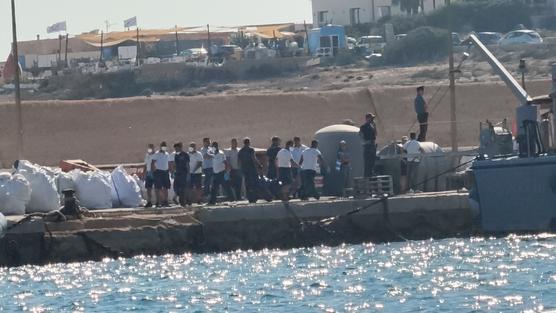
Italian Coast Guards officers carry a body bag on the dock of Lampedusa harbor on Wednesday, August 13, 2025, after a boat carrying nearly 100 migrants capsized off the Italian island.
 
In its geographic situation between the North African coasts of Libya and Tunisia and Italy, Lampedusa has  become the chosen route for illegal/irregular migration routes to Europe for  well over a decade. Even back in early 2010s, the passage of boats, people and bodies of those that perished on the way through by this most dangerous of sea routes, created pressure linked to growing numbers of arrivals on the island, striving to accommodate their needs.
 
Lampedusa is a small, rocky island in the middle of the Mediterranean. It became one of the busiest yet deadliest entry points to Europe through a crisis of migration from countries in the Middle East and North Africa. The year 2015 marked the most frantic challenges of Europe's efforts to deal with  huge waves of incoming migrants, with the European Union convincing its member-states that a fair apportionment of migrants between all would relieve the unbearable burden of stress that Italy found itself in.
 
A handful of Eastern European countries shunned the prospect of absorbing migrants whose culture, heritage, religion and values were often in opposition to their own. Western Europe answered the call, with Austria and Germany declaring their borders would be open to welcoming migrants. The result was not quite as salutary to the social order of those countries welcoming and making an effort to settle the migrants as their humanitarian gesture might assume.
 
https://assets.cfr.org/image/fetch/t_tgh-max_2600x2600/https://build.thinkglobalhealth.org//wp-content/uploads/2023/12/header_0.jpg
Migrants wait in a boat during a search and rescue (SAR) operation in central Mediterranean Sea on August, 17, 2022 REUTERS/Juan Medina
 
Typically, when migrants landed in Lampedusa as their first step in achieving their goal to enter Europe, most migrants were transferred to Sicily or the Italian mainland then dispersed across centers for asylum seekers and migrants across Italy.  When the Italian coast guard failed to succeed in  locating and aiding a sea-unworthy vessel crammed tight with migrants and drownings occurred, the bodies were brought to cemeteries in Sicily to be interred in unmarked graves.
 
The Italian and European authorities, along with the Italian Red Cross, worked in tandem to produce an efficient system of dealing with the hundreds of thousands of migrants entering Italy through Lampedusa. Arrivals by land and sea have been greatly reduced from their 2015 high point of over a million, now averaging about 180,000 annually; each year producing 3,000 deaths in the perilous voyages. The Central Mediterranean route remains a primary passage used by migrants attempting to reach Europe, and one of the deadliest.
 
On that route alone in 2025 over 1,300 people were recorded as dead or missing; a number widely considered to represent a significant underestimate. Deadly illegal sea crossings on small                    unstable boats packed with people have become 'normalized', bringing in people leaving Bangladesh and Pakistan, Eritrea and Guinea among countless others. The passengers for the most part are young, working-age people who continue to aspire to reach Europe, gambling on success, despite widespread knowledge of the dangers involved. 
 
Once in Europe, and undocumented, many work at picking tomatoes, harvesting oranges, cleaning hotel rooms and caring for the elderly as personal support workers in overworked and understaffed health care systems or on farm fields short of workers, a form of labour unpopular with the youth of the home countries. Lampedusa's role, given its placement in the Mediterranean as an entranceway to Europe continues to be a critical entry point to the continent. 
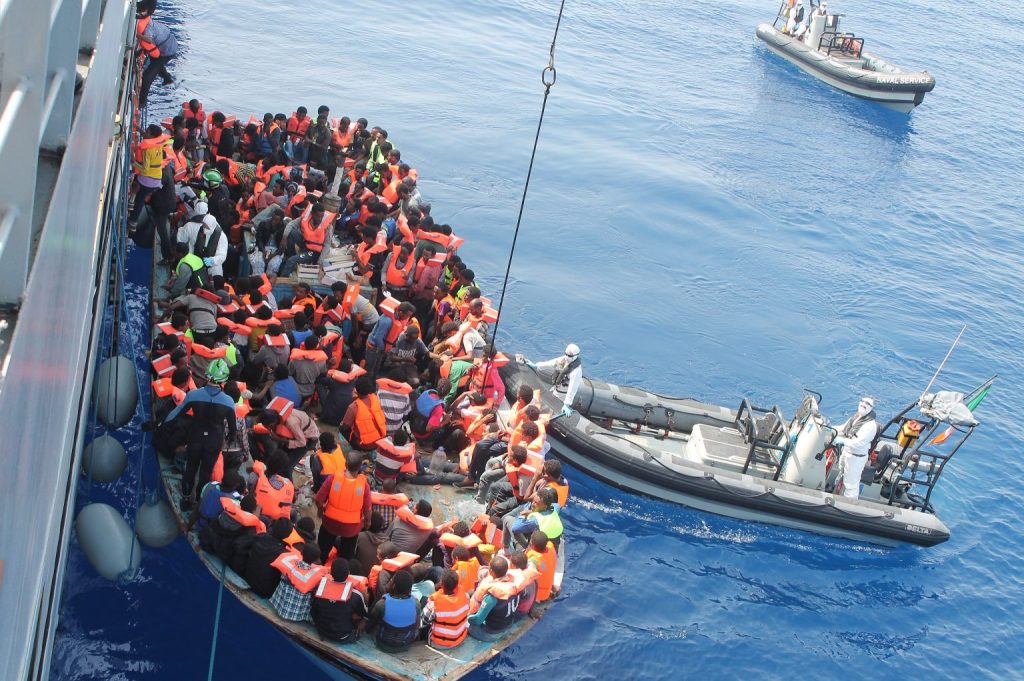
 
https://www.atlanticcouncil.org/wp-content/uploads/2023/07/Villa-1536x1022-1-1024x681.jpg
Irregular migration from North Africa to Europe is on the rise again. This is particularly true along the Central Mediterranean route, which connects northern African countries (mainly Libya and Tunisia) to Italy.  Atlantic Council.org


Labels: , , , ,

Monday, December 08, 2025

That Elusive Peace Between Totalitarian Islam and Israel

"[International mediators, led by the U.S. are working] to force the way forward [to the second phase to cement the deal]. What we have just done is a pause. We cannot consider it yet a ceasefire."
"A ceasefire cannot be completed unless there is a full withdrawal of Israeli forces, there is stability back in Gaza, people can go in and out, which is not the case today."
"There is a root for this conflict. And this conflict is not only about Gaza."
"It's about Gaza. It's about the West Bank. It's about the rights of the Palestinians for their state."
"We are hoping that we can work together with the U.S. administration to achieve this vision at the end of the day." 
Sheikh Mohammed bin Abdulrahman Al Thani, Qatari prime minister 
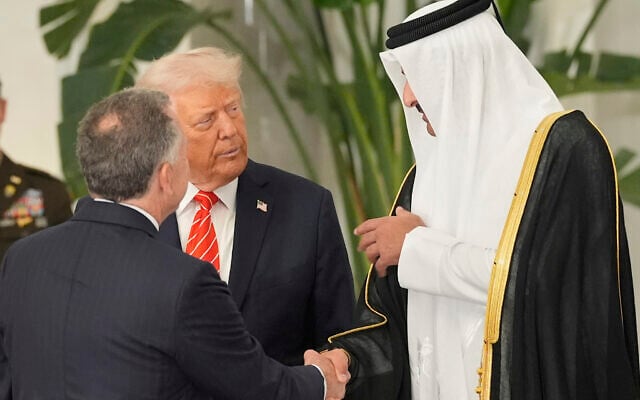
Qatar's Emir Sheikh Tamim bin Hamad Al Thani shakes hands with White House Special Envoy Steve Witkoff, as they speak with President Donald Trump before a state dinner at Lusail Palace in Doha, Qatar, May 14, 2025. (AP Photo/Alex Brandon)
 
In actual fact, this conflict is about Israel refusing to depart from its resumed geographic seat on a mere portion of its ancestral homeland. It is about surrounding Arab/Muslim countries apoplectic at the presence of a Jewish state reborn on land that the Arab conquest consecrated to Islam. It is about over four millennia of historical existence of Jews being wiped off the slate of history to argue that 'Palestine' is a deserved homeland for Arabs who migrated from Syria, Lebanon and Egypt in the last century to claim it as their own, when 'Palestine' always denoted a Jewish presence.
 
It is about repetitive bouts of conflict forced on the Jewish state by hostile, aggressive neighbours in a sectarian-tribal-clan tradition of competition and conflict. And it is, above all, the collective Middle East Arab councils of those governments inciting Arab Palestinians to believe that the land in question is theirs and theirs alone. The Arab Palestinians in fact, serve as a device to convince the international community that a human rights violation of immense proportions took place when Arab Palestinians were displaced when Jews reclaimed their patrimony.
 
And while most of those surrounding states -- who forcefully exiled a greater number of Jews who had lived in Arab countries for millennia, greater in number than the Palestinians who fled 'Palestine' in 1948 -- have now softened their stance and are prepared to accept that the Jewish presence which predated their own is permanent and its presence can enhance future prospects for peace and prosperity, the Palestinians themselves see the imperative of denying Israel's presence as cast in stone. They have, of course, had great assistance from Aryan-Muslim-Shiite Iran and from Qatar and their satellite Shiite militias. Iran has provided the theological impetus and Qatar the funding for terrorist groups dedicated to Israel's annihilation.
 
The Hamas charter pledge of destroying Israel alongside that of the Popular Front for the Liberation of Palestine, Fatah and Palestinian Islamic Jihad are the Palestinian instruments of terror that Iran and Qatar rely upon to produce the coveted goal of Jewish annihilation. Hezbollah, Yemen's Houthis and Shia militias loyal to Iran have collectively done their utmost in that direction. Despite all odds, Israel's military has met them all in combat and remains immovable. Even so, Qatar, aided by Turkey, has no intention of allowing Israel to defeat the combined forces of Islamist jihadists.
 
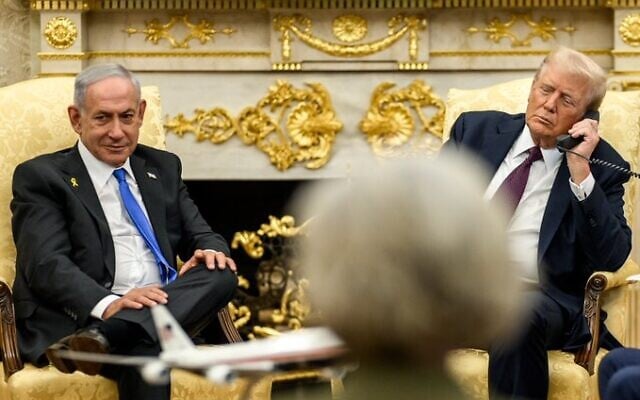
US President Donald Trump hosts a trilateral phone call with Prime Minister Benjamin Netanyahu and Prime Minister Mohammed bin Abdulrahman bin Jassim Al Thani of Qatar in the Oval Office, September 29, 2025. (The White House)
 
Qatar is alerting the United States, Israel's powerful backer, that the Trump peace plan is in a 'critical moment' with the first phase 'over', and the second soon to begin. Actually, it is not over until it is over; the first phase is incomplete, not only because the last of the Israeli hostages held in Gaza has not yet been returned, but critically, Hamas will not, as 'agreed upon' surrendered its arms. It has actually been busy in the interval between 'phases' of the peace plan, rearming, recruiting, reordering priorities and digging in as it resumes its control over that portion of Gaza it still occupies.
 
And this not-unexpected turn of events is being engineered and supported by Qatar, Iran and Turkey, for Gaza to remain in Hamas control, despite powerful rival clans in Gaza opposing Hamas's return to power and the conflict in that sector is ongoing. Gaza 'health officials' -- which is to say Hamas health sector operatives -- warn the international community of Palestinians still being targeted by the Israeli military, but further elaboration explains that these are Hamas operatives approaching Israeli troops in areas off limits to them as per the agreement.
 
The second phase relies upon the deployment of an international security force in Gaza, formation of a new technocratic government, disarmament of Hamas which would in theory lead to an eventual Israeli forces withdrawal. There are no expectations that such an international security force will deploy to Gaza; no foreign countries are anxious to have their military personnel placed in the kind of danger facing Hamas would entail. And since Hamas leaders have stated time and again they will not surrender their arms, Israeli troops will not withdraw.
 
https://media.tag24.de/720x480/q/5/q57mwogxsv4q6rnvhtjiber2ywdw6yjp.jpg
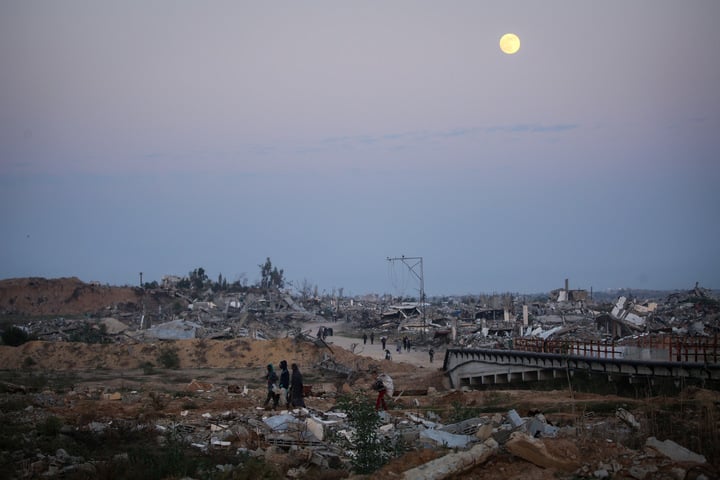
People walk amid the rubble of destroyed buildings as the Cold Moon, the last supermoon of the year, rises over the Nuseirat camp for displaced Palestinians in the central Gaza Strip on December 4, 2025.   Eyad BABA / AFP
 

Labels: , , , , , ,

Friday, December 08, 2023

World Class Scoundrels Oozing Sanctimony

"It's very important for us to exchange views of the situation in the region, particularly regarding the Palestinian situation."
"Our relations are developing very well. Please convey my best wishes to leader [Ayatollah Ali] Khamenei."
"Thanks to his support, we have gained good momentum over the past year [in Ukraine]."
Russian President Vladimir Putin
 
"[There is an urgent need to stop Israeli bombardment of the Gaza Strip', a child is killed there every ten minutes."
"It's not just a regional issue, it's an issue for the entire humankind."
Iranian President Ebrahim Raisi 
Iranian President Ebrahim Raisi in Moscow
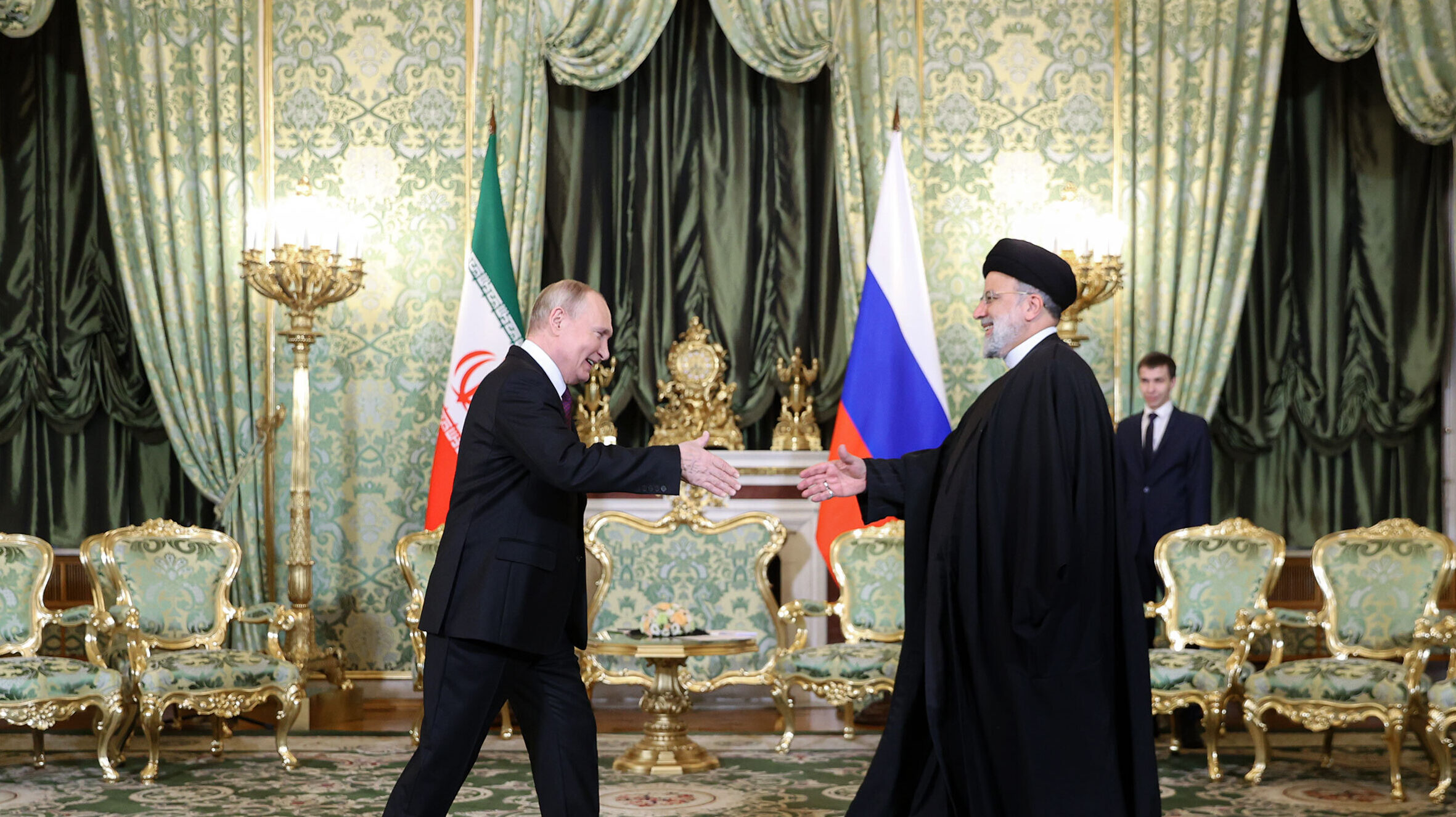
Russian President Vladimir Putin (L) meets with Iranian President Ebrahim Raisi (R) at Kremlin Palace in Moscow, Russia on December 07, 2023. (Photo by Iranian Presidency / Handout/Anadolu via Getty Images)
 
Preparing to run again for his fifth term as President of Russia, after having changed the Russian constitution from its previous limits, to pave the way for his planned undisturbed czardom with new elections upcoming in March of 2024, Vladimir Putin has been busy consolidating his/Russia's status as new major influencer in the Middle East. He is amenable in the process to extending Russia's loyal friendship to all the states, Sunni, Shia, and Judaic, strategizing his responses to whoever and whichever audience he finds himself in company with at any given time.

The current blitz of Middle East diplomacy included state visits to the United Arab Emirates and Saudi Arabia, all geared to raising Moscow's power broker profile in the region. The current Israel-Hamas conflict has been cast by this master Rasputin as a failure of diplomacy on the part of the United States, where Moscow could step in as an effective mediator, one with friendly ties to both Israel and the Palestinians. As for Iran's concern over the danger to Palestinian children, this is an Islamofascist theistic regime that hangs its own children for 'crimes against the state'.

The Islamic Republic of Iran which materially supports Hamas as it does Yemen's Houthis, both proxies of Iran like Hezbollah in Lebanon, has repeatedly warned that the current conflict dating from October 7 -- when Hamas invaded southern Israel to pillage, slaughter, rape, mutilate and torture Israeli citizens living in towns and villages, kibbutzim bordering on Gaza, brought the wrath of the Israel Defense Forces down on Gaza, pledging to destroy the terrorist group once and for all -- could spread to other areas in the ME. 
 
The hypocrisy is staggering in its blatant sanctimony. Vladimir Putin is concerned with the misfortune of his two friends, Israel and Hamas, who are fighting one another; both intent on destroying the other; he doesn't seem to care which one succeeds. This, at a time when his two-year bombardment of Ukraine has visited ruination and broken towns and millions of displaced civilians, tens of thousands killed -- at his command, relentless in his pursuit of neutering Ukraine and absorbing its territory.
 
And Iran, which cultivates terror groups under its aegis in a command performance of long standing geared to enhancing its position as the rightful power in the Middle East, in a Shi'ite versus Sunni, Persia versus Arab states power play replete with nuclear threats and declarations of total innocence of intent, yet arming the Houthis in Yemen, Hezbollah in Lebanon, and Hamas in Gaza, strenuously lays plans to ensure that a wider conflict will ensue, enabling Iran to mount its throne of ME control.
 
In Russia's all-out, implacable war against Ukraine, it is the Islamic Republic that is supplying Russia with most of its lethal drones, helping it toward accomplishing its goal of destroying Ukraine. The United States suspects as well that Tehran may be providing Moscow with ballistic missiles to be used against Ukraine. Iran, for its part, has announced a deal finalized for Su-35 fighter jets from Russia and additional military equipment including attack helicopters, radars and combat-trainer aircraft, from Russia.
 
How, which is the entity absorbed in drawing the entire Middle East region into a conflagration?
 
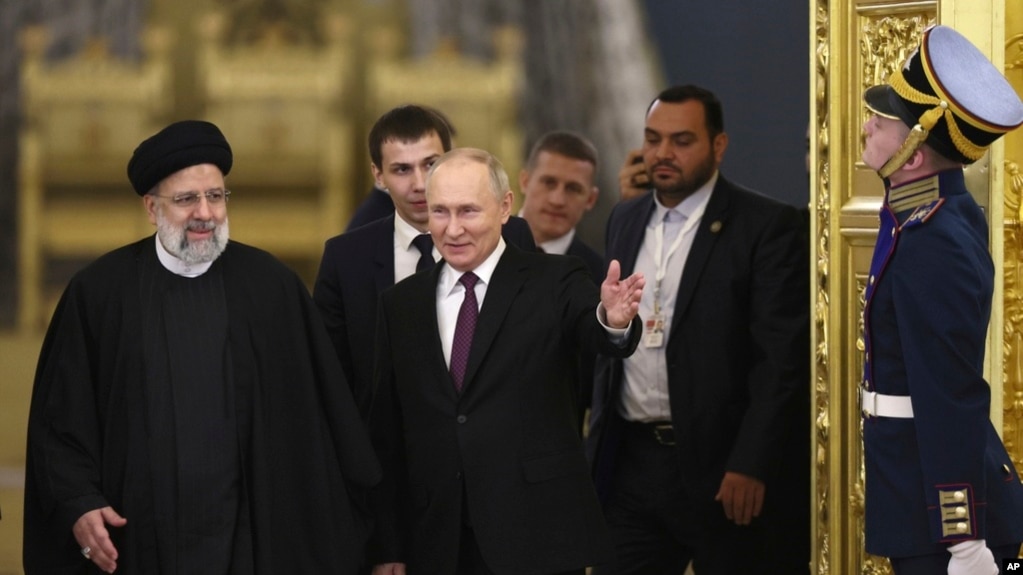
Russian President Vladimir Putin, center, welcomes Iranian President Ebrahim Raisi, left, for the talks at the Kremlin in Moscow, Dec. 7, 2023. (Pool Photo via AP)

Labels: , , , ,

Monday, November 07, 2022

Girls' and Women's Sporting Life in the Arab Middle East

"Sometimes we face some difficulties, of course. Like, 'This is a game only for boys or males, why do you wear shorts?' --and so on. This is a huge problem we face."
"But I think with time, it's getting better and better."
Masar Athamnehy, 20, Orthodox Club women's soccer team, Amman, Jordan
 
"Life has become hell for us, as a woman we can't do anything by our choice."
"Unfortunately,l my dream  to make it to Afghanistan's national team] remained just a dream."
Sabera Akberzada, 17, Afghanistan
 
"You're a girl, it's not right [they tell me]."
"I fell in love with the game because it's got action. I love it a lot, more than any other sport."
Sarah Asimrin 13, Amman, Jordan
 
"There is no support for women's sports in the Gaza Strip -- no support to be like girls in other parts of the world."
Maha Shabat, team manager Beit Hanoun Al-Ahli Youth Club, Gaza

"On the internet, I see many girls [elsewhere] playing normally."
"[The biggest obstacle in Gaza is society and tradition but I just] think positively about the criticism. I will take it as a motive to proceed and challenge everyone."
Rama Ashour, 14, Gaza
Joud Shunti, 23-year-old goalkeeper, trains with the Orthodox Club's women's team in Amman, Jordan. (Raad AL-Adayleh/The Associated Press)
 
The Middle East is a geographic region where the game of soccer has enthusiastic fans everywhere. Even among girls and women for whom participation in any kind of sport, much less soccer, is untraditional and goes against the cultural/religious strain of what is viewed as fitting for women in society. In Amman, Jordan, 13-year-old Sarah Asimrin and her younger sister might be viewed as coming by their fascination with soccer as an inherited trait, since their father is himself a soccer coach at a private academy in Amman.

Mad for the men's game of soccer as the region may be, the women's game has no real status and there is little interest in financing it as long as conservative interests continue to insist that girls and sports just do not fly, along with the issue of uniforms being entirely unsuited since they typically reveal bare skin on legs and arms. Jordan stands out as one of the leaders in the region, with a network of girls' youth and school leagues.

In Saudi Arabia where only in the last few years were women given permission to even attend soccer games as spectators, the first matches of a new women's Premier League were held. For the first time the Saudi national women's team played against international teams. Tournaments newly launched allow women's teams opportunities in international competitions.

The smaller West Asian and Asian football associations held their own first women's club championships several years back. A women's club championship was inaugurated in Cairo by the African Federation last year. This year's games began in Morocco with a sizeable financial incentive for the winners even though the win was considerably less than the $2.5 million that goes to the winning men's club.
Football Player for the Egyptian National Team. Sarah Essam
 
Financial incentives are provided by Jordan's Football Association in support of forming women's teams, so that even some conservative clubs have joined. A holdup in promoting women's teams is the fact that they fail to generate income. Since Qatar was named host of the World Cup this year, it has departed from its traditional lag in promoting women's soccer, to develop women's teams at universities, holding soccer academies for girls, as a new initiative.

The region's most prominent contrast is Egypt with its men's teams -- wealthy powerhouses -- winning regional tournaments on a regular basis even while women's soccer languishes in neglect. Egypt's Wadi Degla wins most women's competitions. The price has been public backlashes where a victory by the under-20 national women's team over Lebanon led to a barrage of sexual harassment on social media of obscene comments and sneers at girls playing soccer.

The African Champions League is to require clubs in its men's tournament to include and promote women's teams, a move that should have the effect of moving the Egyptian clubs to alter their resistance to aiding the formation of women's soccer clubs. In the Palestinian West Bank, women's soccer is somewhat active, while it has a non-existent presence in the Gaza Strip where its 2.3 million residents are conservative and its Islamist government in Hamas has little patience for women's freedoms.

The Beit Hanoun Al Ahli Youth Club with 20 girls playing basketball and soccer wear pants rather than shorts, and long-sleeve shirts. Their soccer-playing days are over once they reach age 17, when they no longer play, looking toward marriage instead. And in Afghanistan since the Taliban takeover of the country, the nascent women's sport scene collapsed under order of the authorities, leaving hundreds of female athletes without recourse to the sports they love.

"I feel so worried and so sorry for women, young women who wanted to be independent. I don't think women will play sports again in Afghanistan", sighed Khalid Popal, a former captain of the women's national team now living in exile in Denmark, and desperately trying to get members of the under-15 team still in Afghanistan to safety outside her benighted country.

Soccer player Insherah Heyasat, left, gives instructions during a training of the Orthodox Club's women's team in Amman, Jordan, on Oct. 22. Women's soccer has been long been neglected in the Middle East, a region that is mad for the men's game and hosts the World Cup for the first time this month in Qatar. (Raad AL-Adayleh/The Associated Press)
 

Labels: , , , , , ,

Sunday, December 12, 2021

World Population

"The last time that global population declined was in the mid-14th century, due to the Black Plague."
"If our forecast is correct, it will be the first time population decline is driven by fertility decline as opposed to events such as a pandemic or famine."
"Africa and the Arab world will shape our future, while Europe and Asia will recede in their influence. By the end of the century, the world will be multipolar, with India, Nigeria, China and the United States the dominant powers."
"Improvements in access to modern contraception and the education of girls and women [have led to the decrease in population]."
"Three factors drive the fertility rate -- the average number of children a woman delivers over her lifetime which is the largest determinant of population. The global total fertility rate is predicted to steadily decline, from 2.37 in 2017 to 1.66 in 2100, well below the minimum rate [2.1 live birth was per woman] considered necessary to maintain population numbers."
Stein Emil Vollset, professor of Global Health, Institute for Health Metrics and Evaluation
Japan ... Global population to decline in coming decades Photograph:( AFP )

The world population stands at the present time at roughly 7.8 billion people with experts believing the global population to peak at around 9.7 billion by 2064, before turning around to steadily decline to 8.79 billion by 2100. A new study recently published in the Lancet journal has for the first time revealed that the world's population is forecasted to decline, beginning in the next few decades, a phenomenon seen for the first time in centuries.

Japan, Thailand, Italy, Spain, Portugal and South Korea are among up to 23 countries that could realize a population decrease by 50 percent, resulting from low birthrates balanced against an aging population. China too, as the most populous country in the world, a country that has experienced huge population growth, is expected to leap forward exponentially, from 1.03 billion in 2017 to 3.07 billion forecasted for 2100. 

There are some countries, on the other hand, where an increase in population is being forecasted, among them countries in North Africa, the Middle East and sub-Saharan Africa. There, populations are estimated to triple from 1.3 billion in 2017 to 3.07 billion by 2100. Professor Vollset identifies the decrease in population linked to two key factors; contraception and education.


Labels: , , , , , ,

Saturday, May 23, 2020

A Biblical Plague

"[Locusts] don't fly 24 hours a day like a particle. They take off in the morning after a certain time and land just before sunset at a certain time."
"And then they rest and they go again."
"So often we will get out-of-the-blue reports of swarms landing on the coast of the Red Sea."
"The concern of the recipient country is how many more swarms are we going to get and where are they coming from?"
Keith Cressman, senior locust forecasting officer, UN Food and Agriculture Organization
Samburu men attempt to repel locusts
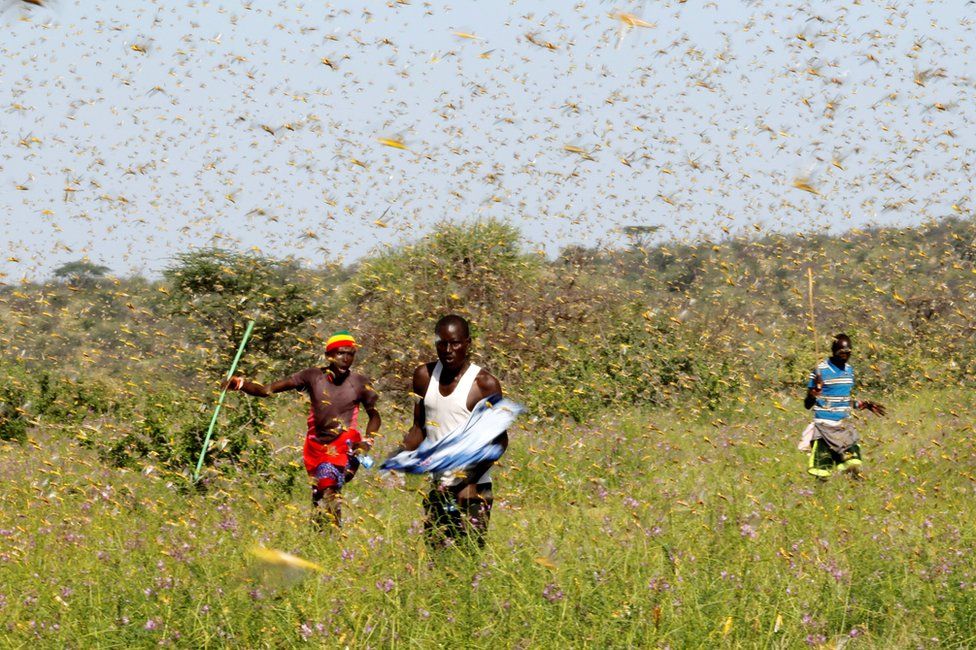
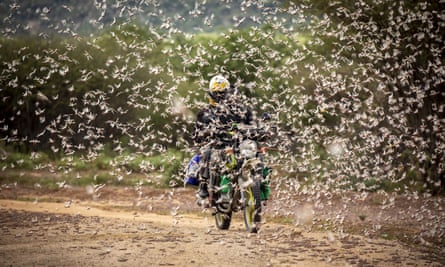
Men try to repel locusts flying over grazing land in Lemasulani village, Samburu county, Kenya   Reuters
News bounced around the world lately of an historic surge of desert locusts whose wholesale numbers threaten agricultural crops that countries depend on to feed their populations. East Africa has seen a recent upsurge of arrivals of a plague of vegetation-devouring locusts darkening the skies as they fly over unfortunate countries, then settle in countless numbers to ravage the landscape below. Scientists eager to find ways to alert nations to defensive action have developed a sophisticated air pollution model in anticipation of where and when the pests are blown by prevailing winds.

Extreme rainfall creates breeding conditions that favour the destructive pests, and over the last year-and-a-half those conditions have created the perfect scenario to encourage a vast infestation of locusts threatening food availability from Africa to the Middle East where great swarms of desert locusts from the Arabian Peninsula began their rampage across East Africa, devouring vegetation anywhere they landed, in 2020. And wherever they landed a double plague of the novel coronavirus and the locusts have bedevilled those unfortunate geographies.

A hand holds a desert locust
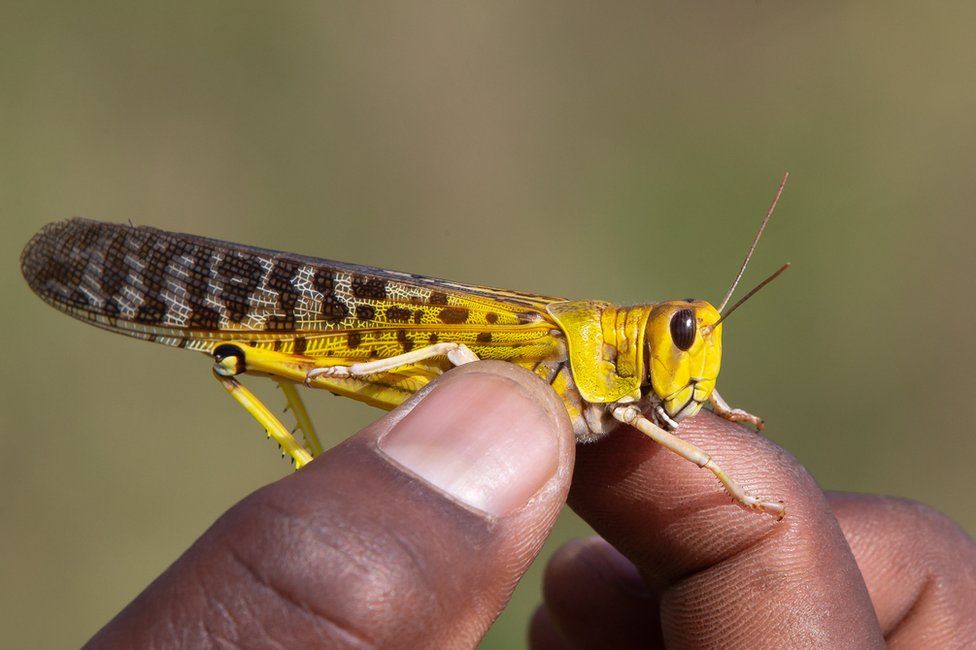
A desert locust is held in Katakw, Kenya    Getty Images
Ten countries in the Greater Horn of Africa along with Yemen experienced infestations of historic proportions, leading to a situation where over 42 million people could face "severe acute food insecurity", according to the UN Food and Agriculture Organization (FAO). March and April's heavy rainfall brought ideal conditions for waves of breeding locusts, leaving authorities desperate to find any protocol to help prepare for oncoming onslaughts.

Keith Cressman of the FAO has teamed up with scientists at the National Oceanic and Atmospheric Administration in the U.S. to develop a web app to be used in forecasting where wind will blow locusts once they've taken flight. An atmospheric model called HYSPLIT, powers the app, typically used by scientists to monitor the spread of pollution particles -- soot from power plants, ash from a volcanic eruption -- and their subsequent dispersal in the atmosphere. The app has been modified to track whatever is transported through the atmosphere, including locusts, as "passive flyers".

A swarm of desert locusts in Kipsing

Desert locusts swarm in  Kenya on 31 March.
Photograph: Sven Torfinn/FAO via AP
Dr. Cressman several years ago began the use of HYSPLIT in predicting where locust swarms were moving based on field observations. Now that the locust crisis intensified in East Asia, he realized the model could be used effectively should it be tweaked to account for some idiosyncratic aspects of locust behaviour which led him in Feburary to reach out to NOAA's Air Resources Laboratory in College Park, Maryland, to assess whether the daily cycle could be integrated into his model runs.

Following a few weeks of "very intensive, long discussions", the lab produced an initial version of a web app in March to model dozens of swarms at a time, predicting their location at five-minute intervals, seven days in advance, allowing Dr.Cressman to predict where swarms will land should they be flying at different altitudes, subject to various wind speeds and even different wind directions.Even where a recently spotted swarm originated can be worked out with the use of the model.

By June's end, a new generation of locusts will have hatched and matured to become "hungry teenagers" in northern Kenya and southern Ethiopia, stated Dr.Cressman, of a generation of locusts set to take flight in search of food around the time many East African farmers begin harvesting their spring crops. Anticipating where a swarm will strike next is viewed as integral to aiding local authorities conduct pesticide treatments to prevent crop losses.

Somaliland Locusts Swanson (11 of 17).jpg
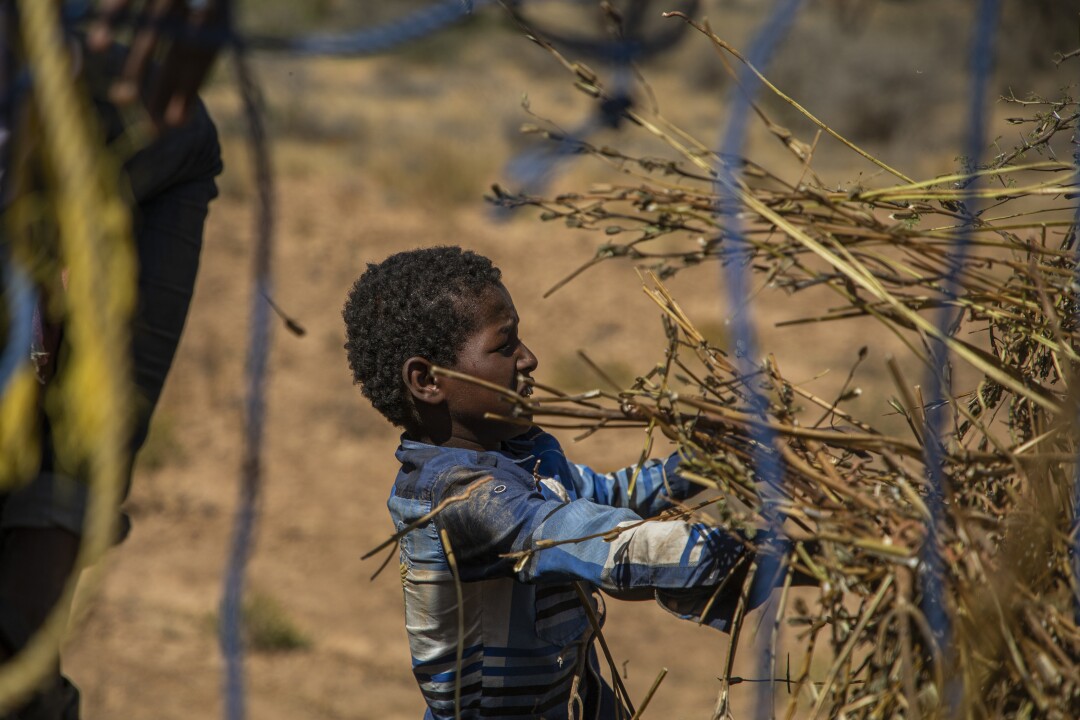
A boy helps collect the remains of a sesame crop that was devastated by locusts in Somalia.
(Will Swanson / For The Times)

Labels: , , , , ,

Saturday, June 03, 2017

"Liberating" Palestine, Boycotting a Film Tainted by Israel

"I am sending my love and prayers to my fellow Israeli citizens."
"Especially to all the boys and girls who are risking their lives protecting my country against the horrific acts conducted by Hamas, who are hiding like cowards behind women and children."
Israeli actress Gal Gadot
Israeli actress Gal Gadot arrives at the premiere of Warner Bros. Pictures' 'Wonder Woman' at the Pantages Theatre on May 25, 2017 in Hollywood, California.  (Frazer Harrison/Getty Images/AFP)
Israeli actress Gal Gadot arrives at the premiere of Warner Bros. Pictures' 'Wonder Woman' at the Pantages Theatre on May 25, 2017 in Hollywood, California. (Frazer Harrison/Getty Images/AFP)
"In typical Lebanese fashion and because we definitely have our priorities in order, Lebanon’s government decided to rise up from its slumber and resist, even though the movie has been announced for over three years now."
"The fact of the matter is that if you have a problem with the content of a movie, the actor or actress leading it or anything pertaining to it… Simply don’t go watch it."
"Call for a boycott, but you sure as hell have no right in making sure no one else gets to watch it too."
Blogger Elie Fares --  “A Separate State of Mind” blog
It is a cardinal sin to be an Israeli. All the more so, an Israeli who served in the Israel Defence Force. And since everyone in Israel, male or female, is expected to serve through general conscription for a two-year period in defence of their nation, those who wish to see Israel destroyed feel justified in considering all Israeli Jews as criminal persecutors of Palestinians. The simple fact that Israel must maintain a standing army in preparedness for any contingency owes to the other fact; that its neighbours wish to destroy it.

Palestinians cannot have it both ways; waging both physical war with Israel and expecting Arab Palestinians to recognize their obligation to attack Jews in an effort to 'recapture' the land it sits upon as its ancient heritage, but which Palestinian Arabs contest as their very own, and engaging in slanderous propaganda popular wherever anti-Semitism thrives, eager to join the Boycott-Divestment movement. But eager and prepared to present itself as a partner for peace with Israel.

The film Wonder Woman, which sets out to portray women as physically powerful, courageous and as determined as any man, in a campaign to save the world, has garnered lots of praise and worldwide attention. Advance premieres have resulted in critics giving it excellent reviews, and people are eager to see the film, considered a first of its kind because it features a woman in a super-hero role, usually reserved for super-men.
"She's incredibly strong, but she also stands for something which is the opposite of being violent -- which is love, truth, compassion."
"As a woman, it was interesting sometimes that I would say, 'I think [females] might fight a little differently than [males] might fight."
"The challenge is to see both the good and bad of mankind..."
"We all want to bring, not only a hero to the world, but a message of helping anybody find their voice."
Patty Jenkins, director, Wonder Woman
Perhaps the director's words hit the issue square, though of a certainty they weren't intended to be political. But what she says and how she describes the film and what it explores in human relations appears to lead directly to Israel-as-metaphor.

Wonder Woman is opening during the Muslim holy month of Ramadan and theatres in the United Arab Emirates, Qatar and Kuwait are scheduled to run the film. Oman and Bahrain are also going to feature this blockbuster that has aroused interest in theatre-goers worldwide. But film enthusiasts in Lebanon are just plain out of luck, because its ministry of economy has banned the film. Not because the theory  of a woman daring to do what men have always done is offensive to a religion where women are neither seen nor heard in public.

But because its star, a woman, is an Israeli Jew; a combination that makes for detestation and anger. Beirut had prepared to schedule the film at one of its cinemas but though posters and billboards went into play no one in the capital of Lebanon or elsewhere in the country will now see it because it has become symbolic of the state of war between Lebanon and Israel. Lebanon's Iran-led Hezbollah paramilitary group and the Islamic Republic of Iran, both committed to Israel's destruction, have, needless to say, great influence in this matter.

An Islamist Republic whose focus is on supporting terrorism world-wide and its creature, a terrorist group, both of which are helping Syria's mass-murdering president in his sectarian war against his own people would like the world to believe that it is Israel and its presence in the Middle East that is responsible for the violence, bloodshed and barbarism that floods the nations of Arab and Aryan Islam. The freedoms that Lebanese once enjoyed in a country once admired for its openness and social advancement has disappeared, with Druze, Christians, Sunni and Shiite Islam at one another's throats.

And it all began when the Palestinian Liberation Organization under the late Yasser Arafat made Lebanon its conflict outpost after Jordan's then-King Hussein refused to allow his country to continue to be overrun by Palestinian militias, attacking Israel over the border and destabilizing both Israel and Jordan. What the PLO failed to accomplish in Jordan (though a slow-simmering effort continues) it accomplished handily in Lebanon before it was forced from there, too.

But the chain of events leading from Lebanon's dystopian malfunctions which bred Hezbollah when the Iranian Republican Guard Corps infused Shiites with the sacred vision of jihad and martyrdom has entirely disrupted the country and its administration, the larger waves of which stimulated Sunni states like Saudi Arabia to encourage their own brand of death-dealing-and-loving jihad beginning with al-Qaeda and ending with Islamic State of Iraq and the Levant.

Should anything untoward happen to ISIL, the Muslim Brotherhood hovers in the background, infesting the Islamic nations of the Middle East and North Africa, and installing themselves throughout the Western world, infiltrating Europe, North America and Oceania.

Labels: , , , , ,

Friday, May 26, 2017

No Boundaries, No Hostilities in Collaborative Science

"Today sees the fulfillment of many hopes and dreams. The hope that a group of initially inexperienced young people could build SESAME and make it work - they have: three weeks ago SESAME reached its full design energy. The hope that, nurtured by SESAME’s training program, large numbers of scientists in the region would become interested in using SESAME – they have: 55 proposals to use the first two beamlines have already been submitted. And the hope that the diverse Members could work together harmoniously."
"As well as being a day for celebration, the opening is an occasion to look forward to the science that SESAME will produce, using photons provided by what will soon be the world’s first accelerator powered solely by renewable energy."
President of the SESAME Council, Professor Sir Chris Llewellyn Smith

"We call it the light at the end of the tunnel."
"Jordan was the site [the Jordanian desert]. It was where everybody could come."
"I actually got to live in a universe where Arabs, Israelis, Iranians, Pakistanis work together for the same cause for their own people, for humanity. And that definitely feels good."
Eliezer Rabinovici, theoretical physicist, Hebrew University, Jerusalem
The Synchrotron-Light for Experimental Science and Applications (Sesame) research centre in Jordan.
The Synchrotron-Light for Experimental Science and Applications centre (known as Sesame) in Jordan. Photograph: http://www.sesame.org.jo/

Dr. Rabinovici has had the rare good fortune to see his efforts of twenty years bearing fruit. It is for that length of time that he has been involved in hoping to create a Middle Eastern Science Committee. In 1993 he had been working at CERN, on the Large Hadron Collider, of the European Organization for Nuclear Research near Geneva, where five years ago the Higgs boson was finally found.

A colleague from Italy, Sergio Fubini, planted the seed of an idea in Dr. Rabinovici's head by telling him it was time he placed his "naive idealism" to the test. With that prodding Drs. Rabinovici and Fubini set out to create the Middle Eastern Science Committee, leading to a meeting in November 1995 in Egypt where scientists from around the Middle East were assembled.

German scientists offered the group an old accelerator nicknamed Bessy. Bessy had once served in Berlin as a light source and at that juncture she was being replaced. The accelerator was dismantled and then shipped in boxes to the site in the Jordanian desert where the group was preparing to set itself up to fully engage in the serious business of scientific investigation into the energy of light.

The group had named itself SESAME, the name derived from an acronym for Synchrotron-light for Experimental Science and Applications in the Middle East. May 16 was its official opening. SESAME is comprised of physicists from Cyprus, Egypt, Iran, Israel, Jordan, Turkey and Pakistan, and including the Palestinian Authority; a membership whose scientists are dedicated to collaboration in the name of science.
His Majesty King Abdullah II following the opening of SESAME, flanked by Heads of the delegations of the SESAME Members and Directors of International Organisations that have supported SESAME**. (Image: Noemi Caraban Gonzalez/CERN)

The institute has been established with the particle accelerator known as a synchrotron, to study the phenomenon of speeding electrons. These scientists are invested in harnessing the electrons in a 'dance' which would emit powerful beams of radiation, called synchrotron light, and that light made use of, to study properties of materials, from semiconductors to viruses.

Throughout the world about sixty such light sources exist and are studied for their increasing value as tools in medicine and engineering. Scientists in California using X-rays from a light source, discovered recently new details in the structure of proteins regulating blood pressure. That insight raises the possibility of improved treatment for hypertension.

CERN, viewed by SESAME as a guide toward their own potential for success came about when UNESCO conceived of reviving science in Europe post World War II, and at the same time fostering the Continent's capacity to cooperate in a time of peace, as a means of keeping the peace and furthering science at the very same time.

Dr. Christopher Llewellyn Smith, Oxford University physics professor, and now president of the SESAME Council, observes that the major difference lies in the fact that hostilities in Europe have long since passed, whereas in the Middle East they are alive and thriving. Synchrotron light sources' study is meant to transform wasted energy into a scientific tool.

In machines like the Large Hadron Collider, as charged particles accelerate around an electromagnetic racetrack, they radiate energy, called synchrotron radiation. Arrays of magnets called wigglers and undulators can be inserted to induce the electrons to dance, producing powerful pencil-beams of light types. The manner in which these beams of light are absorbed by target materials, or reflected, can reveal molecular arrangements and shapes in the manner in which the double helix of DNA had been revealed by X-ray photographs in the 1950s.

A grant from the European Union enabled CERN to assist in building the magnets and to supervise construction of the SESAME machine, part of the $90-million raised to date to make the project possible. Jordan offered another $7 million for a solar power plant to result in Sesame presenting as the first accelerator worldwide to be powered through renewable energy.

A worker looks at research data at the Sesame facility.
A worker looks at research data at the Sesame facility. Photograph: Kareem Shaheen

Labels: , , , ,

Tuesday, November 08, 2016

Getting Around to Agriculture and DNA Migration in Ancient Fertile Crescent Times

"It's a part of the story of civilization that we're just beginning to understand."
"There seem to be [early genetic traces in primitive farming peoples] expansions out in all directions."
Dr. Iosif Lazaridis, postdoctoral researcher, Harvard Medical School

"It's not like you had one Near Eastern population that developed farming that expands and overruns all the others."
Dr. David Reich, geneticist, Harvard Medical School

"This botanical find is really opening new windows to the past. You have to remember Ohalo is a unique preservation. Between Ohalo and the beginning of the Neolithic we have a blank. And when the early Neolithic arrives people start [agriculture again] from scratch."
"We’re not trying to say cultivation and an agricultural way of life started in Ohalo and then continued to the Neolithic. You can’t say that. What you can say is that this was perhaps a trial cultivation from which we can understand how humans were always sophisticated, trying to push borders and make life better."
Professor Ehud Weiss, head, archaeological botany lab, Department of Land of Israel Studies


JTB Photo/UIG via Getty Images
Ears of emmer wheat, a crop first farmed in the Fertile Crescent more than 10,000 years ago
Dr. Reich's leading theory that groups of farming communities erupted spontaneously, without having had contact with and inspiration from one another to turn to agricultural pursuits, does not find complete agreement with others of his colleagues. Dr. Melinda A. Zeder, senior research scientist at the Smithsonian National Museum of Natural History in Washington does support the working idea that across the Fertile Crescent now known as the Middle East, independent farming arose as a new human enterprise.

On the other hand, an archaeologist at Harvard University, Dr. Ofer Bar-Yosef, feels it far more likely that agriculture on a wide basis had an initial evolution, whose success swiftly rippled from one group to another. It seems the oldest sites showing evidence of agricultural activity on a large scale appeared in what is now northern Syria and southern Turkey. Needless to say at that time in evolutionary history there were no Syrians and Turks to claim the land.

According to the research in DNA about eight thousand years ago there were presumably few tribal, religious or ethnic barriers existing between the people inhabiting the Fertile Crescent and they recognized one another as residents of a common area with the Near East presenting at that time -- according to the researchers who have interpreted the results of what they have discovered -- as a homogeneous mix of people. Usually homogeneity excludes a mixture of anything.

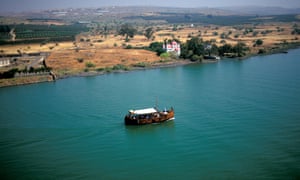
The Sea of Galilee in Israel.
The Sea of Galilee in Israel. Archaeologists made their discovery at a site called Ohalo II which was occupied at the height of the last ice age. Photograph: Hanan Isachar/Alamy

But in this case scientists appear to feel that peace reigned at this ancient time in pre-history with one group of people viewing another with the equanimity of collegiality, as opposed to a spirit of challenge and offense, more in keeping with the older, larger theory of territorial imperatives leading one group to view another as competition for scarce resources. If indeed the greater Middle East at a time in ancient history represented a pacific area of human settlement, they have long since strayed far from this ideal.

Dr. Reich had hopes that he could find more evidence in his scientific explorations on early human settlements and emerging realization of land pasturage and agriculture. He thought of the possibility of accessing archaeological samples in a more systematic manner across the Fertile Crescent. His hopes temporarily dashed, in deference to extending his personal life expectancy rather than expose himself and his team to the dangers inherent in the conflict gripping Syria at the present time.

For the present, he and his colleagues will have to feel satisfied with what they have to date uncovered, that in central Jordan (long, long predating the current Hashemite Kingdom) the remains of a ten thousand-year-old village named Ain Ghazal lies, considered to be evidence of one of the world's first ever farming villages that arose at the dawn of agriculture.

Research has turned up evidence that farmers at Ain Ghazal took to raising barley, wheat, chickpeas and lentils, while others belonging to the village would trek off seasonally for long periods of time with herds of sheep and goats into the hills for them to graze and mature. This is a momentous discovery; the time in the mists of the primitive past when humans domesticated animals and grew plants from seeds in an organized fashion.

It was when humankind changed from wandering the land from season to season and began to settle in discrete places setting the template aeons into the future where we are today, as 'civilized' societies living urban lifestyles, long distanced from our nomadic beginnings.
 
early farmers the Fertile Crescent


DNA was extracted from skeletons found at Ain Ghazal along with other early settlements discovered in the larger area. It is now held as settled that agriculture originated in the areas that now include current-day Iraq, Syria, Lebanon, Israel and Jordan, dating back to about 11,000 or even 23,000 years, according toIsraeli archaeologists who last year revealed the presence of what they believe are the earliest known attempts at agriculture, 11,000 years before the generally recognized advent of organized cultivation.

Their conclusion was based on a study that investigated over 150,000 samples of plant remains that were gathered for examination from an unusually well preserved hunter-gatherer settlement located on the shores of the Sea of Galilee in northern Israel.

A team of researchers at Johannes Gutenberg University, Mainz, Germany reconstructed genomes from four early farmers extracted from the Zagros Mountains; bones dating back to around ten thousand years. David Reich and his colleagues managed to recover genetic material extracted from 44 sets of remains in the Near East, including DNA from early farmers who existed at that time in Iran, along with bones extracted from yet another site like the one at Ain Ghazal.

Even more ancient genetic material from early hunter-gatherers in the region was also discovered dating back as far as 14,000 years.

In the geography now known as Turkey early farmers appear to have crossed the Bosporus to travel into Europe some 8,000 years ago, encountering no other farmers, but rather hunter-gatherers who had existed there for over 30,000 years. The invading farmers took possession of much of the territory they had invaded, converting it into farmland.

The early farmers in Iran expanded easterly and their descendants ended up in India, there DNA now seen to provide a large proportion of the east Indian genomes.

The people of Ain Ghazal, on the other hand saw an expanded population moving into East Africa and where, in Somalia, a third of the DNA of people there was also inherited from the Ain Ghazel migrants. What research has established is that the people originally from Ain Ghazal show evidence of having scattered their DNA into East Africa; the first agriculturalists of the southern Levant made East Africans beneficiaries of both their genetic endowment and their agricultural skills.
.

Labels: , , ,

Thursday, April 14, 2016

Our Civilized, 21st-Century World

What a flawed world we have created for ourselves. Not necessarily the world that surrounds us, the world that nature allows us to live within, the natural world of our environment which we depend so heavily on to support everything we do, however we live, and in the process exploit its resources beyond sustainability. No, I mean the world that we have constructed, the social world that reflects our values and what we think of as our survival imperatives.

Perhaps it's fair to point out that we are endowed with characteristics that nature has designed for us, and some of them -- many of them -- are less than admirable. Our penchant, for example, of constantly dedicating ourselves to having power of one kind or another over others whom we presume to be less worthy than ourselves, or with whom we have a long-standing, ongoing argument about resource ownership, from land to the natural resources within that land that we boast is our own to do with as we will.

And then there are the ideas, the idea that one religion, one ideology is far superior to another, valued by a great body of people also inhabiting a pluralist geography, when the majority throws its weight around and the minority chafe and cry foul, and sometimes surrender, but sometimes create non-state militias to bring the polarized views to a head through violent conflict. Through it all, we live and we love and we raise the next generation, and we attempt to instill in them the values that we feel hold true, reflecting human rights and dignity.

Which is to say, some of us do, and many more do not, and the tension between the two continues to breed suspicion, hatred and violence. In Western societies the right to life and liberty under a democratic system of governance is held up as the most certain way to achieve equality and peace. In other parts of the world, where tribalism, clan conquests and religious beliefs clash with those of others' widespread beliefs in the sanctity of life and the requirement to shelter children to adulthood often don't prevail.
"It may seem unimaginable to you that child soldiers exist. It seemed impossible to me when I first encountered them that anyone would abuse the state of childhood so ruthlessly. And yet the reality for many rebel and gang leaders, and even state governments, is that there is no more complete end-to-end weapon system in the inventory of war machines than the child soldier. Its negligible technology, simple sustainment requirements, unlimited versatility in all possible facets of low-intensity conflict, and capacity for barbarism has made the child soldier the weapon of choice in over thirty conflicts around the world, [an] ultimate cheap, expendable, yet sophisticated human weapon, at the expense of humanity's own future: its children."
"Thanks to a worldwide proliferation of light weapons and ammunition, combined with the limitless resource of children as a result of the overpopulation in developing countries in conflict, such as we see in so many cases in Africa, there is no more readily available, cost-effective and renewable weapon system in existence today. Desperate children, boys and girls, are cheap to sustain, have no real sense of fear, and are limitless in the perverse directions they can be manipulated through drugs and indoctrination since they have not yet developed a concept of justice and have been ripped away from their families to fend in the new perverted family of armed force."
"Children are vulnerable and easy to catch, just like minnows in a pond, especially in places where families are being destroyed by famine, epidemic, AIDS, warring factions. Children are faceless and they are considered expendable. The guns are light enough for children to carry, and they are plentiful."
"Girls are an even greater asset, as they can do everything that boys can do, and so much more. They set up bivouacs, prepare the food, control the younger children and are used as sex slaves and bush wives."
"Children are excellent as combatants, as bait for ambushes, as cannon fodder. They are light to transport but still heavy enough to explode land mines so adults can move safely in their wake."
Romeo Dallaire, former Canadian soldier, head of UN mission to Rwanda, parliamentarian : They Fight Like Soldiers, They Die Like Children
child soldier gun
emmanuel braun / reuters    A young rebel fighter mans a large-caliber machine gun on the Chad-Sudan border. UNICEF estimates that there are 250,000 child soldiers worldwide
During the Iran-Iraq war Iranian boys were given 'keys' to hold to open their way to Paradise, as they walked through areas heavily mined by the Iraqis, to clear the way for troops; the children expendable, the seasoned, battle-hardened Iranian soldiers not. In Gaza, young, very young children are dressed in fatigues, given weapons to brandish, while older children are enrolled in 'summer schools' to teach them the rudiments of battlefield action. Sudan, Somalia, South Sudan, Libya, Mali, Chad, Uganda and Central African Republic are some of the African countries which train and deploy child soldiers. South America, Asia, the Middle East and Africa can boast with pride their use of child soldiers.
child soldier gun
jamal saidi / reuters     A young Palestinian member of Fatah al-Islam trains with a weapon at Nahr al-Bared refugee camp, Lebanon. Fatah al-Islam is a militant Sunni Islamist group with reported ties to Al-Qaeda
Accusations have recently surfaced against Nigeria's Boko Haram for its abductions of children for the purpose of training them as child soldiers. These vulnerable children whose family villages have been destroyed by the jihadist group, members of their families raped and murdered, are horribly abused, threatened, starved, then taught to redeem themselves by adapting their childhood years to the pursuit of military atrocities. 

Last year in Kenya al-Shabaab, a Boko Haram counterpart, attacked a residential school in Garissa, and slaughtered 147 young university students. In Iraq, the Islamic State of Iraq and the Levant which is seen as a beacon guiding light for Islamist jihad, declared war on the world, starting with Christians and Yazidi minorities. When they stormed the Yazidi stronghold of Sinjar, a bloody slaughter took place, and thousands of women and children were abducted, the women and children raped, and taken as slaves. ISIL indoctrinates children into Islamist jihad, preparing them to engage in conflict.

This is 21st-Century barbarism.


child soldier gunHo/News: Reuters

Labels: , , , ,

Sunday, March 06, 2016

It's a Cruel World of Indentured Labour

"Our investigations at sea and across the Thai seafood sector continue to find extensive violence, corruption and abuse." 
"Slaves are still on the boats; nationals of neighbouring states are still trafficked in to provide cheap or free labour, and Thai fishing vessels continue to fish illegally and unsustainably, thereby reinforcing the economic incentives to use bonded, forced and slave labour to keep the costs down."
Steve Trent, director, Environmental Justice Foundation (EJF)
When we do our supermarket shopping for food products and look at the seafood, deciding whether to buy shrimp this week or something else for the dinner table do any of us give a thought as to where and how those shrimp are caught and transported? Human traffic smugglers persuade vulnerable young people from poor backgrounds in southeast Asia to go to Thailand to earn a living in the fishing market where they will have a good salary, sufficient to send back home to their families. And sometimes families take the initiative and sell their teenage children to the human traffickers out of financial desperation.
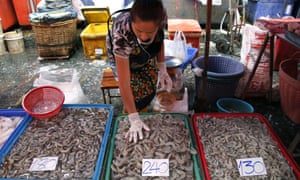
A fish-seller sorts shrimp at Klong Toey market in Bangkok. Activists claim that government measures have failed to end labour abuses in Thailand’s seafood industry
A fish-seller sorts shrimp at Klong Toey market in Bangkok. Activists claim that government measures have failed to end labour abuses in Thailand’s seafood industry. Photograph: Barbara Walton/EPA

"In our work in southeast Nepal, we find that unsafe migration and bonded labour are very closely connected."
"The families desperately hope that income from their members, mostly young men, working in the Middle East will allow them to pay off debts to the landlord for whom they work, and even perhaps allow them to purchase some land to be able to gain some independence. But when it goes wrong and the family member is in conditions of slavery in the destination area, then the family at home is often deeper in debt bondage because they have borrowed in order to send the worker abroad."
Ginny Baumann, Senior Programs Officer at the Freedom Fund
In Qatar construction in preparation for the 2022 FIFA World Cup has employed tens of thousands of people from India, Nepal, the Philippines and elsewhere, and hundreds of those workers have died as a result of unsafe working conditions and no regard for the safety of people working as indentured labourers. And nor is Qatar alone in this violation of human rights in exploiting the labour of workers from southeast Asia. Migrant workers are in high demand in Bahrain, Kuwait, Oman, Saudi Arabia and the United Arab Emirates.

Their oil wealth has stimulated massive investment in huge new infrastructure building, and eye-popping architecturally bold ventures to loud acclaim, but with no indigenous workforce to labour at the construction projects, the intake of foreign workers anxious for employment is huge. Gulf state citizens have traditionally, because of their countries' oil wealth, received free social benefits, with no incentive left to them to provide the muscle and talent to engage in construction work. The benefits that accrue to the indigenous citizens do not migrate to foreign labourers. 

The Democratic Republic of Congo, beset by years of conflict in tribal, ethnic and clan violence, is a country rich with natural resources. Slavery is a condition that rears its ugly head there with open pits in the Walikale area tunnelling into a mountain from which men and  women extract coltan, a mineral used in electronic products, like cellphones. The workers have no rights, are kept in deplorable conditions and fed a miserable diet with no medical care. They are pressed to work, hale or ill. Armed guards stand watch over them.

The women are raped by the guards routinely, under this unspeakable system of slave labour. We are unknowingly complicit when we buy products that contain elements procured in trade with these countries. Such a mine has no legal recognition, the mineral extracted goes onto the corporate market through middlemen, at a cheap price enabled by slavery. The supply chain is almost unknowable and untraceable by Western governments attempting to establish origins. We aid slavery by default, through no discernible fault of our own.

Women employed as domestics in the Gulf states must surrender their passports, leaving them unable to flee an abusive employer for fear of being without papers so the authorities will deport them and they will be left without employment unable to send support money back to their countries of origin. Foreign workers labouring under these conditions have no rights under the laws of the countries that import them to produce labour that no Gulf citizen would demean themselves with.

"Women [in Qatar] who have been physically or sexually abused face major obstacles to getting justice. None of the women researchers spoke to had seen their attackers prosecuted or convicted. In one horrific case, a domestic worker broke both her legs and fractured her spine when she fell from a window as she tried to escape a rape attack by her employer. Her attacker then proceeded to sexually assault her as she lay on the ground, injured and unable to move. Only afterwards did he call an ambulance.
When researchers interviewed her six months after the attack, she was still using a wheelchair. Despite her appalling injuries, the Public Prosecutor dismissed the case due to “lack of evidence” and she returned to the Philippines last year. Her employer has never been held accountable."    Amnesty International

Labels: , ,

Friday, February 19, 2016

Devastating Cultural Heritage

"[The practice is] regarded as part of our culture, or a confirmation that they will be officially 'Islamized'. [The practise] in Indonesia is mostly symbolic [no cutting at all]."
Jurnalis Uddin, chairman, Center for Population and Gender Studies, Yarsi University, Jakarta

"They think it's a family or cultural tradition, and an Islamic obligation, yet they can't name any verses in the Q'uran about female circumcision."
Rena Herdiyani, government lobbyist, Kalyanamitra, NGO

"Mutilation is horrible, but it's not true that it happens here. They cannot stop us. It's our tradition."
Fitri Yanti, 30, Indonesia


The ancient ritual of female genital cutting practised throughout Africa and the Middle East is also widespread in Indonesia, which is home to 12.7% of the world's estimated 1.7-billion Muslims, qualifying it as the country with the largest Muslim population in Asia. Almost half of all women in he country appear to have undergone ritual circumcision. An adjustment was recently made by the United Nations in their global figure for women and girls who have undergone circumcision.

Where formerly that number was estimated to be $130-million women who have experienced genital cutting, that number has now risen to $200-million with the inclusion of Indonesia. Female circumcision can run the gamut from slight cuts to radical, rough surgery where the clitoris and labia are removed and the vaginal passage is sewn shut, creating all manner of dire health problems including difficulty in urinating, in menstruating and in childbirth resulting from scars tissues.

Where once, in Medieval Europe, women were often forced to wear metal girdles (chastity belts) that were locked as restraints against infidelity, either voluntary or forced, in today's world nothing like it exists except for the presence of women and girls of African, Asian or Middle Eastern heritage living in the West, where the cultural dedication to continuing the practise carries on. The number of countries across the globe where female genital cutting is a social custom, however, is 30.

"We knew the practice existed but we didn't have a sense of the scope", explained Claudia Cappa, a statistics specialist for UNICEF. With the addition of Indonesia, it is clear that genital cutting is not limited as "an African problem". Indonesian experts are quick to explain that the extremely severe disfiguring that describes female genital mutilation (Clitoridectomy or infibulation) is not normally done in that country; rather they claim, it is a mere 'scratch'.

The official Indonesian government defines female circumcision as "an act of scratching the skin that covers the front of clitoris without injuring the clitoris". The percentage of girls aged 15 to 19 who have been cut worldwide has been reduced from 51 percent in 1985 to 37 percent at the present time, in countries where the practise remains a normal part of the social-cultural contract. In Egypt 30 years ago 97 percent of 15 to 19-year-olds were circumcised; the new figure is 70%. High by any measure.

Liberia has reduced its rate of female circumcision from 72 percent to 31 percent, and Burkina Faso from 89 percent to 58 percent. Despite public pressure from outside those countries that practise circumcision, and indeed from within as well, the practise continues. "Current progress is insufficient to keep up with increasing population growth", reports UNICEF. As a result, if trends continue the number of girls and women undergoing circumcision "will rise significantly over the next 15 years".

Ten years ago in a bid to enter the modern world, the government of Indonesia attempted a ban against circumcision, but that came up against vigorous resistance from religious authorities for whom the custom is important, that girls undergo the ritual before marriage. That led the government to neutralize its position, issuing regulations that state only medical professionals should be engaged in the cutting practise.

That change has led to a bit of a dilemma. Since medical providers perform the procedure, legitimacy is conferred on the practise by default. "We are very concerned with medicalization. Medical personnel are looked up to and are seen as knowing what's good for your girl", observed Francesca Moneti, child protection specialist with UNICEF.

As for Indonesian women themselves, a survey obtained their views and they vary. While female circumcision does take place in the countryside, it is confoundingly, more prevalent among  urban, wealthier families. This is a custom that reflects a patriarchal society's concern over female sexual morals, an effort to ensure that sex is not pleasurable for women, but a painful ordeal, to restrain them from infidelity.

As in so many cultural practices introduced to demean and disempower women that become so all-prevailing, women embrace the custom because without engaging in it they become social outcasts for whom good marriages are impossible to attain to. This is so engrained in society that women become the most vocal supporters of such customs harmful to women's health,dignity and longevity.
Beliefs in female circumcision practices within society:
  • "It can ensure virginity (maintain chastity before marriage)
  • It can ensure fidelity during marriage
  • It will increase male sexual pleasure
  • It can secure or enhance fertility
  • It can secure the economic and social (i.e. marital) future of daughters
  • It will prevent the clitoris from growing long like a penis
  • Through the reduction or elimination of the female genitalia, that this will attenuate the sexual desire in the female
  • The female genitalia are considered both dirty and unsightly
  • It will keep the female clean, and more hygienic
  • It is an important ritual and part of the initiation of girls into womanhood
  • It is 'tradition' and part of one's cultural heritage
  • That it is a religious mandate -- although the practice predates both Christianity and Islam"
    • (http://www.disabilityworld.org/01-03_04/women/fgm.shtml)

Labels: , , , ,

 
()() Follow @rheytah Tweet