Ruminations

Blog dedicated primarily to randomly selected news items; comments reflecting personal perceptions

Tuesday, October 04, 2022

The Pestilence Threatening Us

"Even just based on waning immunity the time since the average person had their last infection or their last booster, a wave was expected. As usual, it's hard to say, will this be a big wave? Will it be a small wave. For sure it's a wave of some kind."
"[Science magazine warned one or more of several highly immune strains of SARS-CoV-2 -- BA.2.785/2. BQ.1.1, BF.7] may well cause big, new COVID-19 waves this fall and winter."
"It's [natural selection] increasing evidence that they [variants] are doing something, and what that something is, is probably to evade immunity. So they're even better at reinfecting people."
"I don't want to underplay what this virus has been putting us through -- it clearly is able to evolve in all kinds of different directions and surprise us. Bit it's encouraging that we are seeing the same mutations, repeatedly. Which suggests, at least for now, a limited supply of adapted mutations." 
"My crystal ball is my fantastic other colleagues with CoVaRR-Net [Canada's national Coronavirus Variants Rapid Response Network]. All credit to all these people who are sharing data and analyzing it."
"If you are a few months from your past infection or past vaccine, go get your booster. The more immunity we can get in the population, the less bad this wave will be in terms of overall transmissions and hospitalizations, and bad outcomes we want to avoid."
Jesse Shapiro, genomic evolutionary biologist, McGill University
A recent spike in cases and hospitalizations in the U.K., and a recent rise of the virus in wastewater levels in Ontario and Saskatchewan have scientists bracing for potential fall and winter waves. (Ben Nelms/CBC)
"They are basically less easily recognized by the antibodies that are in the majority of people right now."
"It's kind of saying that the virus is constrained. It's hobbled a little bit."
"Here in British Columbia, it's estimated we're under-reporting cases by 100-fold."
"COVID now, for almost all of us in Canada, is a disease our immune system recognizes."
"So when we get infected, if we don't have antibodies in our bloodstream currently, we have memory cells that remember this virus, that remember SARS-CoV-2, and kick into action."
"The bad news is that COVID is still rampant at the moment. So that first wave of protection -- having antibodies that recognize and prevent you from getting infected in the first place -- is still the one you want to go for."
Sarah Otto, evolutionary biologist, University of British Columbia 
Virologists are concerned new Omicron subvariants could potentially drive future COVID waves, especially given their concerning mutations. (Ben Nelms/CBC)
 
Throughout Canada, the state of public immunity has not reached the peak that health scientists would prefer it to be, leading the country's public health agency to appeal to the public to get "up to date" with their vaccines, now that new bivalent shots targeting the original SARS-CoV-2 strain along with the original BA.1 strain of Omicron are being made available. Bivalent vaccines that target the BA.4 and BA.5 strains currently along with BA. 2 the most prominent circulating strains in Canada have not yet been approved by Health Canada.

Quebec, Alberta and British Columbia are currently seeing infections and hospitalizations rising in a system already strained past the capacity of hospitals to absorb, and health care workers to manage. A gradual increase is being seen in cases in Ontario with the number of tests checking positive rising in the past two weeks. A new wave of COVID-19 is not only in the works, it's started. The pathogenic virus persists at a high rate of infection across the entire country. 

A vast convergence of evolution is transpiring, explained Dr. Shapiro an associate professor in McGill's department of microbiology and immunology. The same mutations or combinations of mutations are appearing in many of the variants and subvariants on key sites of the viral genome, allowing them to spread more rapidly, despite circulating within a highly immunized population. It is biology's natural selection that favours the same mutations repeatedly. New lineages or subvariants emerging from Omicron, a deep branch of the biogenetic tree of SARS-CoV-2.

Although none of the new variants are circulating at high levels in Canada, there is some concern that BQ.1.7, with a striking constellation of mutations increasing the capacity of the virus to evade antibodies, might sweep through populations as though no one has any immunity: "I don't think that's going to be the case, based on what I've seen so far. It's just helping the virus spread a little bit, not game-changer amounts. But it's too early to know for sure", hazarded Dr. Otto.

Omicron continues to mutate and produce new strains that have been shown to better evade immunity with the potential to drive new COVID waves. (Evan Mitsui/CBC)

Labels: , , , ,

Wednesday, April 27, 2022

COVID-19 Subvariants

"Recombinant variants are not an unusual occurrence, particularly when there are several variants in circulation, and several have been identified over the course of the pandemic to date."
"As with other kinds of variant, most will die off relatively quickly."
Susan Hopkins, chief medical adviser, U.K. Health Security Agency (UKHSA)

"Scientists are looking for signs that Omicron recombinants such as XE change disease severity, transmissibility or impact the effectiveness of diagnostic tests, vaccines or treatments for COVID-19."
"While preliminary international reports have shown that XE has modestly increased transmissibility compared to BA.2, more data is needed to confirm this finding."
Public Health Agency of Canada
Tulio de Oliveira posed for a portrait in his lab

Tulio de Oliveira’s team at Stellenbosch University in South Africa discovered the BA.4 and BA.5 subvariants of Omicron.   Credit: Stefan Els/Stellenbosch University

The Omicron subvariant XE -- one of several hybrid variants that have recently emerged -- is being tracked by Health Canada. That they are considered recombinant variants indicates that they contain genetic material of two or more different variants or subvariants. To the present, 32 detections of Omicron recombinants are in circulation. An April 8 technical briefing from the U.K. Health Security Agency identifies XE with three mutations, not present in BA.1 or BA.2.

The "stealth Omicron", the XE variant has been identified as a recombination of Omicron BA.1 and Omicron BA.2, the highly-transmissible Omicron driving Canada's sixth wave at the present time. The U.K. identified its first case of XE in January of 2022. To April 4, 1,179 XE cases have been confirmed in the United Kingdom, and since reported found in other countries, including Canada, India, Japan, Thailand and Israel. Obviously carried from a source location through travel and return to one's home country.

Viruses like HIV and influenza commonly produce recombinant variants. a not-unique phenomenon among such pathogens. Yet other recombinants have been identified; variants XD and XF, both labelled Deltacron; combining Delta and Omicron variants. Delta, seen to be more dangerous and communicable than the original from which it developed from through mutation, and Omicron variants, less lethal, but more communicable.

Most confirmed cases of XD, identified by the UKHSA, have been found in France, and the second most numerous findings at this eaqrly stage, in the United Kingdom. XF is just behind XD in prevalence, but appears to have petered out. The World Health Organization's technical lead, Maria Van Kerkhove, stated based on initial analysis XE has a ten percent growth advantage over BA.2, making it slightly more transmissible. 

Symptoms that arise with contracting any of the recombinant variants are unlikely to be more serious than other variants, since reports indicate BA.2 is no more severe than BA.1 and variants of the original COVID-29 tended to result in decreased severity. XE under Omicron is considered a variant of concern by the World Health Organization; with XD listed as a monitored variant.

The most reliable way to being protected from experiencing severe COVID symptoms according to health experts -- irrespective of the variant type -- is through a full series of vaccinations and a booster dose. "We need to critically ensure that those around the world, particularly those who are most vulnerable, get vaccinated in every single country", stated Van Kerkhove of the WHO.

Physical distancing, mask wearing, avoiding crowded indoor spaces, better ventilation (opening windows and doors) and remaining home if unwell, continue to be advised as measure that work well in preventing the spread of the virus, as well as the prevention of severe disease outcomes and death. It is primarily among the large numbers of people in emerging economies that have not been vaccinated from among whom the variants have the opportunity to mutate and to thrive.

Covid variants are new versions of the virus that are smarter at surviving. (Photo: hms.harvard.edu / Wikipedia)

Labels: , , , , , ,

Sunday, April 17, 2022

The Virus With Endless Mutations

"When you look at what's happening right now and try to tell the story of what might occur, you're challenged."
"[For now, scientists are left] watching and learning."
Michael Osterholm, director, Center for Infectious Disease Research and Policy, University of Minnesota

"Whenever we see those mutations, we're a little bit concerned, but it's hard right now to really estimate how big of a concern those variants will be."
"We should see some increase in cases. What we're hoping is this will now be a manageable increase."
"Omicron is evolving to be perhaps even better at infecting people -- the big question is how much better is it going to get."
"That's something that we'll have to wait and see [about]."
Andy Pekosz, virologist, Johns Hopkins Bloomberg School of Public Health

"While the prevalence of lineages and sub-lineages may fluctuate, what we are focused on is monitoring for any changes in disease burden caused by Omicron lineages."
Nicholas Spinelli, spokesman, Centers for Disease Control and Prevention
Omicron coronavirus variant continues to spread in Manhattan, New York City
Viruses mutate all the time but only some mutations affect their ability to spread or evade prior immunity  Reuters
 
Authorities at the CDC fully anticipate the emergence of new lineages of COVID, planning to track the subvariant case numbers, hospitalizations and deaths. There is confidence among their officials that tools that have managed to slow the spread of past variants will in all likelihood continue their  usefulness against those that are recognized as new mutant strains.

The spread of new, highly transmissible versions of the Omicron variant is being tracked by experts in the field of virology in New York state and in Europe, studying the latest evidence of the coronavirus's capacity to generate fresh threats to humanity through overhauling its genetic profile. No one can yet feel any confidence in predicting the spread of new subvariants and how ill people who contract them may become.

Central New York, around Syracuse and Lake Ontario, is among the first communities in the United States to contend with the new Omicron subvariants. Officials in New York state announced two new Omicron subvariants, BA.2.12 and BA.2.12.1, which are now the dominant forms of the coronavirus centrally in the state. Infections have risen there at two times the state average.

No evidence exists that is seen as cause for more severe disease developing. The state health department's estimate is that there is a 23 to 27 percent growth advantage in the new strains over the BA.2 variant, itself known to be more infectious than the original Omicron. What is recognized,  however, is that this situation reports significant community spread related to the two subvariants in the United States.

Cases and hospitalization increases nationwide resulting from the BA.2 subvariant led to the discovery of the new subvariants. A greater number of people making use of at-home tests has led to concerns the official numbers may actually represent an underestimate. The pandemic public health emergency measures and the mask mandate for travellers have been extended as a consequence, the rise in cases cited as the reason.

Health authorities in Canada have seen a recent surge across the country as well, driven by the Omicron variant and the BA.2 subvariant. The concern is that the new sublineages' mutations may help the virus enter cells faster and evade vaccine- and infection-boosted immunity. The good news is that no evidence has been seen of increased disease severity in these subvariants.

A month ago, the two subvariants accounted for over 70 percent of cases reported in central New York, while data show an increase to 90 percent of all new cases for April. The subvariants are in evidence even as most public health interventions like mask mandates were lifted. Scientists are tracking the new variants for a better idea of their contagion and potential for causing more severe illness.

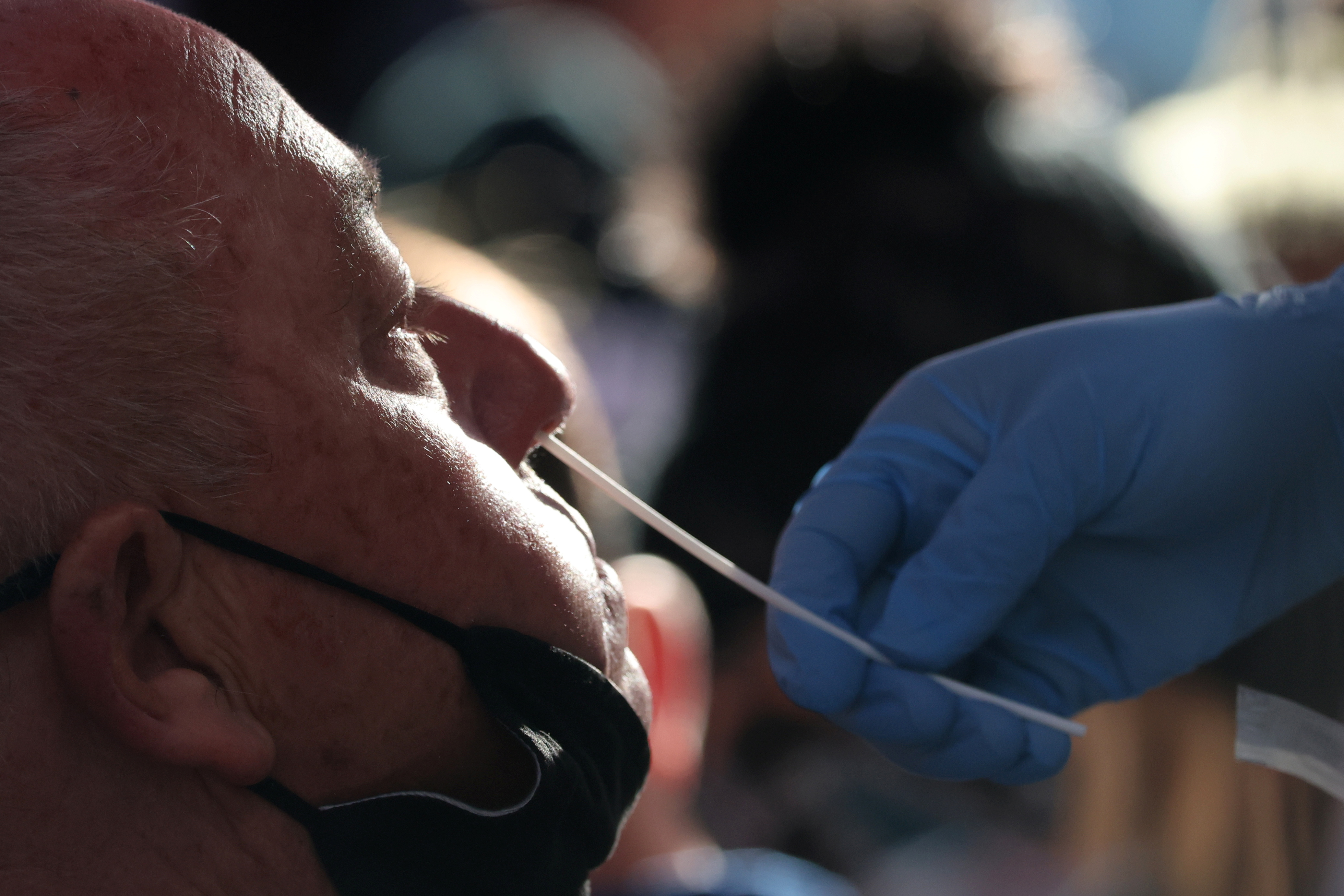
A man took a coronavirus test at pop-up site in New York on Monday.
Credit...Brendan Mcdermid/Reuters

Labels: , ,

 
()() Follow @rheytah Tweet