Ruminations

Blog dedicated primarily to randomly selected news items; comments reflecting personal perceptions

Sunday, April 17, 2022

The Virus With Endless Mutations

"When you look at what's happening right now and try to tell the story of what might occur, you're challenged."
"[For now, scientists are left] watching and learning."
Michael Osterholm, director, Center for Infectious Disease Research and Policy, University of Minnesota

"Whenever we see those mutations, we're a little bit concerned, but it's hard right now to really estimate how big of a concern those variants will be."
"We should see some increase in cases. What we're hoping is this will now be a manageable increase."
"Omicron is evolving to be perhaps even better at infecting people -- the big question is how much better is it going to get."
"That's something that we'll have to wait and see [about]."
Andy Pekosz, virologist, Johns Hopkins Bloomberg School of Public Health

"While the prevalence of lineages and sub-lineages may fluctuate, what we are focused on is monitoring for any changes in disease burden caused by Omicron lineages."
Nicholas Spinelli, spokesman, Centers for Disease Control and Prevention
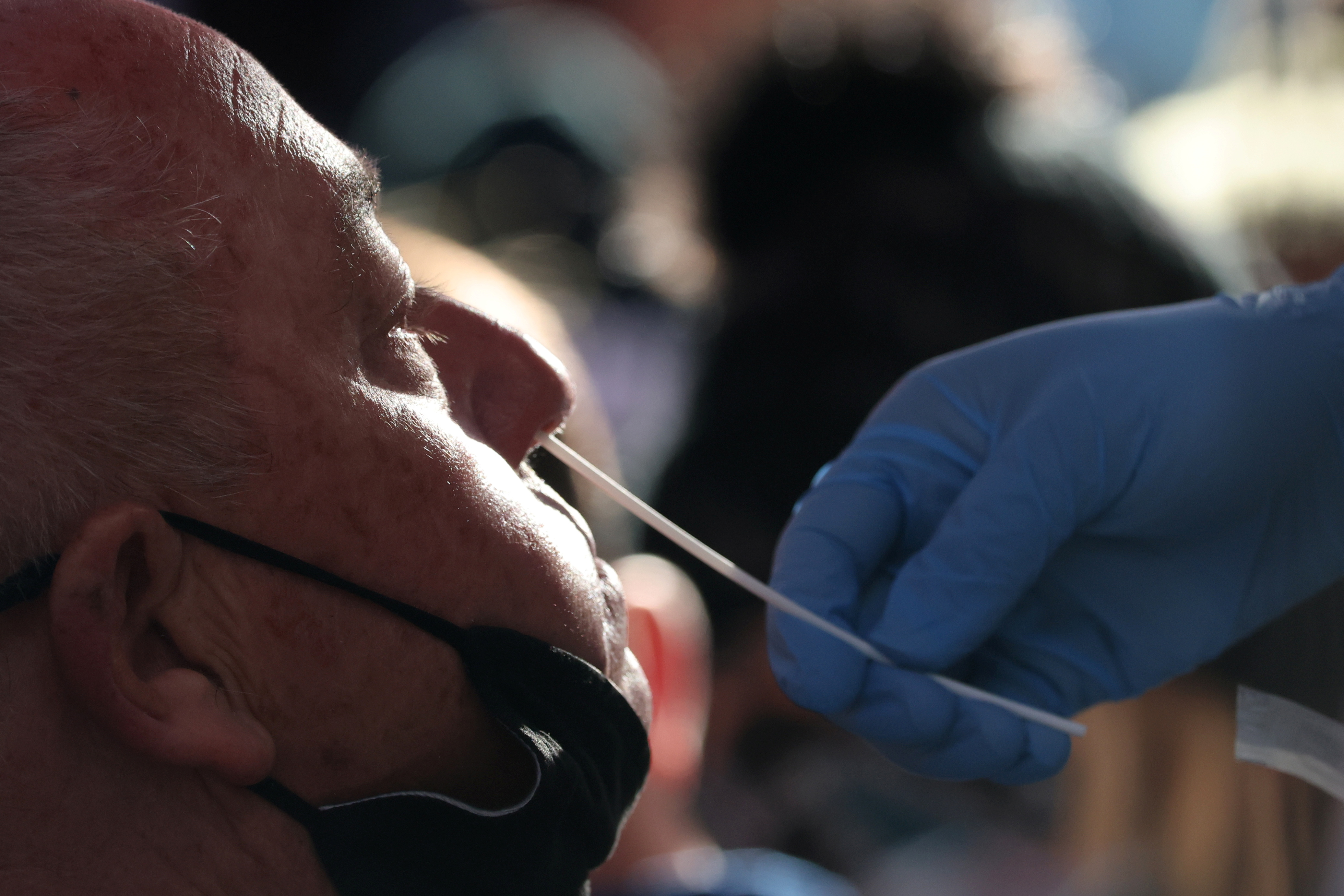
Omicron coronavirus variant continues to spread in Manhattan, New York City
Viruses mutate all the time but only some mutations affect their ability to spread or evade prior immunity  Reuters
 
Authorities at the CDC fully anticipate the emergence of new lineages of COVID, planning to track the subvariant case numbers, hospitalizations and deaths. There is confidence among their officials that tools that have managed to slow the spread of past variants will in all likelihood continue their  usefulness against those that are recognized as new mutant strains.

The spread of new, highly transmissible versions of the Omicron variant is being tracked by experts in the field of virology in New York state and in Europe, studying the latest evidence of the coronavirus's capacity to generate fresh threats to humanity through overhauling its genetic profile. No one can yet feel any confidence in predicting the spread of new subvariants and how ill people who contract them may become.

Central New York, around Syracuse and Lake Ontario, is among the first communities in the United States to contend with the new Omicron subvariants. Officials in New York state announced two new Omicron subvariants, BA.2.12 and BA.2.12.1, which are now the dominant forms of the coronavirus centrally in the state. Infections have risen there at two times the state average.

No evidence exists that is seen as cause for more severe disease developing. The state health department's estimate is that there is a 23 to 27 percent growth advantage in the new strains over the BA.2 variant, itself known to be more infectious than the original Omicron. What is recognized,  however, is that this situation reports significant community spread related to the two subvariants in the United States.

Cases and hospitalization increases nationwide resulting from the BA.2 subvariant led to the discovery of the new subvariants. A greater number of people making use of at-home tests has led to concerns the official numbers may actually represent an underestimate. The pandemic public health emergency measures and the mask mandate for travellers have been extended as a consequence, the rise in cases cited as the reason.

Health authorities in Canada have seen a recent surge across the country as well, driven by the Omicron variant and the BA.2 subvariant. The concern is that the new sublineages' mutations may help the virus enter cells faster and evade vaccine- and infection-boosted immunity. The good news is that no evidence has been seen of increased disease severity in these subvariants.

A month ago, the two subvariants accounted for over 70 percent of cases reported in central New York, while data show an increase to 90 percent of all new cases for April. The subvariants are in evidence even as most public health interventions like mask mandates were lifted. Scientists are tracking the new variants for a better idea of their contagion and potential for causing more severe illness.

A man took a coronavirus test at pop-up site in New York on Monday.
Credit...Brendan Mcdermid/Reuters

Labels: , ,

Friday, April 15, 2022

Xi Jinping's Triumph in Leadership

"Until Omicron, I actually thought a COVID-zero approach could be plausible. [But] it's just so insidious, it can just spread so quickly."
"I feel it's kind of like a losing battle. You could do it for a week or two ... then it's going to come back again."
"I just don't know how China will be able o avoid what happened in Hong Kong, write large."
"If everyone stays home, the outbreak will get snuffed out. But ... even if Shanghai can snuff out this particular outbreak, there's going to be more introduction of it, because it's circulating everywhere else in the world."
Dr.Jeff Kwong, public-health professor, University of Toronto

"What happens to your pet if you test positive remains an unsettling grey area with no clear solution."
"Horror stories circulate online about pets being left behind and one was recently killed with a shovel by a person in a haz-mat suit."
CNN journalist David Culver, Shanghai
Shanghai police remove protester
One clip shows a policeman in a hazmat suit removing a protester from the scene  BBC
 
CNN journalist Culver, as a resident of Shanghai, has his own very personal fears aside from his writing about regular morning marches of neighbourhood residents to designated areas where they are tested by health officials wearing haz-mat suits. Should they test positive they are immediately sequestered, not permitted to return home and must go into isolation. If they have pets at home the pets are confiscated and put to death. David Culver has nightmares of testing positive, worried about abandoning his dog, as he would be forced into quarantine.
 
Shanghai's 25-million residents have been cooped into lockdown for weeks, unable to leave their homes except for COVID testing, and living with food shortages caused by the enforced total lockdown. A lockdown originally meant to last a few days, but that has been ongoing now for weeks with no indication how long it may last, as long as COVID-positive cases continue to present and authorities continue to react with draconian methods of isolation. The situation led to people shouting in desperation from open windows in their apartments and from balconies.
 
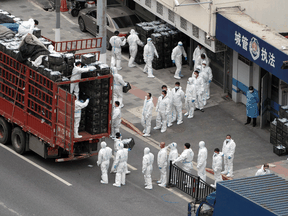
People wearing personal protective equipment transfer food supplies and necessities for local residents during a COVID-19 lockdown in Shanghai, April 5, 2022.
People wearing personal protective equipment transfer food supplies and necessities for local residents during a COVID-19 lockdown in Shanghai, April 5, 2022. Photo by AFP via Getty Images
 
The protests spurred officials to seek a solution to the angry social protests, including media posts in a country not known to tolerate dissent. The solution? Drones, circulating in neighbourhoods with very specific messages: "Please comply with COVID restrictions. Control your soul's thirst for freedom. Do not open your windows and sing", the female voice instructs.

Children separated from their parents when found to be COVID-positive. This is a reflection of China's   COVID-zero policy meant to completely eradicate, not merely control SARS-CoV-2. The virus is not responding positively to that goal, however, and the method finds no wide public acceptance. Chinese health authorities who subscribe to the COVID-zero manoeuvres insisting on complete lockdown to effectively beat virus transmission, appear not to have reckoned with the high transmissibility of the Omicron strain.
 
Staff members organise mass food orders from locked down Shanghai residents. Photo: Reuters
Staff members organize mass food orders from locked down Shanghai residents. Photo: Reuters

"Judging from how this pandemic is being handled by different leaderships and systems ... [we can] clearly see who has done better", China's President Xi Jinping has boasted in the past. And it did realize a good measure of success with pop-up cases here and there and swift responses in fragmented areas, quickly contained. Until Omicron arrived and infections began reaching into the stratosphere, as much as 15,000 daily of late. Beijing's firm orders for Shanghai's total lockdown reflected its wish to avoid the disaster in Hong Kong.

Hong Kong's own COVID-zero achievements were blown to smithereens when three million people were infected and mass deaths occurred. In both areas low vaccination rates among people aged 80 and over and lack of access to mRNA vaccines seem partly to blame. That the most vulnerable age group in the populations have not been vaccinated seems like an an avoidable Achilles heel that should not have gone unaddressed. China's home-grown vaccines have a relatively low efficacy rate; somewhere around 50% and less, compared to the mRNA vaccines.

Locked into their homes the population has been unable to work, attend school, shop, attend medical appointments. The government plan to supply people with food deliveries has overburdened commercial delivery services, the result of which has been that a great many people face starvation, deprived of food access. Clearly, China's approach to stifling the virus that originated in Wuhan, China and went on speedily to infect the global population, has been nothing to celebrate as a success.

Workers in protective suits disinfect an old residential area under lockdown amid the COVID-19 pandemic, in Shanghai on April 15.  ALY SONG/Reuters

Labels: , , , , , , , ,

Thursday, December 02, 2021

Waiting On Omicron With Tenterhooks of Apprehension

"For the unvaccinated, mild COVID could train the immune system, much like vaccines. For the vaccinated it would be like a natural booster."
"[Should it somehow turn out that the Omicron variant produces only mild disease]; That would mean let it run. Let it run its course and reach the world."
"Maybe it causes half the amount of hospitalization and deaths. [But if there are far more infections], that's still a lot of hospitalizations and deaths."
"It could be in a population that was so isolated that Omicron evolved there and it never got out until now. It's possible that Omicron has been hiding out for most of 2021 inside somebody. That would suggest that all these changes in the spike that we're seeing actually weren't selected to help transmit from person to person. They were selected to survive and propagate within that person's body."
"But we really have zero idea. At this point I give it about a 50-50 chance of being more or less severe. That's how unsure science is at the moment."
"[If it can spread much more easily through the air], and you need even smaller particles to get infected because it's so good at getting inside our body, that is a game changer. That's my nightmare." 
Sarah Otto, evolutionary biologist, University of British Columbia

"For viruses to evolve to become less severe there needs to be 'selective pressure'. "They [viruses] don't 'care' about how sick they make people, as long as they can spread."
"[With SARS-CoV-2 the virus can spread quite efficiently, even if people don't yet show symptoms, or fail to altogether, meaning] it's not clear that there's much pressure on the virus to cause less severe illness."
Matthew Miller, associate professor of infectious diseases and immunology, McMaster University, Hamilton
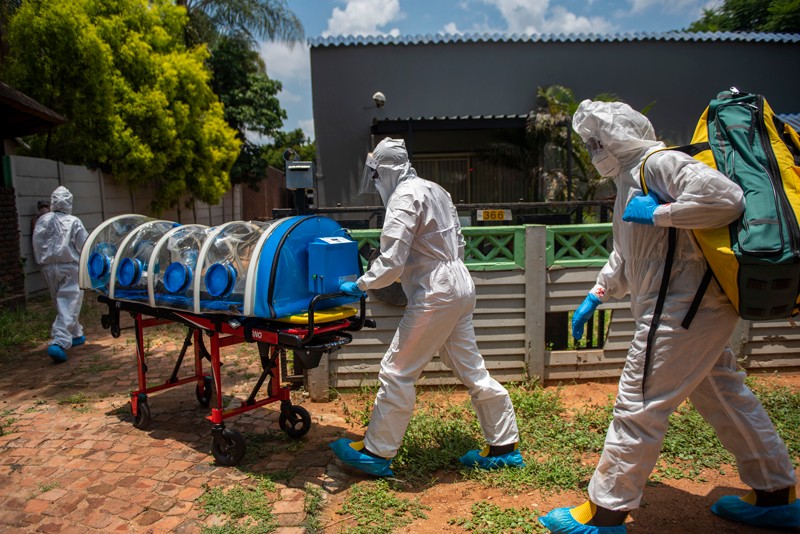
People wearing personal protective equipment pick up a suspected COVID-19 patient

Medics at an infectious-disease unit in South Africa, where a new strain of COVID is spreading quickly.  Credit: Alet Pretorius/Gallo Images/Getty

New reports have come in from South Africa with some doctors reporting cases they have seen appearing to be mostly mild, with fever, cough, aches and pains, hitting mostly younger adults of university age and healthy people. The reports speak of toddlers in hospital with Omicron, but not the medically fragile. These reports lift the hopes of experts in the field elsewhere, who study them. Doubts exist over whether Omicron is more infectiously spreadable, or can elude a degree of immunity from vaccinations or past infections.

In early stages of an outbreak by viruses new to humans they tend to cause more serious disease leading to a pandemic, attributable party to the fact that there is no pre-existing immunity. When people become very ill very quickly they become less efficient in spreading the virus since their illness keeps them isolated and away from the public. When this happens the virus tends to wear itself out. The SARS-CoV-2 experience has taught science that people can spread the virus efficiently even if they aren't showing symptoms yet.
 
WHO LabelPango LineageEarliest documented samplesTransmissibilityImmune EvasivenessVaccine Effectiveness
AlphaB.1.1.7United Kingdom+ + +— —√
BetaB.1.351South Africa++ + + +√
GammaP.1Brazil+ ++ +√
DeltaB.1.617.2India+ + + ++ +√
LambdaC.37Peru+ + + ++ +√
OmicronB.1.1.529South Africa+ + + + (?)+ + + + (?)?
 
According to studies, 40 to 50 percent of South Africans have been exposed to SARS-CoV-2 in earlier waves with one paper estimating the number of infections to be 7.8-fold higher than recorded cases. A situation of immunity which combined with vaccination could have the effect of providing protection against serious disease, which in part might help explain why symptoms of the Omicron infections appear mild. Scientists tend to to be fixated on the number of mutations on the Omicron spike protein.

It is that spike on the surface of the SARS-CoV-2 virus used by it to fix itself onto body cells when infection occurs, enabling the virus to replicate once it reaches the organs. "We've seen some of these three mutations [which enable the spike to better bind to cells] in different variants of concern [but none have all three. When my colleagues saw that they were like, 'Uh, oh'," said Dr. Otto. Cases of Omicron have now been confirmed in Canada, the U.S., Belgium, the Netherlands, France, Germany, Portugal, Italy and the United Kingdom. Like the original, it has lost no time in international travel.

There is a theory that the new variant might have been living inside one or two immunocompromised people for whom clearing the virus was difficult. In such hosts the virus could reproduce to high loads -- alternately linger for a greater period of time in people with immune systems weakened by malnutrition, unclean drinking water, untreated HIV or other conditions, according to Professor Miller. The greater the length of time the virus remains in situ, the more opportunities it has to acquire mutations.

On the other hand, according to Dr.Otto, though Omicron possesses a range of mutations in the spike protein "there's still a lot of spike that's not changed, and our immune reactions should recognize other parts well if we've been vaccinated. But it will spread like wildfire among the unvaccinated". According to the head of Moderna a "material drop" in vaccine efficacy is expected. Yet Dr.Otto is optimistic that a high vaccination rate means "we've got a base of immunity, and it's not like [Omicron] has changed at hundreds of sites in the spike. It's just changed at 30". 

Tellingly, in Tshwane, South Africa where Omicron was first identified, 87 percent of hospital admissions took place among the unvaccinated. Dr.Otto still finds it troubling that a fully vaccinated traveler who had arrived in Hong Kong from Vancouver contracted the variant virus from another traveler from South Africa staying across the hall in the same airport quarantine hotel. Translated into transmission terms it may mean that Omicron is able to transmit through smaller particles in the air, relating to more longer-distance aerosol transmission.

A man receives a dose of a COVID-19 vaccine in Soweto, Johannesburg, South Africa, on Monday. The omicron variant, first identified in South Africa, has now spread to at least a dozen other countries. Denis Farrell/AP

Labels: , , , ,

Wednesday, October 06, 2021

Imperative: Avoiding Delta Strain COVID Contagion

"[Those infected with the COVID variants were for the most part youngerm less likely to have underlying health problems] but nonetheless had  higher crude risks of hospitalization and ICU admissions."
"It is remarkable that we detected a clear and significant elevated risk of uncommon delayed outcomes, such as death."
Canadian Medical Association Journal-published study authors

Canadian Medical Association Journal: 193 (39)

"Canada is battling a different pandemic from the one it faced in early 2020."
"The virus has become smarter and more dangerous, which means that we need to be smarter too."
"Perverse pandemic misinformation [has stoked vaccine hesitancy and vaccination refusal, jeopardizing hopes of achieving herd immunity]." 
"[Leaders in Alberta and Saskatchewan with high and rising COVID cases are facing critical care demands where both provinces' leaders] decided to disregard the cautions of scientists who warned of the dangers of VoCs (variants of concern), instead promising] the best summer ever."
Krsten Patrick, (interim) editor-in-chief, CMAJ editorial
"India had really done a great job of controlling COVID, and then all of a sudden they lost control, they had this massive explosion."
"Looking at the chaos that Delta wrought in India, we should probably have known that this is really bad."
"I think the experiece now, over and over in the pandemic, is when something blows up in one country or another, pay attention to what they're telling you."
"On top of that, when they [COVID variants] infect people, they're more likely to make people really sick. We see this across the lifespan. It's not like this is only 70-year-olds. When we see 40-year-olds die of this, 50-year-olds in the ICU in significant numbers, that's probably also a variant thing.":
"I don't think we'll be in this for another year. We are going to see seasonal epidemics of a very nasty coronavirus. But that's very different from a pandemic that takes down society."
Dr. David Fisman, epidemiologist, Dalla Lana School of Public Health, University of Toronto
Coronavirus
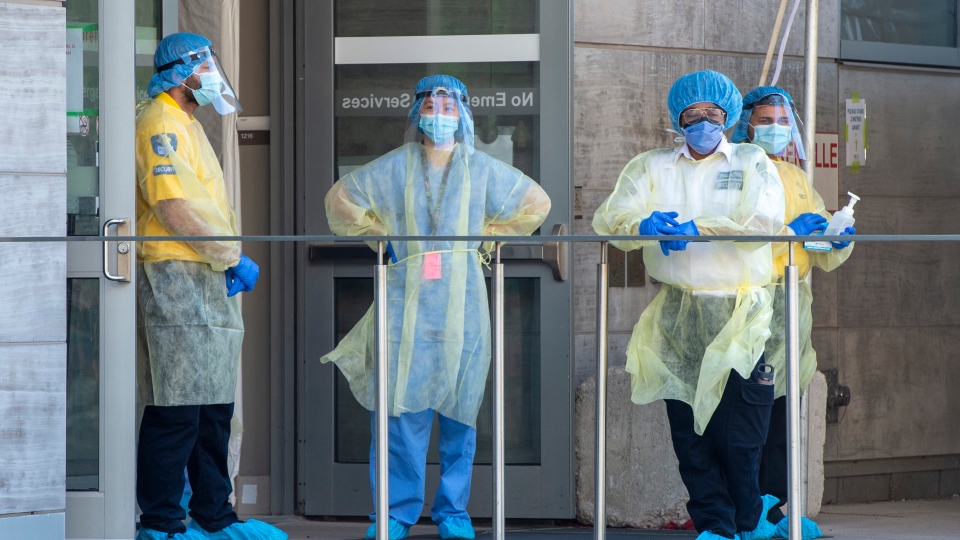
Security guards and a heath-care worker wait for patients at the Women's College Hospital COVID-19 testing centre in Toronto. (THE CANADIAN PRESS / Frank Gunn)
 
The recently published study that appeared in the Canadian Medical Association Journal was the work of epidemiologists David Fisman and Ashleigh Tuite, both with the Della Lana School of Public Health at the University of Toronto. Their study confirms that COVID-19 variants while more contagious than the original Wuhan strain of the coronavirus are also responsible for making those infected more ill. And of those variants none is more infectious and certain to cause serious illness than the Delta strain.

The two researchers based their study on over 212,000 cases of COVID-19 recognized between February through to June in Ontario, finding higher risks of hospitalization, intensive care admissions and rates of death with 'variants of concern' (VoCs). People infected with the Alpha, Beta or Gamma variants were seen to be about 50 percent likelier to be hospitalized or to die in comparison to those who were infected with the original strain.

The risk of hospitalization with Delta turned out to be 108 percent higher, with intensive care admissions an alarming 235 percent higher, and shockingly, 133 percent higher death rates. Only 2.8 percent of the total cases in the study were attributed to Delta, currently the dominant strain in circulation. What has also been validated is that on average younger, less health-impacted individuals are being infected with the variants. On the other hand, vaccines succeeded in "undoubtedly blunt(ing)" variants' severity with 80 to 90 percent protection of dying from COVID, even if the vaccinated contracted COVID.

And even though vaccine-induced immunity is beginning to wane and their effects may turn out not to be as lasting as hoped for, they don't represent the sole factors "dimming the light at the end of the pandemic tunnel", explained out Kirsten Patrick, pointing to the tsunami of outright false information circulating in the general public on COVID and vaccinations. Most of those who ended up in critical care with COVID-19 are the unvaccinated.

The study by Drs.Fisman and Tuite has conclusions consistent with other studies out of England, Scotland and Singapore whose findings were also of higher risks of poor outcomes with the Delta variant infections. And the conclusions fit right in with India's experience with the coronavirus. As Dr. Fisman pointed out, the variants are more infectious so it becomes more difficult to control outbreaks and harder to control their spread. And with their greater infectiousness the numbers required to reach herd immunity soar.

To the present, an estimated 15 percent of eligible Canadians continue to decline vaccination. The Ontario study encompassed 212,326 people screened for variants who had tested positive for SARS-CoV-2. The mutations that resulted on part of the spike protein, more readily adhered to and entered human cells. On a more optimistic note, Dr.Fisman pointed out the down-trend of the number of people an infected individual infects and that deaths too caused by COVID are diminishing in total numbers.

The takeaway from the study of the Delta variant is that vaccinations should not be regarded as simply an altruistic choice that primarily keeps severe disease from spreading to older and more vulnerable populations.  Nathan Denette/The Canadian Press

Labels: , , , , ,

 
()() Follow @rheytah Tweet