Ruminations

Blog dedicated primarily to randomly selected news items; comments reflecting personal perceptions

Tuesday, September 25, 2018

Daily Prayers

"I was on the raft for one month and 18 days. My food ran out after the first week. I had to soak my clothes in the sea, then I squeezed and drank the water."
"I thought I will never meet my parents again, so I just prayed every day."
"It was early morning on August 31 when I saw the ship and I lighted up the lamp and shouted 'help!' using the HT [handy-talky portable radio]."
"The ship had passed about one mile but then it turned to me. Might be because I used the English word [help]. Then they talked on the HT [hand-held radio]."
Aldi Novel Adilang, 18, Jakarta, Indonesia

"Aldi said he had been scared and often cried when adrift."
"Every time he saw a large ship, he said he was hopeful, but more than ten ships passed him, and none of them stopped."
Fajar Firdaus, Indonesian diplomat, Osaka, Japan
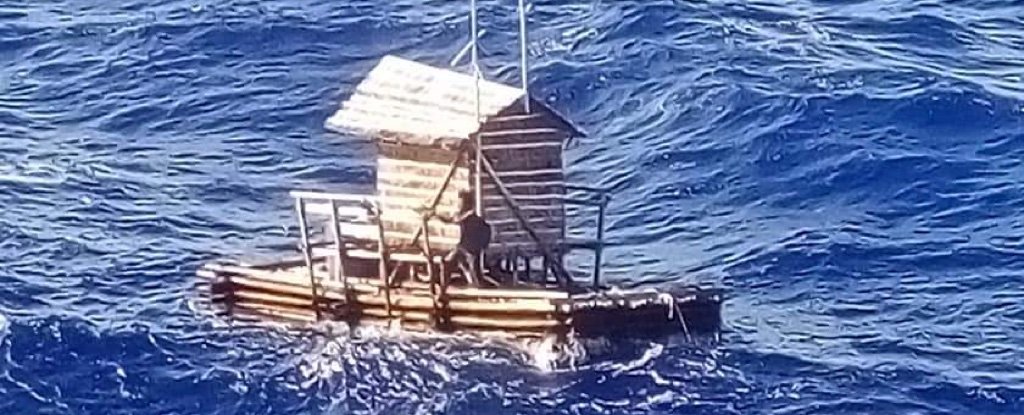
main article image
(Indonesian Consulate General Osaka/Facebook)

Adilang worked as a lamp lighter on a rompong since the time he was sixteen years of age. The rompong, a raft of wood topped by a hut is lit at night to attract ocean fish to the shoreline of Indonesia's coastal area of North Sulawesi, an aid to local fishermen whose living is crucial to the general diet of the population. Lamp lighters lead a solitary existence; the fishing rafts are moored at least 100 kilometres offshore, with no paddle, no engine, set dozens of kilometres apart.

The rafts are anchored with ropes but occasionally they break, from relentless friction. Once weekly supplies, fuel for a generator, food and any other necessities are dropped off for the minders who communicate with fishing boats via a hand-held radio they are supplied with. Work contracts are for six-month periods. For their efforts, the fish minders earn $130 monthly, a considerable assist to a large family whose children are expected to help support the family income.

Adilang's fish trap went adrift on the Pacific Ocean when its moorings slipped. To survive, he caught fish, cooking them by using the wooden fences along the top of the rompong to make cooking fires. Aspirants to the job must prove they are capable of fending for themselves and this young man certainly did. Ten ships passed the stranded youth and despite his efforts to bring his plight to their attention, none responded, "unaware of my ordeal", he explained. There were days with no rain, and that's when Adilang drank seawater.

After fifty days at sea the Panamanian-flagged MV Arpeggio off the island of Guam -- some 1,920 kilometre from where Adilang's wooden fish trap came loose -- stopped to rescue the boy. Although this was the third time his raft had come loose and drifted, on the other two occasions the raft had been rescued by the ship of the owner of the 50 rafts. When Adilang saw the ship passing he once again attempted to draw the attention of its crew as he had done with the previous ships that had failed to notice his efforts.
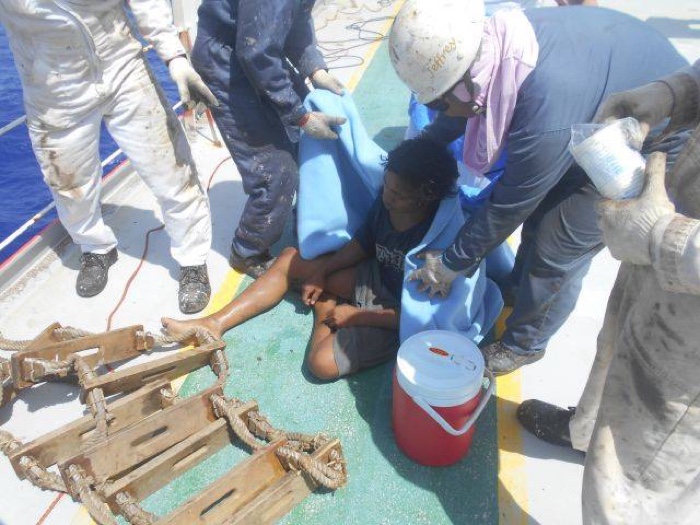
576 indonesian teenager adrift 2
(ICGO/Facebook)

Once he had succeeded in alerting the crew of the ship to his presence, rescue was complicated by the condition of the ocean, assailed by high waves -- a completely agitated surface. The Arpeggio's crew threw a rope as the tanker circled around the raft. The rope was beyond Adilang's grasp, leading him in desperation to leap into the water. In his weakened condition he barely managed to grasp the rope. Eventually a member of the Arpeggio's crew was able to grasp his hand, pulling him to safety.

Once aboard and safe, the Arpeggio contacted the Indonesian mission in Japan when the ship docked and officials from the Osaka consulate arrived to take the boy into their custody on September 6, returning him to Indonesia two days later. The youngest son of four siblings, Adilang has decided that rompong work as a lamp lighter attracting fish is not a career he plans to carry on with. "My parents agree", he said.

576 indonesian teenager adrift 3
Adilang (in white T-shirt) reunited with his family (ICGO/Facebook)

Labels: , ,

Sunday, September 09, 2018

Ocean Cleanup, System 001

"The plastic is really persistent, and it doesn't go away by itself and the time to act is now."
"We still have to prove the technology -- which will then allow us to scale up a fleet of systems."
"One of our goals is to remove 50 percent of the Great Pacific Garbage Patch in five years."
"I'm the first to acknowledge this has never been done before and that it is important to collect plastic on land and close the taps on plastic entering into the ocean, but I also think humanity can do more than one thing at a time to tackle this problem."
Boyan Slat, 24, Netherlands innovator, founder, The Ocean Cleanup

"We at the Ocean Conservancy are highly skeptical but we hope it works. The ocean needs all the help it can get."
"If you don't stop plastics from flowing into the ocean, it will be a Sisyphean task [to rescue oceans from the unstoppable flood of waste plastics]."
"He [Boyan Slat and Ocean Cleanup] has set a very large and lofty goal, and we certainly hope it works, but we really are not going to know until it is deployed."
"We have to wait and see."
George Leonard, chief scientist, Ocean Conservancy
The Ocean Cleanup System

According to George Leonard, eight tonnes of plastic waste annually enters the ocean, crying out for a purposeful approach to solve the issue, beginning with the obvious; to shield the ocean from plastic entering it to begin with. He is convinced that educating the public to the critical element of recognizing the need to use less plastic, recycle and reuse plastic in favour of simply discarding it in vulnerable environments is to convince that it is everyone's responsibility. Single-use plastic containers and bottles are a scourge.

The annual International Coastal Cleanup scheduled for September 15 sponsored by Ocean Conservancy alerts people to the issue and succeeds in mustering sufficient interest in evoking a personal sense of mission that an anticipated million volunteers worldwide plan to gather trash from beaches and waterways in a group effort mounted by the non-profit environmental advocacy group.  Last year's Coastal Cleanup saw roughly 10,000 tonnes of plastics collected globally over a two-hour period of intensive activity.

The Ocean Cleanup has even greater, more ambitious aspirations for cleaning up the ocean, beginning with a plan to deploy a long floating boom to net plastic litter in the ocean between California and Hawaii, in a trial run to clean up the largest garbage patch in the heart of the Pacific Ocean. A floating boom 600-metres in length is being towed to the Great Pacific Garbage Patch from San Franscisco. This system was created by The Ocean Cleanup.
Ocean Cleanup Project
If the pilot project is a success, Slat plans to launch a bigger system to tackle the Great Pacific Garbage Patch. (Photo: The Ocean Cleanup)
The barrier itself, buoyant and shaped like a giant U with a tapered three-metre-deep screen is intended to emulate a coastline to trap as much of the 1.8 trillion pieces of plastic as possible that science estimates whirls about in  giant gyre. The design is meant to ensure that ocean animals won't be caught within the net, but can escape it by swimming beneath the screen. The giant device is fitted with solar power lights, cameras, sensors and satellite antennae.

The system is programmed to communicate its position at all times so support vessels are able to cull out collected plastic every few months to transport their 'catch' to dry land where it will undergo recycling. All the plastic refuse scooped out by the system will be dumped into shipping containers for collection and when full, returned to land. Whether the system will prove to be as efficient as hoped, and is able to withstand harsh conditions will be determined over time.

Donations to fund the project came from a multitude of sources, the most notable perhaps and substantial from the founder of PayPal and from Salesforce.com. Success of this pilot project will determine whether an additional dozens of free-floating barriers can proceed to cleanse the Pacific Ocean substantially by 2020. Designed to withstand harsh weather conditions and continual wear and tear, the barriers will remain in the water for several decades, expected during that period to collect 90 percent of the patch's trash.

Of primary concern is that marine animals and other wildlife not be trapped by entanglement in the net that hangs below the ocean's surface. Mr. Slat points out that the system employs a screen instead of a net to ensure that animals will not become entangled in a net-like device. And that a boat with experienced marine biologists will venture out for regular forays to inspect the device, ensuring that no animals do come to harm.

The Ocean Cleanup

Labels: , ,

Thursday, August 16, 2018

That Incomparable View -- Playing Chicken With Nature

http://www.therealtymedics.com/wp-content/uploads/2017/10/Beachfront-Home-Florida.jpg
Beachfront homes, Florida  Photo: the realtymedics.com

"Its foundation is already starting to slip."
"We're going to see more of this kind of thing happen to coastal housing, and not just in Oregon."
"A lot of these wealthier homeowners are playing chicken with nature, and losing."
Phillip Johnson, executive director, Oregon Shores Conservation Coalition

"I plan to stay and fight as long as I can."
"I'm not even thinking about giving up my house. At least, not yet."
Justine Kenney, retired stockbroker, Nantucket, Massachusetts

"Erosion doesn't destroy the beach or the environment."
"The problem comes when you build on them and you don't want to move away."
Robert Young, geologist, Western Carolina University
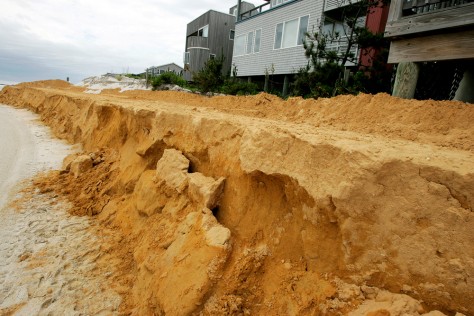
Image: Sand dumped to protect homes
Some 3,000 cubic yards of sand were dumped outside these homes in Harvey Cedars, N.J., in early July as an emergency step. Most homeowners there want to go ahead with a beach restoration project, but a few are holding out. Erosion has created steep cliffs in some spots that the locals have dubbed "Harvey Cedars Bluffs.''


"When you look at oceanfront property, there are three things any property owner is interested in. Number one and the most important is the view of the ocean. Number two is access to the ocean, and number three is the breeze, which is an important factor."
"A lot of people don't like to use their air conditioning. They say the evening breeze off the ocean is something special. [Putting dunes as tall as 29 feet that are 50 feet wide in behind homes would reduce property values by 40 percent.] If you have a million-dollar property, it's now worth $600,000."
Ken Porro, lawyer, oceanfront property, Harvey Cedars, New Jersey
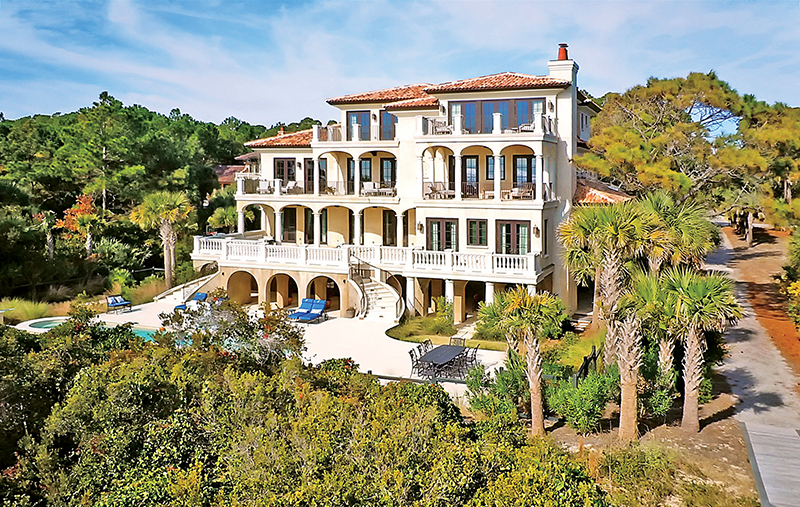
In the town of Rockaway Beach, Oregon, great beachfront swaths -- facing rising tides which result in record levels of erosion -- have been eaten away, threatening the stability of costly homes built on bluffs overlooking the ocean. A six-bedroom home on the northern coast of the state with a hot tub and a swimming pool, a Tuscan-style residence with a 3,300 square feet interior, boasting sweeping views of the Pacific Ocean is now in direct peril. The property was once considered a real estate treasure. Built in 2009 for over $1-million  it stood close to ten metres from the ocean.

Now, that last word in comfortable living, a sought-after property, is not quite so sought-after any longer. From the effect of erosion caused by those high tides the owners can enjoy watching from their large windows overlooking the ocean that sweep the beachfront, the house now is perilously perched under three metres from the dune's edge. It is a disaster waiting to happen, and happen it will, predict local officials -- guessing before the end of the year.

The owner of the property has expended tens of thousands of dollars, attempting to save his home. Dump-truck-loads of sand have been deposited on the beach in front of the residence. And the owner is contemplating the installation of permanent rock-and-boulder barriers, in the hope of protecting the bluff from any additional erosion under the waves' interminable onslaught. He is awaiting the go-ahead from state officials.

There is nothing particularly new about costly homes balancing on the edge of cliffs overlooking the ocean. Such homes are still in high demand, but that demand is soon to evaporate and the current owners left with little to celebrate. Affluent purchasers of such special beachfront properties were always willing to pay premium prices for palatial real estate, knowing those properties would be expected to increase in value. Rising sea levels, however, have altered both perceptions and the properties that were once so alluring.

Owners of homes in wealthy enclaves on both the Atlantic and the Pacific coasts of the United States now face similar battles caused by rising tides and the erosion they are responsible for. Some of the most prized waterfront real estate -- from New England to California is steadily evaporating into the oceans -- whose views and ocean-proximity were once the major selling point for these esteemed properties. True, the owners are wealthy, but they are discovering that their desperate efforts to save their investments are just that; desperate but futile.

Bluffs battered by rising tides that ravage their integrity edge homes ever closer to the sea despite millions some homeowners have dedicated to moving their homes further back on their lots. Experts estimate that in Malibu, California, home to one of the costliest beachfront areas in the country some lots have lost up to 17 metres of beach in the last ten years alone. Local authorities are prepared to spend millions -- up to $60M every ten years -- hauling tons of sand in hopes of restoring the vanishing beaches and dunes. Increased taxes will be levied on the over 100 properties involved, to achieve this.
Photo courtesy of Cocoran Group Real Estate
In Nags Head, North Carolina on the Outer Banks, waterfront property costs over a million dollars where the beach has been eroding roughly two metres each year, according to the North Carolina Division of Coastal Management; more than four times the median rate for North Carolina's coast and where the town is prepared to spend $48M dredging sand from the sea floor to dump it onto the beaches. At taxpayers' expense, of course. "These beaches are doomed. The buildings are doomed, too", states Orrin Pi8lkey, professor of geology, Duke University.

More than 300,000 homes in the United States likely will be affected by chronic flooding within the next 30 years as a result of rising sea levels, according to a study by the Union of Concerned Scientists. Properties valued at nearly $140-Billion across the country are at risk, suggests the study. Ocean City in Maryland, where town officials have been replenishing the beaches, spending millions in the process, is listed among a number of locations along the Atlantic Ocean at risk of chronic flooding by 2045.

Photo courtesy of Kiawah Island Real Estates

Labels: , , , , , ,

 
()() Follow @rheytah Tweet