Ruminations

Blog dedicated primarily to randomly selected news items; comments reflecting personal perceptions

Saturday, April 30, 2022

Sea Floor Fossils Revealed Atop Swiss Alps

"The tooth is particularly interesting because it could possibly -- but unlikely -- represent the largest animal to ever inhabit Earth."
"The Alps have a very complicated structure, with giant slabs of rock consisting of former sea floor, called nappes, piled on top of each other by the African plate pushing into the European plate."
"The nappe that the ichthyosaurs come from is the highest in the pile. This piling up happened in the last 35 million years or so." 
"Maybe there are more rests of the giant sea creatures hidden beneath the glaciers."
Martin Sander, paleontologist, University of Bonn 
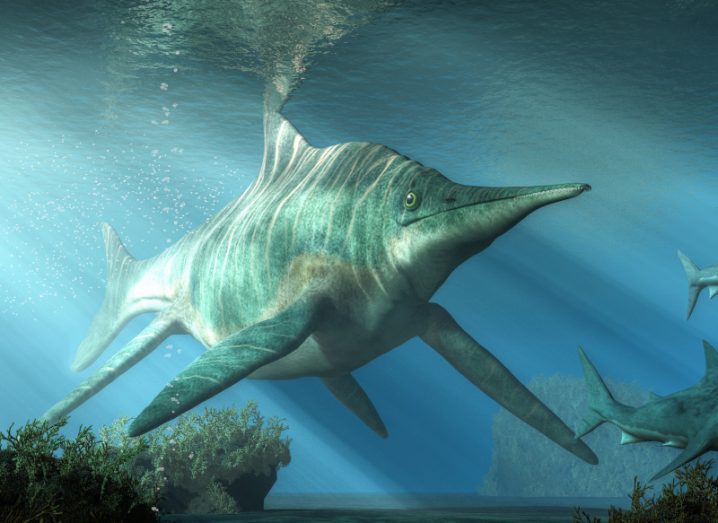
Illustration of the massive marine reptile called the ichthyosaur, swimming next to other sea creatures to the side.
Illustration of an ichthyosaur. Image: © Daniel Eskridge/Stock.adobe.com
 
The blue whale, an aquatic mammal that grows up to around 30 meters in length is considered to represent the largest-ever creature that Earth has ever seen. New discoveries on long-extinct Triassic ichthyosaurs may now crown these marine reptiles as having been even greater in size than the whales. The giant ichthyosaurs' bodies were shaped elongated with relatively small skulls. That early in the evolutionary cycle they may have borne small brains.

Specimen fossils were discovered back in the 1970s and '80s in the eastern Alps at three sites, in Switzerland. It is only now that after a deep study of the fossils that they are being scientifically described. A study has now been published in the Journal of Vertebrate Paleontology. Found atop the Chrachenhorn mountain near Davos, one of the fossils was a tooth.
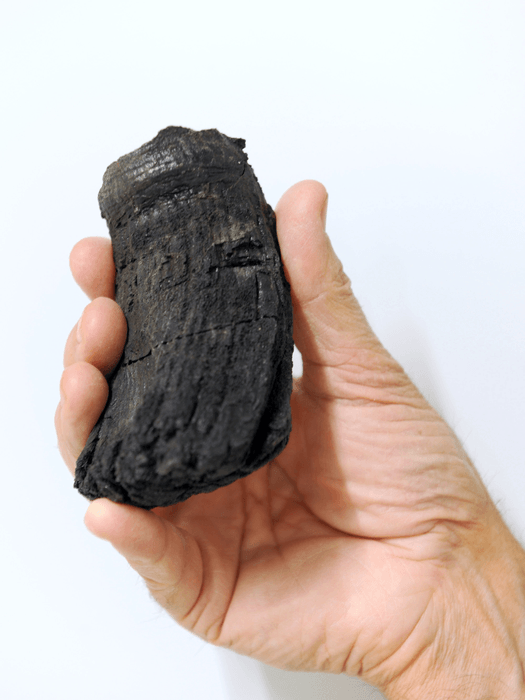
An ichthyosaur tooth fossil in a person's hand.
The root of the ichthyosaur tooth fossil, with a diameter of 60mm. Image: Rosi Roth/University of Zurich
 
More complete fossil remains were described as a rib and vertebrae from two ichthyosaur species, one judged to be 21 meters in length, the other about 15 meters; considerable size in any natural lexicon of Earth's creatures, large and small. Dating to around 205 million years back, close to the conclusion of the Triassic Period, the three individual creatures represented by the fossil remains are considered to be the largest of the giant ichthyosaurs to inhabit the oceans, when dinosaurs were starting to dominate land.

They were all found on three mountains in the Swiss Alps at an elevation of 2,740 meters above sea level. The third of the specimens, representing a tooth, was the largest from any ichthyosaur ever found. Its base is 6cm wide with an estimated length of 15cm, testing the imagination to envision a fearsome predator of the day. Last year, a 18-mters-long ichthyosaur was described as having had a tooth with a base 2cm wide.

"Then a tooth 6 centimetres wide could possibly have come from an animal 54 meters in length", suggested Dr.Sander; a formidable, absolutely unimaginable size. Other giant ichthyosaurs evidently ate small fish and squid, sucking them up, engulfing them in their toothless mouths. Fossils formed in an ancient seabed were found on top of mountains resulting from the inexorable, crushing movement of immense plates making up Earth's crust; a process called plate tectonics.
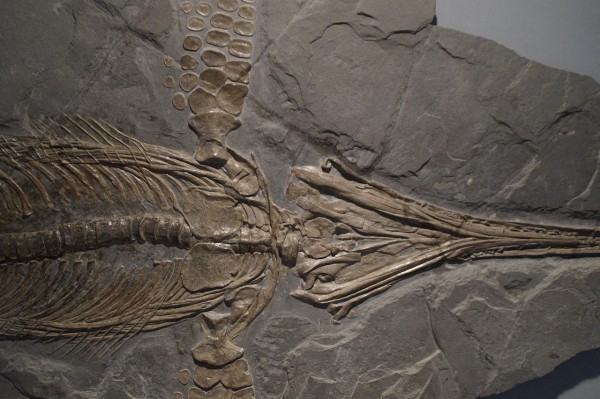
 Fossils of Giant Sea Monster From 205 Million Years Ago Found 9,000 feet Above Sea Level in the Swiss Alps
(Photo : Pixabay/Efraimstochter)
Fossils of Giant Sea Monster From 205 Million Years Ago Found 9,000 feet Above Sea Level in the Swiss Alps

Labels: , , , ,

Tuesday, April 23, 2019

Tyrannosaurus rex : King of the Dinosaurs

"In the last thirty years, the number of tyrannosaurs has increased threefold."
"The golden age of paleontology is right now."
"We have as much evidence that T.rex had feathers as we do that Neanderthals had hair."
Mark Norell, curator, fossil amphibians, reptiles and birds, American Museum of Natural History, New York

"It took evolution a long time to make T.rex."
"For most of the time they [early tyrannosaurs] were second- or even third-tier predators."
"People who study non-dinosaurs say dinosaurs get all the attention. People who study dinosaurs say theropods get all the attention."
"People who study theropods, say, oh, tyrannosaurs get all the attention."
Stephen Brusatte, paleontologist, University of Edinburgh, Scotland

Tyrannosaurus rex, by the very indisputable fact that it is the largest land predator that has ever existed, does, quite, 'get all the attention', focusing peoples' minds on their incredible size, ferocity, temperament and appetite. It was named the world's most charismatic megafossil, after T.rex was described in 1905. That first fossil, and its monumental size was thought to be an anomaly, that another would likely never be disinterred.

Yet for over a century, T.rex has added extraordinarily to the study of dinosaurs with the pace of discovery recently ramped up with many of the new findings about T.rex along with other tyrannosaurs recognized as its relatives. Now, T.Rex: The Ultimate Predator, a new exhibit at the American Museum of Natural History is slated to showcase that ancient monster of size and appetite. The Smithsonian National Museum of Natural History in Washington is set to reopen its hall of fossils with its own T.rex in a new stance, in June.

According to Dr. Mark Norell, curator at the American Museum of Natural History, T.rex has been an enormous assist in fostering a surge of interest in dinosaur paleontology given the rising number of researchers and new fossil discoveries thanks to the increase in the sophistication of new study techniques. "The golden age of paleontology is right now", stated his co-curator of the new show, Gregory Erickson, a paleobiologist at Florida State University.

"There were probably only six of us in the world who were paid" to study dinosaurs exclusively, explained Phillip J. Currie, paleobiologist at the University of Alberta. "Right now, there's maybe 150", he said, in light of the explosion in the field. The first discovery of T.rex created a sensation, and now each new skeleton or partial skeleton find has been met with the same kind of enthusiasm. The Field Museum in Chicago attracts international attention with its T.rex skeleton.

That skeleton, discovered in 1990, turned out to be the largest, most complete T.rex ever, which the museum paid $8.3 million for. Another giant skeleton discovered shortly afterward is set to be unveiled at the Royal Saskatchewan Museum in Regina, in May. Few finds are 90 percent intact as was the Chicago skeleton. Studies, with the use of CT scans, chemical analyses and new microscopic techniques illuminate behaviour, evolution and sensory capacities of T.rex.

The skull's musculature indicated that T.rex had a bite strength of 3,540 kilograms, deemed sufficient to cleave bones of other massive dinosaurs. Bone growth rings' studies led to a determination of how old individuals dinosaurs were and how swiftly they grew to maturity. T.rex, it appears, gained over two kilograms daily in its teenage years, living to age 30, at most. Judging by fossilized footprints of a dinosaur grouping, T.rex was held to be a social animal, one that likely hunted in groups.

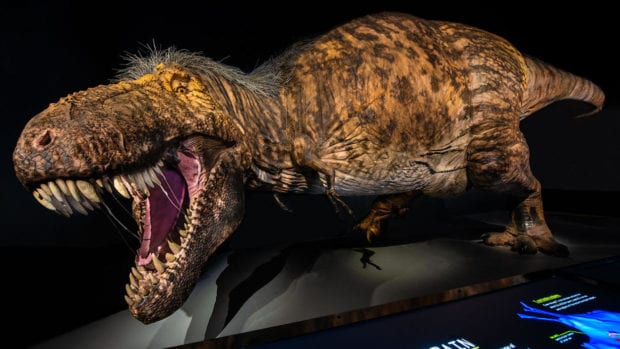
Its brain was large even for its size, leading to the conclusion that its intelligence level was higher than other dinosaurs'. T.rex had excellent vision, with ears adapted for hearing low-frequency sounds and its brain case suggests that T.rex's olfactory capacity was superb. Feathers? It had feathers, more in its younger years, but likely had a tail plume at maturity though no T.rex fossil has been found indicating the presence of feathers.

According to Dr. Norell, considering what is known about other tyrannosaurs, related dinosaurs and the course of evolution, scientists are confident in asserting that T.rex had feathers growing out of parts of its hide.

There are over two dozen other dinosaurs dating back 100 million years before T.rex came on the scene, included in its superfamily of tyrannosaurs. The early tyrannosaurs for the most part were small; some chicken-sized while many were the size or dogs or deer. They were not the top predators for most of the 100 million years of their existence.

Then came the emergence of T.rex close to the end of the age of dinosaurs, swiftly becoming the dominant predator in North America. A reputation that draws some irritation from researchers of other early creatures that evolved aeons ago.

Visitors to T. rex: The Ultimate Predator will encounter a massive life-sized model of T. rex with patches of feathers—the most scientifically accurate representation of T. rex to date.
D. Finnin/© AMNH

world's most accurate T. rex model New York Natural History

Labels: , , , ,

 
()() Follow @rheytah Tweet