Adaptive Deep Brain Stimulating, a Promising Therapy for Parkinson's Disease
"Five years later, I'm taking only one pill a day, whereas I used to take five or six.""It's not a cure or miracle, but it's definitely a game changer in the sense of feeling better day-to-day.""The tremor's gone, dyskinesia is gone, and I don't have that brain fog that I used to have when I was taking so many meds."Professor Keith Krehbiel, political scientist, Parkinson's patient"For some patients, especially people who have more severe symptoms, standard DBS that is always on at one constant setting doesn't give them enough benefit. The needs of the brain change depending on their activity level, such as when they're awake versus asleep, and particularly according to their medication cycle.""One way to develop this kind of algorithm is to first do some studies of brain signals in known conditions. Then you can train an artificial intelligence algorithm on this known data, so that the AI program learns what combinations of brain signals are associated with different states."Professor Philip Starr, neurological surgery, University of California, San Francisco"Imagine you're in a crowd, and there's a hum of conversation, but you can easily hear yourself talk -- that's the normal broadband neural activity situation.""But with oscillopathy, it's as if you're in a protest march where everybody's chanting the same thing, and you can't hear yourself speak."Dr. Helen Bronte-Stewart, professor of neurology and neurological sciences, Stanford School of Medicine
 |
Five years ago Keith Krehbiel, along with others volunteered to take part in an innovative non-pharmacological treatment for Parkinson's disease; Adaptive deep brain stimulation whose purpose is to enhance deep brain stimulation -- an existing treatment for the condition -- but with the addition of artificial intelligence. Their most debilitating motor symptoms has been virtually eliminated with the emerging therapy, their quality of life considerably improved.
At the same time they have been enabled with the use of the therapy to reduce their medication intake and with it, they have experienced a decrease in corresponding negative side-effects. The scientists probing the Adaptive deep brain stimulation therapy with the intention of improving its effects hope that it will in time help other Parkinson's patients aside from their test subjects.
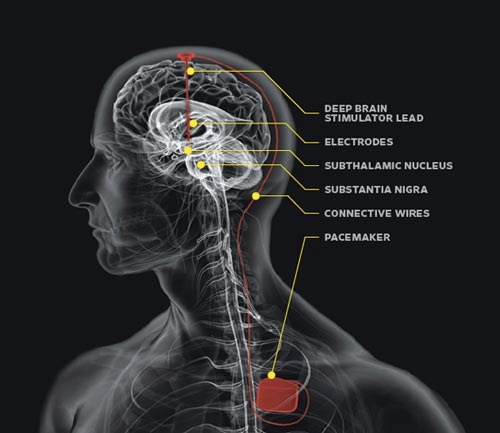
DBS (Deep Brain Stimulation) has been in use since 1997 as an established surgical therapy for the treatment of symptoms of Parkinson's. A device similar to a heart pacemaker is implanted in the brain with DBS, to deliver electrical pulses. Conventional DBS is regarded as a one-size-fits-all approach to ameliorating the devastating effects of Parkinson's. Adaptive DBS on the other hand, personalizes therapy based on brain activity in real time for patients, with the help of AI.
 |
The brain, like the heart, produces patterns of electrical activity produced by neurons; in other words, normal rhythms. Epilepsy and schizophrenia are medical conditions associated with abnormal brain rhythms, with a similarity to cardiac arrhythmias. Neurons become overly synchronized in Parkinson'sin what is recognized as oscillopathy, with its potential of interfering with the normal transfer of information, and lead to symptoms like tremors and stiffness.
Parkinson's medications and DBS dampen oscillopathy in the brain. Steady electrical pulses from DBS help to pace the neuronal firing in a manner overriding hyper-synchronization of oscillopathy, restoring brain rhythms to normal. Conventional DBS delivers electrical stimulation at a constant -- "always on" -- setting where periods of under-stimulation and over-stimulation can occur, that result in slowness of movement, or dyskinesias (respectively).
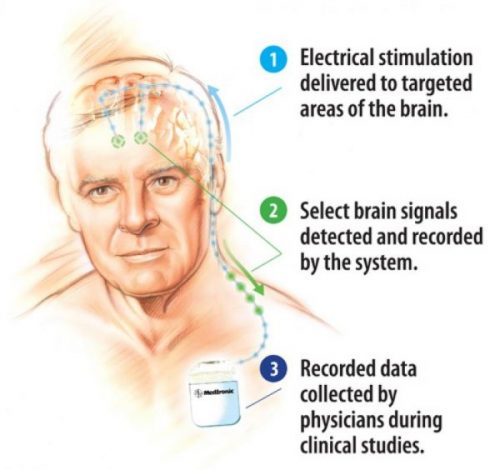
On the other hand, Adaptive DBS detects real-time neural signals and automatically adjusts stimulation in response to oscillopathy or other biomarkers. An algorithm delivering the right amplitude or 'dose' of stimulation when it is needed in an adaptive manner, to provide a more stable therapeutic experience for patients is achieved with Adaptive DBS when AI modelling is used to develop an algorithm.
Adaptive DBS is associated with greater motor symptom control, fewer side-effects, and lower electrical energy delivered in comparison to conventional DBS, as has been demonstrated through early studies. In 2024, Professor Starr and colleagues conducted a pilot study of four participants with Parkinson's to discover that Adaptive DBS improved motor symptoms and quality of life, far in excess of what conventional DBS delivers.
 |
The Starr team of scientists personalized algorithms for each of their study patients, bringing them into the clinic and measuring their brain rhythms, on or off levodopa, a Parkinson's medication used to increase levels of dopamine. 68 patients with Parkinson's were included in the ADAPT-PD clinical trials, (leading to the FDA approval), which included Krehbiel, with a previously implanted conventional DBS system. Dr. Bronte-Stewart and colleagues provided the patients with Adaptive DBS and the participants were sent home for 30 days.
Full results of the study not yet published, preliminary data reveals no serious adverse device events, and 98 percent of participants decided to remain on Adaptive DBS, in long-term followup. The therapy is not meant for everyone with Parkinson's. A good response to dopaminergic medications such as levodopa is a requisite, while patients considered for the therapy should not be too advanced in Parkinson's.
Andrew O'Keefe, a researcher and neurosurgical trainee at King's College London and colleagues are experimenting with stimulating various areas of the brain with directional electrodes to stimulate forward or backward; targeting and precisely controlling stimulation has the potential to improve DBS effectiveness. He hopes to optimize not only when, but where to deliver therapy, according to which biomarkers are involved, highlighting the complexity involved.
"It's like the hardest Sudoku problem you've ever tried to solve in three dimensions. It's insoluble for a human.""But for an AI program, that's like grist to its mill. AI is incredibly good at sorting those complicated problems out."Dr. Andrew O'Keefe
 |
Labels: Adaptive Deep Brain Stimulation, Deep Brain Stimulation, Parkinson's Disease, Treatment Therapies
posted by Pieface @ 8:08 PM
0 comments