Ruminations

Blog dedicated primarily to randomly selected news items; comments reflecting personal perceptions

Thursday, March 04, 2021

Playing golf may be better for Parkinson's sufferers than Tai Chi for improving balance and mobility, a study suggests.  
Playing golf study    Credit:  Mike Ehrmann/Getty
"We know that people with Parkinson's disease benefit from exercise, but not enough people with the disease get enough exercise as therapy."
"Golf is popular -- the most popular sport for people over the age of 55 -- which might encourage people to try it and stick with it. We decided to compare golf to Tai Chi in our study because
Tai Chi is the gold standard for balance and preventing falls in people with Parkinson's."
"Our finding that golfers were much more likely to continue with their sport is exciting because it doesn't matter how beneficial an exercise is on paper if people don't actually do it."
Dr.Anne-Marie Wills, Massachusetts General Hospital, Boston
exercise
Exercise is an important part of healthy living for everyone. For people with Parkinson’s disease (PD), exercise is more than healthy — it is a vital component to maintaining balance, mobility and activities of daily living. Exercise and physical activity can improve many PD symptoms. These benefits are supported by research.  Parkinson's Foundation

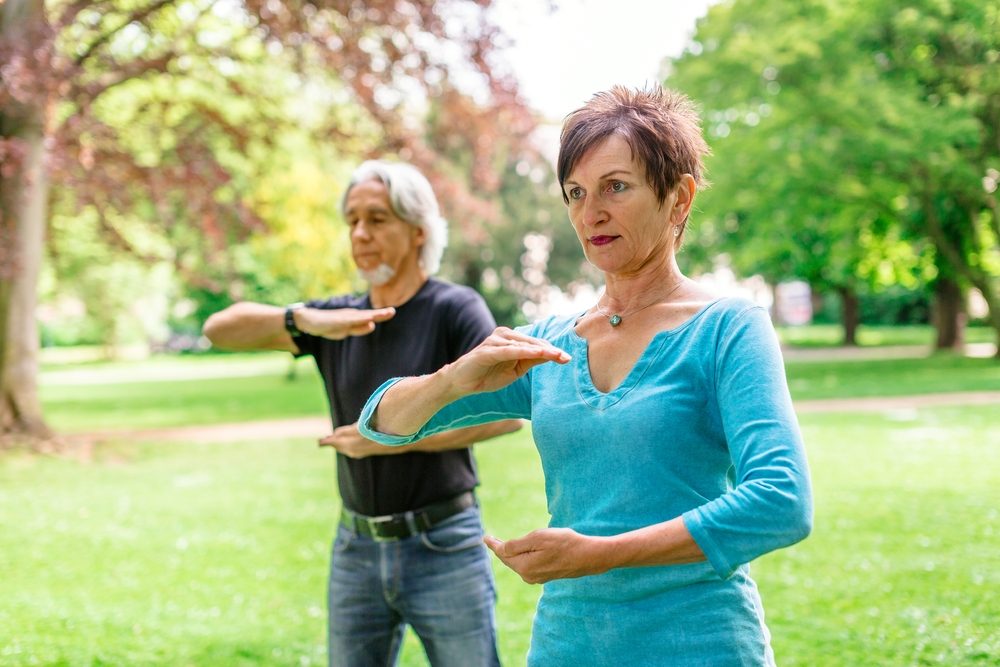
An industry of offerings for exercise treatment for Parkinson's focus on Tai Chi classes. Tai Chi is known for its role in improving balance and mobility, according to studies. According to Richard Selby who instructs in Tai Chi at the Central London Community Health-care NHS [British National Health Service] Trust's Parkinson's Day Unit, patients are given a "sense of well-being which helps them manage their condition better". 

Twice-weekly Tai Chi training, according to a previous study reported in the New England Journal of Medicine, led to improved postural stability, walking ability, and fewer falls on the part of patients. Now another research project has surfaced with interesting conclusions. The research is to be presented at the annual meeting of the American Academy of Neurology where the finding that people who practise golf swings at a driving range appear quicker and more mobile following ten weeks of practise than those who practised Tai Chi is to be released.
A yoga instructor assists a senior with her posture.
John Hopkins Medicine
 
Not a particularly large study, with twenty participants with moderate Parkinson's disease. The study participants were divided into two groups where eight people were randomly assigned to practise golf, a dozen others did Tai Chi. Both groups completed the assigned ten weeks of two one-hour group classes weekly. Researchers tested patients' balance, walking ability and risk of falling, both at the start and the finish of the study.

Study participants  were timed in one test that had them rising from a chair, walking ten feet, and then returning to the chair and seating themselves. Those who practised golfing, were timed at 0.96 seconds faster at the end of the test, than at the beginning. Those who practised Tai Chi were 0.33 seconds slower in response, while no difference was seen between the two groups in risk of falls or adverse effects.

Over four in five of the people who were assigned golf felt they were likelier to continue golfing, in comparison with a third of those who practised Tai Chi, feeling they would be interested in continuing with it. Perhaps it would be best not to overlook the fact that exercise of any kind is beneficial to those with Parkinson's; some types more effective overall, but all choices render benefits.
 
https://www.parkinsons.org.uk/sites/default/files/styles/image_4by1_large/public/2019-01/Tai-Chi-move-1.jpg?itok=CP3CFaAO

"Although Tai Chi shows statistically significant improvements on motor function and balance for patients with PD in the current meta-analyses, there is indeed not enough evidence to conclude that Tai Chi is effective for PD because of the small treatment effect, methodological flaws of the eligible studies, and insufficient follow-up. Consequently, large-scale, high-quality RCTs with long follow-up are warranted to confirm current findings of Tai Chi for PD."
Conclusion: A Meta-Analysis on the Efficacy of Tai Chi in Patients with Parkinson's Disease 
Ji Zhou,1 Tao Yin,2 Qian Gao,3 and Xiao Cun Yang3
"We found that a program of twice-weekly tai chi for 24 weeks, as compared with a resistance-training program or a stretching program, was effective in improving postural stability and other functional outcomes in patients with mild-to-moderate Parkinson's disease. Tai chi training also significantly reduced the incidence of falls, as compared with the stretching program. Improvements in primary and secondary outcomes were maintained 3 months after the intervention, a finding that is consistent with prior research involving adults 70 years of age or older. No serious adverse events were observed during tai chi training, indicating the safety and usefulness of this intervention for persons with Parkinson's disease."
Tai Chi and Postural Stability in Patients with Parkinson's Disease
Fuzhong Li, Ph.D., Peter Harmer, Ph.D., M.P.H., Kathleen Fitzgerald, M.D., Elizabeth Eckstrom, M.D., M.P.H., Ronald Stock, M.D., Johnny Galver, P.T., Gianni Maddalozzo, Ph.D., and Sara S. Batya, M.D.
 
Study Finds Tai Chi Improves Motor Function in Parkinson’s Patients
Parkinson's News Today

Labels: , , , , ,

Monday, May 27, 2019

Golf as Exercise

"Walking the golf course certainly counts as exercise. Even riding in a golf cart is better than doing nothing. But to meet the recommended level for good health, you probably need to increase your activity. The American Heart Association recommends 150 minutes of moderate-intensity exercise per week to help reduce the risk for heart attack and stroke. This is equal to 30 minutes five days a week. One way to achieve this is with brisk walking (4 mph) for 10 miles per week, which burns a total of approximately 1,000 calories."
"Studies have found that walking 18 holes is about equal to brisk walking in terms of intensity (even though golf walking is stop-and-go). A golfer may walk four miles and burn 800 to 900 calories during an average round with help from swinging clubs. If you ride in a cart, the walking distance drops to about one mile and you burn half the calories. So playing two walking rounds per week is a good way to meet the minimum exercise requirement."
"However, in order to gain the maximum cardiovascular benefit from exercise, you may want to add a day or two of higher-intensity activities, such as running, tennis, or something similar that raises your heart rate. The good news: you do not need more than an hour per day. Research has found there is little additional benefit after that time period."
—William Kormos, MD
Editor in Chief, Harvard Men's Health Watch


Ryo Ishikawa, one of Japan's biggest golf stars, demonstrates his swing on the pro tour in February.
Donald Miralle/Getty Images

Winter's over, it's golf time. Everyone's anxious to get out on the green; watching golf tournaments on television can be packed away for the time being, and the golf bag dusted off. And if you're thinking health and fitness and exercise packed into a day of bracing fresh air and sunshine, what's not to like? On the other hand, if you're equating the game you play with the game that the named professionals play, it just isn't the same thing; not as 'physical'. And while a professional golfer has to be equipped with endurance, flexibility and strength for ultimate links success, the ordinary player doesn't.

Were you aware that a portable gym is part of the entourage of the PGA? That most professional golfers follow a year-round fitness regimen to ensure they keep in shape, and most do it with the help of a personal trainer? That's professional commitment. Walk the course or use a golf cart? Walking can be a challenge if it's a hilly terrain, not so much of it's flat, but as an exercise option is preferential. And of course age comes into the equation as well as how hefty the weight of the golfer is, embarking on that 18-hole adventure.

A number of studies report a positive link between regular golf activities and an extended life expectancy, so you practise the game you love and at the same time gift yourself with an improved lifestyle and presumably a longer life. Good formula. Golfers, it would appear, can appreciate that the studies appear to agree that golfers gain by having a 40 percent lower mortality rate than those who don't play golf. They don't know what they're missing.

walking while golfing
Image: Monkey Business Images/ Thinkstock

It isn't golf itself per se that gives golfers that advantage, however; it's the walking, and the added physical act of swinging a golf club. It also helps that golf is a very social game that can be shared with friends, family and business associates. That commitment to regularly playing golf, a game that is so much a passion for so many, has its advantages, burning three to eight calories a minute, which comes out to 264 or 450 calories each game. As for the energetic golfers who prefer to walk the course, they will cover 8 to 13 kilometres walking an 18-hole course.

Which will qualify as a moderate-intensity aerobic activity, taking into account that 8 to 13 kilometers represents 11,245 to 16,667 steps reflected on a step counter. But if you ride a cart, that step count is reduced to 6,280 steps, equating with 5 km over 18 holes. Activity fluctuates between light, moderate and high intensity activities throughout the course of the game, reflecting walking, standing or swinging a golf club.

A caution: too many hours where the same motion is repeated tends to be hard on joints, not to mention the effect of poor swing mechanics, the secondary cause of injury among non-pro golfers.
The elbow, wrist, hand and shoulder of golfers are prone to injury, and so too is the spine which must rotate with speed, power and full motion range, requiring a more than a modicum of strength and flexibility. Other sports, however, have a greater risk of injury than golf.

But there's another statistic of more than passing interest, where in the United States, golf comes with the highest incidence of lightning strikes -- resulting in death -- a penalty too dire to contemplate. In extreme weather situations, it's wise, no doubt about it, to clear the course, and speedily. And in good weather when the sun beams down, slather on sunscreen because golfers have a higher-than-average risk of skin cancer, given their long hours of exposure walking that salubrious course under sunny skies.

Even golfers using a motorized cart can burn about 1,300 calories and walk 2 miles when playing 18 holes.
Halfdark/fstop/Corbis

Labels: , , , ,

 
()() Follow @rheytah Tweet