Ruminations

Blog dedicated primarily to randomly selected news items; comments reflecting personal perceptions

Monday, August 18, 2025

When Allies Fall Out

"Sections of the Indian foreign policy community feel 'betrayed' by the Donald Trump administration, which has found unexpected affection for Rawalpindi, raised a host of tough demands on trade, and threatened additional tariffs on India because of its BRICS membership and continued purchase of Russian oil."
"It is, perhaps, a small consolation that India is not alone. America’s neighbours and largest trading partners [Mexico and Canada] and its longstanding allies in Europe and Asia have even more reasons to feel betrayed."
C. Raja Mohan, Indian Express
 
"[There will be] very pragmatic strategic recalibrations [by New Delhi to protect its interests]."
"[India's growing economy allows its leaders breathing room, bit it is still a moment of] deep introspection [for the country]."
"We have to draw our lessons from that and really focus on the national priorities and what we need to do to become strong and more influential."
Nirupama Rao, former Indian ambassador to Beijing and Washington 
 
"In the dim-lit antechambers of global power, India stands as both witness and architect to a world on the edge of multipolar chaos."
"The tectonic plates of international order are shifting, and New Delhi – long a master of strategic ambiguity – now finds itself the subject of a more perilous experiment in global pressure with Washington brandishing the threat of sweeping tariffs and secondary sanctions."
"Republican Senator Lindsey Graham’s bill – stipulating 500% tariffs on countries buying Russian oil to curb Moscow’s aggression against Ukraine – puts India’s time-honoured doctrine of ‘strategic autonomy’ to its severest test."
"NATO Secretary General Mark Rutte’s subsequent warning to India of being hit ‘very hard’ by secondary sanctions if it continues to trade with Russia only underlines the gravity of the challenge."
Vinay Kaura, Royal United Services Institute  
Sunday Guardian

India, the world's most populous democracy, knows what it feels like to be caught between a rock and a hard place. And right now, the walls of that hard place are steadily albeit slowly moving inward to trap India, giving it due cause for concern and certainly cause to look about carefully in considering its options. Options which in and of themselves complicate an already complex situation, making it extremely difficult to make critical decisions. For any decisions made will come with ready-made headaches at a time when India would prefer to focus on its strengthening economic situation as a potential to nudge China aside as the world's premier producer of hard goods on the world stage.

On the one hand, New Delhi's growing power as a world-class producer capable of overturning China's current status as the globe's producing colossus, has seen Beijing's attention also swivelled to that likelihood so there is a certain level of tension to add to the belligerent territorial claims of the two giants over border issues and the high plateau Himalaya in particular. Rivalry of this calibre makes for uneasy neighbours.
But it is not only China and its penchant for territorial aggression that makes its neighours nervous; in India's case there is another neighbour with whom relations are fraught with tension; the ill will that emanates from Pakistan toward India is best seen in their fractious relations over Kashmir, a tinderbox of unresolved claims leading to occasional vociferous accusations and culminating in indecisive, violent clashes.
 
India's sterling relations with the United States, arguably still the world's dominant superpower, have recently taken a turn for the worse. Although in President Donald Trump's first administration no issues erupted that would rock a congenial relationship between the two countries had surfaced, the second Trump administration has roiled all of America's trade partners to a significant degree, threatening to upend world trade, causing no end of turmoil in stock markets and the suddenly wobbling global economy. 
 
When that calm and friendly relationship between India and the U.S. erupted suddenly into an antagonistic trade issue, it was not only India, but all of the U.S.'s normally reliable Western-democratic allies finding themselves staring down the barrel of a targeted trade tariff of staggering proportions. The Trump administration levying a whopping 50 percent tariff on Indian goods as punishment for Russian oil contracts by New Deli and Moscow stunned Prime Minister Narendra Modi.
 
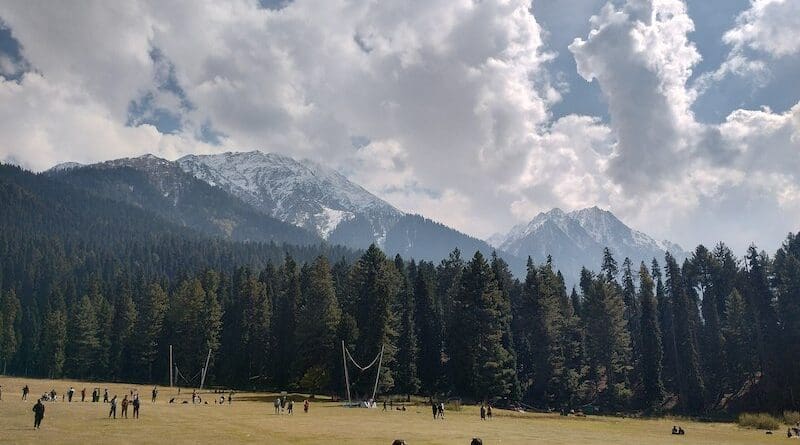
Baisaran Valley, near Pahalgam, Jammu and Kashmir, India. Photo Credit: Hellohappy, Wikipedia Commons
 
And when Donald Trump recognized Pakistan on an equal footing during a standoff between India and Pakistan over a conflict that began when Hindu tourists in Kashmir were attacked and killed by Pakistani terrorists whom New Deli identified as linked to the Pakistani military, India was taken aback, insulted and incredulous that this could occur, when even Trump himself has acknowledged that Pakistan harboured and sponsored terrorists in their midst -- with India in mind.
 
Donald Trump took credit for smoothing over the rankled hostility between the two neighbours, even as India took credit for its superior military having gained the advantage over Pakistan that led to a ceasefire. That Narendra Modi took exception to Trump's declaration as a premier peacemaker whose overtures had succeeded in arranging the ceasefire and his subsequent declaration of India having been responsible in view of its military success over Pakistan did not endear him to his erstwhile ally.
 
The diplomatic distance that ensued, made the imposition of steep tariffs inevitable as Mr. Modi has opened up to Vladimir Putin of Russia, both vowing to deepen "the India-Russia Special and Privileged Strategic Partnership" -- a red flag to a raging bull. With India facing a situation where rivals like China and the United States hemming in India's ambitions on the economic and diplomatic front, uncertainty reigns, forcing India to recommit to its doctrine of "strategic autonomy"; a situation similar to what Israel, an ally of India, is facing for entirely different reasons.
 
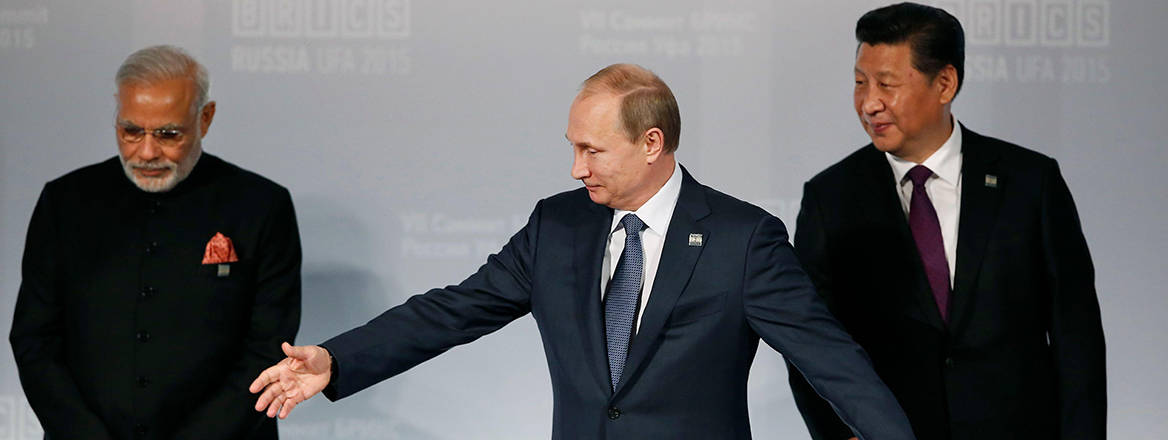
Russian President Vladimir Putin, welcomes Indian Prime Minister Narendra Modi and Chinese President Xi Jinping prior to a signing ceremony at the BRICS Summit in Ufa, Russia, Thursday, July 9, 2015.
Royal United Services Institute, U.K.

Labels: , , , , , , ,

Saturday, September 23, 2023

Canada, Once Again on the World Stage

"Amid the ongoing diplomatic tensions between India and Canada over the killing of Hardeep Singh Nijjar, sources have revealed that the Khalistani leader was found to be at flight risk in the United States and was on USA’s no-fly list in 2019."
"Meanwhile, in contradiction to Trudeau’s recent support to the Khalistani activist, it has been learned that Nijjar was also included in Canada's no-fly list in 2017–18."
YouTube
 
"Murdered Khalistani separatist Hardeep Singh Nijjar, a designated terrorist in India, was allegedly involved in crime since the 1980s and had connections with local goons from a young age, a detailed dossier prepared by Indian authorities, and accessed by NDTV, revealed. It further says Nijjar, who fled to Canada on a forged passport in 1996 and maintained a low profile as a truck driver there, travelled to Pakistan for arms and explosives training. He also allegedly ordered several killings and attacks in Punjab while taking refuge on Canadian soil."
"Later, he allegedly came in touch with Pakistan based KTF Chief, Jagtar Singh Tara. He also visited Pakistan in the garb of a Baisakhi jatha member in April 2012 and underwent an arms and explosive training there for a fortnight, the dossier said."
NDTV legacy news outlet
 
"In light of the current environment where tensions have heightened, we are taking action to ensure the safety of our diplomats."
"As a result, and out of an abundance of caution, we have decided to temporarily adjust staff presence in India."
Jean-Pierre Godbout, spokesperson, Global Affairs Canada
 
"There is no question that India is a country of growing importance. And a country that we need to continue to work with."
"We're not looking to provoke or cause problems. But we are unequivocal around the importance of the rule of law and unequivocal about the importance of protecting Canadians and standing up for our values."
"We call upon the government of India to work with us to take seriously these allegations and to allow justice to follow its course."
Prime Minister Justin Trudeau
 
"[It appears Canada's allegations] are primarily politically driven."
"No specific information has been shared by Canada on this case. We are willing to look at any specific information; we have conveyed this to the Canadians."
Indian External Affairs Ministry spokesperson Arindam Bagchi
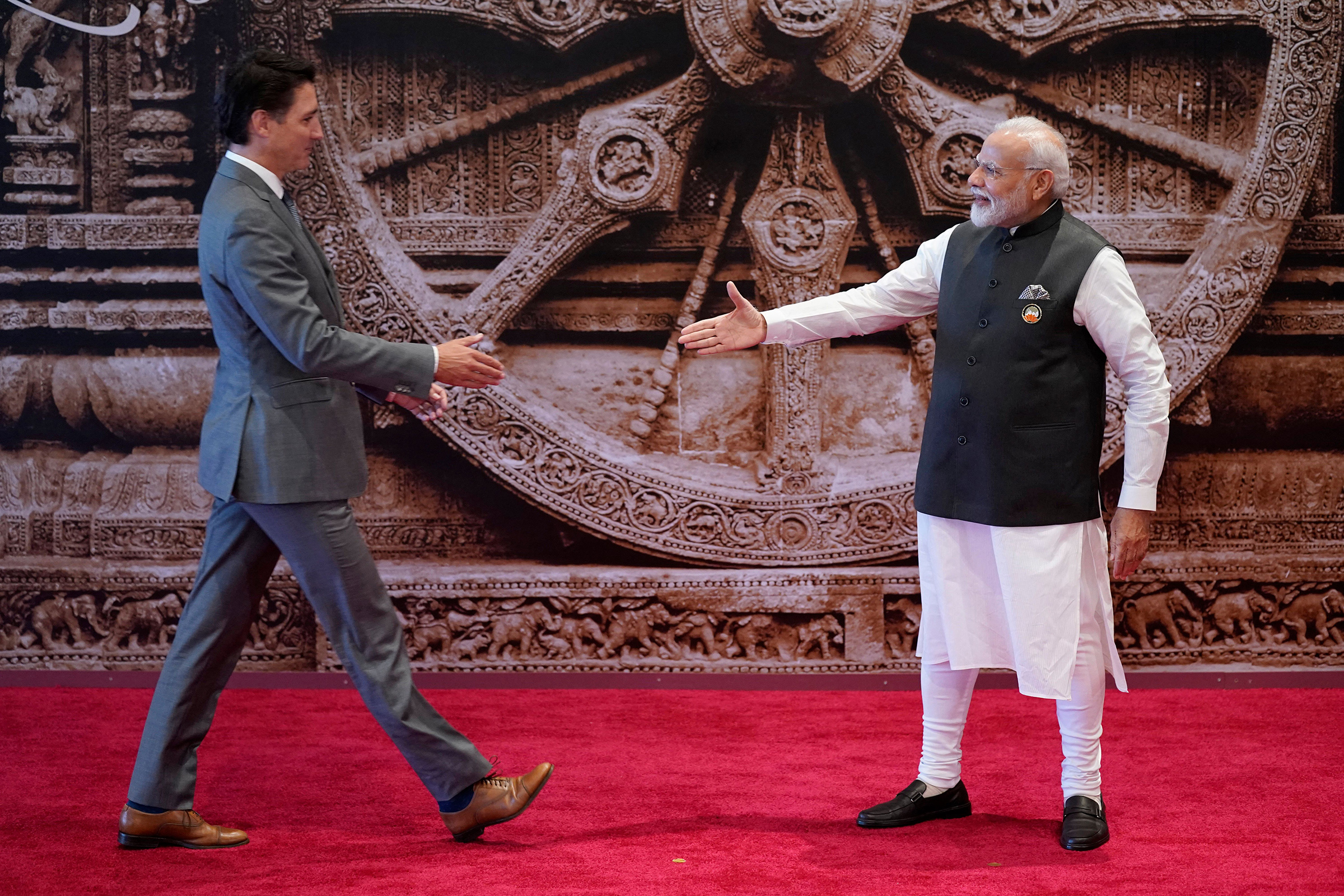
India's Prime Minister Narendra Modi greets Canada's Prime Minister Justin Trudeau ahead of the G20 Leaders' Summit in New Delhi on Sept. 9. (Evan Vucci—POOL/AFP/Getty Images)
India's Prime Minister Narendra Modi greets Canada's Prime Minister Justin Trudeau ahead of the G20 Leaders' Summit in New Delhi on Sept. 9  Evan Vucci—POOL/AFP/Getty Images
 
Prime Minister Justin Trudeau's accusation on Monday that the Indian government had a role in orchestrating an assassination of a Canadian Sikh embroiled in Khalistani agitation against India did not go down well in India. As a prime minister with a personal background in administrative malfeasance, lapse of ethical conduct, theatrical and embarrassing behaviour on the world stage, while at home pushing a woke agenda on mostly unwilling Canadians whom he refers to as 'racist' and 'homophobic' for their protests, and having alienated one end of the country from the other by his environmental politics, it is hard for many to take his accusations seriously.
 
In June of this year a Surrey, B.C. resident with citizenship in Canada, Hardeep Singh Nijjar -- described variously as a "Sikh community leader" and a "peaceful advocate for Sikh independence" as president of the Guru Nanak Sikh Gurdwara in Surrey -- was gunned down in the parking lot of the gurdwara by two masked thugs who fled the scene and whose identities remain unknown. In India, on the other hand, the man had a notorious reputation as a terrorist: a "terrorist fugitive from India who emigrated to Canada".
 
On his disastrously embarrassing 2018 trip to India, Justin Trudeau had been handed a list of "Khalistani operatives in Canada" by Amarinder Singh, at the time chief minister of Punjab province. Nijjar's name was on that list. Canada has a reputation of harbouring Sikh separatists. Khalistanis, as they are called, are known to be extremists and have been involved in violent incidents in the past, not the least of which was their bombing of Air India Flight 182, which killed 329 people -- most of whom were Canadian-Indian Hindus -- in mid-flight over Ireland in 1985.
 
A banner with the image of Khalistani extremist Hardeep Singh Nijjar is seen at the Guru Nanak Sikh Gurdwara temple in Surrey, British Columbia (REUTERS)

Little wonder that Prime Minister Narendra Modi is convinced that Canada has done nothing to prevent the threat of violence against its diplomats assigned to Canada on the evidence, blatant and ignored. There are more incidents of agitation for a Punjab Khalistani homeland out of Canadian Sikh separatists than there is among Punjab majority-Sikh residents where it is now considered a non-issue. The provocations and threats emanate from among Canadian Sikh separatists who stage loud protests in Vancouver and Toronto with placards openly threatening Indian diplomats.

One parade float in Brampton Ontario glorified the 1984 assassination of former Indian prime minister Indira Gandhi by her trusted Sikh bodyguards. And then there was the issue of an unofficial Khalistani secessionist referendum held in the Toronto area a year ago, a referendum that Hardeep Singh Nijjar was deeply involved with. Billboards in Surrey in the aftermath of Nijjar's killing were emblazoned with "assassination wanted", listing names and photographs of Indian diplomats. 

Little wonder the government of India is convinced that Canada is wholly indifferent to the safety and security of its large expatriate Indian community, both Hindu and Sikh, living in Canada, almost two million in combined numbers, much less the large number of Indian students who come to Canada for their post-secondary education in a fellow democracy.

People carrying yellow flags walk down a city street on a sunny day.
Supporters of the Khalistan movement, a push for an independent Sikh homeland in northern India, protest outside the Consulate General of India in Vancouver on Sept. 8. (Ben Nelms/CBC)

Labels: , , , ,

 
()() Follow @rheytah Tweet