Ruminations

Blog dedicated primarily to randomly selected news items; comments reflecting personal perceptions

Saturday, December 06, 2025

Trading on Moral Imperatives

"India is a great power, not a British colony. And everyone will have to accept that."
"[Russia plans to cooperate with India in] the most important areas: cutting-edge technology, space exploration and nuclear energy."
"[Heavy sanctions on the Russian economy caused] certain difficulties [but there are solutions and those countries that hinder third-country trade will] ultimately suffer losses themselves."
"The United States itself still buys nuclear fuel from us for its own nuclear power plants. If the US has the right to buy our fuel, why shouldn't India have the same privilege?"
Russian President Vladimir Putin 
 
"[India is not neutral on the war in Ukraine and stands on] the side of peace [welcoming efforts to find a] lasting [solution to end the war]."
"[Increasing India's] connectivity between Russia and India remains a] major priority [for India]."
"Energy security has been a strong and important pillar of the India-Russia partnership."
"The India-Russia friendship has remained steady like a guiding star." 
"We have agreed on an economic cooperation program for the period up to 2030. This will make our trade and investment more diversified, balanced and sustainable."
Indian Prime Minister Narendra Modi 

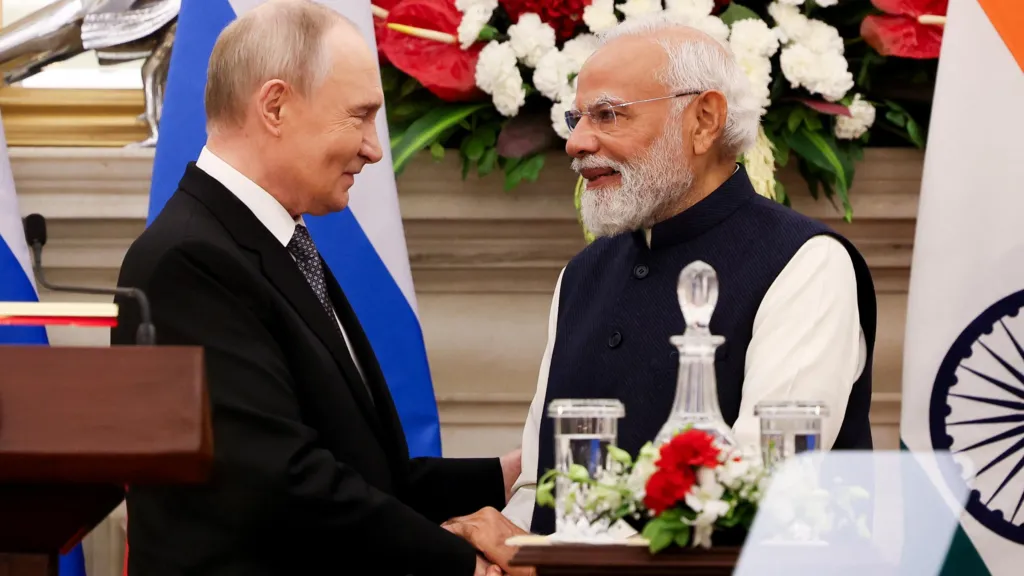
https://ichef.bbci.co.uk/news/1024/cpsprodpb/3c5c/live/b75f4f30-d1c3-11f0-a892-01d657345866.jpg.webp
Russian President Vladimir Putin has said Moscow is ready to provide "uninterrupted shipments" of fuel to India, as Delhi faces pressure from the US to stop buying Russian oil.   BBC

 
"[Indian energy companies decide on purchases based on] evolving market dynamics [and] commercial issues."
Indian Foreign Secretary Vikram Misri 
 
"Protecting the India-America relationship from the Trump problem is very important."
"The U.S. is a much bigger market for India than Russia can ever dream of becoming [despite longstanding India-Russia ties]." 
"We have to ensure that we do nothing with Russia that will give Trump another excuse to put blame on India."
"That has to be at the back of our mind." 
Dilip Sinha, retired Indian diplomat and commentator 
It is hugely unlikely that either Foreign Secretary Misri or retired Indian diplomat Mr. Sinha have all that much to be concerned with in relation to Mr. Putin's visit to India to discuss trade ties with Prime Minister Modi bothering the Trump White House. President Trump has made it obvious that he has a soft spot for Vladimir Putin that fits well with his predilection for finding favour with 'strongmen' whether they're from Russia, Turkey, Syria or Saudi Arabia. The ongoing war in Ukraine with the  agony of hanging on while the beleaguered nation is slowly suffocating under the weight of Moscow's larger army and military equipment is an inconvenience to President Donald Trump in President Zelenskyy's refusal to wave a white flag.
 
The prevailing issue seems more one of inconvenient events swamping a relationship sullied by the fact that one of the principals is a territorially grasping dictator deliberately oblivious to his revanchist passions' cost in human lives to achieve his goals of re-assembling the former Soviet Union's stranglehold on its neighbours. India itself has one such neighbour which has its own territorial ambitions grasping Tibet, Xinjiang and Inner Mongolia, challenging India, Japan, Vietnam, the Philippines, Taiwan and South Korea for territories it contests as its own.
 
Yet, in the interests of solidarity with the oppressed by the savagely territory-acquisitioning bullies of the world, India, the world's most populist country, energy-hungry in the bargain, dances with the devil with whom his country has had long remunerative relations in an attempt to balance its relations both with the United States and Russia from which its energy needs can be satiated for an economy growing in leaps and bounds. 
 
Narendra Modi, himself receiving Mr. Putin at a New Delhi airport, expressed his emotions with a bear hug, later hosting President Putin at a private dinner at his official residence. This is the occasion of the 23rd India-Russia Summit meant to discuss deep economic cooperation relating to defence, energy and skilled labour mobility. And Prime Minister Modi faced up to the unenviable diplomacy required to balance his nation's relationship with both Moscow and Washington which under the Trump administration is far less tricky than onlookers might suppose.  
 
The European Union, on the other hand, might very well take justifiable umbrage with New Delhi where trade talks there too could be a feature for consideration. It is Europe, after all, that quails at the prospect of Ukraine's complete defeat, knowing that the Kremlin might very well continue its depredation of Eastern European states. The hostile atmosphere in Europe toward Moscow in the face of Russia's bold assertions of power exacerbated by the airspace incursion of drones attributed to the Russian military and Mr. Putin poking at their defences tell the story of the attitude Europe can take to Mr. Modi's accommodation with Russia.
 
https://i.cbc.ca/ais/570ec606-1ae0-4068-96f5-92a02c070fca,1764952966569/full/max/0/default.jpg?im=Crop%2Crect%3D%280%2C0%2C3543%2C2348%29%3BResize%3D805
Putin, right, walks past guards of honour during a ceremonial reception prior to his meetings with Indian officials in New Delhi on Friday. (Konstantin Zavrazhin/Sputnik/Reuters)


Labels: , , ,

Monday, August 18, 2025

When Allies Fall Out

"Sections of the Indian foreign policy community feel 'betrayed' by the Donald Trump administration, which has found unexpected affection for Rawalpindi, raised a host of tough demands on trade, and threatened additional tariffs on India because of its BRICS membership and continued purchase of Russian oil."
"It is, perhaps, a small consolation that India is not alone. America’s neighbours and largest trading partners [Mexico and Canada] and its longstanding allies in Europe and Asia have even more reasons to feel betrayed."
C. Raja Mohan, Indian Express
 
"[There will be] very pragmatic strategic recalibrations [by New Delhi to protect its interests]."
"[India's growing economy allows its leaders breathing room, bit it is still a moment of] deep introspection [for the country]."
"We have to draw our lessons from that and really focus on the national priorities and what we need to do to become strong and more influential."
Nirupama Rao, former Indian ambassador to Beijing and Washington 
 
"In the dim-lit antechambers of global power, India stands as both witness and architect to a world on the edge of multipolar chaos."
"The tectonic plates of international order are shifting, and New Delhi – long a master of strategic ambiguity – now finds itself the subject of a more perilous experiment in global pressure with Washington brandishing the threat of sweeping tariffs and secondary sanctions."
"Republican Senator Lindsey Graham’s bill – stipulating 500% tariffs on countries buying Russian oil to curb Moscow’s aggression against Ukraine – puts India’s time-honoured doctrine of ‘strategic autonomy’ to its severest test."
"NATO Secretary General Mark Rutte’s subsequent warning to India of being hit ‘very hard’ by secondary sanctions if it continues to trade with Russia only underlines the gravity of the challenge."
Vinay Kaura, Royal United Services Institute  
Sunday Guardian

India, the world's most populous democracy, knows what it feels like to be caught between a rock and a hard place. And right now, the walls of that hard place are steadily albeit slowly moving inward to trap India, giving it due cause for concern and certainly cause to look about carefully in considering its options. Options which in and of themselves complicate an already complex situation, making it extremely difficult to make critical decisions. For any decisions made will come with ready-made headaches at a time when India would prefer to focus on its strengthening economic situation as a potential to nudge China aside as the world's premier producer of hard goods on the world stage.

On the one hand, New Delhi's growing power as a world-class producer capable of overturning China's current status as the globe's producing colossus, has seen Beijing's attention also swivelled to that likelihood so there is a certain level of tension to add to the belligerent territorial claims of the two giants over border issues and the high plateau Himalaya in particular. Rivalry of this calibre makes for uneasy neighbours.

But it is not only China and its penchant for territorial aggression that makes its neighours nervous; in India's case there is another neighbour with whom relations are fraught with tension; the ill will that emanates from Pakistan toward India is best seen in their fractious relations over Kashmir, a tinderbox of unresolved claims leading to occasional vociferous accusations and culminating in indecisive, violent clashes.
 
India's sterling relations with the United States, arguably still the world's dominant superpower, have recently taken a turn for the worse. Although in President Donald Trump's first administration no issues erupted that would rock a congenial relationship between the two countries had surfaced, the second Trump administration has roiled all of America's trade partners to a significant degree, threatening to upend world trade, causing no end of turmoil in stock markets and the suddenly wobbling global economy. 
 
When that calm and friendly relationship between India and the U.S. erupted suddenly into an antagonistic trade issue, it was not only India, but all of the U.S.'s normally reliable Western-democratic allies finding themselves staring down the barrel of a targeted trade tariff of staggering proportions. The Trump administration levying a whopping 50 percent tariff on Indian goods as punishment for Russian oil contracts by New Deli and Moscow stunned Prime Minister Narendra Modi.
 
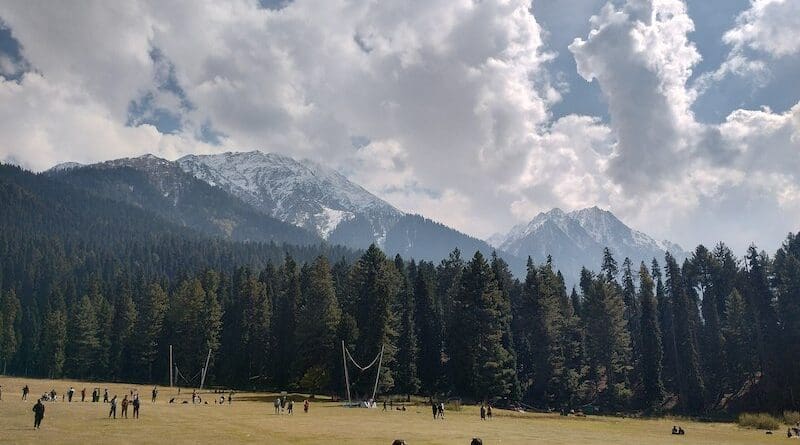
Baisaran Valley, near Pahalgam, Jammu and Kashmir, India. Photo Credit: Hellohappy, Wikipedia Commons
 
And when Donald Trump recognized Pakistan on an equal footing during a standoff between India and Pakistan over a conflict that began when Hindu tourists in Kashmir were attacked and killed by Pakistani terrorists whom New Deli identified as linked to the Pakistani military, India was taken aback, insulted and incredulous that this could occur, when even Trump himself has acknowledged that Pakistan harboured and sponsored terrorists in their midst -- with India in mind.
 
Donald Trump took credit for smoothing over the rankled hostility between the two neighbours, even as India took credit for its superior military having gained the advantage over Pakistan that led to a ceasefire. That Narendra Modi took exception to Trump's declaration as a premier peacemaker whose overtures had succeeded in arranging the ceasefire and his subsequent declaration of India having been responsible in view of its military success over Pakistan did not endear him to his erstwhile ally.
 
The diplomatic distance that ensued, made the imposition of steep tariffs inevitable as Mr. Modi has opened up to Vladimir Putin of Russia, both vowing to deepen "the India-Russia Special and Privileged Strategic Partnership" -- a red flag to a raging bull. With India facing a situation where rivals like China and the United States hemming in India's ambitions on the economic and diplomatic front, uncertainty reigns, forcing India to recommit to its doctrine of "strategic autonomy"; a situation similar to what Israel, an ally of India, is facing for entirely different reasons.
 
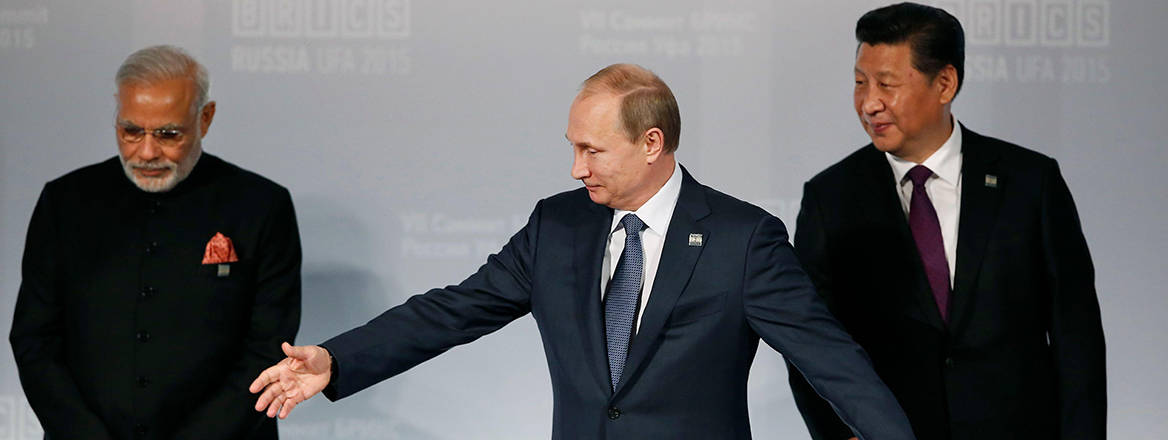
Russian President Vladimir Putin, welcomes Indian Prime Minister Narendra Modi and Chinese President Xi Jinping prior to a signing ceremony at the BRICS Summit in Ufa, Russia, Thursday, July 9, 2015.
Royal United Services Institute, U.K.

Labels: , , , , , , ,

 
()() Follow @rheytah Tweet