Dining in Peaceful Serenity
"Restaurants have definitely gotten louder if you look at long-term trends.""I noticed I was having a little bit of anxiety [in New York, finding quieter spots to eat], because you'd show up at a plqce, never met the person and then, the place is a lot louder than you thought it was going to be if you looked it up on Yelp, Google, OpenTable, whatever resource you use.""And all of a sudden, you're sitting there and I'm only able to really follow half of what they say, at most. It's like you hear words and you have to put it in a puzzle.""But it's just very anxiety-producing. It makes it hard to connect with somebody. You're not relaxed.""Noise stresses the body. It's also a public health issue. It's not just hearing health."Gregory Scott, founder, SoundPrint, app for noise detection
 |
The SoundPrint app is designed with a built-in, crowd-sourcing decibel meter. Measurements during peak dining times on the busiest days of the week have determined that four of ten restaurants in Canada are loud enough that repeated exposure has the potential to impair hearing. An estimated three out of ten restaurants are considered to be less noisy to the extent that conversations are possible between table-mates.
81 decibels or higher falls into the "very loud" category with the potential to cause hearing loss linked to prolonged exposure.
When the sound ambience at a restaurant reaches 87 decibels, comparable sound is that of a blender, while at 83 decibels the sound is like standing 30 metres from a diesel train travelling at 72 kilometres an hour. Time spent in these places of constantly loud sound threatens the well-being of dining guests and far more so for employees of restaurants exposed to noise for extended periods of time.
The founder of SoundPrint launched his app in New York in April of 2018. It was quickly taken up by the hearing health community, expanding from restaurants use to bars, cafes and tea shops, retailers, arenas, gyms, parks, libraries along with other similar venues. Then other communities; those with sensory disorders like autism, blindness and low vision, as well as people with traumatic brain injury and post-traumatic stress disorders began using the app.
"We all have ears. You know something's loud. You can just feel it. But there was no tool to really helpunite everyone""To be like, 'Look, this is an issue'. And so, all of a sudden, all the data started coming in, and we were just sitting on something different. Nobody had the data."Gregory Scott, founder, SoundPrint
Finally, the mainstream population began getting in touch, wanting to find quiet places where they wouldn't have to shout to be heard. Although helping people find quiet places remains the app's focus, it has taken on additional purposes. Now it has become a source of evidence-based data indicating precisely how loud or quiet venues are, and by extension, how loud or quiet cities are. A noise complaint feature has been added, to indicate whether a user would like SoundPrint to contact the venue.
/cdn.vox-cdn.com/uploads/chorus_image/image/59518909/Iphone_screens.0.jpg)
A system to connect venue managers with acoustic consultants is being developed, to determine whether assistance bringing the sound volume down would be useful. Close to 2.5 billion people are expected to suffer hearing loss by 2050, according to the World Health Organization. The WHO recommends that people avoid exposure to sounds louder than 70 decibels over a 24-hour period, to prevent noise-induced hearing loss.
A 2018 study published in the Open Journal of Social Sciences showed sleep can be affected by loud sound and contribute to exhaustion. The difficulty of carrying on a conversation in loud settings for people with hearing loss can lead to increased isolation. People in over 50 countries now use SoundPrint. The largest number of submissions come from the United States, followed by Canada, the United Kingdom, Australia and Germany.
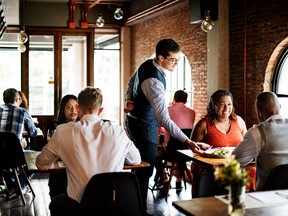
While New York City registers an average of 77.8 decibels and Miami 78.2 decibels, Canadian cities tend to average 78.8 decibels. Over time, restaurants have transitioned from being a place for quiet conversations to the present where they are noisier in part, due to architecture and design trends. Communal, or tightly spaced tables, hardwood floors and open kitchens all contribute to the cacophony. Quieter places typically have carpeting on the floor, upholstery on the chairs, tablecloths, well-spaced tables, nooks and side rooms. Panelling, plants, drapery all absorb sound.
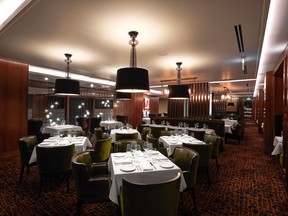 |
| The dining room at Hy’s Steakhouse in Toronto, which SoundPrint has ranked as having a “moderate” noise level and has been nominated for the app’s Quiet List. Photo by Hy's Steakhouse & Cocktail Bar |
Labels: Bars, Health Impact, Noise Level, Restaurants, SoundPrint
posted by Pieface @ 8:29 PM
0 comments