Ruminations

Blog dedicated primarily to randomly selected news items; comments reflecting personal perceptions

Tuesday, February 11, 2020

The Wonder of the Night Sky

"I think of it as being like, if you just suddenly said, 'Hey ... in order to make a profit, I'm going to just destroy all flowers and make them so that people can't see flowers anymore'."
"You could say, 'Well, OK, maybe we didn't really need the flowers', but there's a certain quality of life that you're losing from that."
Sharon Morsink, physics professor, University of Alberta observatory

"The prospects for radioastronomy are arguably even worse than for the optical side."
"The footprint of these satellites is going to be much, much bigger than ground-based transmitter making it much harder to establish preserves."
"They are going to be blinding the radio telescopes, possibly quite literally if the signals are going to be strong enough to damage the receivers that we're working with."
"[An occultation] might be a real dip because the star might be doing something strange, or it might be one of these [darkened] satellites, how are we going to tell? We can't."
David Clements, astronomer, Imperial College London 
Parkes Radio Telescope
The Parkes Radio Telescope in Australia.
REUTERS/Stefica Nicol Bikes

"I think the point to be made here is it's a national process rather than an international one. Even though the impacts are global."
"[Elon] Musk is the great disrupter. Just like he disrupted global transportation with electric cars, he's now disrupting global communications with Starlink and that could be a very good thing."
"He's forcing established institutions to get moving, to grapple with the new world he's creating."
Michael Byers, professor of international politics, University of British Columbia
For every conundrum of a problem that rises to trouble the world there are always several perspectives. And billionaire entrepreneur Elon Musk has seemingly impulsively created more than one person's share of presenting the world community with a level of consternation revolving around the vast topical issues he involves himself with; credibly as it happens, but with their irritating baggage, nonetheless.

A boy watches the Milky Way in the sky over the Tatacoa Desert, in Colombia, on October 11, 2018.
Luis Acosta/AFP via Getty Images

His ambitious plan to plant a network of satellites across the sky in the creation of the "world's most advanced broadband internet system", to help connect remote communities, among other things, such as the Arctic, has moved from the drawing board to action. His company SpaceX, last week launched its fourth grouping of satellites into orbit. Over two thousand satellites currently spin about the Earth, many of them visible to the naked eye. Steadily moving across the sky as a blip of light no one could mistake for a star or a plane; too low for the former and too high for the latter.

The blueprint he has envisaged and has placed into motion is adding another 12,000 satellites within the next several years in the creation of a satellite-constellation he has named Starlink. And nor is  his the only enterprise contemplating adding communications equipment to the night sky. And there's the rub; the night sky as we know it -- already compromised by the glow of the world's metropoli, is set to become ever brighter, a light-glare that will make it beyond difficult for astronomers to view the planets, the stars, the constellations and the universe at large through even the most powerful of telescopes.
starlink train
An astronomer in the Netherlands captured a Starlink train zooming across the sky shortly after its launch.
Vimeo/SatTrackCam Leiden

SpaceX appears well aware of concerns emanating from the scientific community related to Starlink's potential to occlude the night sky. Testing has begun on the potential for a dark coating on satellites to make them less visibly reflective. Which hasn't sufficiently persuaded some astronomers who are reported to be considering legal action to put a halt to the encroaching luminosity of the night sky. SpaceX's work is costly in the technical production of the satellites, the propulsion systems to whip them into space, and with legal licensing hurdles to leap.

But in fact, any ambitious company with the cash flow that SpaceX has, contemplating their own additions to the viral communications industry from space can register with the International Telecommunications Union for an assigned space slot in high orbit. SpaceX's plan calls for its satellites to launch into low orbit, with no slots assigned, giving free rein to populate the night sky with reflective light.

A SpaceX Falcon 9 rocket heads into the clouds after successfully being launched from Cape Canaveral Air Force Station carrying 60 Starlink satellites, on November 11, 2019.
SOPA Images/LightRocket via Getty Images

There are of course, regulatory bodies such as the United Nations Committee on the Peaceful Uses of Outer Space, and the Inter-Agency Space Debris Co-ordination Committee, both of which have issued international guidelines relating to the exploration and use of space for the benefit of humanity. How, however, to address the issue of how many satellites can be lifted into the sky, and how satellite traffic can be regulated, and how to deal with light pollution, remains.

OneWeb, a global communications company, is considering a constellation of satellites of its own and has initiated its first satellite launch a year ago, preparing now to launch a following batch of 34 satellites from Kazakhstan. Amazon too, is prepared to enter the game with its own network of satellites. Commercializing space to a degree not envisioned heretofore.

Currently, points out Professor Morsink, astronomers are searching out objects near Earth, like "asteroids, which could smash into the Earth and cause mass extinctions sort of like what happened to the dinosaurs". The presence of thousands of satellites illuminating and crowding their field of vision makes it impossible to track the presence of new or moving objects....
"It becomes like every other sector, a race to quantity. Bigger, better, cheaper."
"[The sheer number of Starlink satellites planned -- 42,000 -- is what makes this a pressing threat]: If we were talking about one or two satellites I wouldn't be worrying too much."
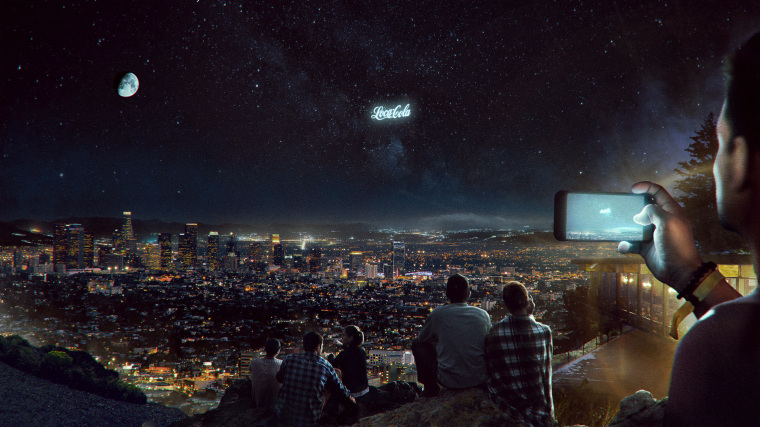
"Who's stopping other people saying well if it's just about the money I'm going to put Coca-Cola streaming across the sky and that's it, and we've lost capability. Then that means that astronomy, to progress, needs to launch satellites and we can't do anything from the ground, and that's going to be a big slow-down in terms of science."
"Unfortunately, popular culture sees astronomy as a hobby rather than a science and they forget an enormous portion of physics that we know now is thanks to astronomy. Which, at the end of the day, is the biggest lab we have at our disposal." 
Giorgio Savini, director, University College London Observatory

Labels: , ,

Friday, February 01, 2019

Advertising In Space

A screen capture from StartRocket's promotional video for their Orbital Display. Image Credit: StartRocket.
Universe Today -- space and astronomy news
"New ages demand new gods."
"It was the first time somebody made entertainment in space ... and advertising is part of entertainment."
"People hate me because they think in two years the whole sky will be covered in advertising."
Vlad Sitnikov, CEO, StartRocket, Russian start-up

"It might be a good starting point to re-examine the whole nature of regulation of space activity."
"We know that the use of outer space for positioning nuclear weapons is prohibited, but there is no such prohibition on the placing of giant billboards [in space]."
Christopher Newman, professor of space law, Northumbria University, Britain

"Advertising in space seems to be simply a wasteful and expensive way of ruining the view of the night sky."
"Light pollution on the ground makes it difficult enough already to see the sky -- the stars and the Milky Way -- from many locations, and advertising in space is a way of destroying that beautiful vista from the remaining unsullied sites."
Robert Massey, deputy executive director, Britain's Royal Astronomical Society
Image: A Russian startup, StartRocket, plans massive billboards to beam advertisements to Earth.
StartRocket's space-based ads would be visible only at night but could be seen from just about anywhere on Earth.   StartRocket

Yet another intrusion into the night sky. Who in their right mind would look forward to gazing upward at night to search the sky for identifiable stars and constellations, revelling in the majesty of the view  and then shockingly coming across the logo of a soft drink manufacturer or a fast-food conglomeration, moving sedately along the Milky Way. Transforming the magical to the pedestrian in one fell swoop. That is, should StartRocket have its way in plans to place billboards in space.

The plan is to develop a system whereby hundreds of tiny satellites can be manipulated to form a massive commercial display visible from Earth. This represents the latest of ventures following musing about asteroid mining and space hotels, all visualized as what the future holds in mining space for its commercial potential. Astronomers have reacted to the proposal unleashed in mid-January with predictable alarm.

And the question is now raised whether it is high time that some universal standards be put in place by global agreement to shelter space from such intrusions. Regulations to be agreed upon and observed that would constrain any such future exploitation of space beyond the mess humankind has already made to transform it into a giant garbage dump of dead satellites and other human-responsible space debris.

The brilliant hypothesis that space could be used to advantage advertising, assembling clients who wouldn't mind paying a hefty invoice for the privilege of their messages reaching around the world came to advertising expert Vlad Sitnikov in the wake of the rocket propulsion company Rocket Lab launching a disco ball named Humanity Star into orbit, which remained visible to the human eye for a period of months.
Image: A Russian startup, StartRocket, plans massive billboards to beam advertisements to Earth.
A Russian startup, StartRocket, plans massive billboards to beam advertisements to Earth.   StartRocket

StartRocket, confident of its ability to blueprint a suitable technical plan, has teamed with experts from a Moscow private university, Skoltech where the team plans to place 200 tiny satellites -- CubeSats -- at an altitude of some 500 kilometres in the lower orbit of Earth by 2021. Each satellite equipped with a sun-reflecting sail would be designed to fly in close companionship with one another to create pixels of a gigantic screen to be switched on and off in displaying words or logos.

The estimated investment for production is expected to exceed $150-million. On the other hand it would cost about $200,000 for clients to contract for eight hours of advertising. A promotional video was released in early January and since then thousands of calls have come in from abroad to StartRocket, including a rough dozen from potential clients; while many other messages reflect the opinions of people opposed to the idea.

Each display would appear the size of a half moon, visible for six minutes at a time, from anywhere in the world. On the other  hand, to derive the most potential from the advertising, the plan is to target large population bases where light pollution from cities is  high to begin with. Dusk or dawn being the preferred times for display, when people tend to be about in the streets, according to Mr. Sitnikov, in the interests of the bottom line.

The 1967 Outer Space Treaty drafted during the Cold War, focuses on peace and exploration, mentioning nothing about advertising. So, from a legal standpoint, there doesn't appear to be much that can be done about the plan to invade the inner ring of Earth's atmosphere as things stand, save an immediate and concentrated campaign on the part of astronomers and lawmakers to ensure that this is an idea quickly nipped in the satellite bud.
A screen capture from a promotional video on StartRocket's website. Image Credit: StartRocket.
A screen capture from a promotional video on StartRocket’s website. Image Credit: StartRocket.


"Launching art projects like this with no commercial, scientific, or national security value seems unwise…Space is getting increasingly crowded. There are over 20,000 objects with orbits in the official public catalog maintained by the U.S. Air Force."
"Less than 10 percent of those objects are active satellites—the rest are dead satellites, old rocket bodies and parts of spacecraft."
University of Michigan astronomy professor Patrick Seitzer

Labels: , , , ,

Wednesday, November 20, 2013


Orbital Launching Record Number Of Satellites Tonight

November 19, 2013


Image Caption: A Minotaur rocket similar to the rocket pictured is set to launch from Wallops on November 19. Credit: NASA 
Lee Rannals for redOrbit.com – Your Universe Online
 
Orbital Sciences announced on Tuesday that it is in the final preparations for the launch of a mission that will place a record number of satellites into orbit.

The company’s Minotaur I rocket will be launched from the Mid-Atlantic Regional Spaceport at NASA’s Wallops Flight Facility in eastern Virginia tonight. The rocket will be taking up the Department of Defense Operationally Responsive Space Office’s ORS-3 mission, or the Enabler mission.

This mission will demonstrate launch and range improvements to include automated vehicle trajectory targeting, range safety planning, and flight termination. It will also see to it that the Air Force’s Space Test Program Satellite-3 and 28 CubeSats are placed into orbit.

Orbital Sciences has a Orbital/Suborbital Program (OSP) government contract, under which the company designs, integrates, tests and provides space launch services with the Minotaur I, IV, V and VI rockets.

“We are pleased that the ORS office has chosen the Minotaur I rocket to support this important mission that will not only launch the Air Force’s Space Test Program Satellite-3 and 28 CubeSats, but will also demonstrate new methods and technologies designed to reduce overall launch costs,” Mr. Ron Grabe, Orbital’s Executive Vice President and General Manager of its Launch Systems Group, said in a press release. “We look forward to a successful launch of the ORS-3 mission and the opportunity to continue supporting the Department of Defense’s important work in the area of ORS systems.”

One of the 28 CubeSats that will be onboard the Minotaur I rocket belongs to the Thomas Jefferson High School for Science and Technology. This satellite, known as TJ3Sat, is the first satellite to be built and tested by high school students.

During the past few years, volunteers from Orbital have helped mentor students and provide engineering oversight to help make the TJ3Sat possible. The satellite was assigned to the ORS-3 mission through NASA’s Educational Launch of Nanosatellites (ELaNa) program based on launch manifest availability.

Orbital offered up some volunteers to help the high school students develop the satellite. The company also provided the testing facilities and financial support for the project.

Not only will this be the 25th Minotaur rocket to be launched, but the mission will also involve placing a record number of satellites into orbit. If all goes according to plan, this mission could represent a reduction in future timelines, eventually resulting in decreased mission costs.

Source: Lee Rannals for redOrbit.com – Your Universe Online


Labels: , , , ,

 
()() Follow @rheytah Tweet