Ruminations

Blog dedicated primarily to randomly selected news items; comments reflecting personal perceptions

Thursday, December 23, 2021

Early Consensus on Omicron? Not Quite!

"There is something going on ... in terms of the difference in the immunological response for Omicron vs Delta."
"[Findings suggested breakthrough infections and reinfections from Omicron were] less severe [and that immune protection from T-cells and B-cells] mediated [Omicron's] progression to severe disease [despite diminished antibody protection]."
"It's about what [it] means in terms of absolute numbers as, if the numbers are so big it can still cause a substantial public health problem even if, per case, the risk of severe disease is less."
Professor Cheryl Cohen, epidemiologist, University of Witwatersrand, South Africa
 
"It is primarily young and vaccinated people who are infected with Omicron, and when we adjust for this, we see no evidence that Omicron should result in milder disease."
Henrik Ullum, director, Statens Serum Institut, Denmark
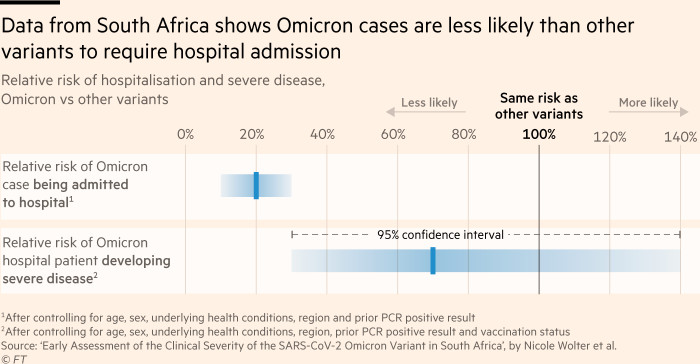
Chart showing that research from South Africa finds Omicron cases are less likely than other variants to require hospital admission

According to health-care data out of South Africa, Denmark and the United Kingdom, findings appear to indicate by separate research teams that fewer cases of severe disease will erupt from Omicron, despite its higher rate of infectiousness, than the previous COVID-19 iteration, Delta. Despite that finding, there remains insecurity of knowledge about the ever-mutating, ever surprising SARS-CoV-2 virus to the point that these same researchers caution that health services can still be strained owing to the new variant's high degree of infectiousness.

All are in agreement that unvaccinated groups remain the most at-risk for infection. And that the proportion of all cases developing severe disease remains lower than with other variants, despite Omicrons breakthrough infections and reinfections causing mild symptoms. Omicron now accounts for a major proportion of COVID-19 cases in a growing number of countries, including the United States. The study carried out by South Africa's National Institute For Communicable Diseases found among those who tested positive in October and November, Omicron was 80 percent less likely to be admitted to hospital than Delta cases.

The same research team released a second analysis controlling for vaccination status, finding that once admitted to hospital Omicron and Delta cases from recent weeks held similar likelihood of progressing to a serious condition. Over 10,000 Omicron cases formed the basis for the analyses, including over 200 hospital admissions. Research out of Denmark indicated that among those who tested positive between November 12 and December 15, Omicron cases appeared three times less likely for hospital admission than cases with other variants, while cautioning that outbreaks among  younger groups could skew data.
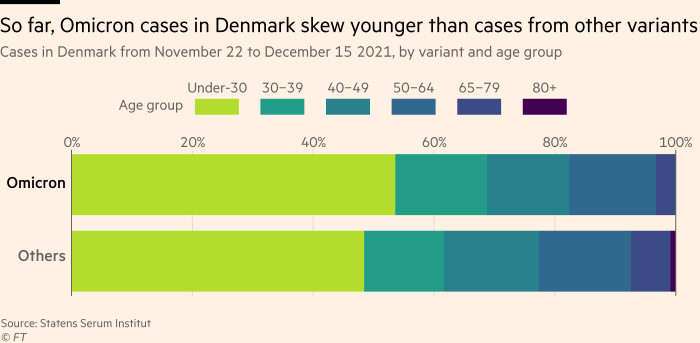
 
Chart showing that so far, Omicron cases in Denmark skew younger than cases from other variants
 
Omicron -- in the absence of evidence for any intrinsic reduction in severity -- is not precluded from resulting in less severe outcomes at the population level, given that a greater share of cases are among people with some protection against severe disease through prior infection or vaccination. "Due to Omicron's higher immune evasion, this pattern will persist in a population-level assessment", explained Professor Samir Bhatt, at University of Copenhagen.

The British study analyzed data from PCR-test confirmed cases in England between Dec.1 and Dec.14, concluding that "Overall, we find evidence of a reduction in the risk of hospitalization for Omicron relative to Delta infections, averaging over all cases in the study period". According to Imperial College researchers, risk of any visit to hospital with Omicron was between 20 and 25 percent lower than with the Delta strain. Britain reported over 100,000 new cases of COVID-19 on Wednesday, the first time since wide-spread testing was available.

People who had received at least two vaccine doses remained substantially protected against hospitalization, even if protection against infection has largely been lost against the Omicron variant, according to their estimates. Denmark on Sunday introduced a suite of measures to contain Omicron's spread; among which was theatre and museum closures and capacity limits in bars, restaurants and shopping centres.

A drop-off in severity could make the decision of countries like Britain and the United States not to impose restrictions "just about tenable", according to Professor Peter Garred, clinical immunologist at Copenhagen's Rigshospitalet, Denmark's largest hospital.

Technicians in Durban, South Africa, conduct antibody testing in a laboratory at the African Health Research Institute
Technicians in Durban, South Africa, conduct antibody testing in a laboratory at the African Health Research Institute Technicians conduct antibody testing at the African Health Research Institute in Durban, South Africa Waldo Swiegers/Bloomberg
"[Policymakers should be a] little careful about making the narrative that it's more mild [because it would be] some weeks [before the variant's impact on hospitals becomes clear]."
"I fear that because of the infectiousness of Omicron ... what we see right now will be very different n just about two weeks' time."
Professor Thea Kolsen Fischer, head, virus and microbiological specialist diagnostics, Staten Serum Institut, Denmark

Labels: , , , , , , , ,

Tuesday, December 21, 2021

Omicron in South Africa

"At this early point, we believe there is hope that the severity is lower. [However], we should not be lulled into any type of complacency."
"[The higher risk of breakthrough infections compared to Delta also means masking, distancing and] caution [and] prudence [remain important]."
"There is no reason to panic in this regard, [infection of children remaining low], without question."
"[South Africa is seeing a steep trajectory of new infections] indicating very rapid spread. This is clearly a highly contagious variant of SARS-CoV-2."
Dr.Ryan Noach, CEO, Discovery Health
Vaccination centre in Sandton, South Africa
Getty Images
 
Discovery Health, the largest private health insurance administrator in South Africa, has released an analysis based on over 211,000 positive COVID-19 test results; 41 percent derived from adults who had two doses of the Pfizer-BioNTech vaccine. Some 78,000 of those test results were attributed to the newly-discovered Omicron infections occurring between November 14 and December 7, when the variant was first noted to be in circulation.

Researchers studied the Pfizer real-world vaccine effectiveness against Omicron infection hospital admissions and the risk of reinfection for those people known to have been previously infected with SARS-CoV-02 [with circulating antibodies]. Scrutiny concluded that people infected with Omicron seemed less likely to develop severe disease in comparison to adults who had been infected in the first wave of COVID in South Africa.

The risk of hospital admission was 29 percent lower for adults, once adjusted for age, sex, underlying health conditions and vaccine status. The encouraging drop in severity suggests an "apparent de-linking" of infections with hospitalizations, according to a slide presentation given at a press briefing. During the first three weeks of South Africa's Omicron wave, hospital admissions and death from infections rose rapidly, while at this point both have decreased their steep ascent.

All this, while keeping in mind that South Africa has a high rate of background immunity, meaning in the first waves to strike the population infections were widespread. Fully 72 percent of the population in Gauteng -- the outbreak epicentre and province where Omicron was first identified in November -- is felt to have been previously infected, in particular throughout the Delta wave. 

What remains unclear at this juncture is how Omicron will evolve in other countries with lower vaccination or lower rates of prior infections. "We have to see what happens in other parts of the world before we can make a call on this" Glenda Gray, president CEO of the South African Medical Research Council, cautioned. Should a surge emerge it would overwhelm health systems through sheer case volume, Dr.Noach added.
 
He stressed that the single most important intervention is vaccination. The evidence is that those who are vaccinated experience milder infections; primarily it is the unvaccinated that end up in hospital and needing supplemental oxygen. Children under 18 years of age appear to have a 20 percent higher risk of hospitalization, yet child admissions to hospital remain very low.

Most COVID infections in children admitted to hospital are picked up incidentally during routine screening when children present for problems unrelated to COVID, according to anecdotal reports. During the study period, children were 51 percent less likely as opposed to adults, to test positive for COVID. Most children experience mild symptoms: sore throat, congestion, headache and fever, resolving within three days.

In the current Omicron wave, two doses of Pfizer-BioNTech provide 33 percent protection. representing a significant drop from the 80 percent protection in earlier waves, but the vaccine appears to be providing 70 percent protection against severe complications requiring hospital admission. "Whilst protection against hospital admission reduced from the highs of 93 percent in South Africa's Delta-driven variant, 70 percent is still regarded as very good protection", concluded the investigators.

That level of protection held in all age groups, in people aged 18 to79. For those previously infected with COVID, reinfection risk appeared significantly higher compared to earlier variants -- those infected with Delta face a 40 percent relative risk of reinfection with Omicron, according to data suggestion; a possible function of waning antibodies

The infection  appears to have a shorter incubation period (three to four days). A scratchy or sore throat the most common early symptom to appear, similar to earlier waves. Nasal congestion, dry cough and muscle aches and pains are other typical features of Omicron onset, with lower back pain a hallmark symptom. But there appears to be less respiratory distress; leading to lower admission numbers to ICUs in comparison to previous waves. 

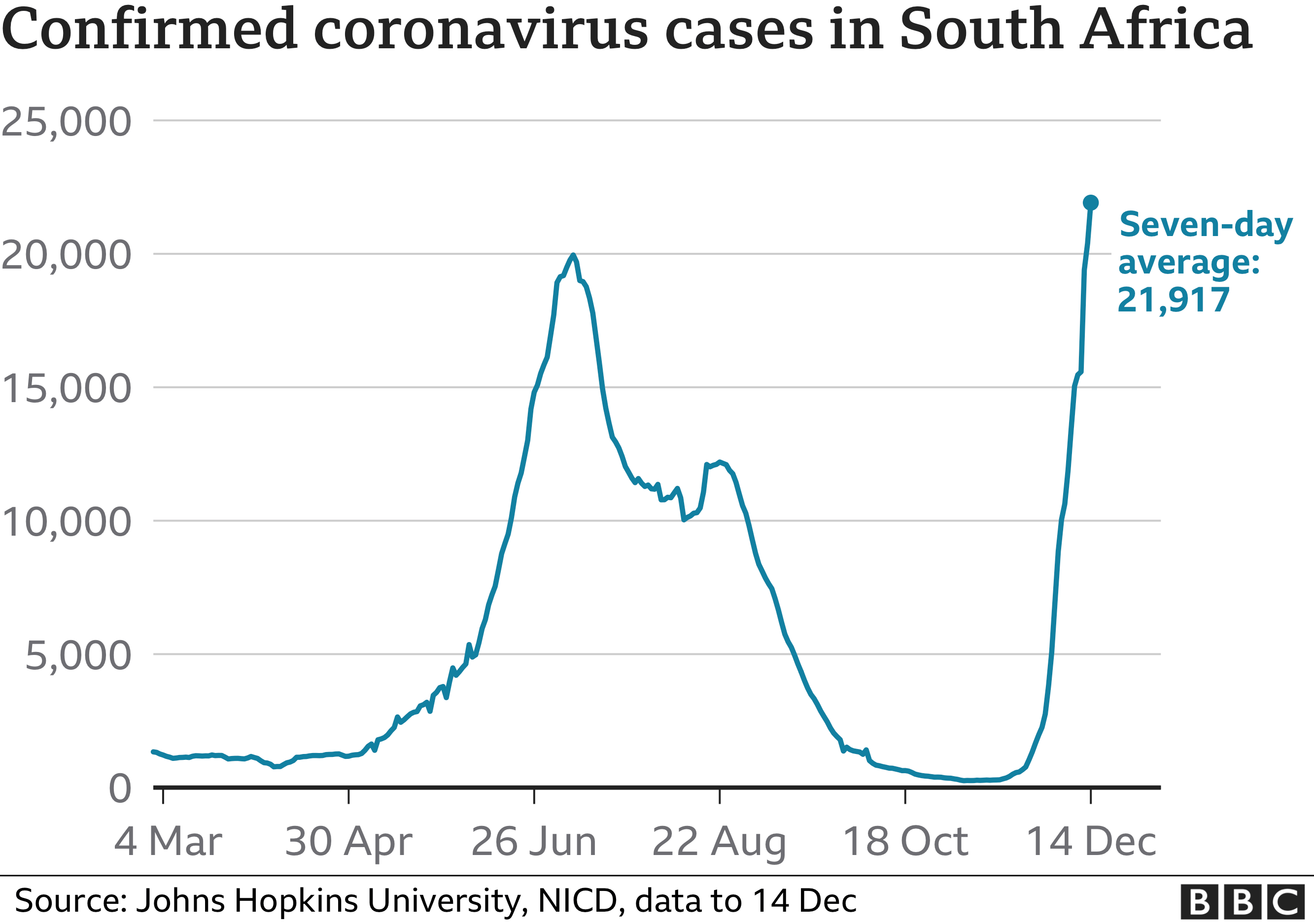
Chart showing the third and fourth waves in South Africa

Labels: , , , ,

 
()() Follow @rheytah Tweet